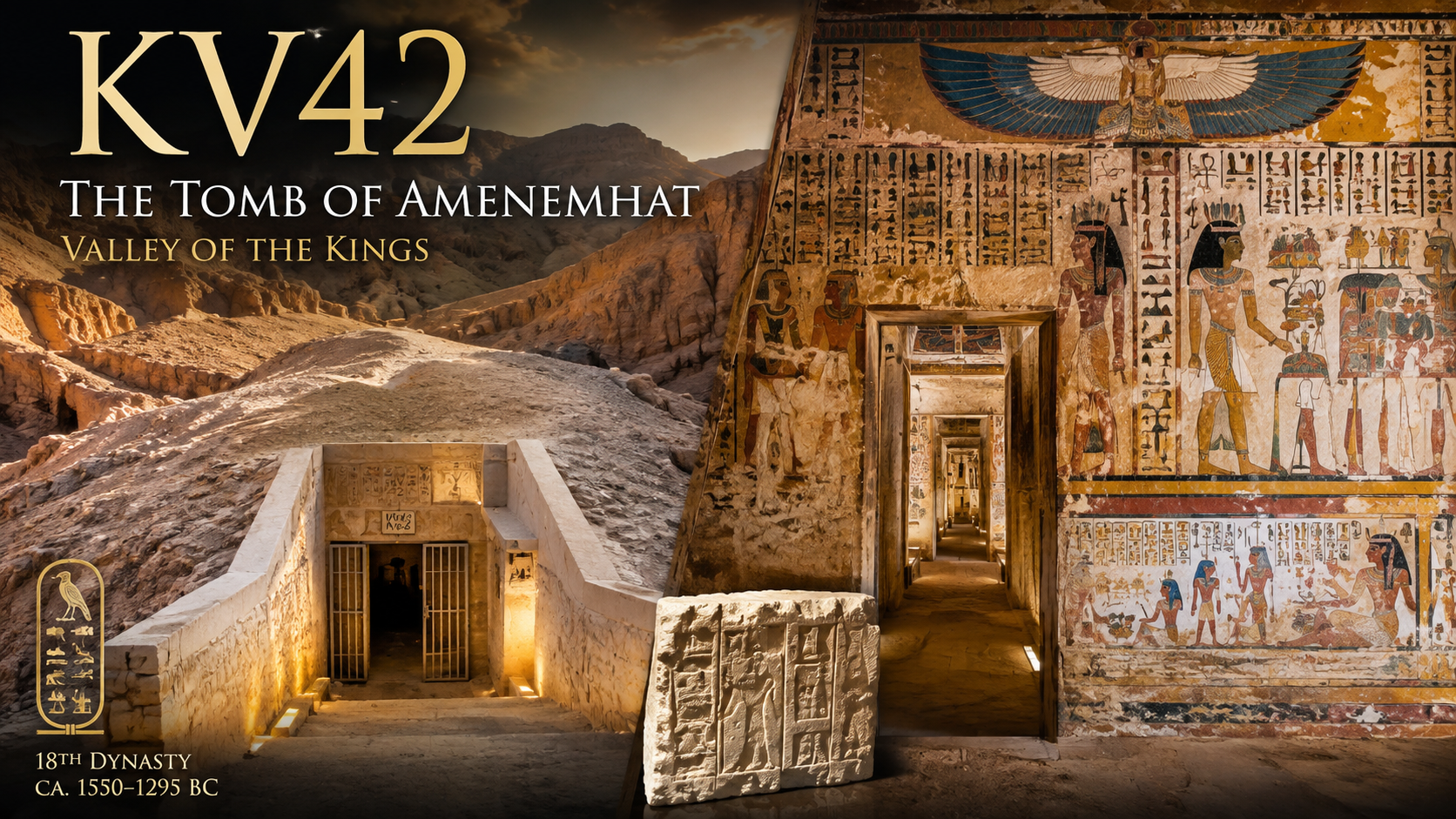
KV42 is one of the most intriguing Eighteenth Dynasty tombs in the Valley of the Kings because it combines unmistakably royal architecture with a complicated history of ownership and reuse.
The tomb was originally prepared for Queen Merytre-Hatshepsut, Great Royal Wife of Thutmose III and mother of Amenhotep II. This identification is supported by foundation deposits discovered by Howard Carter in 1921 near the tomb’s entrance. Model vessels from those deposits bear the queen’s name, providing strong evidence that KV42 was commissioned for her.
Yet Merytre-Hatshepsut apparently was never buried there.
Instead, funerary equipment belonging to Sennefer, the powerful Mayor of Thebes during the reign of Amenhotep II, and his wife Senetnay, a royal nurse, was discovered inside KV42. Whether they were actually buried there, were transferred there later, or had some of their equipment deposited in the tomb remains debated.
Architecturally, KV42 is much more impressive than the small shaft tombs built for most private individuals. It contains descending corridors, a well chamber, a pillared hall, and a large cartouche-shaped burial chamber resembling the royal tombs of the early Eighteenth Dynasty.
KV42 therefore occupies an unusual position between royal and private burial history. It was designed for one of Egypt’s most important queens but eventually became associated with members of Amenhotep II’s court.
- Structure: KV42
- Location: Valley of the Kings, East Valley, Thebes West Bank, Luxor
- Original Owner: Queen Merytre-Hatshepsut
- Later Associations: Sennefer, Senetnay, and members of their family
- Dynasty: Eighteenth Dynasty
- Site Type: Royal tomb later reused or associated with non-royal burials
- Decoration: Limited painted decoration
- Interior Layout: Stairways, corridors, well chamber, pillared chamber, burial chamber, and side rooms
- Axis Type: Bent
- Public Access: Closed
Who Was Queen Merytre-Hatshepsut?
Merytre-Hatshepsut was one of the most important royal women of the middle Eighteenth Dynasty. She became the principal wife of Thutmose III and carried the prestigious title Great Royal Wife. She was also the mother of his successor, Amenhotep II.
Her other titles included:
- King’s Great Wife
- King’s Mother
- God’s Wife
- King’s Daughter or related royal titles in some contexts
- Mistress of the Two Lands
Despite the name Hatshepsut appearing within her own titles, she should not be confused with the famous female pharaoh Hatshepsut. Merytre-Hatshepsut belonged to the following generation and became the wife of Hatshepsut’s stepson and co-ruler Thutmose III.
Her position became particularly important after the death of Thutmose III, when her son Amenhotep II became king.
Relationship With Thutmose III
Thutmose III ruled Egypt for more than fifty years, initially alongside Hatshepsut and later independently. Merytre-Hatshepsut appears to have become his principal queen during the later part of his reign.
Together they had several children, including Amenhotep II, who ultimately inherited the throne. The decision to construct a substantial royal tomb for Merytre-Hatshepsut inside the Valley of the Kings reflects her extraordinary position as both Great Royal Wife and mother of the future king.
Most queens were not buried in monumental tombs in the main Valley of the Kings. KV42 therefore represents an exceptional royal privilege.
Mother of Amenhotep II
Merytre-Hatshepsut’s greatest dynastic importance came from her role as mother of Amenhotep II. Amenhotep II succeeded Thutmose III and continued Egypt’s military and imperial policies during the middle Eighteenth Dynasty.
His own tomb, KV35, became one of the most important monuments in the Valley because it was later used as a royal mummy cache.
Merytre-Hatshepsut’s relationship with Amenhotep II may also explain why KV42 later became associated with Sennefer and Senetnay, both of whom belonged to the king’s court. Senetnay served as a royal nurse, while Sennefer became one of the most powerful officials in Thebes.
Location
KV42 lies in the southern branch of a side valley leading toward KV34, the tomb of Thutmose III. Its location places the queen close to her husband’s burial. Nearby tombs include:
- KV31, containing five unidentified elite mummies
- KV32, the tomb of Queen Tiaa
- KV33, an unidentified Eighteenth Dynasty tomb
- KV34, the tomb of Thutmose III
- KV37, an anonymous elite tomb
- KV40, a collective tomb containing members of the royal family and household
The concentration of royal women, royal relatives, and elite court burials in this side valley shows the area held special importance during the Thutmosid period. KV42’s location near KV34 was almost certainly intentional.
Description
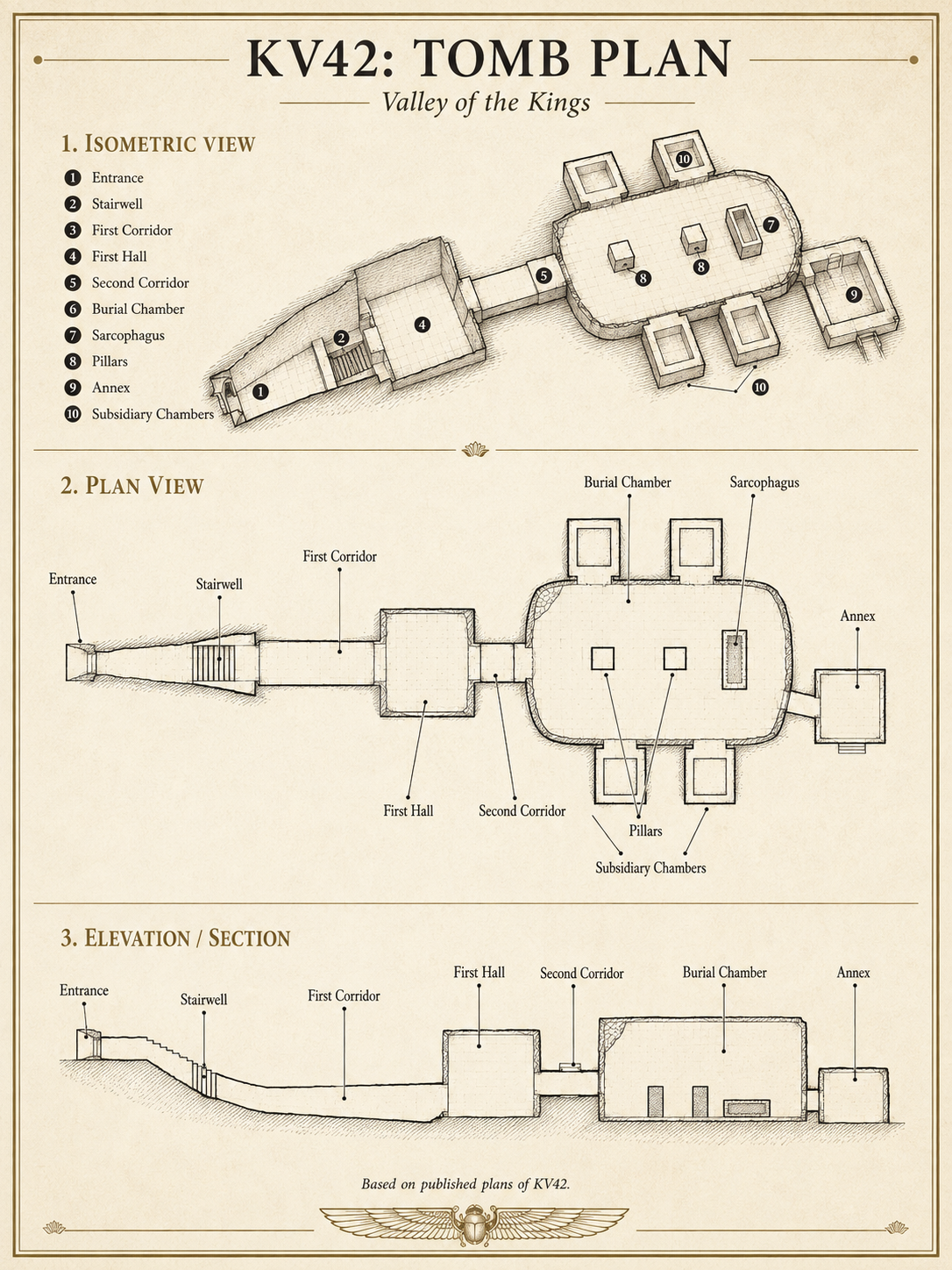
KV42 is a large and architecturally sophisticated tomb. It follows a bent-axis plan typical of the early and middle Eighteenth Dynasty. The monument contains:
- Entrance staircase
- Descending corridors
- A well chamber
- A pillared chamber
- A second descending passage
- A large burial chamber
- Subsidiary side rooms
The design is far more elaborate than the shaft-and-chamber tombs used by most officials. Its scale and arrangement clearly indicate that KV42 was originally intended for someone of royal status.
A Royal-Scale Tomb
One of the most important clues to KV42’s original function is its architecture. The tomb is larger than known private tombs of the Eighteenth Dynasty and includes features normally associated with royal burials.
These include:
- A bent axis
- A well chamber
- Pillared spaces
- A large formal burial chamber
- A cartouche-shaped burial chamber
- Subsidiary storage rooms
The design places KV42 within the architectural tradition of the early royal tombs rather than ordinary elite burials. This is why the later presence of Sennefer and Senetnay’s funerary equipment initially created such confusion.
The Cartouche-Shaped Burial Chamber
The burial chamber is one of KV42’s most distinctive features. Its elongated form with rounded ends resembles a royal cartouche. A cartouche was the oval enclosure surrounding the hieroglyphs of a king’s royal name. In tomb architecture, a similar form could symbolically surround and protect the deceased.
This architectural feature also appears in KV34, the tomb of Thutmose III. The resemblance reinforces the connection between KV42 and the royal burial tradition of the mid-Eighteenth Dynasty.
Pillars
The tomb contains a pillared chamber as part of its descent toward the burial area. Pillars became an increasingly important feature in Eighteenth Dynasty royal tombs. They provided structural support while also creating formal ceremonial spaces within the underground monument. Their presence in KV42 further distinguishes the tomb from the simpler burials of most private officials.
The Well Chamber
KV42 also contains a well chamber. Well shafts appeared in several Eighteenth Dynasty royal tombs and may have served both practical and symbolic functions. Practically, they could trap floodwater and debris before it reached the burial chamber.
Symbolically, the shaft may have represented the primeval waters, the depths of the underworld, or a boundary the deceased crossed on the journey into the afterlife.
The feature strongly reinforces KV42’s royal character.
Decoration
KV42 contains only limited surviving decoration. Unlike KV34 or KV35, it does not preserve a complete Amduat or an extensive program of underworld texts.
The absence of a full royal decorative program has sometimes been taken as evidence that the tomb was never completed for Merytre-Hatshepsut. If she died before the monument was fully prepared, or if plans for her burial changed, work may have stopped before painters completed the walls.
This would explain why KV42 possesses impressive royal architecture but lacks the decorative richness expected in a finished royal burial.
Was Merytre-Hatshepsut Ever Buried in KV42?
Probably not. The foundation deposits demonstrate that KV42 was intended for her, but there is no secure evidence that her burial ever actually took place there. No intact burial equipment belonging to the queen remained in the chamber when the tomb was excavated. Her mummy has never been securely identified.
Some researchers have suggested that she may instead have been buried with or near her son Amenhotep II, possibly in connection with KV35, but this remains uncertain. The distinction is important: KV42 was built for Merytre-Hatshepsut, but she may never have occupied it.
Howard Carter’s Foundation Deposits
The strongest evidence identifying the intended owner came from Howard Carter. In 1921, while working for Lord Carnarvon, Carter discovered foundation deposits around the entrance to KV42.
Foundation deposits were ceremonial groups of miniature objects placed beneath or near important buildings and tombs during construction. The KV42 deposits included model vessels bearing the name of Merytre-Hatshepsut.
These objects provided the key evidence linking the queen with the monument. Before Carter’s discovery, people were much less certain about KV42’s owner.
Why Foundation Deposits Matter
Foundation deposits are among the most useful archaeological tools for identifying ancient Egyptian monuments.
They could contain:
- Miniature pottery
- Model tools
- Food offerings
- Plaques
- Animal remains
- Inscribed objects
The name of the person who commissioned a building was often included. Because these deposits were buried deliberately during construction, they could survive even when the monument itself was robbed or reused.
In KV42, the foundation deposits preserved the identity of the intended owner even after the burial history became confused.
Sennefer
Sennefer was one of the most important officials during the reign of Amenhotep II. He served as Mayor of Thebes, placing him among the highest-ranking administrators in southern Egypt. Sennefer is especially well known because of his decorated private tomb, TT96, at Sheikh Abd el-Qurna.
TT96 is sometimes called the Tomb of the Vineyards because of its famous painted ceiling covered with twisting grapevines. Yet despite having TT96, funerary equipment belonging to Sennefer was also found inside KV42. This created one of the tomb’s greatest mysteries.
Senetnay
Senetnay was Sennefer’s wife and held the important title Royal Nurse. She was closely connected with the household of Amenhotep II and may have helped raise the future king or members of the royal family.
Her high status is demonstrated by the quality of her funerary equipment. Canopic jars bearing her name were found in KV42.
Additional objects connected with Sennefer and Senetnay have also been discovered in KV32, the tomb of Queen Tiaa. Their burial history therefore appears to have involved more than one monument.
Were Sennefer and Senetnay Buried in KV42?
This question remains debated. Howard Carter believed the tomb had been reused for Sennefer and Senetnay because their funerary equipment was found inside.
One possibility is that Amenhotep II granted the unused royal tomb to the couple because of their close relationship with the court. However, some Egyptologists consider this unlikely because even highly favored non-royal individuals usually received much smaller tombs.
Another possibility is that their bodies or equipment were transferred into KV42 during later reburial activity. The archaeological evidence does not provide a completely secure answer.
The Canopic Jars of Senetnay
Among the most important finds were canopic jars belonging to Senetnay. Canopic jars held the internal organs removed during mummification. The four jars were protected by funerary spells and divine guardians.
The discovery of such personal burial equipment strongly suggests that Senetnay’s remains were either buried in KV42 or closely associated with activity inside the monument.
Because her husband Sennefer is also represented among the finds, the two were probably connected with the same secondary burial phase.
Model Vessels of Sennefer and Senetnay
Numerous model vessels bearing the names of Sennefer and Senetnay were also recovered. Model vessels reproduced full-size funerary containers in miniature.
They could symbolically supply the deceased with food, drink, oils, or other provisions needed in the afterlife. Their presence reinforces the conclusion that KV42 was used in connection with the couple’s funerary arrangements even if the exact nature of that use remains uncertain.
Other Burials
KV42 may have contained more than Sennefer and Senetnay. Four male canopic-jar lids were found in addition to Senetnay’s canopic equipment. This suggests that at least one additional man may have been represented among the tomb’s burials.
The burial assemblage has also been connected with members of Sennefer’s family. Some reconstructions therefore treat KV42 as a small family burial cache introduced after Merytre-Hatshepsut’s original royal burial plan had been abandoned.
Baketre
A woman named Baketre has also been connected with the funerary material from KV42. Her precise relationship with the other occupants remains uncertain. She may have belonged to the same family or household as Sennefer and Senetnay. The survival of several names within the burial assemblage reinforces the conclusion that the tomb’s later history involved multiple individuals rather than one simple secondary burial.
Why Would a Private Family Use a Royal Tomb?
If Sennefer and his family genuinely used KV42 as their primary burial place, the privilege would have been extraordinary. Sennefer and Senetnay were closely connected with Amenhotep II. Sennefer governed Thebes. Senetnay served as a royal nurse.
Their family therefore belonged to the inner circle of the royal court. Amenhotep II may have granted them access to a tomb originally prepared for his own mother but never used.
Such a gift would represent an exceptional royal favor.
However, because the interpretation remains disputed, it is best presented as one possibility rather than an established historical event.
Comparison With KV46
The debate becomes especially interesting when KV42 is compared with KV46. KV46 belonged to Yuya and Thuya, the parents of Queen Tiye and therefore the parents-in-law of Amenhotep III.
Despite their extraordinary connection with the royal family, they received a much smaller, undecorated tomb. This has led some Egyptologists to question whether Amenhotep II would really have given Sennefer and Senetnay an abandoned royal-scale tomb.
The contrast does not prove that they were not buried in KV42, but it demonstrates how unusual such a privilege would have been.
Comparison With KV32
KV32 belonged to Queen Tiaa, wife of Amenhotep II and mother of Thutmose IV. Like KV42, it was built for a royal woman and is largely undecorated.
Objects belonging to Sennefer and Senetnay have also been associated with KV32. This suggests that funerary material from their burial may have been moved or scattered between nearby tombs.
Robbery, flooding, ancient reburial, and early archaeological activity could all explain how objects became separated from their original contexts.
Comparison With KV34
KV42’s architecture has frequently been compared with KV34, the tomb of Thutmose III. Both contain a strongly Eighteenth Dynasty royal plan.
KV42 includes:
- A bent axis
- A well
- Pillared spaces
- A cartouche-shaped burial chamber
These features make the monument look much more like a royal tomb than a private burial.
The proximity of KV42 to KV34 also strengthens the connection with Thutmose III’s royal family.
Could KV42 Have Been Intended for Someone Else?
Most modern summaries accept Merytre-Hatshepsut as the intended owner because of Carter’s foundation deposits. Earlier researchers proposed other possibilities, and the tomb’s architecture has generated several theories.
At various times, KV42 has been connected with other royal individuals because its scale and design clearly indicate royal status. However, the foundation deposits naming Merytre-Hatshepsut provide the strongest direct archaeological evidence.
Unless new evidence appears, she remains the best-supported intended owner.
Discovery
The precise discovery history of KV42 is somewhat complicated. The tomb appears to have become known around 1900.
Two local Egyptian excavators, Chinouda Macarios and Boutros Andraos, are credited in some accounts with locating the monument in late 1900. They obtained permission to excavate after reporting that they knew the location of a tomb.
Victor Loret has also been associated with the early exploration of KV42, reflecting the sometimes confusing history of discoveries made during this period.
Howard Carter
Howard Carter excavated KV42 during the early twentieth century. His work revealed much of the tomb’s architecture and funerary material.
The major breakthrough came in 1921 when Carter discovered the foundation deposits naming Merytre-Hatshepsut.
This was just one year before his discovery of Tutankhamun’s tomb, KV62. The KV42 work demonstrates how Carter’s career before Tutankhamun included extensive exploration of other royal and elite monuments throughout the Valley.
Ancient Robbery
KV42 was robbed and disturbed in antiquity. Any original royal burial equipment belonging to Merytre-Hatshepsut, if it was ever placed there, disappeared.
Later funerary material associated with Sennefer, Senetnay, and others was also disturbed.
Robbers searching for precious metals would have targeted:
- Gold jewelry
- Amulets
- Coffin fittings
- Metal vessels
- Gilded objects
- Valuable oils and perfumes
The surviving burial equipment therefore represents only a fraction of what the tomb once contained.
Flood Damage
Like many tombs in the Valley of the Kings, KV42 has suffered from water and flood damage. Flash floods can send large quantities of sand, mud, limestone rubble, and stones through tomb entrances and descending corridors.
Such events can:
- Break pottery
- Displace coffins
- Move human remains
- Destroy textiles
- Damage plaster
- Mix objects from different burial phases
Flooding could also help explain why some funerary objects associated with the Sennefer family appear in neighboring tombs.
Objects Recovered
Objects and materials associated with KV42 include:
- Foundation deposits naming Merytre-Hatshepsut
- Model vessels
- Canopic jars of Senetnay
- Male canopic-jar lids
- Funerary equipment of Sennefer
- Funerary equipment of Senetnay
- Pottery
- Stone vessels
- Human remains
- Coffin fragments
- Other burial equipment associated with members of the family
The combination reflects at least two very different phases of the tomb’s history: its royal construction and its later association with private individuals.
Noteworthy Features
KV42 is notable because it was built for Queen Merytre-Hatshepsut, Great Royal Wife of Thutmose III and mother of Amenhotep II. Its foundation deposits provide unusually strong evidence for the identity of its intended owner.
The tomb possesses royal architecture, including a bent axis, well chamber, pillared spaces, and cartouche-shaped burial chamber. Yet the queen apparently was never buried there.
Instead, the tomb became associated with Sennefer, Mayor of Thebes, his wife Senetnay, and possibly other members of their family. The contrast between royal architecture and private funerary equipment makes KV42 one of the most puzzling tombs of the Eighteenth Dynasty.
Additional Tomb Information
- Original Owner Type: Queen
- Original Owner: Merytre-Hatshepsut
- Later Occupants or Associations: Sennefer, Senetnay, and possibly family members
- Entrance Type: Descending staircase
- Interior Layout: Corridors, well chamber, pillared chamber, burial chamber, and subsidiary rooms
- Axis Type: Bent
- Decoration: Limited
- Principal Period: Middle Eighteenth Dynasty
- Public Access: Closed
Dating
KV42 was associated with several phases during the Eighteenth Dynasty:
- Reign of Thutmose III: Probable construction for Merytre-Hatshepsut
- Reign of Amenhotep II: Possible reuse by Sennefer, Senetnay, and their family
- Later New Kingdom: Robbery and disturbance
- Around 1900: Modern discovery
- Early twentieth century: Excavation by Howard Carter
- 1921: Discovery of foundation deposits identifying the original owner
The evidence indicates that KV42’s primary architectural phase belongs firmly within the royal burial program of the Thutmosid period.
History of Exploration
- Late 1900: Discovery associated with Chinouda Macarios and Boutros Andraos
- Victor Loret: Early exploration or documentation associated with the tomb
- Howard Carter, early twentieth century: Excavation and study
- Howard Carter, 1921: Discovery of foundation deposits naming Merytre-Hatshepsut
- Later twentieth-century researchers: Reassessment of the tomb’s ownership and reuse
- Modern Egyptologists: Continuing study of the relationship between Merytre-Hatshepsut, Sennefer, Senetnay, KV32, and KV42
Site Condition
KV42 is closed to ordinary visitors. The architecture remains recognizable, but the tomb has been affected by robbery, structural deterioration, flooding, and early excavation.
The limited surviving decoration means its significance today comes primarily from its architecture and archaeological contents. Much of the original burial context has been lost, making interpretation difficult.
Why KV42 Matters
KV42 illustrates how dramatically the history of a tomb could change after construction.
It began as a monument for one of the most powerful women in the royal family. Merytre-Hatshepsut was Great Royal Wife of Thutmose III and mother of Amenhotep II. Her burial place was planned close to her husband’s tomb and constructed according to royal architectural traditions.
Yet she apparently never occupied it. Instead, the tomb became associated with a completely different group of people from the royal court.
Sennefer and Senetnay were not members of the ruling dynasty, but they occupied positions of extraordinary influence. Their funerary equipment inside KV42 shows just how closely the highest officials could become connected with the royal household.
The tomb therefore preserves two sides of Eighteenth Dynasty society. Its architecture represents the royal family. Its surviving funerary equipment represents the people who served them.
That combination makes KV42 one of the best examples of how the Valley of the Kings was not simply a cemetery of pharaohs, but a changing funerary landscape shared by queens, royal children, officials, nurses, and favored members of the court.
Interesting Facts About KV42
- KV42 was originally built for Queen Merytre-Hatshepsut.
- She was the Great Royal Wife of Thutmose III.
- She was the mother of Amenhotep II.
- Foundation deposits discovered in 1921 preserve her name.
- The queen apparently was never buried there.
- KV42 has a royal-scale architectural plan.
- Its burial chamber is cartouche-shaped.
- The tomb contains a well chamber.
- Pillared spaces form part of the underground layout.
- Sennefer’s funerary equipment was found inside.
- Sennefer served as Mayor of Thebes.
- His wife Senetnay was a royal nurse.
- Canopic jars belonging to Senetnay were discovered.
- Additional male canopic-jar lids suggest other burials.
- Objects associated with Sennefer and Senetnay have also been found in KV32.
- Scholars disagree about whether KV42 became their primary tomb or a later reburial place.
- Howard Carter helped establish the tomb’s original ownership one year before discovering Tutankhamun’s tomb.
- KV42 is one of the clearest examples of a royal tomb whose intended owner apparently never used it.