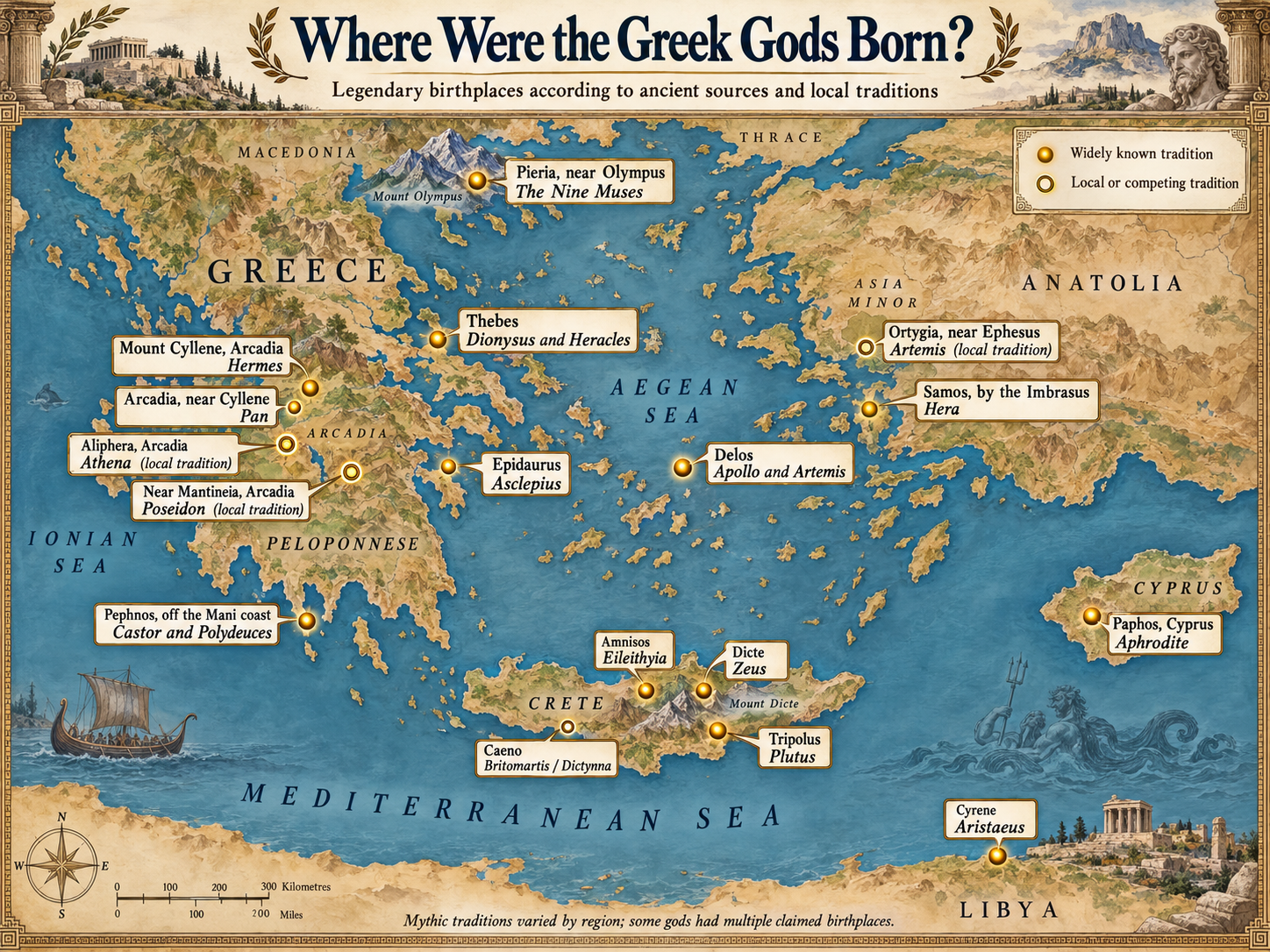
When we think of the ancient Greek gods, we usually picture them living high above the clouds on Mount Olympus, ruling over the mortal world from their magnificent palaces. But according to Greek mythology, Mount Olympus wasn’t necessarily where the gods were born. Their legendary birthplaces were scattered across the ancient Mediterranean, from hidden caves on Crete and sacred mountains in Arcadia to remote islands, mysterious rivers, and even the shores of North Africa.
Some of these locations remain famous today, such as the island of Delos, where Apollo was said to have been born, and Crete, where the infant Zeus was hidden from his father, Cronus. Others are far less familiar, including an ancient Arcadian town that claimed Athena emerged from Zeus’s head within its territory, a riverbank on Samos where Hera was supposedly born, and a small rocky island off the Greek coast associated with the birth of the divine twins Castor and Polydeuces.
What makes these stories particularly fascinating is that the ancient Greeks didn’t always agree about where their gods originated. Different cities and regions preserved competing accounts, sometimes claiming the same deity as their own. Writers such as Hesiod, Homer, Callimachus, Pindar, Strabo, and Pausanias recorded these traditions, leaving us a remarkable geographical record of how the Greeks imagined the beginnings of their divine world.
So where were the Greek gods actually born, according to ancient mythology? To answer that question, we must distinguish between their legendary birthplaces, the places where they were raised, and the sacred locations where their worship became established.
Were the Greek Gods Born on Mount Olympus?
Despite its reputation as the home of the Greek gods, Mount Olympus wasn’t generally considered their birthplace. In Greek mythology, Olympus became the great divine residence of Zeus and the Olympian gods, especially after Zeus defeated the Titans and established his supremacy over the cosmos.
The earliest generations of gods existed long before the Olympians took power. In Hesiod’s Theogony, the universe begins with primordial beings such as Chaos, Gaia (Earth), Tartarus, and Eros, followed by generations of divine descendants, including the Titans and eventually the Olympian gods. These earliest beings don’t necessarily have geographical birthplaces in the ordinary human sense because their origins belong to the creation of the cosmos itself.
Even the six children of Cronus and Rhea, Hestia, Demeter, Hera, Hades, Poseidon, and Zeus, weren’t all assigned identifiable birthplaces in the earliest surviving accounts. The younger Olympians, however, often received elaborate birth stories connected to specific mountains, islands, caves, and cities.
Greek Gods and Their Birthplaces at a Glance
The following table summarizes the birthplaces associated with major Greek gods, goddesses, and divine figures in surviving ancient sources. Some locations represent widely recognized myths, while others preserve regional traditions that differed from the better-known versions.
| Greek Deity | Legendary Birthplace | Ancient Source |
|---|---|---|
| Zeus | Crete; alternatively Mount Lycaeus, Arcadia | Hesiod, Callimachus, Pausanias |
| Hera | Samos, beside the Imbrasus River | Pausanias |
| Poseidon | Near Mantineia, Arcadia | Pausanias |
| Athena | Aliphera, Arcadia; other traditions associate her with the Triton region | Pausanias |
| Apollo | Delos | Homeric Hymn to Apollo |
| Artemis | Delos or Ortygia, including a tradition near Ephesus | Homeric Hymn, Strabo |
| Hermes | Mount Cyllene, Arcadia | Homeric Hymn to Hermes |
| Aphrodite | Sea near Cythera and Cyprus | Hesiod |
| Dionysus | Thebes; several competing locations | Euripides, Homeric Hymn |
| Pan | Arcadia, near Mount Cyllene | Homeric Hymn to Pan |
| Asclepius | Epidaurus; competing Thessalian traditions | Pausanias |
| Nine Muses | Pieria, near Mount Olympus | Hesiod |
| Eileithyia | Amnisos, Crete | Pausanias |
| Castor and Polydeuces | Pephnos, off the Mani coast | Pausanias |
| Heracles | Traditionally Thebes; other traditions differ | Ancient mythographers |
| Aristaeus | Libya, near Cyrene | Pindar |
| Britomartis | Caeno, Crete | Diodorus Siculus |
| Plutus | Tripolus, Crete | Diodorus Siculus |
Zeus: Born on Crete or in Arcadia?
Traditional birthplace: Crete, with a competing claim from Mount Lycaeus in Arcadia.
Zeus, the king of the Greek gods, has one of mythology’s most famous birth stories. His father, Cronus, had been warned that one of his children would overthrow him, so he swallowed each child immediately after birth. When Rhea became pregnant with Zeus, she devised a plan to save her youngest son.
According to Hesiod’s Theogony (lines 453–491), Rhea traveled to Crete, where she gave birth to Zeus and concealed him in a cave. She returned to Cronus with a stone wrapped in swaddling clothes, which he swallowed, believing he had consumed his newborn son.
Later traditions associated Zeus’s infancy with Mount Dicte and Mount Ida, two mountainous regions of Crete. Stories described the infant being protected by the Curetes, divine attendants who clashed their weapons to conceal his cries, while the goat Amaltheia and protective nymphs helped nourish him.
But the Arcadians claimed Zeus for themselves. In his Hymn to Zeus, the Hellenistic poet Callimachus openly discusses the disagreement between Cretan and Arcadian traditions, favoring the account that Zeus was born in Arcadia and subsequently taken to Crete.
Pausanias, writing in the second century CE, records the Arcadian belief that Zeus was raised on Mount Lycaeus. He describes a location on the mountain called Cretea, which the Arcadians identified with the Crete of the myth rather than the Mediterranean island.
These competing stories show how different Greek communities preserved their own accounts of the most powerful deity in their religion. Both Crete and Arcadia claimed an important role in Zeus’s earliest life, although the Cretan tradition became especially prominent in later retellings
Hera: Born Beside a Sacred River on Samos
Traditional birthplace: Samos, beside the Imbrasus River.
Hera, queen of the Olympian gods and goddess of marriage, was also the daughter of Cronus and Rhea. Although Hesiod identifies her divine parents, one of the most distinctive geographical accounts of Hera’s birth comes from Samos.
In Description of Greece (7.4.4), Pausanias records that the Samians believed Hera was born beside the Imbrasus River beneath a willow tree. He even reports that the tree associated with her birth continued to grow within Hera’s sanctuary during his lifetime.
This tradition was closely connected to the Heraion of Samos, one of the ancient Greek world’s most important sanctuaries dedicated to the goddess. The story gave the island a uniquely personal connection to Hera and helped explain the religious significance of its sacred landscape.
Other regions, particularly Argos, maintained important traditions concerning Hera’s worship and upbringing. The Samian account, however, stands out because it identifies a specific riverside location as her birthplace.
Poseidon: The Sea God Born in the Mountains of Arcadia
Traditional birthplace: Near Mantineia, Arcadia.
One of the more surprising Greek birth traditions places Poseidon, god of the sea and earthquakes, deep within the mountainous interior of the Peloponnese. Although Poseidon ruled the oceans, the Arcadians preserved a story connecting his infancy to their inland landscape.
According to Pausanias (Description of Greece, 8.8.2), Rhea hid the newborn Poseidon among a flock of sheep near Mantineia. To deceive Cronus, she claimed to have given birth to a horse and presented him with a foal to swallow instead.
The location was associated with a spring called Arne, whose name was connected with the lambs pasturing nearby. This local tradition provided Poseidon with an alternative to the more familiar account in which Cronus swallowed his children at birth.
Poseidon’s Arcadian birthplace also reflects an important feature of ancient Greek religion. Although modern audiences primarily recognize him as the god of the sea, he possessed strong connections to horses, springs, earthquakes, and inland communities.
Athena: Born From Zeus’s Head in Aliphera
Traditional birthplace: Aliphera, Arcadia, with other geographical traditions.
Athena’s birth is among the most extraordinary events in Greek mythology. According to Hesiod’s Theogony, Zeus swallowed the goddess Metis, who was pregnant with Athena, and later gave birth to Athena from his own head. Artistic and literary traditions frequently portray the goddess emerging fully armed and ready for battle.
Although this story explains how Athena was born, it doesn’t universally establish where the event took place. Several Greek communities associated her emergence with their own landscapes, and one of the most explicit local claims came from Aliphera in Arcadia.
Pausanias (Description of Greece, 8.26.6) reports that the people of Aliphera believed Athena had been born and raised in their territory. They maintained an altar dedicated to Zeus Lecheates, an epithet connected with giving birth, because they believed this was where Zeus had delivered Athena.
The town also possessed a fountain called Tritonis, linking its sacred geography to the goddess’s traditional title, Tritogeneia. Other traditions associated Athena with the Triton River or Lake Tritonis in Libya, demonstrating that even her unusual birth could be attached to different geographical settings.
Aliphera’s claim is especially revealing because it shows how local worshippers incorporated a famous mythological event into their own religious landscape. For the people of Aliphera, Athena’s birth wasn’t merely a distant episode in the lives of the gods. It was an event that had supposedly occurred in their own community.
Apollo and Artemis: Born on Delos or at Ortygia?
Traditional birthplaces: Delos and Ortygia, with a competing tradition near Ephesus.
Apollo and Artemis were the twin children of Zeus and Leto. Their births became closely associated with the island of Delos in the Aegean Sea, although ancient sources preserve important differences concerning where each child was born.
According to the Homeric Hymn to Apollo, Leto wandered in search of somewhere to give birth because other lands feared offending Hera. Eventually, Delos agreed to receive her, and Apollo was born beside a palm tree near Mount Cynthus.
The hymn also distinguishes the births of the twins. It identifies Delos as Apollo’s birthplace but places Artemis’s birth at Ortygia, a name associated with several different locations in ancient geographical traditions.
One important alternative was preserved near Ephesus, in western Anatolia, in what is now Turkey. Strabo (Geography, 14.1.20) describes a sacred grove called Ortygia where the local tradition placed Leto’s childbirth. He mentions the nearby river Cenchrius, where Leto was said to have washed after giving birth, and a sacred olive tree associated with her recovery.
This Ephesian Ortygia shouldn’t automatically be identified with the Ortygia of the Homeric Hymn, which ancient commentators also associated with the area near Delos. Nevertheless, both traditions demonstrate the importance of Artemis’s birth in different religious communities.
Delos ultimately became one of the most celebrated sacred islands of ancient Greece, especially through its association with Apollo. Its religious prestige illustrates how a divine birthplace could become a major pilgrimage destination.
Hermes: Born in a Hidden Cave on Mount Cyllene
Traditional birthplace: Mount Cyllene, Arcadia.
Hermes, the messenger of the gods and patron of travelers, merchants, and thieves, was born in a cave on Mount Cyllene in the Peloponnese. His mother was Maia, one of the Pleiades, and his father was Zeus.
The Homeric Hymn to Hermes describes his birth in a secluded mountain cave, far from the attention of the other immortals. The setting suits a god whose earliest adventures already display his extraordinary cleverness and ability to move between boundaries.
According to the hymn, Hermes began his mischief almost immediately. On the day of his birth, he invented the lyre from a tortoise shell and stole cattle from his older half-brother Apollo.
Mount Cyllene became so closely associated with Hermes that people often called him Cyllenian Hermes. The mountain remained central to his identity, showing how a birthplace could be incorporated into a Greek deity’s names and titles.
Pan: Another Divine Birth in Arcadia
Traditional birthplace: Arcadia, near Mount Cyllene.
Pan, the goat-legged god of shepherds, flocks, rustic music, and wild landscapes, also had strong connections to the mountains of Arcadia. In the Homeric Hymn to Pan, Hermes is described as Pan’s father, and his mother as a daughter of Dryops.
The hymn places their union in Arcadia, near the territory associated with Mount Cyllene. When Pan was born with goat’s legs, horns, and a beard, his appearance frightened his nurse, but Hermes joyfully carried him to Olympus to show the other gods.
The Olympians were delighted by the unusual child, especially Dionysus. The hymn links Pan’s name to the joy he brought the immortals, though other explanations of his name also existed.
Pan’s Arcadian origins remained central to his identity because his divine responsibilities reflected the region’s landscape. Mountains, rocky pastures, caves, and wooded valleys formed the natural environment in which his stories unfolded.
Aphrodite: Born From Sea Foam Near Cyprus
Traditional birthplace: The sea, with Cythera and Cyprus central to her emergence.
Aphrodite’s birth is one of the most famous creation stories in Greek mythology, and it differs dramatically from the births of the other Olympians. Rather than being born from a divine mother in the usual manner, Hesiod describes her emerging from the foam of the sea.
In Theogony (lines 188–206), Cronus attacks his father Uranus and casts his severed genitals into the ocean. Foam gathers around them, and from this extraordinary event the goddess Aphrodite develops.
Hesiod describes Aphrodite first approaching the island of Cythera before traveling onward to Cyprus, where she emerges onto the shore. The association became so important that she received titles connecting her with both islands, including Cytherea and Cyprus-born.
The region around Paphos in Cyprus became particularly important in Aphrodite’s worship. Today, the coastal landmark known as Petra tou Romiou, or Aphrodite’s Rock, is traditionally associated with her legendary emergence from the sea.
Yet another ancient account gives Aphrodite an entirely different parentage. In Homer’s Iliad, she is the daughter of Zeus and Dione, showing that the Greeks didn’t possess a single universally accepted account of the love goddess’s origin.
Aphrodite’s story also reveals why the distinction between a birthplace and a place of emergence matters. In Hesiod’s account, she develops in the sea and becomes visibly present to the world through her arrival at the islands associated with her worship.
Dionysus: The God Who Was Born Twice
Traditional birthplace: Thebes, although ancient sources record many alternatives.
Dionysus, the god of wine, ecstatic celebration, and theater, was traditionally associated with Thebes in central Greece. His mother, Semele, was a mortal princess of Thebes, while his father was Zeus.
According to the familiar myth, Hera became jealous of Semele and manipulated her into asking Zeus to reveal himself in his full divine splendor. Unable to refuse, Zeus appeared in a form that Semele’s mortal body couldn’t withstand, and she was destroyed by his lightning.
Zeus rescued the unborn child and sewed him into his own thigh, allowing the pregnancy to continue until Dionysus could be born. This remarkable sequence earned Dionysus the description of a twice-born god, whose divine birth continued after his mortal mother’s death.
Thebes plays a particularly important role in Euripides’ tragedy The Bacchae, in which Dionysus returns to the city associated with his mother and demands recognition of his divinity. However, the geographical traditions surrounding his birth were far from unanimous.
The Homeric Hymn to Dionysus mentions competing claims involving Icaria, Naxos, the Alpheus River, and Thebes before favoring a more distant setting associated with Mount Nysa. Even the location of Nysa varied considerably among ancient writers, with different accounts placing it in regions ranging from Greece to parts of Africa and Asia.
Dionysus therefore illustrates one of the greatest difficulties in mapping Greek mythology. His birth could refer to his mortal mother’s pregnancy, his emergence from Zeus, or a regional tradition that claimed the god’s earliest appearance.
Heracles: The Divine Hero Born at Thebes
Traditional birthplace: Thebes, though accounts differ.
Although Heracles was originally a mortal hero rather than an Olympian god, his eventual elevation to divine status makes his birth relevant to the story of Greek divinities. He was the son of Zeus and the mortal woman Alcmene, who was living in Thebes in the best-known version of the myth.
According to the traditional account, Zeus approached Alcmene in the appearance of her husband, Amphitryon. She subsequently gave birth to Heracles, whose extraordinary strength and divine ancestry would define his heroic career.
Hera attempted to interfere with his destiny from the beginning, including delaying his birth so that another descendant of Perseus could gain the kingship Zeus had intended for him. Nevertheless, Heracles survived numerous trials, completed his famous labors, and eventually achieved immortality.
Although Thebes is the best-known setting for his birth, ancient accounts weren’t entirely consistent. Other traditions associated his family history and origins with Tiryns and Argos.
The Nine Muses: Born in Pieria Near Mount Olympus
Traditional birthplace: Pieria, northern Greece.
The nine Muses, goddesses of poetry, music, artistic inspiration, and knowledge, were born in Pieria, a region located near Mount Olympus. Their parents were Zeus and Mnemosyne, the goddess of memory.
Hesiod’s Theogony provides one of the clearest descriptions of their divine birth. Zeus spent nine nights with Mnemosyne, and she eventually gave birth to nine daughters who would become the divine patrons of creative and intellectual pursuits.
Hesiod names the nine Muses as Calliope, Clio, Euterpe, Erato, Melpomene, Polyhymnia, Terpsichore, Thalia, and Urania. Their various associations developed over time, and they became especially important as sources of inspiration invoked by poets and storytellers.
Although the Muses were also associated with Mount Helicon in Boeotia, Hesiod explicitly identifies Pieria as their birthplace. Their connection to Olympus reflects their proximity to the divine residence rather than a claim that they were born on the mountain itself.
Asclepius: Born in Epidaurus or Thessaly?
Traditional birthplace: Epidaurus, with competing Thessalian traditions.
Asclepius, the Greek god of medicine and healing, was traditionally regarded as the son of Apollo and Coronis. Ancient writers disagreed about details of his birth, particularly whether he originated in Thessaly or Epidaurus in the Peloponnese.
Pausanias (Description of Greece, 2.26) records the Epidaurian account in which Coronis gave birth while traveling in the region. The infant was left on Mount Titthium, where a goat suckled him, and a dog protected him until a shepherd discovered the extraordinary child.
Other accounts connected Coronis to Thessaly and described Apollo rescuing Asclepius from his mother’s funeral pyre. The conflict between these traditions was sufficiently well known that Pausanias discusses the competing claims and records a Delphic oracle supporting Epidaurus.
Epidaurus eventually became the center of one of the ancient world’s most celebrated healing sanctuaries. People traveled there seeking divine assistance, and the cult of Asclepius spread throughout the Greek and later Roman worlds.
The association between a god’s birthplace and the authority of a religious sanctuary is especially clear in this case. By presenting Epidaurus as the location of Asclepius’s birth, the local tradition reinforced the importance of the healing god’s principal sanctuary.
Eileithyia: Born at Amnisos on Crete
Traditional birthplace: Amnisos, Crete.
Cretans believed Eileithyia, the goddess who presided over childbirth and labor, was born at Amnisos, near Knossos. Her cult was closely associated with a sacred cave in the region, making the location particularly appropriate for a goddess connected with bringing new life into the world.
Pausanias (Description of Greece, 1.18.5) explicitly records the Cretan belief that Eileithyia was born at Amnisos and that her mother was Hera. The association with Crete is also supported by the considerable antiquity of her worship there.
The Odyssey mentions a cave of Eileithyia at Amnisos, demonstrating the site’s place in Greek literary tradition. This reference establishes its religious importance, although it doesn’t itself state that the goddess was born there.
Eileithyia also appears in Apollo’s birth story, where her intervention is necessary before Leto can complete her labor. Her presence in these myths highlights the ancient Greek belief that even the birth of a god could depend upon divine assistance.
Castor and Polydeuces: Born on a Tiny Island Near Mani
Traditional birthplace: Pephnos, off the Mani coast of southern Greece.
Castor and Polydeuces, also known as the Dioscuri and, in Roman tradition, as Castor and Pollux, were heroic twins whose worship occupied an unusual position between the mortal and divine worlds. Their mother was Leda, while their parentage differed among ancient accounts, with Zeus and the mortal king Tyndareus both appearing in their family traditions.
Although the twins were closely associated with Sparta, a local tradition placed their birth at Pephnos, a tiny rocky island off the Mani coast of the Peloponnese. Pausanias (Description of Greece, 3.26.2) records that the people of Thalamae believed the Dioscuri had been born there, a claim he also attributes to the earlier poet Alcman.
The island was said to possess small bronze statues of the twins, reinforcing its connection to their cult. According to the same local tradition, Hermes later carried the infants away to Pellana, where they were raised.
The Dioscuri eventually became divine protectors associated with horsemanship, sailors, and rescue from danger. Their birth tradition demonstrates how even a small coastal location could acquire religious significance through association with a celebrated pair of mythological figures.
Aristaeus: Born in Libya Near Cyrene
Traditional birthplace: Libya, in the region of Cyrene.
Not all Greek divine birth traditions were confined to the Greek mainland and Aegean islands. Aristaeus, a pastoral divinity associated with beekeeping, livestock, agriculture, and useful rural skills, was connected to Cyrene in North Africa.
His parents were Apollo and the nymph Cyrene, a remarkable huntress whom Apollo carried from Greece to Libya. In Pindar’s Ninth Pythian Ode, the centaur Chiron foretells that Cyrene will bear Apollo a son in Libya, where divine powers will nurture the child.
Aristaeus eventually became associated with olive cultivation, beekeeping, and other agricultural practices. Diodorus Siculus also places his origins in Libya and describes how his knowledge benefited human communities.
His story reflects the expansion of Greek religious traditions beyond the Aegean world. The ancient Greek city of Cyrene, in what is now Libya, provided a setting where mythology, local identity, and agricultural worship could meet.
Britomartis and Plutus: Other Divine Births on Crete
Traditional birthplaces: Caeno and Tripolus, Crete.
Crete’s importance in Greek mythology extended far beyond Zeus’s infancy. Diodorus Siculus preserves additional traditions concerning deities believed to have been born on the island, including Britomartis and Plutus.
Britomartis, also known as Dictynna, was a goddess associated with hunting and later closely identified with Artemis. In Library of History (5.76.3), Diodorus states that she was born at Caeno in Crete, the daughter of Zeus and Carme. Her myths link her to hunting nets, the wilderness, and the island’s distinctive religious traditions.
Plutus, the personification of wealth and abundance, was also assigned a Cretan birthplace. Diodorus (Library of History, 5.77.1–2) records a tradition that he was born at Tripolus to Demeter and Iasion.
The historian also explains a different interpretation of the same story, in which the name Plutus refers to the abundance of agricultural produce generated through cultivation. These accounts connect divine wealth with the fertility of the land and the prosperity made possible by agriculture.
Both traditions illustrate how the inhabitants of Crete presented their island as an important source of divine beings and religious knowledge.
What About Hades, Demeter, Hestia, Ares, and Hephaestus?
Not every major Greek god was associated with a clearly identifiable birthplace. Some of the most important Olympian gods and their relatives appear in genealogical accounts that explain their parentage without specifying a particular location.
Hades, Demeter, and Hestia were children of Cronus and Rhea, just like Zeus, Hera, and Poseidon. Hesiod describes their births and Cronus’s decision to swallow them, but he doesn’t supply distinct geographical birthplaces for these children in the same way that other sources identify Crete as the setting of Zeus’s infancy.
Ares, the god of war, was closely associated with Thrace, but that association shouldn’t automatically be interpreted as proof of a traditional birthplace there. Similarly, Hephaestus had important connections with Lemnos, including myths concerning his fall from Olympus, but the island wasn’t necessarily understood as the location of his birth.
Persephone, daughter of Zeus and Demeter, was linked to numerous sacred landscapes through the story of her abduction by Hades. Those locations are generally connected with her disappearance, her mother’s search, or her worship rather than a firmly established account of where she was born.
In these cases, identifying a region as a god’s homeland, principal sanctuary, or place of upbringing is more accurate than inventing a precise birthplace that the surviving ancient sources don’t clearly establish.
Why Did Different Greek Cities Claim the Same God’s Birthplace?
The competing birthplaces of Greek deities weren’t simply mistakes made by ancient storytellers. They reflect the decentralized character of ancient Greek religion, which developed through numerous communities that shared recognizable gods while maintaining distinctive local traditions.
Ancient Greece lacked a single, universally authoritative mythological text. Poets, priests, travelers, and regional communities preserved versions of divine stories that could differ in genealogy, chronology, and geography.
A city or island that claimed to be a god’s birthplace could gain considerable religious importance. Such a connection helped explain why a sanctuary existed in a particular place, why a community practiced special rituals there, or why it considered a deity especially protective of its inhabitants.
These traditions also shaped how people understood sacred places. A mountain cave could become the hiding place of an infant god, a spring could commemorate a divine birth, and an ordinary tree could become a physical reminder of an event believed to have occurred in the mythical past.
Pausanias provides particularly valuable evidence because he often records local beliefs without insisting that one version must be correct. His writings preserve a religious world in which different communities could recognize the same deity while telling different stories about that deity’s origins.
For modern readers, these differences make Greek mythology richer rather than less coherent. They reveal how ancient people connected divine stories to the real landscapes surrounding their homes.
Frequently Asked Questions About Greek Gods’ Birthplaces
Where were most of the Greek gods born?
No single birthplace fits all the Greek gods. Their legendary origins were associated with locations throughout Greece and the wider Mediterranean, while some early or primordial deities had no specific geographical birthplace.
Was Zeus born on Mount Olympus?
No, Zeus was most famously believed to have been born on Crete, where Rhea hid him from Cronus. The Arcadians preserved a competing birth tradition tied to their region, particularly Mount Lycaeus, while Mount Olympus became associated with Zeus’s later rule over the gods.
Where were Apollo and Artemis born?
Apollo was traditionally born on Delos, while Artemis was variously associated with Delos and Ortygia. Ancient writers also preserved a local Ephesian tradition connecting the twins’ birth to a sacred grove called Ortygia near Ephesus.
Where was Athena born?
Athena was famously born from Zeus’s head, but ancient traditions disagreed about where that event occurred. Pausanias records that the people of Aliphera in Arcadia believed she was born and raised in their territory, while other traditions associated her origins with the Triton region.
Which Greek goddess was born from the sea?
Aphrodite was born from sea foam according to Hesiod’s Theogony, with Cythera and Cyprus closely associated with her emergence. Homer, however, gives her a different genealogy, identifying Zeus and Dione as her parents.
Were any Greek gods born outside Greece?
Yes, several ancient traditions placed divine births outside the geographical boundaries of modern Greece. Aristaeus was associated with Libya, while an Ephesian tradition located the birth of Apollo and Artemis near Ephesus in what is now Turkey. Other myths extended divine origins and childhood stories into additional parts of the Mediterranean and beyond.
The Birthplaces of the Greek Gods: Where Mythology Meets Geography
The legendary birthplaces of the ancient Greek gods reveal a world in which mountains, caves, rivers, islands, and coastlines were woven into sacred history. For the Greeks, these landscapes weren’t simply the backgrounds of mythological stories. They were places where the divine world had supposedly touched the earth.
From Zeus’s hidden infancy on Crete to Aphrodite’s emergence from the sea, each tradition connected a deity with a particular place and community. Even when different regions claimed the same god, those competing traditions preserved important information about how the ancient Greeks understood their religion, geography, and cultural identity.
Today, many of the landscapes associated with these stories can still be visited, including Delos, Samos, Arcadia, Crete, Epidaurus, and Cyprus. Their ancient sanctuaries and surviving traditions remind us that Greek mythology wasn’t confined to the imagined palaces of Mount Olympus. It extended across the real Mediterranean world, transforming familiar places into sacred landmarks and giving the gods a geography of their own.