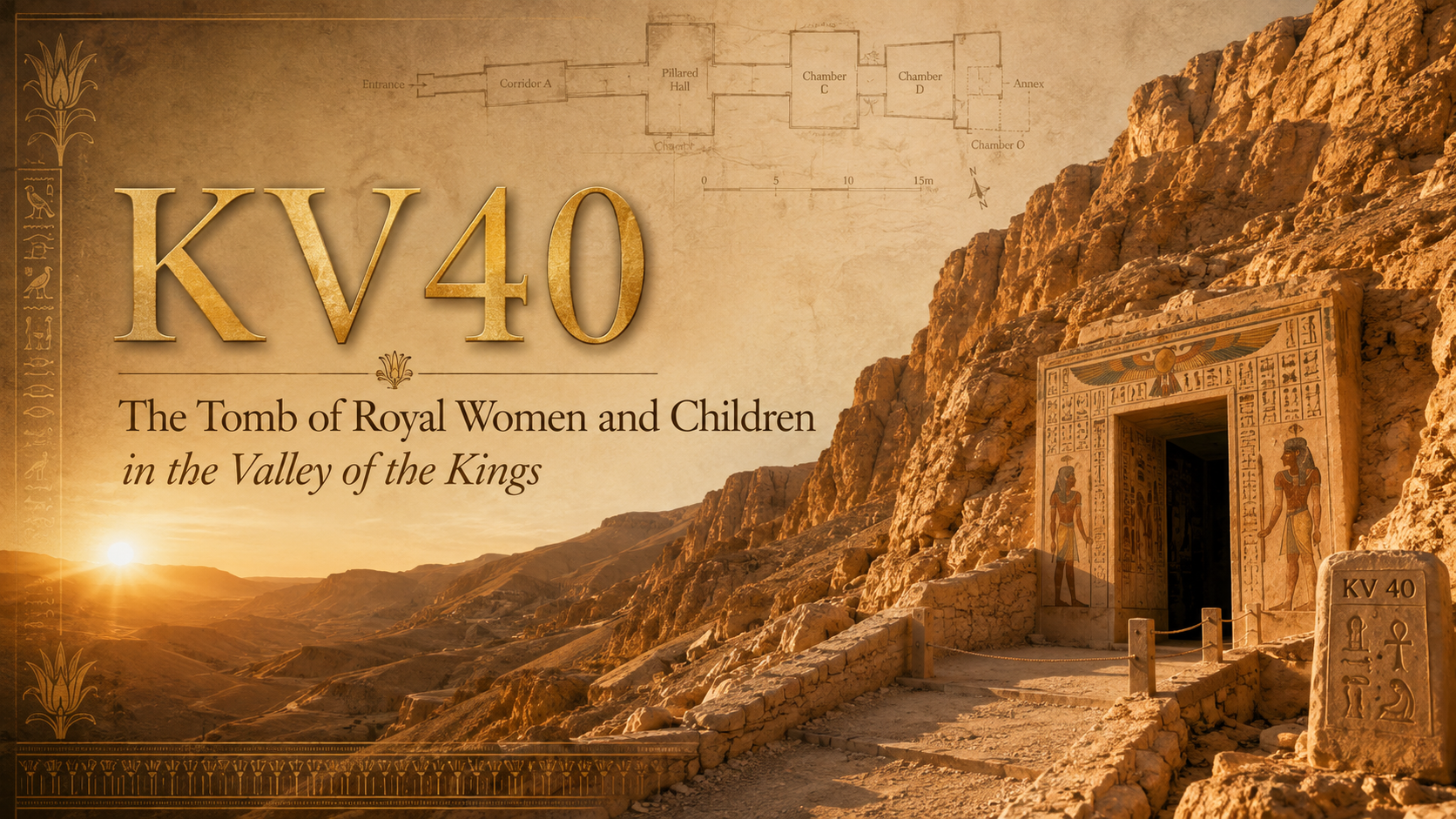
KV40 is one of the most extraordinary collective tombs ever discovered in the Valley of the Kings. For more than a century, it was little more than a number on archaeological maps. Victor Loret discovered and explored the tomb in 1899, but he left no detailed excavation report, and its occupants remained unknown.
That changed dramatically when the University of Basel Kings’ Valley Project began investigating KV40 in the twenty-first century. Beneath centuries of debris, soot, shattered coffins, broken pottery, and badly disturbed human remains, archaeologists uncovered evidence for an enormous burial group connected directly with the royal families of Thutmose IV and Amenhotep III.
More than 100 inscribed pottery dockets and numerous mummy labels preserved the names and titles of people buried inside the tomb. At least 30 individuals could be identified by name, including eight King’s Daughters and four King’s Sons. Others belonged to what the inscriptions call the “household of the royal children.”
The tomb also contained women whose names appear to be foreign, suggesting that foreign princesses or women who entered the Egyptian court through diplomatic relationships may have been buried alongside members of the royal family. The tomb included children, newborn infants, young adults, and older adults.
KV40 was later reopened and reused during the Third Intermediate Period, particularly the Twenty-second Dynasty. Those later burials were themselves robbed, and at some point a destructive fire burned through parts of the tomb, blackening walls and damaging mummies, coffins, textiles, and cartonnage.
By the time archaeologists finished documenting its complex burial history, KV40 had revealed the remains of more than 80 men, women, and children from different periods.
What originally appeared to be a minor, undecorated tomb became one of the richest sources of information about the private world surrounding the Eighteenth Dynasty royal court.
- Structure: KV40
- Location: Valley of the Kings, East Valley, Thebes West Bank, Luxor
- Owner: Members of the Eighteenth Dynasty royal family and household
- Associated Kings: Thutmose IV and Amenhotep III
- Dynasty: Eighteenth Dynasty, with later reuse during the Third Intermediate Period
- Site Type: Collective royal-family shaft tomb
- Decoration: None
- Interior Layout: Deep shaft leading to a central chamber and four side chambers
- Public Access: Closed
KV40 lies in the side valley leading toward KV34, the tomb of Thutmose III. This area contains an unusually dense concentration of Eighteenth Dynasty royal and elite tombs, including:
- KV31, which contained five unidentified elite mummies
- KV32, the tomb of Queen Tiaa
- KV33, an unidentified tomb near Thutmose III
- KV34, the tomb of Thutmose III
- KV36, the tomb of Maiherpri
- KV37, an unidentified Eighteenth Dynasty burial
- KV42, a royal-scale tomb associated with the Thutmosid court
- KV64, which contained an earlier Eighteenth Dynasty burial and the later burial of Nehemesbastet
The concentration is not accidental. Archaeological evidence increasingly shows that this side valley served as a burial ground not only for kings but also for queens, royal children, relatives, nurses, favored officials, and members of the royal household.
KV40 provides some of the strongest evidence for this wider use of the Valley of the Kings.
Description
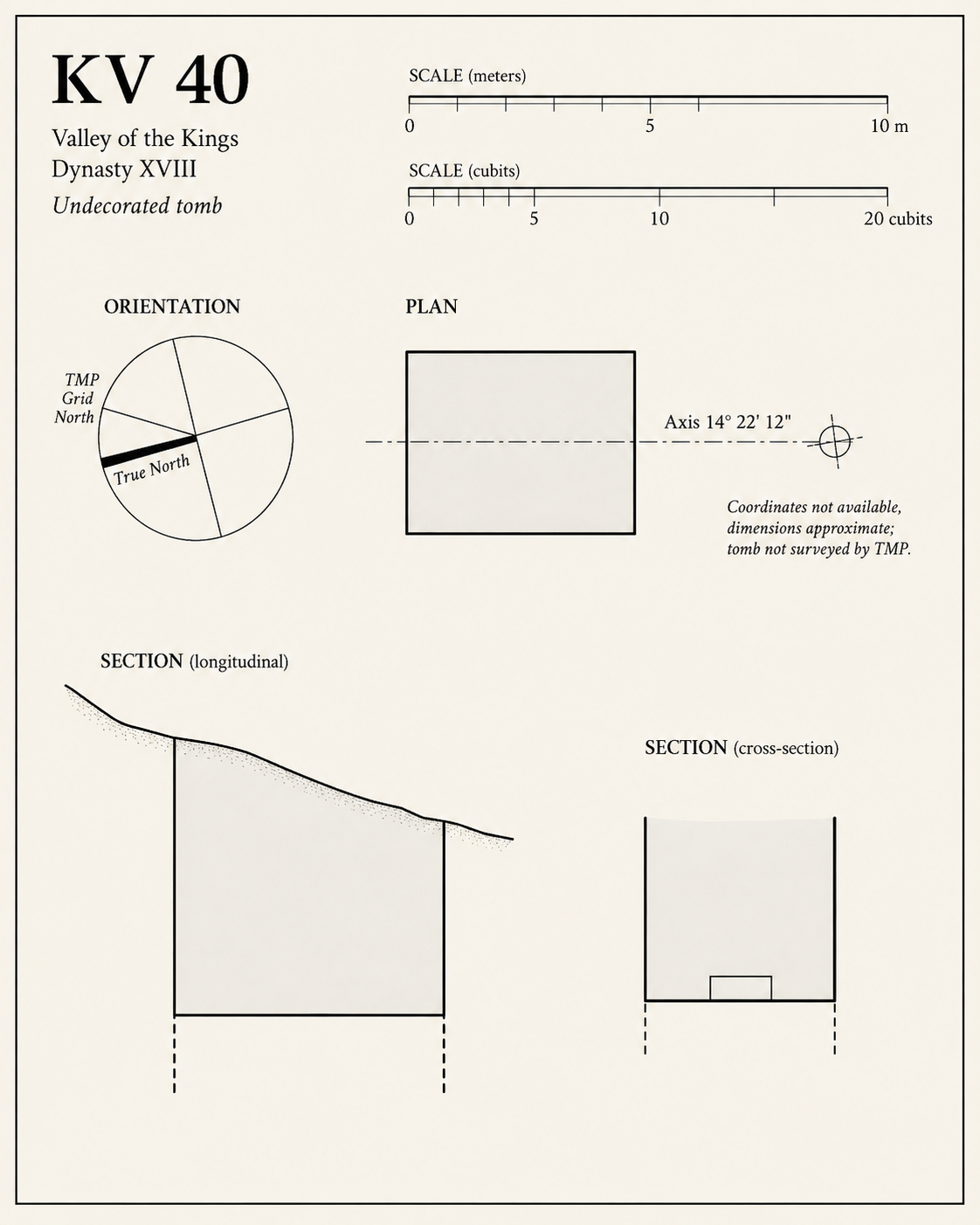
KV40 is entered through a deep vertical shaft approximately six meters deep. At the bottom, the shaft opens into a central underground chamber. Four additional chambers branch from this central room, creating a five-room subterranean complex.
This is considerably more elaborate than many of the nearby shaft tombs, some of which contain only one small burial chamber.
The basic layout consists of:
- A vertical entrance shaft
- A central chamber
- Four surrounding side chambers
The arrangement provided substantial space for multiple coffins and funerary equipment.
The architecture makes much more sense now that archaeologists know KV40 contained a large number of burials. Instead of being designed for one individual, the monument appears to have developed as a collective resting place for members of the royal household.
An Undecorated Tomb
KV40 contains no surviving painted or carved wall decoration. There are no scenes from:
- The Amduat
- The Book of Gates
- The Litany of Ra
- The Book of the Dead
- The Book of Caverns
No wall cartouches identify a single owner. This initially made the tomb difficult to interpret. In the great royal tombs, the king’s identity is announced repeatedly through inscriptions and images. In KV40, identity had to be recovered from the portable objects placed with the dead.
The names written on pottery, mummy labels, coffin fragments, and other burial objects ultimately proved far more informative than decorated walls would have been.
Who Was Buried in KV40?
KV40 was not the tomb of one individual. It was used for a large group of people associated with the royal court during the reigns of Thutmose IV and Amenhotep III.
The University of Basel discovered more than 100 inscribed vessel dockets and numerous mummy labels. These inscriptions allowed researchers to identify at least 30 people by name.
Among those named were:
- Eight King’s Daughters
- Four King’s Sons
- Other members of the household of the royal children
- Women with apparently foreign names
- Members of the wider palace community
None of the named royal children had previously been securely identified from other historical sources. KV40 therefore introduced an entirely new group of members of the Eighteenth Dynasty royal family to Egyptology.
The Household of the Royal Children
One of the most important phrases recovered from the inscriptions is the “household of the royal children.”
This indicates that KV40 was connected with an organized palace institution surrounding the king’s sons and daughters. A royal child did not live alone. Princes and princesses were surrounded by:
- Nurses
- Tutors
- Servants
- Attendants
- Companions
- Administrators
- Foreign retainers
- Other household personnel
Some of these people may have remained attached to royal children throughout their lives.
The evidence from KV40 suggests that this social community could continue even in death. The tomb may have provided a collective burial place where royal children and people closely associated with them were interred together.
Eight King’s Daughters
At least eight women named in the surviving inscriptions carry the title King’s Daughter.
This is an extraordinary discovery because many royal daughters are poorly documented in Egyptian historical records.
Some princesses appeared prominently on temples and statues, but others left almost no surviving trace. KV40 demonstrates that the royal family was substantially larger than the individuals who appear repeatedly on monumental inscriptions.
None of the eight princesses identified from KV40 had previously been known securely from other sources.
Their burials therefore expand our understanding of the royal families of Thutmose IV and Amenhotep III.
Four King’s Sons
Four named individuals carry the title King’s Son. Like the princesses, these princes were previously unknown from surviving royal monuments.
The discovery is important because Egyptian succession history tends to emphasize only those princes who became crown prince or king. Many other sons of a pharaoh may have died young or occupied positions that left little monumental evidence.
KV40 preserves traces of these otherwise forgotten members of the royal family.
Children and Infants
KV40 contained the remains of people of many different ages.
These included:
- Newborn infants
- Babies
- Children
- Adolescents
- Young adults
- Mature adults
The presence of infants is particularly moving evidence of mortality within the royal household.
Even Egypt’s wealthiest families could not protect children from disease, infection, complications of birth, and the other dangers of ancient life.
The Valley of the Kings therefore contains not only monumental stories of pharaohs and empire, but also evidence of royal families confronting the deaths of their children.
More Than 80 Individuals
Early announcements from the Basel excavation reported at least 50 people.
Continued excavation and anthropological analysis increased the minimum number substantially. The University of Basel now reports that KV40 contained more than 80 male and female mummies of different ages, representing burials spanning the Eighteenth through Twenty-second Dynasties.
The bodies were extremely fragmented because of:
- Ancient robbery
- Repeated disturbance
- Later reuse
- Fire
- Movement of objects
- Early exploration
Researchers therefore had to identify individuals through skeletal analysis rather than simply counting intact mummies.
The Foreign Women of KV40
Some of the most intriguing people identified in KV40 were women whose names appear to be non-Egyptian. Examples reported by the University of Basel include names such as:
- Bint-Anat
- Bascha
- A woman whose name or title can be interpreted as Mistress of Punt
Some names were written with the hieroglyphic throwing-stick determinative used to mark foreigners. This strongly suggests that at least some of the women buried in KV40 came from outside Egypt.
Diplomatic Marriages
The presence of foreign women raises the possibility that KV40 contained women who arrived in Egypt through international diplomacy.
During the Eighteenth Dynasty, Egyptian kings maintained relationships with rulers across the Near East and surrounding regions. Diplomatic marriages could bring foreign princesses and their entourages to the Egyptian court.
Amenhotep III is especially famous for maintaining extensive diplomatic relationships with neighboring kingdoms.
If some KV40 women were foreign princesses, their burials reveal what happened after they joined the Egyptian court.
They received Egyptian funerary treatment.
Their bodies were mummified, supplied with Egyptian-style burial goods, and placed within the Valley of the Kings alongside members of the pharaoh’s family.
Were These Women Part of a Royal Harem?
Popular accounts sometimes describe KV40 as a “royal harem tomb.” That description should be used cautiously.
The ancient Egyptian royal household included wives, princesses, children, attendants, foreign women, servants, and administrators. The modern word “harem” can create a misleading picture focused primarily on the king’s sexual partners.
The inscriptions from KV40 instead point toward a broader social and administrative institution connected with royal children and the palace. A better description is that KV40 served as a collective burial place for members of the royal family and royal household.
Thutmose IV
The earliest named burial group appears to be associated with Thutmose IV’s reign. Thutmose IV was the son of Amenhotep II and Queen Tiaa, whose tomb KV32 lies in the same side valley.
His reign falls during the middle Eighteenth Dynasty, when this region of the Valley increasingly became associated with royal relatives and court members. Some of the people buried in KV40 may have been direct family members.
Amenhotep III
KV40 appears to have remained important during the reign of Thutmose IV’s son, Amenhotep III.
Amenhotep III ruled Egypt during one of the most prosperous periods of the New Kingdom. His court was internationally connected, immensely wealthy, and supported by a large royal household.
The inscriptions from KV40 provide an unusually intimate counterpart to the king’s monumental temples, statues, and palaces.
Instead of showing Amenhotep III as a divine ruler, KV40 introduces us to children, relatives, foreign women, and household members who lived around him.
The University of Basel describes its discoveries as providing significant new information about the social entourage of Amenhotep III.
Pottery Dockets
Broken pottery provided the key to identifying KV40’s occupants. More than 100 vessel dockets preserve hieratic administrative inscriptions written in ink.
These dockets could include:
- Names
- Titles
- Contents
- Administrative information
- Institutional affiliations
The pottery may look less spectacular than gold jewelry or painted coffins, but it proved far more historically valuable.
A few lines of ink on a broken jar were enough to reveal identities that had been lost for more than three thousand years.
Mummy Labels
Small inscribed labels associated with the bodies also helped identify the dead.
Mummy labels could preserve a deceased person’s name so that the body remained identifiable during embalming, transportation, burial, or later funerary activity.
In a collective tomb containing dozens of individuals, such labels were especially important.
Without them, the heavily damaged human remains would have been almost impossible to connect with specific names or titles.
Burial Equipment
Despite extensive robbery and destruction, thousands of fragments of funerary equipment survived.
Finds included:
- Wooden coffins
- Cartonnage mummy cases
- Funerary masks
- Textiles
- Pottery vessels
- Mummy labels
- Inscribed jar fragments
- Wooden objects
- Leather
- Faience
- Plant remains
- Embalming material
- Human remains
The assemblage’s fragmented nature has required years of conservation and reconstruction.
Eighteenth Dynasty Funerary Masks
Fragments of cartonnage funerary masks from the Eighteenth Dynasty survived inside KV40.
Cartonnage was created from layers of linen or papyrus covered with plaster and painted.
The mask provided the deceased with an idealized eternal face and protected the head of the mummy.
Most KV40 masks were smashed into small pieces by robbers and later fire damage. Conservators have nevertheless been able to join some fragments and reconstruct portions of the original designs.
Research into these fragments has revealed differences in construction techniques, layering, painting, and surface treatment.
Textiles
KV40 contained an enormous amount of linen.
Researchers identified:
- Ordinary mummy bandages
- Fine linen
- Coarser fabrics
- Textiles with colored stripes
- Fringed textiles
- Pieces with seams
- Repaired textiles
- Reused cloth
Some textiles had clearly served another purpose before being reused for mummification.
This is important because burial textiles were not always produced specifically for funerals. Clothing and household fabrics could be repurposed as mummy wrappings.
The University of Basel undertook a systematic study of these textiles to understand their manufacture and use in royal burial practices.
The Rare Ancient Sock
One particularly unusual textile from KV40 was a preserved sock.
It survived well enough to be conserved and later displayed at the Luxor Museum.
Objects like this provide a completely different connection with the ancient dead than royal statues or monumental inscriptions.
The people of KV40 did not exist only as titles such as “King’s Daughter.” They wore clothing, used fabrics, raised children, and lived within the everyday world of the palace.
Ancient Robbery
KV40 was repeatedly robbed.
The University of Basel believes that major looting probably occurred during the late Nineteenth and Twentieth Dynasties.
The robbers appear to have concentrated particularly on metal objects. They removed gold, silver, bronze, jewelry, amulets, coffin fittings, and other valuable materials almost completely.
Wooden coffins were smashed open. Thieves unwrapped or tore apart mummies as they searched the linen for jewelry.
The damage was so extensive that the burial assemblages became mixed together.
A Tomb Full of Chaos
When archaeologists entered the side chambers, they did not find neat rows of intact mummies. Instead, they encountered a chaotic mixture of:
- Human bones
- Mummy fragments
- Linen
- Coffin pieces
- Cartonnage
- Pottery
- Burial goods
- Burned material
- Soot
- Debris
This destruction made KV40 extremely difficult to interpret.
The archaeology depended on reconstructing thousands of small fragments and identifying patterns in material repeatedly disturbed over thousands of years.
The Fire in KV40
At some point after the tomb had been reused, a major fire burned inside KV40.
The walls were blackened with soot, while bodies, coffins, cartonnage, textiles, and burial equipment were burned or charred.
The University of Basel specifically investigated the fire as part of its later research program.
The blaze may have been connected with tomb robbery, although the precise circumstances remain uncertain.
Fire inside an underground tomb can become especially destructive because heat, smoke, and restricted airflow concentrate within the chambers.
The Human Remains and Fire
The fire badly damaged the human remains, but scientific analysis showed that important biological material survived.
Researchers tested bone fragments for collagen and found it in all samples examined. This was significant because preserved collagen enables radiocarbon analysis.
Researchers also selected samples for ancient DNA research.
The Basel team hoped that genetic analysis might help determine family relationships among individuals buried during the Eighteenth Dynasty and those belonging to the later Third Intermediate Period burial group.
The Twenty-second Dynasty Reuse
KV40 did not cease functioning after the Eighteenth Dynasty.
Centuries later, during the Third Intermediate Period, the tomb was reopened and used again.
Numerous coffin and cartonnage fragments date stylistically to the Twenty-second Dynasty.
These later burials were placed among the disturbed remains of the earlier royal-family burials rather than after a complete clearing of the tomb.
KV40 therefore became a burial place containing people separated by several centuries of Egyptian history.
Why Were Old Tombs Reused?
By the Third Intermediate Period, many tombs in the Valley of the Kings were no longer functioning as protected royal monuments.
Political power had changed, royal burials had moved elsewhere, and many older tombs had already been robbed.
These abandoned underground spaces offered ready-made burial chambers.
Several tombs investigated by the University of Basel show evidence of reuse during this period, including:
The reuse of KV40 demonstrates how the meaning of the Valley changed over time. A burial place originally created for members of the Eighteenth Dynasty royal household could later become a cemetery for an entirely different group.
Discovery by Victor Loret
Victor Loret discovered KV40 in 1899. Loret was then conducting one of the most productive excavation periods ever undertaken in the Valley of the Kings.
His discoveries and investigations included:
Unfortunately, no detailed excavation report for KV40 was published. This lack of documentation meant that little was known about the tomb for more than a century.
The Tomb Was Forgotten
After Loret’s exploration, KV40 received relatively little attention.
Its entrance remained known, but the monument was not considered particularly important. Like many undecorated shaft tombs in the Valley, it was overshadowed by the magnificent royal tombs nearby.
When the University of Basel began studying the smaller tombs surrounding KV34, KV40 became part of a much broader investigation into who else besides kings had been buried within the royal necropolis.
The decision transformed our understanding of the site.
University of Basel Excavations
The University of Basel Kings’ Valley Project began a systematic modern investigation of the tomb during its research into the side valley surrounding Thutmose III.
As the chambers were cleared, it became obvious that KV40 contained an enormous amount of archaeological material.
In the 2013–2014 phase of the project, researchers announced the discovery of dozens of mummified individuals. Further work continued through subsequent seasons, especially in the side chambers.
By 2014–2015, excavation focused heavily on Chamber D, where numerous mummy remains had been damaged by both robbers and fire.
From 50 to More Than 80 Mummies
The first major announcement concerning KV40 reported remains from at least 50 people.
As the team continued excavation and anthropological study, that number increased.
The University of Basel now states that the tomb contained over 80 male and female mummies of different ages, including infants.
This makes KV40 one of the largest known collective burial assemblages from the Valley of the Kings.
Scientific Study of the Mummies
Specialists from the University of Zurich and the Swiss Mummy Project studied the remains.
Their research examined:
- Age
- Sex
- Health
- Anatomical abnormalities
- Mummification methods
- Fire damage
- Biological relationships
- Nutrition
- Disease
The University of Basel notes that the mummy studies have provided new information about health, nutrition, hygiene, and social conventions within the Eighteenth Dynasty royal court.
This makes KV40 important not only to Egyptology but also to bioarchaeology and the history of medicine.
Ancient DNA Research
Researchers selected samples for ancient DNA analysis. One of the most interesting questions is whether researchers can establish biological relationships among the royal children and other occupants.
DNA could potentially reveal:
- Sibling relationships
- Parent-child relationships
- Maternal lines
- Connections between Egyptian and foreign individuals
- Relationships among later burial groups
The difficult preservation conditions, including heat from the ancient fire, make such research challenging.
Nevertheless, preliminary collagen testing suggested that at least some of the bone material remained suitable for advanced analysis.
Objects Recovered
The enormous KV40 assemblage includes:
- Human mummies and skeletal remains
- Infant and child burials
- Wooden coffin fragments
- Eighteenth Dynasty funerary masks
- Twenty-second Dynasty cartonnage
- Mummy labels
- More than 100 inscribed pottery dockets
- Large storage vessels
- Fine pottery
- Linen mummy wrappings
- Colored and fringed textiles
- Leather fragments
- Faience objects
- Wooden objects
- Plant remains
- Embalming materials
- Coffin and funerary equipment
- Burned burial material
Most objects survive only as fragments because of robbery, later reuse, and fire.
Noteworthy Features
KV40 is notable for several reasons:
- It was used as a collective burial tomb.
- It contained members of the families of Thutmose IV and Amenhotep III.
- The inscriptions refer to the “household of the royal children.”
- More than 80 individuals from different periods were represented.
- At least 30 Eighteenth Dynasty occupants are named.
- Eight named individuals carry the title King’s Daughter.
- Four carry the title King’s Son.
- Infants, children, and adults were buried there.
- Several women appear to have had foreign origins.
- Researchers recovered more than 100 inscribed pottery dockets.
- Most of the named royal children were previously unknown.
- The tomb was extensively robbed.
- Metal burial objects were especially targeted.
- KV40 was reused during the Third Intermediate Period.
- Numerous later coffins and cartonnage fragments date to the Twenty-second Dynasty.
- A major fire damaged the burials.
- The tomb contained extensive surviving textiles.
- A rare ancient sock from KV40 was conserved for exhibition.
- Victor Loret discovered the tomb in 1899.
- The University of Basel transformed modern understanding of KV40 through systematic excavation and scientific analysis.
Dating
KV40 was used during several major periods:
- New Kingdom, Eighteenth Dynasty: Original construction and burial of royal family and household members
- Reign of Thutmose IV: Early royal-family burials
- Reign of Amenhotep III: Continued use for royal children, household members, and foreign women
- Late Nineteenth to Twentieth Dynasty: Major episodes of robbery
- Third Intermediate Period: Reuse of the tomb
- Twenty-second Dynasty: Additional burials with decorated coffins and cartonnage
- Later antiquity: Further disturbance and fire
- 1899: Exploration by Victor Loret
- Twenty-first century: Systematic excavation, conservation, and scientific analysis
History of Exploration
- Victor Loret, 1899: Discovery and excavation; no detailed report published
- Theban Mapping Project: Architectural recording
- University of Basel Kings’ Valley Project, twenty-first century: Systematic excavation
- 2013–2014: Major discovery and documentation of the collective burial assemblage
- 2014–2015: Intensive recovery of mummy remains from side chambers
- 2016–2018: Conservation and analysis of coffins, cartonnage, textiles, pottery, inscriptions, and human remains
- 2018 onward: Continued anthropological, textile, radiocarbon, and genetic research
Conservation Challenges
KV40 presents extraordinary conservation problems. Thousands of fragments have been affected by:
- Fire
- Soot
- Robbery
- Crushing
- Ancient handling
- Modern exposure
- Age
- Organic deterioration
Many objects could not even be studied until soot was removed from their surfaces.
Cartonnage pieces required careful cleaning before researchers could identify painted decoration. Textiles had to be separated, categorized, stabilized, and stored in appropriate conditions.
Human remains required individual documentation and organized storage within the tomb.
Protecting the Tomb
The University of Basel has also worked to protect the entrances of smaller tombs throughout the side valley.
Cleared shafts have received low protective walls and roofs designed to reduce:
- Flash-flood damage
- Falling debris
- Accidental entry
- Modern rubbish accumulation
These structures are intentionally designed to blend with the surrounding landscape.
Site Condition
KV40 remains closed to ordinary visitors.
The tomb itself is undecorated, while much of its importance comes from the archaeological material found inside rather than its architecture.
The original burial assemblages are heavily fragmented, but years of conservation and analysis continue to reconstruct information from what survived.
Many finds remain stored and studied within controlled archaeological contexts.
Why KV40 Matters
KV40 fundamentally changed our understanding of the Valley of the Kings.
The name of the cemetery can suggest it was exclusively a place for pharaohs. KV40 demonstrates something far more complicated.
The royal necropolis also included the people who surrounded the king.
Princes and princesses lived and died here. Foreign women entered the Egyptian court and were eventually buried according to Egyptian customs. Babies and children from the royal household received burials alongside adults. Servants, companions, and attendants appear to have belonged to the same funerary community.
KV40 also preserves people who disappeared completely from conventional Egyptian history. At least 30 names recovered from pottery and mummy labels belonged to individuals who were otherwise unknown. Eight royal daughters and four royal sons effectively returned to history because somebody wrote their names in ink on burial vessels more than three thousand years ago.
The tomb therefore gives us something the enormous temples of Amenhotep III cannot.
Those monuments tell us about the pharaoh.
KV40 tells us about the people around him.
Interesting Facts About KV40
- Victor Loret discovered KV40 in 1899.
- Loret never published a detailed excavation report.
- The tomb contains five underground chambers.
- Its entrance shaft is approximately six meters deep.
- The tomb is completely undecorated.
- KV40 was a collective burial place rather than a single-person tomb.
- More than 80 individuals from different periods were represented.
- Infants were buried alongside children and adults.
- At least 30 Eighteenth Dynasty people are named.
- Eight were identified as King’s Daughters.
- Four were King’s Sons.
- None of these named royal children had been securely known from other sources.
- More than 100 inscribed vessel dockets survived.
- Some women apparently came from outside Egypt.
- Scholars have interpreted one name as Mistress of Punt.
- The foreign women may have entered Egypt through diplomatic relationships.
- The tomb was reused during the Twenty-second Dynasty.
- Ancient robbers targeted metal burial objects.
- A major fire severely damaged the tomb.
- Thousands of coffin and funerary mask fragments survived.
- Researchers recovered large amounts of linen and mummy wrappings.
- A rare ancient sock from KV40 was conserved and exhibited.
- Scientific analysis has examined the occupants’ ages, health, sex, and mummification.
- KV40 is one of the best sources for reconstructing the private social world of Amenhotep III’s court.