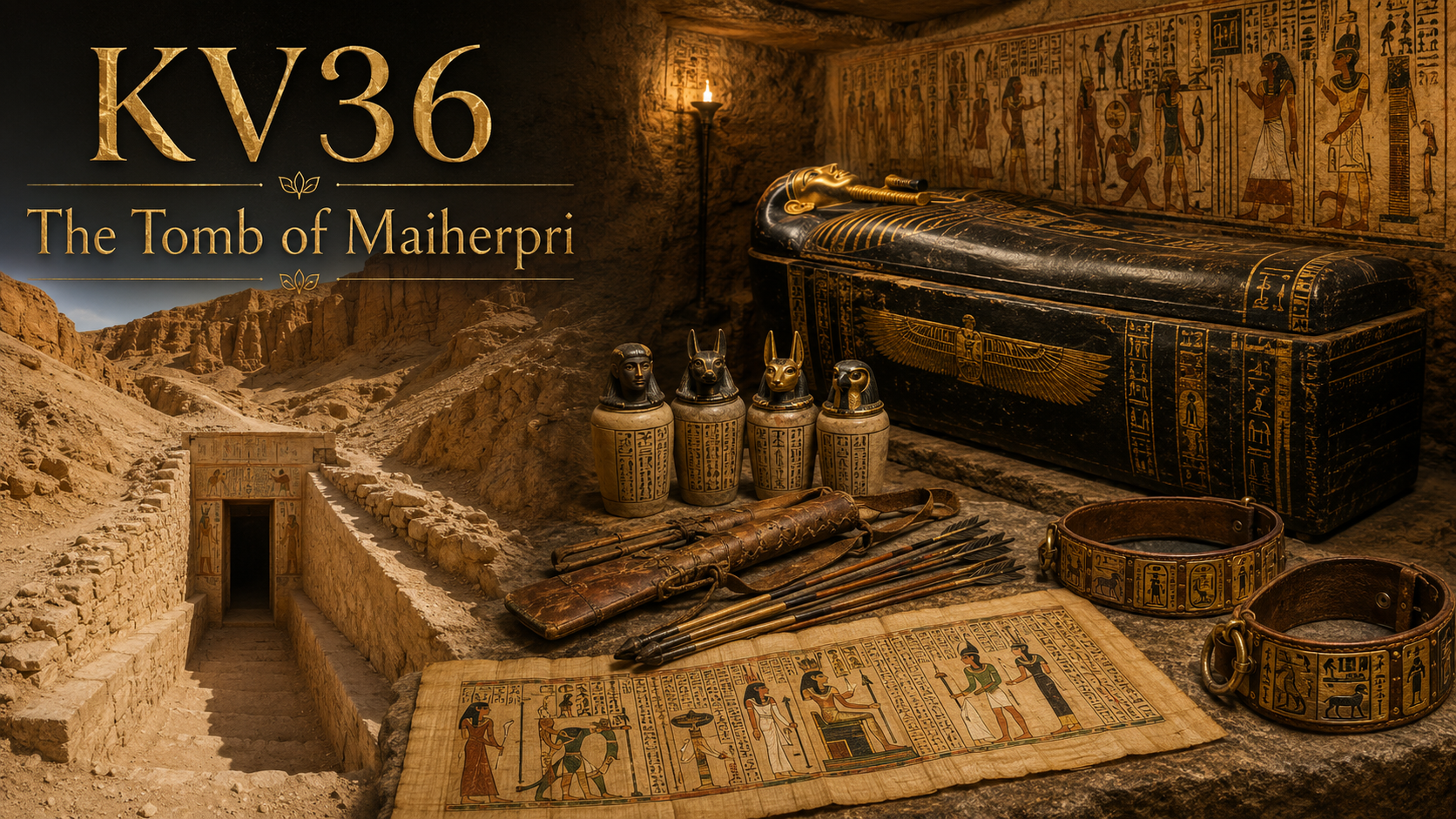
KV36 is the tomb of Maiherpri, a young and exceptionally favored member of the Egyptian royal court who received the extraordinary privilege of being buried among the pharaohs in the Valley of the Kings.
The tomb itself is remarkably modest. A vertical shaft descends to a single undecorated burial chamber measuring only a few meters across. Yet when French Egyptologist Victor Loret discovered KV36 in March 1899, he encountered one of the most complete elite burials ever found in the Valley.
Ancient thieves had entered the tomb and removed some jewelry, textiles, metal objects, and valuables from Maiherpri’s mummy. However, much of the burial remained remarkably intact. The chamber still contained Maiherpri’s coffins, mummy and funerary mask, canopic equipment, Book of the Dead, pottery and stone vessels, food offerings, floral remains, archery equipment, leather arm guards, and even two elaborately decorated dog collars. More than 100 objects survived.
The discovery gives us an unusually detailed glimpse into the funeral of a high-ranking member of the Eighteenth Dynasty court. It also raises a fascinating question: who exactly was Maiherpri, and why was a man who was not a pharaoh given a richly furnished burial inside Egypt’s royal cemetery?
- Structure: KV36
- Location: Valley of the Kings, East Valley, Thebes West Bank, Luxor
- Owner: Maiherpri, also spelled Maiherperi
- Dynasty: Eighteenth Dynasty
- Site Type: Elite shaft tomb
- Decoration: None
- Interior Layout: Shaft and single burial chamber
- Public Access: Closed
Who Was Maiherpri?
Maiherpri remains an enigmatic figure because almost everything known about him comes from the objects buried in KV36. His name is commonly translated as “Lion of the Battlefield.” His funerary equipment preserves several important titles, including:
- Child of the Kap, or royal nursery
- Fan-bearer on the Right Side of the King
- Companion of the King
- A man who followed the king on journeys or campaigns to foreign lands
The title “Child of the Kap” indicates that Maiherpri was raised or educated within the royal nursery, an institution where royal children and selected children of important families were brought up together. His title of Fan-bearer on the Right Side of the King placed him close to the pharaoh and could indicate a position of considerable trust and prestige.
Maiherpri’s precise relationship with the royal family remains unknown. He may have been the son of an important foreign or Nubian family, a member of the extended royal household, or an individual who rose to prominence through service to the king. The evidence does not allow us to identify his parents or establish that he was himself a royal prince.
Was Maiherpri Nubian?
Maiherpri is frequently described as being of Nubian ancestry.
His beautifully illustrated Book of the Dead portrays him with dark brown skin and tightly curled black hair. When his mummy was unwrapped in 1901, Georges Daressy also noted his dark complexion. The mummy wore a tightly curled wig attached to the shaved scalp.
These features have led many scholars to propose a Nubian origin or ancestry. However, Maiherpri’s precise ethnic and family background cannot be established from appearance alone.
What is clear is that Maiherpri occupied an exceptionally privileged position within Egyptian society. Regardless of his ancestry, he was raised within the royal environment, served close to the king, and was granted burial in the Valley of the Kings.
When Did Maiherpri Live?
The exact reign during which Maiherpri lived and was buried remains debated.
His burial clearly belongs to the middle Eighteenth Dynasty, but scholars have proposed dates ranging from the reign of Hatshepsut and Thutmose III through the reigns of Thutmose IV and Amenhotep III. Some researchers favor an earlier date under Hatshepsut or Thutmose III, while others have placed him closer to Thutmose IV.
Because no surviving object identifies the king Maiherpri served, it is safest to describe KV36 as a middle Eighteenth Dynasty burial rather than assigning it confidently to one specific pharaoh.
Location
KV36 lies on the floor of the East Valley of the Kings, between the tomb of Amenhotep II, KV35, and the area containing KV13.
It stands opposite the entrance to the side wadi leading toward KV34, the tomb of Thutmose III.
Nearby tombs include:
- KV34, Thutmose III
- KV35, Amenhotep II
- KV37, unknown owner
- KV42, associated with the Thutmosid royal court
The location is significant. Maiherpri was not buried in the ordinary private cemeteries of western Thebes. He was placed inside the same protected landscape used for kings, queens, princes, and some of the most trusted members of the royal household.

KV36 is one of the simplest tombs in the Valley of the Kings. A vertical shaft descends from the surface to a single rectangular burial chamber located on its western side.
There are no corridors, pillared halls, additional storerooms, or decorated chambers. Despite its simplicity, the burial chamber was large enough to hold a surprisingly extensive collection of funerary equipment.
The Theban Mapping Project records an axis of approximately 288° 50′ 48″, oriented generally westward, with the entrance at an elevation of approximately 179.81 meters above sea level.
Measurements
- Maximum Height: Approximately 1.62 m
- Minimum Width: Approximately 1.01 m
- Maximum Width: Approximately 4.03 m
- Total Length: Approximately 6.34 m
- Total Area: Approximately 18.54 m²
- Total Volume: Approximately 24.77 m³
- Elevation: 179.81 m above sea level
- Axis: 288° 50′ 48″
- Axis Orientation: West
The total length and area published for KV36 are only a fraction of those of the great royal tombs nearby, emphasizing how compact Maiherpri’s burial actually was.
Decoration
KV36 is completely undecorated. Its walls contain no painted scenes, carved reliefs, hieroglyphic inscriptions, or funerary texts.
This was not unusual for non-royal tombs in the Valley during the Eighteenth Dynasty. Instead of placing religious texts on the walls, Maiherpri’s burial relied on portable funerary equipment, especially his magnificent Book of the Dead, coffins, amulets, canopic equipment, and mummy mask.
The contrast between the plain chamber and the richness of the objects inside is one of KV36’s most striking features.
Discovery by Victor Loret
Victor Loret discovered KV36 on March 30, 1899, during his second major season of excavation in the Valley of the Kings.
Loret was then director of the Egyptian Antiquities Service. He had already made extraordinary discoveries in the Valley, including KV34, the tomb of Thutmose III, and KV35, the tomb of Amenhotep II.
His workers searched the southern part of the Valley by cutting exploratory trenches down to the bedrock. After numerous unsuccessful test pits, one trench revealed the shaft of KV36.
Loret descended the shaft and entered the burial chamber on March 31. The scene inside was extraordinary.
What Loret Found Inside
Although tomb robbers had entered KV36 in antiquity, they had not emptied it.
A large black-painted wooden sarcophagus decorated with gilded inscriptions stood near one wall. Maiherpri’s canopic chest was positioned nearby. Large pottery vessels lined part of the chamber, while food offerings and floral material remained piled in another area.
An additional coffin lay overturned in the room. Pottery and calcite vessels, bows or archery equipment, arrows, leather arm guards, dog collars, funerary objects, and Maiherpri’s personal possessions were scattered throughout the chamber.
Loret recognized the name Maiherpri in the gilded inscriptions on the burial equipment. Officials cleared the tomb quickly because they feared thieves might target the newly discovered objects. By April 7, the entire burial assemblage had been packed into sixteen crates for transportation to Cairo.
One of the First Nearly Intact Valley Burials
KV36 occupies an important place in the history of archaeology. Although ancient thieves had already disturbed the burial, Victor Loret encountered a tomb that still contained much of its original funerary assemblage. It was one of the earliest substantially intact burials discovered in the Valley of the Kings.
This was more than two decades before Howard Carter discovered Tutankhamun’s KV62 in 1922. The contents of KV36 demonstrated what a wealthy Eighteenth Dynasty burial could look like when large portions of its funerary equipment survived in context.
The Coffins of Maiherpri
Maiherpri received an unusually elaborate set of coffins. His mummy was ultimately enclosed within a large rectangular wooden outer sarcophagus painted black and decorated with gilded inscriptions. Inside were nested anthropoid coffins shaped like the deceased.
Another anthropoid coffin was discovered overturned in the burial chamber. Evidence suggests that it may originally have been intended as part of Maiherpri’s nested coffin set but was too large to fit properly and was therefore left unused beside the completed burial.
This mistake provides a rare glimpse into the practical realities of ancient Egyptian funerals. Even carefully prepared royal and elite burial equipment did not always fit together exactly as planned.
The Black and Gold Sarcophagus
Maiherpri’s rectangular outer sarcophagus is one of the most visually striking pieces from KV36. It was constructed from wood, painted black, and decorated with gilded bands of hieroglyphic inscriptions and religious imagery.
Black carried strong funerary symbolism in ancient Egypt. It could represent the fertile soil of the Nile Valley, regeneration, and the resurrection of Osiris.
Gold was associated with the flesh of the gods and eternal divine existence. The combination of black and gold therefore transformed Maiherpri’s coffin into a powerful symbol of death followed by rebirth.
Maiherpri’s Funerary Mask
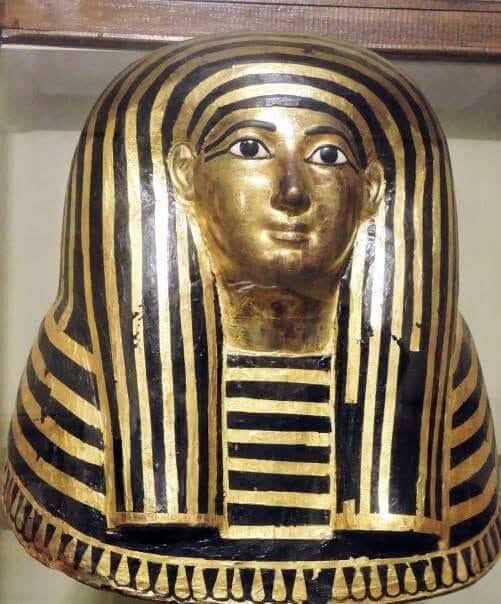
Maiherpri’s mummy wore a black-and-gold cartonnage funerary mask. The mask covered his head and shoulders and provided an idealized eternal face for the deceased.
Even though ancient thieves cut through the mummy wrappings looking for precious objects, the funerary mask survived. Its style resembles other elite funerary masks from the middle Eighteenth Dynasty and provides another clue to the approximate date of the burial.
The Mummy of Maiherpri
Maiherpri’s mummy survived inside the tomb despite ancient robbery. Georges Daressy formally unwrapped the mummy on March 22, 1901. He found the body of a young adult man whose arms rested along the front of his thighs. The head had been shaved and covered with a tightly curled wig fixed to the scalp.
Modern assessments generally place Maiherpri’s age at death at approximately 25 to 30 years, although earlier researchers sometimes suggested a slightly younger age. Ancient thieves had sliced through the linen wrappings to search for jewelry and amulets. Nevertheless, several objects escaped them.
Jewelry the Robbers Missed
Ancient thieves removed many of the valuable objects placed within Maiherpri’s wrappings, but they did not find everything.
Among the surviving pieces were:
- Bracelets
- Beads from a collar
- A scarab
- Carnelian beads
- Gold beads
- A gold plate covering the embalming incision
The gold embalming plate is particularly interesting. It protected the incision through which the embalmers had removed the internal organs. Its survival demonstrates how hurried or incomplete the ancient robbery must have been.
The Book of the Dead of Maiherpri
One of the greatest treasures recovered from KV36 was Maiherpri’s beautifully illustrated copy of the Book of the Dead.
The papyrus contains spells intended to protect and guide him through the afterlife. It includes vignettes showing Maiherpri himself, making it one of the most important visual sources for his appearance and identity.
In these scenes, Maiherpri is shown with dark skin and curled black hair.
The Book of the Dead helped the deceased overcome supernatural dangers, enter the realm of the gods, receive food and offerings, pass judgment, and ultimately achieve eternal existence.
Maiherpri’s papyrus is considered one of the outstanding surviving Books of the Dead from the New Kingdom.
The Canopic Chest
KV36 contained Maiherpri’s wooden canopic chest. The chest is shrine-shaped and decorated with gilded religious inscriptions and protective deities. Inside were four calcite canopic vessels used to preserve the organs removed during mummification.
Each jar was protected by funerary spells and divine guardians. When discovered, some of the jars still retained linen wrappings around them, emphasizing the careful ritual treatment given to the king’s favored courtier.
Archery Equipment
Maiherpri was buried with an impressive collection of archery equipment.
The finds included:
- More than fifty arrows
- Two decorated leather quivers
- Two leather wrist or arm guards
The absence of bows may indicate that robbers removed them, although it is impossible to know for certain.
The equipment has often been connected with Maiherpri’s name, “Lion of the Battlefield,” and with his position close to the king. However, his surviving titles do not securely identify him as a military commander.
The archery equipment could also have been associated with royal hunting.
The Dog Collars
Among the most personal objects found in KV36 were two decorated leather dog collars. One was decorated with horses and lotus designs. Another showed animals involved in a hunting scene and had once been partly gilded.
An inscription identified the dog associated with one collar. Its name has been rendered as Tantanuit, Ta-ent-niuwt, or approximately She-of-Thebes.
These collars offer a rare glimpse into Maiherpri’s personal world. They suggest that hunting dogs may have played an important role in his life, whether as personal animals or as part of his duties within the royal household.
Was Maiherpri the King’s Master of the Hunt?
The combination of archery equipment and dog collars has led some scholars to suggest that Maiherpri may have been involved with the king’s hunting activities.
His title as Fan-bearer on the Right Side of the King already placed him close to the pharaoh. Participation in royal hunts would have provided another setting in which trusted courtiers accompanied the ruler.
However, no surviving title explicitly calls Maiherpri “Master of the Hunt.” It is best to treat this interpretation as an intriguing possibility rather than a confirmed office.
Food for the Afterlife
KV36 contained considerable evidence of food offerings. Ancient Egyptians believed that the deceased continued to require nourishment after death. Tombs could therefore contain meat, bread, drink, fruit, and other provisions.
Loret recorded food offerings and plant material inside KV36, while large vessels probably contained liquids, oils, or other supplies.
Some jars containing oils appear to have been opened by tomb robbers. The contents had apparently spoiled by the time the thieves entered, so the jars were abandoned instead of being carried away.
This provides an unusual insight into the behavior of ancient tomb robbers, who selectively removed objects they considered useful or valuable.
Ancient Robbery
KV36 was not truly untouched. Robbers entered the tomb in antiquity and opened Maiherpri’s coffins. They sliced through his mummy wrappings in search of gold, jewelry, and amulets.
They appear to have removed:
- Jewelry
- Clothing and textiles
- Metal vessels
- Cosmetics
- Possibly furniture
- Possibly bows and other reusable equipment
However, the robbers left behind many objects that were bulky, difficult to reuse, spoiled, or overlooked.
Their incomplete work is the reason KV36 survived as such an extraordinary archaeological discovery.
Howard Carter’s Discovery Above KV36
KV36 produced another surprise several years after Loret’s excavation. On February 26, 1903, Howard Carter was clearing the area above the tomb when he discovered a small wooden box hidden in a cleft in the rock.
The box bore Maiherpri’s name and contained two leather loincloths.
The objects may have been removed from KV36 by ancient thieves and temporarily hidden nearby with the intention of retrieving them later.
If so, the robbers never returned.
Why Was Maiherpri Buried in the Valley of the Kings?
Maiherpri’s burial is important because he was not a reigning pharaoh. The Valley of the Kings was primarily the cemetery of New Kingdom rulers, but it was never used exclusively for kings. Queens, princes, royal children, nurses, high officials, and other favored people could sometimes receive burial within the sacred royal landscape.
Maiherpri’s titles show that he was raised within the palace environment and served close to the king. Being granted KV36 therefore provides strong evidence of extraordinary royal favor.
His richly furnished burial reinforces the impression that Maiherpri occupied a place within the highest levels of the Egyptian court.
Objects Recovered
The remarkable assemblage from KV36 included:
- Maiherpri’s mummy
- Cartonnage funerary mask
- Large rectangular outer sarcophagus
- Multiple anthropoid coffins
- Book of the Dead papyrus
- Canopic chest
- Four calcite canopic jars
- Jewelry and beads
- Scarabs and amulets
- More than fifty arrows
- Two decorated leather quivers
- Leather wrist guards
- Two decorated dog collars
- Pottery vessels
- Calcite and stone vessels
- Oil containers
- Food offerings
- Plant and floral remains
- Funerary equipment
- Written documents
- Leather clothing
- Personal possessions
More than 100 objects survived despite the ancient robbery.
Noteworthy Features
KV36 is notable for several reasons:
- It belonged to the high-ranking courtier Maiherpri.
- Maiherpri was a Child of the Royal Nursery.
- He was Fan-bearer on the Right Side of the King.
- His precise relationship to the royal family remains unknown.
- His burial dates to the middle Eighteenth Dynasty.
- The exact reign of his burial is debated.
- KV36 consists only of a shaft and one chamber.
- The tomb is completely undecorated.
- Victor Loret discovered it in 1899.
- Despite ancient robbery, much of the burial remained intact.
- More than 100 funerary objects survived.
- Maiherpri’s mummy was still present.
- His Book of the Dead is one of the tomb’s greatest treasures.
- The burial contained more than fifty arrows.
- Two decorated dog collars were found.
- One collar preserves the name of a dog.
- An additional coffin appears to have been abandoned because it did not fit the burial set.
- Howard Carter later found a box bearing Maiherpri’s name hidden above the tomb.
- KV36 provides one of the clearest pictures of an elite Eighteenth Dynasty burial before Tutankhamun’s tomb was discovered.
Site Information
Structure: KV36
Owner: Maiherpri
Dynasty: Eighteenth Dynasty
Entrance Location: Valley floor near the base of a cliff
Entrance Type: Vertical shaft
Interior Layout: Shaft and single chamber
Axis Type: Straight
Axis: 288° 50′ 48″
Axis Orientation: West
Elevation: 179.81 m above sea level
North: 99,454.423
East: 93,994.392
Decoration: None
The coordinates, elevation, axis, and simple shaft-and-chamber plan are recorded by the Theban Mapping Project.
Dating
KV36 was used during:
- New Kingdom, middle Eighteenth Dynasty: Construction and burial of Maiherpri
- Ancient period: Robbery of the burial
- 1899: Discovery and excavation by Victor Loret
- 1901: Formal unwrapping and examination of Maiherpri’s mummy
- 1903: Howard Carter’s discovery of additional objects associated with Maiherpri above the tomb
- Modern period: Study, conservation, museum display, and archaeological reassessment
The precise pharaoh under whom Maiherpri served remains uncertain.
History of Exploration
- Ancient period: Tomb entered and partially robbed
- Victor Loret, March 30, 1899: Discovery of KV36
- Victor Loret, March 31, 1899: Entry into the burial chamber
- Victor Loret and team, April 1899: Clearance and removal of funerary equipment
- Georges Daressy, 1901: Examination and unwrapping of Maiherpri’s mummy
- Howard Carter, 1903: Discovery of a box and leather loincloths associated with Maiherpri above the tomb
- Twentieth and twenty-first centuries: Reassessment of Loret’s excavation records and continued study of the objects
Much of the modern understanding of the tomb improved after Loret’s surviving notes and photographs were rediscovered and published during the early twenty-first century.
Conservation History
The contents of KV36 were removed shortly after the discovery and transferred to the Egyptian Museum in Cairo.
Because the tomb itself contains no painted wall decoration, conservation concerns focus primarily on the stability of the shaft and burial chamber rather than fragile painted plaster.
The funerary equipment requires considerably more conservation attention. Wood, leather, papyrus, textiles, cartonnage, and organic materials from the tomb are vulnerable to changes in humidity, temperature, light, and handling.
Site Condition
KV36 is small and structurally simple.
Most of its original contents were removed in 1899, leaving the burial chamber largely empty. The tomb is not normally open to the public.
Its importance today lies primarily in the extraordinary collection of artifacts and human remains recovered from it rather than the appearance of the underground chamber itself.
Why KV36 Matters
KV36 provides something that many of the Valley of the Kings’ magnificent royal tombs cannot: a remarkably complete picture of an elite individual’s burial.
Maiherpri’s tomb allows us to see his coffins, mummy mask, Book of the Dead, canopic equipment, clothing, weapons, hunting equipment, food, pets, and personal possessions as parts of a single funerary assemblage.
It also demonstrates how socially diverse the Valley of the Kings could be. Maiherpri was not a pharaoh, yet he was permitted to rest in the royal necropolis surrounded by burial equipment worthy of a man with extraordinary access to the throne.
The objects make Maiherpri more than a name on a tomb list. His arrows suggest his activities, his dog collars reveal something of his personal life, his papyrus shows how he expected to navigate the afterlife, and his mummy preserves the remains of the young man himself.
More than three thousand years after his burial, KV36 remains one of the Valley of the Kings’ most intimate windows into the life and death of a member of Egypt’s royal court.
Interesting Facts About KV36
- KV36 belonged to Maiherpri.
- His name means approximately “Lion of the Battlefield.”
- Maiherpri was raised in the royal nursery.
- He became Fan-bearer on the Right Side of the King.
- He died as a relatively young man, probably around 25 to 30 years old.
- His exact ancestry remains uncertain, although Nubian ancestry has often been proposed.
- His tomb contains only one burial chamber.
- The burial chamber has no wall decoration.
- Victor Loret discovered KV36 on March 30, 1899.
- The tomb had been robbed but retained much of its original contents.
- More than 100 objects survived.
- Maiherpri’s mummy was found inside.
- His Book of the Dead contains portraits of him.
- More than fifty arrows were placed in the tomb.
- Two decorated dog collars survived.
- One dog collar preserved the animal’s name.
- An extra anthropoid coffin apparently did not fit within the completed coffin set.
- Howard Carter found additional objects belonging to Maiherpri four years after the tomb’s discovery.
- KV36 was one of the most complete burials found in the Valley before Tutankhamun’s tomb.
