KV33 is a small but unusually designed tomb located beside KV34, the royal tomb of Pharaoh Thutmose III. Although no surviving inscription identifies its owner, its architecture, pottery, and location suggest that it was created during the middle of the Eighteenth Dynasty, most likely during the reign of Thutmose III.
The tomb is reached by a short flight of descending steps that leads directly into a central chamber with two adjoining rooms. This arrangement makes KV33 different from many of the nearby non-royal tombs, which are usually entered through deep vertical shafts.
Its most remarkable feature is a shallow sunken area in the floor of the main chamber. Such depressions were normally created to receive a sarcophagus and are otherwise associated with royal tomb architecture. This has raised the intriguing possibility that KV33 was intended for a member of the royal family rather than an ordinary official.
When the University of Basel cleared the tomb in 2012, archaeologists found fragmentary human remains, broken stone vessels, wooden fragments, and a large pottery assemblage. No object preserved the owner’s name, but the quantity of storage jars suggests that KV33 may originally have contained as many as three burials.
Despite its modest dimensions and lack of decoration, KV33 remains one of the most unusual anonymous tombs in the Valley of the Kings.
- Structure: KV33
- Location: Valley of the Kings, East Valley, Thebes West Bank, Luxor
- Owner: Unknown
- Possible Occupants: One or more members of the Eighteenth Dynasty royal family or court
- Probable Date: Reign of Thutmose III
- Site Type: Undecorated corridor tomb
- Public Access: Closed
KV33 lies high in the cliffs at the end of the side valley leading toward KV34, the tomb of Thutmose III.
Its entrance is located immediately beside the approach to the king’s tomb, placing its occupants within one of the most prestigious areas of the royal necropolis. The surrounding valley contains several tombs associated with the family and court of the Thutmosid kings.
Nearby tombs include:
- KV31, which contained five unidentified elite mummies
- KV32, the tomb of Queen Tiaa
- KV34, the tomb of Thutmose III
- KV36, the tomb of Maiherperi
- KV40, a large burial complex for royal children and members of the royal household
- KV42, a royal-scale tomb associated with the Thutmosid court
KV33’s location beside Thutmose III strongly suggests that its owner held exceptional status, even though no name survives.
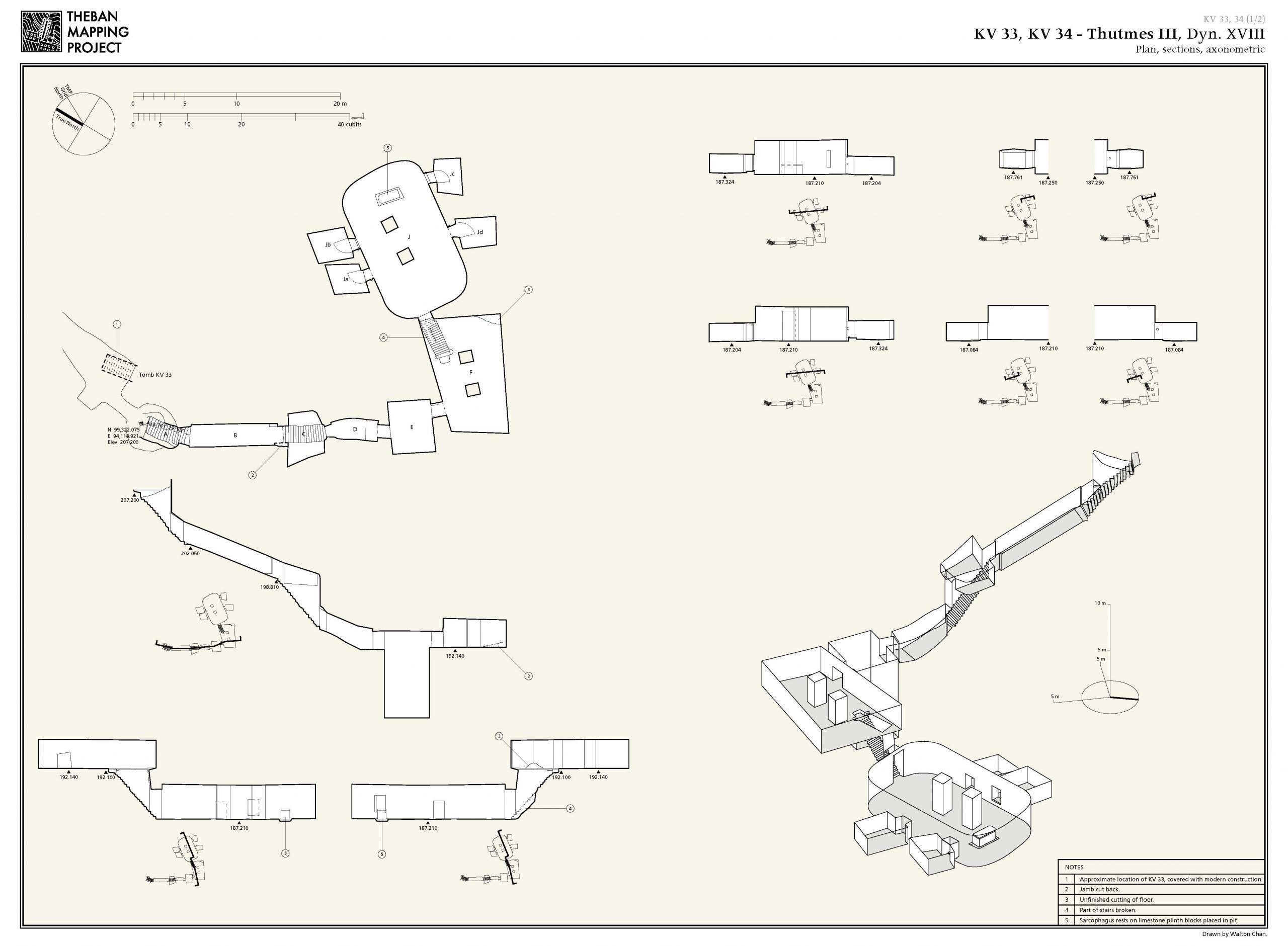
KV33 has a compact but distinctive plan.
Ten well-cut steps descend directly from the surface into a central chamber. Two side chambers open from this room, producing a simple three-room layout. There is no vertical shaft and no long entrance corridor.
The tomb consists of:
- A stepped entrance
- A central chamber with a transverse axis
- Two adjoining side chambers
- A shallow sunken area in the floor of the main chamber
The walls are neatly cut but completely undecorated.
Although the monument is small, its architecture is more complex than a basic one-room burial. The arrangement may have allowed the central chamber to serve as the principal burial area while the two side rooms held additional coffins, funerary goods, or members of the same family.
An Unusual Corridor Tomb
Most of the smaller tombs in this part of the Valley are entered through vertical shafts.
KV33 belongs to a different architectural group. Its entrance consists of descending steps leading directly into the underground rooms. Unlike other corridor tombs, however, KV33 lacks a second sloping passage between the entrance and burial chamber.
Instead, the staircase opens immediately into the central room.
The University of Basel describes this arrangement as unusual because the central chamber lies on a transverse axis and connects directly with several adjoining rooms.
The Sunken Floor
The most intriguing architectural feature of KV33 is a shallow recess in the floor of the main chamber.
In the eastern third of the room, the floor lies approximately 20 centimeters below the surrounding surface. Similar depressions were used in later royal tombs to hold a stone sarcophagus.
This feature is significant because sarcophagus recesses are generally associated with pharaonic tombs rather than ordinary private burials.
Several interpretations are possible:
- The recess may have held a stone sarcophagus.
- KV33 may have been intended for a royal family member.
- The design may imitate royal architecture because of the owner’s exceptional status.
- The floor may have been altered during a later construction phase.
No sarcophagus was found inside the tomb, and no inscription identifies a royal occupant. Even so, the unusual recess gives KV33 a stronger connection with royal burial traditions than many neighboring tombs.
Decoration
KV33 is completely undecorated.
Its walls contain no surviving:
- Painted scenes
- Carved reliefs
- Hieroglyphic inscriptions
- Cartouches
- Offering formulas
- Funerary texts
- Images of gods or the deceased
The absence of decoration was normal in many tombs created for royal relatives and court officials during the middle Eighteenth Dynasty.
Religious protection could instead be provided through coffins, amulets, canopic equipment, shabtis, papyri, and other portable funerary objects.
Unfortunately, KV33 was robbed and disturbed, so most of its original burial equipment disappeared before modern excavation.
Who Was Buried in KV33?
The owner of KV33 remains unknown.
Archaeologists recovered fragmentary human remains, but none preserved enough evidence to identify a specific historical person. No coffin inscription, shabti, canopic jar, seal, or other object revealed a personal name.
The tomb’s location and architecture suggest several possibilities:
- A prince or princess
- A queen or secondary royal wife
- A close relative of Thutmose III
- A royal nurse
- A senior palace official
- A member of the royal household
- Several related elite individuals
The safest conclusion is that KV33 belonged to one or more privileged people closely connected with the court of Thutmose III.
Was KV33 a Multiple Burial?
The quantity of pottery found inside KV33 suggests that the tomb may have contained more than one burial.
Archaeologists reconstructed at least 40 large storage jars from the surviving fragments. The University of Basel proposed that the unusually high number of vessels could indicate that as many as three people were originally buried in the tomb.
This theory fits the tomb’s three-room layout. The central chamber and two side rooms could have held separate coffins or burial assemblages.
However, the number of jars does not prove the precise number of occupants. Some vessels may have held embalming materials, offerings, linen, or supplies intended for one especially elaborate burial.
KV33 should therefore be described as a possible collective or family tomb rather than a confirmed three-person burial.
Pottery
Pottery provided the strongest evidence for dating KV33. The assemblage included:
- At least 40 large storage jars
- Medium-sized bowls with red splash decoration
- A finely made red-slipped carinated bowl with a black band around the rim
- Larger carinated bowls with red-painted rims
- A single flowerpot
- A small number of marl-clay vessel fragments
The large jars were probably used to store embalming materials, linen, food, oils, resins, water, or other supplies connected with the funeral.
Many vessels could be reconstructed almost completely from base to rim, despite having been shattered and scattered throughout the tomb.
Red Splash Decoration
Many of the pottery vessels from KV33 were decorated with irregular red splashes.
This style is an important dating tool. The ceramics closely resemble pottery recovered from KV31, another tomb associated with the middle Eighteenth Dynasty.
The predominance of red splash decoration led researchers to date KV33 most probably to the reign of Thutmose III.
The pottery differs from material found in KV30, which belongs to a later phase beginning around the reign of Amenhotep III. This comparison helps establish a relative chronology for the smaller tombs in the side valley.
Stone Vessels
Fragments of fine stone vessels were also found inside KV33. Several were made from calcite, commonly called Egyptian alabaster. These vessels may have held:
- Oils
- Perfumes
- Cosmetics
- Ritual substances
- Embalming materials
- Food offerings
The fragments were carefully documented during the 2013 and 2014 study season. None preserved an inscription identifying the tomb’s owner.
Although fragmentary, the stone vessels indicate that the original burial contained objects of significant quality and expense.
Wooden Fragments
Archaeologists recovered pieces of wood from the tomb debris.
These may have belonged to:
- Coffins
- Funerary furniture
- Boxes
- Shrine elements
- Model objects
- Handles or fittings
The wood was badly damaged and incomplete. Ancient robbers may have broken coffins and furniture apart while searching for gold, jewelry, metal fittings, and amulets.
No surviving wooden fragment preserved the owner’s name.
Human Remains
Fragmentary human remains were found among the debris. The bodies had been disturbed and damaged before modern excavation. Because the tomb had been robbed and later filled by water-borne debris, the remains no longer lay in their original positions.
The surviving evidence confirms that KV33 received at least one actual burial. The pottery assemblage and room arrangement suggest that several people may have been interred there, but the precise number remains uncertain.
Ancient Sealing Stones
Large stones recovered from the debris may once have formed part of the blocking placed across the tomb entrance.
After an ancient Egyptian burial, workers commonly sealed the entrance with stones and mud plaster. This protected the burial and concealed the underground rooms.
The stones inside KV33 may have been displaced when robbers broke through the entrance or when floods carried debris down the staircase.
Flooding
KV33 was affected by at least two separate flood events. When the University of Basel cleared the tomb, debris filled the rooms to a height of approximately 1.2 meters. Archaeologists identified two layers of material washed inside at different times.
Floodwater carried:
- Sand
- Limestone chips
- Stones
- Pottery fragments
- Human remains
- Wooden debris
These deposits mixed and displaced the surviving contents, making it difficult to reconstruct the original burial arrangement.
The stepped entrance made KV33 especially vulnerable because water could flow directly from the hillside into the underground chambers.
Discovery by Victor Loret
Victor Loret discovered KV33 in 1898 while exploring the Valley of the Kings.
Loret also discovered several major monuments, including KV35, the tomb of Amenhotep II. However, no detailed excavation report for KV33 survives.
The tomb was apparently explored by Loret and his team, but the extent of their work is uncertain. They may have removed objects or human remains without leaving a complete archaeological record.
Because the tomb was small and undecorated, it received far less attention than the nearby royal tomb of Thutmose III.
An Early Tourist Attraction
KV33 was accessible to tourists during the early twentieth century.
A 1902 Baedeker travel guide described it as a small tomb containing two empty rooms reached by a flight of steps.
This reference shows that the monument was once open and visible to visitors, although it was never a major attraction.
At some point, a modern bench was constructed over the tomb’s entrance. The entrance became partly hidden beneath this installation until archaeologists removed the bench during the 2012 excavation.
Excavation by the University of Basel
The University of Basel Kings’ Valley Project excavated KV33 in 2012. The team removed the modern bench covering the entrance and cleared the ten descending steps. Inside, debris filled the chambers to a depth of about 1.2 meters.
The excavation recovered:
- Pottery
- Stone-vessel fragments
- Wooden fragments
- Human remains
- Large stones from the ancient blocking
- Flood deposits
No object identified the tomb’s original owner.
Architectural Survey
A complete architectural survey of KV33 followed the excavation. Researchers recorded:
- The outline of every room
- Sections through the chambers
- Doorway shapes
- Step shapes
- Differences in floor level
- Debris lines preserved on the walls
The survey data were prepared for the creation of a detailed three-dimensional model of the tomb.
Photographic documentation was also completed, including interactive panoramic imagery.
The Connection to Thutmose III
KV33’s proximity to KV34 is unlikely to be meaningless. The tomb lies beside the burial place of Thutmose III, one of the most powerful kings of the Eighteenth Dynasty. The pottery also points to his reign.
This suggests that the owner belonged to the king’s family, household, or inner court. Burial near the pharaoh could express:
- Family relationship
- Personal loyalty
- Royal favor
- Service within the palace
- Religious closeness to the king in the afterlife
No surviving evidence identifies a specific person, but KV33 appears to form part of a carefully organized royal burial landscape surrounding Thutmose III.
Comparison with KV31
KV31 and KV33 share several important features. Both tombs:
- Date to the middle Eighteenth Dynasty
- Lie near the tomb of Thutmose III
- Contained large pottery assemblages
- Included vessels with red splash decoration
- May have held multiple burials
- Belonged to unidentified members of the elite
- Were robbed and disturbed
The similarities in pottery suggest that the two tombs may have been used during approximately the same period.
KV31 contained five mummified individuals, while KV33 preserved only fragmentary remains. Together, the tombs provide evidence for a group of privileged burials clustered around the king.
Noteworthy Features
KV33 is notable for several reasons:
- Its original owner remains unknown.
- It lies immediately beside KV34, the tomb of Thutmose III.
- It probably dates to the reign of Thutmose III.
- Ten steps lead directly into a central chamber.
- Two side rooms open from the central chamber.
- The tomb is completely undecorated.
- A shallow recess in the floor may have held a sarcophagus.
- Sarcophagus recesses are usually associated with royal tombs.
- At least 40 large storage jars were represented.
- The pottery may indicate as many as three original burials.
- Victor Loret discovered the tomb in 1898.
- Tourists could enter KV33 in the early twentieth century.
- A modern bench was later built over the entrance.
- The University of Basel excavated the tomb in 2012.
- Flood deposits filled the chambers to a depth of about 1.2 meters.
- No surviving object revealed the owner’s name.
Additional Tomb Information
Owner Type: Unknown royal relative or elite court member
Entrance Type: Descending staircase
Interior Layout: Central chamber with two side chambers
Axis Type: Transverse chamber plan
Decoration: None
Probable Date: Reign of Thutmose III
Principal Use: One or more elite burials
Public Access: Closed
Dating
KV33 was used during the following periods:
- New Kingdom, middle Eighteenth Dynasty: Construction and original burial, probably during the reign of Thutmose III
- Ancient period: Robbery and disturbance
- Later antiquity: At least two flood events
- 1898: Discovery or early exploration by Victor Loret
- Early twentieth century: Open to tourists
- 2012: Modern archaeological excavation
- 2013–2014: Study, architectural survey, and documentation
History of Exploration
- Victor Loret, 1898: Discovery and probable initial exploration
- Baedeker guide, 1902: Description as a small tourist-accessible tomb
- Modern period: Construction of a bench over the entrance
- University of Basel Kings’ Valley Project, 2012: Clearance and excavation
- University of Basel, 2013–2014: Pottery study, architectural survey, object documentation, and photography
Conservation History
The University of Basel documented the tomb following excavation and completed a detailed architectural and photographic survey.
Conservation work focused on:
- Recording the chamber surfaces
- Stabilizing fragile finds
- Reconstructing pottery vessels
- Conserving stone-vessel fragments
- Documenting human remains
- Securing the entrance
- Monitoring structural conditions
The removal of the modern bench allowed the original entrance and stairway to be recorded properly.
Site Condition
KV33 remains structurally recognizable, but its original contents were heavily disturbed.
Ancient robbery removed most valuable burial equipment. Flooding deposited large quantities of debris and scattered the remaining pottery, wood, stone vessels, and human remains.
The tomb contains no surviving wall decoration and is closed to visitors.
Why KV33 Matters
KV33 is important because its architecture does not fit neatly into the normal division between royal and non-royal tombs.
Its small size and lack of decoration resemble an elite private burial. However, the floor recess intended for a sarcophagus is normally associated with tombs prepared for pharaohs.
This combination suggests that KV33 may have belonged to someone who occupied an unusually elevated position within the family or court of Thutmose III.
The tomb also contributes to a broader picture of the Valley of the Kings. It was not simply a cemetery for isolated kings. It was a carefully organized sacred landscape in which royal wives, children, relatives, nurses, officials, and favored attendants could be buried close to the reigning pharaoh.
Although KV33 has not revealed its owner’s name, its rooms and surviving objects show that the anonymous dead could still receive a privileged place beside one of Egypt’s greatest kings.
Interesting Facts About KV33
- KV33 lies beside the tomb of Thutmose III.
- Its owner has never been identified.
- The tomb probably dates to Thutmose III’s reign.
- It has ten descending entrance steps.
- The staircase leads directly to the main chamber.
- Two side chambers open from the central room.
- The tomb contains no wall decoration.
- A 20-centimeter floor recess may have held a sarcophagus.
- At least 40 large pottery jars were found.
- The vessel count may indicate three burials.
- Victor Loret discovered the tomb in 1898.
- KV33 appeared in a tourist guide published in 1902.
- A modern bench was later built over its entrance.
- Archaeologists removed the bench and excavated the tomb in 2012.
- Flood deposits inside reached approximately 1.2 meters deep.
- The tomb has been surveyed for a detailed three-dimensional reconstruction.