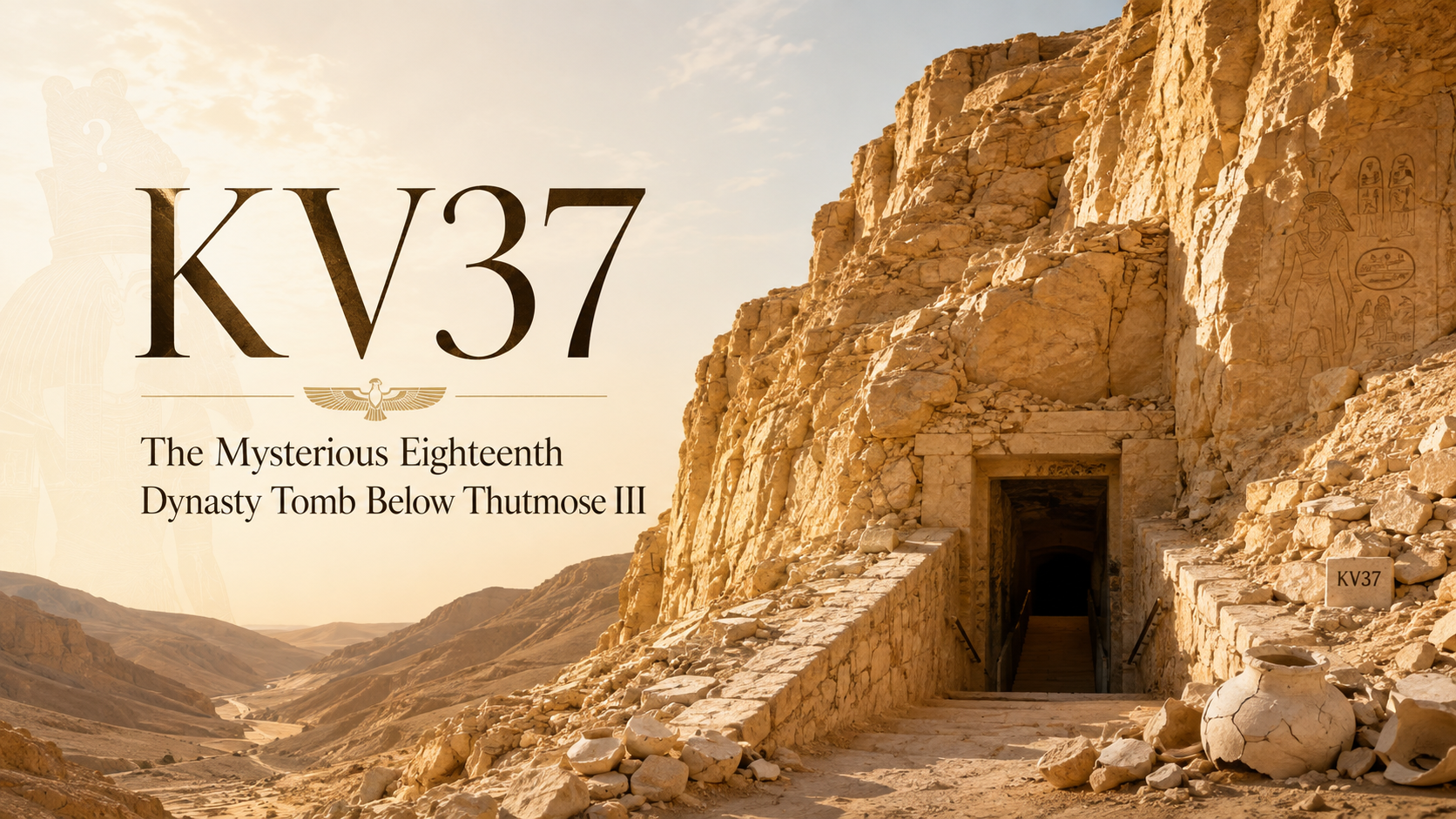
KV37 is one of the many anonymous tombs hidden within the Valley of the Kings, but archaeological evidence shows that it was more than an abandoned excavation. Bone fragments and the remains of numerous large whitewashed storage jars demonstrate that the tomb was used for burial, probably during Egypt’s Eighteenth Dynasty. Unfortunately, no surviving inscription identifies the person or people originally placed inside.
The tomb lies immediately below the high cliff containing KV34, the royal tomb of Thutmose III. Its architecture consists of a descending entrance followed by another corridor leading to a single rectangular burial chamber. This corridor-style layout distinguishes KV37 from many of the small shaft tombs scattered through the same side valley. The University of Basel specifically identifies KV37 and Queen Tiaa’s KV32 as examples of Eighteenth Dynasty corridor tombs.
KV37 became even more puzzling because researchers reportedly found objects associated with several different periods. Victor Loret’s nineteenth-century excavation recorded material connected with Thutmose IV and Seti I, while later investigators found Eighteenth Dynasty pottery and evidence of ancient disturbance. This mixture has led to the suggestion that tomb robbers may have entered KV37 and perhaps used it temporarily to sort or store material removed from other tombs.
Modern archaeology returned to KV37 in 2016, when the University of Basel Kings’ Valley Project relocated its buried entrance and re-cleared the monument. The work recovered the remains of at least 29 large storage jars, recorded ancient red mason’s marks on the walls, and produced detailed modern documentation of a tomb largely forgotten for more than a century.
- Structure: KV37
- Location: Valley of the Kings, East Valley, Thebes West Bank, Luxor
- Owner: Unknown
- Probable Date: Eighteenth Dynasty
- Site Type: Undecorated corridor tomb
- Interior Layout: Stairway, descending corridors, and single burial chamber
- Axis Type: Straight
- Decoration: None
- Public Access: Closed
KV37 is located in a branch of the southern side valley leading toward KV34, the tomb of Thutmose III. Its entrance is cut into the cliff base below the modern staircase leading to KV34. Today, KV37 lies several meters beneath the modern ground surface because generations of excavation, road construction, erosion, and dumped archaeological debris have raised the surrounding valley floor.
Nearby tombs include:
- KV32, the tomb of Queen Tiaa
- KV33, an unidentified Eighteenth Dynasty tomb
- KV34, the tomb of Thutmose III
- KV36, the tomb of Maiherpri
- KV38, associated with the reburial of Thutmose I
- KV40, a large burial complex used by members of the royal household
- KV42, a royal-scale tomb connected with the Thutmosid court
The University of Basel’s research in this side valley was designed specifically to investigate how these smaller tombs related spatially and socially to the nearby royal monuments.
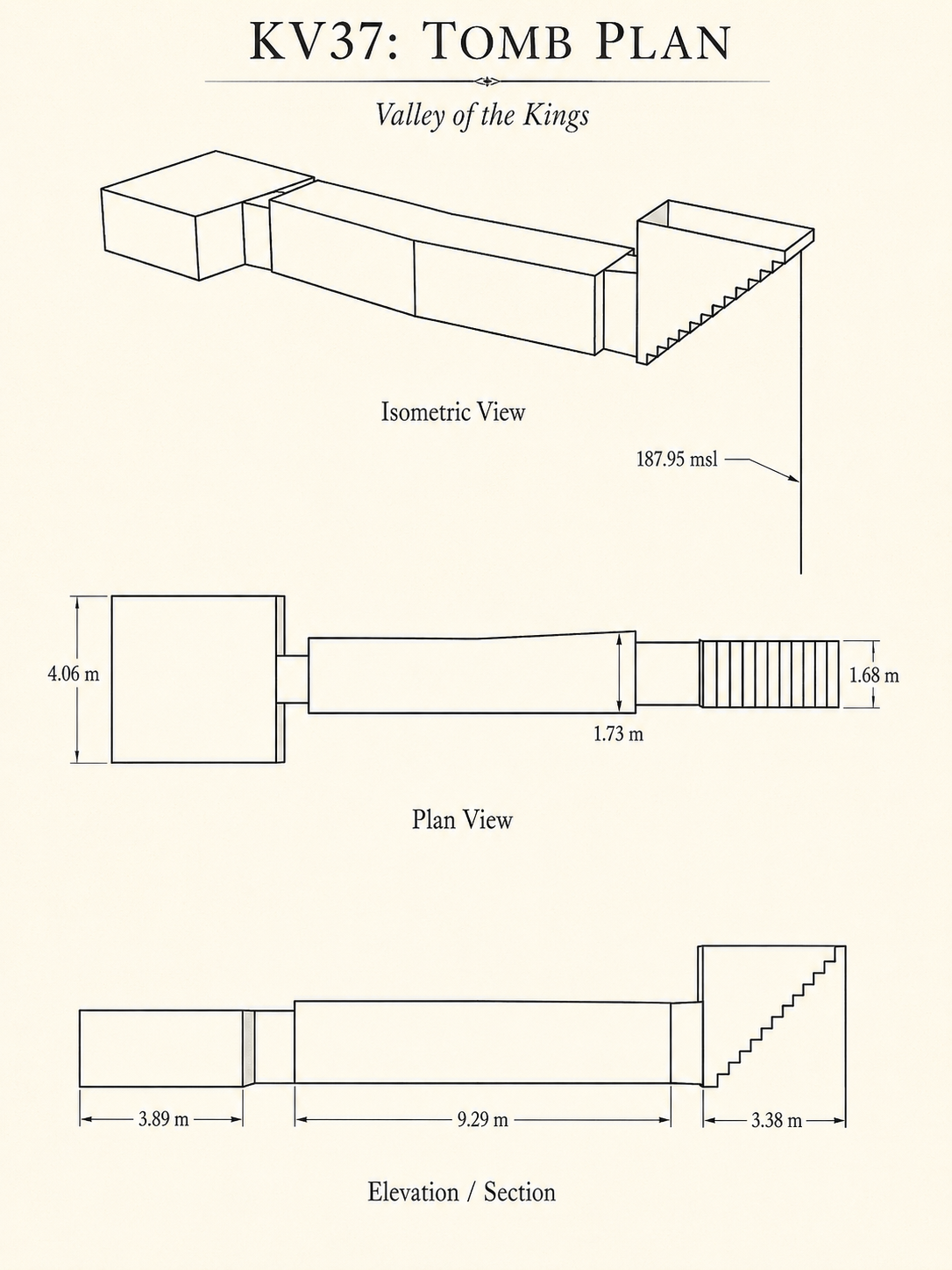
KV37 has a simple straight-axis layout. A stairway descends from the surface into an entrance passage. A second slightly descending corridor continues toward a single rectangular burial chamber.
Unlike KV36, which is entered through a vertical shaft, KV37 belongs to what the University of Basel classifies as a corridor tomb. In this architectural type, a sloping or stepped entrance passage is normally followed by another descending corridor before reaching the burial chamber.
The tomb contains no side chambers, pillars, wells, storerooms, or additional burial suites.
Its simple arrangement would have provided enough space for a coffin, funerary equipment, food offerings, storage jars, and other burial provisions without approaching the scale of a royal tomb.
Measurements
KV37 is a relatively small tomb.
- Maximum Height: Approximately 1.96 m
- Minimum Width: Approximately 1.12 m
- Maximum Width: Approximately 4.05 m
- Total Length: Approximately 18.39 m
- Total Area: Approximately 38.04 m²
- Total Volume: Approximately 61.38 m³
- Elevation: Approximately 187.95 m above sea level
Published measurements give KV37 a total length of slightly more than 18 meters, making it considerably larger than a simple shaft-and-chamber tomb such as KV36 but still very modest compared with the great royal monuments nearby.
Decoration
KV37 is completely undecorated. Its walls contain no surviving:
- Painted scenes
- Carved reliefs
- Hieroglyphic funerary texts
- Cartouches
- Images of the deceased
- Representations of Egyptian gods
- Offering formulas
This lack of decoration was typical of the smaller Eighteenth Dynasty tombs in this part of the Valley. The University of Basel notes that the undecorated tombs it investigated generally had rough walls without finished plaster or painted religious scenes.
Instead, portable funerary objects such as coffins, papyri, amulets, canopic equipment, shabtis, and other burial goods would have provided religious protection. Unfortunately, almost none of KV37’s original burial equipment survived in an identifiable context.
Ancient Mason’s Marks
Although KV37 contains no finished decoration, archaeologists discovered ancient red paint marks on the walls of the entrance passage.
The workmen who excavated the tomb made these marks, which probably served as guides during construction. Similar red marks occur in other undecorated tombs investigated by the University of Basel.
Such marks are valuable because they preserve evidence of the tomb-building process itself. Before painters, plasterers, and funerary specialists arrived, quarrymen had to lay out the underground architecture and determine the intended position of passages and chambers.
KV37 therefore preserves traces of the people who constructed the monument even though the name of the person for whom they built it has disappeared.
Who Was Buried in KV37?
The identity of KV37’s original occupant remains unknown. No surviving object securely preserves a personal name, title, or family relationship. Nevertheless, bone fragments and funerary pottery confirm that the tomb was used for burial rather than simply abandoned after construction.
Its location within the side valley associated with Thutmose III suggests that the occupant probably belonged to the royal court. Possible candidates include:
- A royal relative
- A prince or princess
- A secondary royal wife
- A royal nurse
- A high-ranking official
- A trusted palace attendant
- Another member of the royal household
None of these possibilities can currently be proven.
Burial in the Valley of the Kings itself suggests exceptional status. Egypt’s Ministry of Tourism and Antiquities notes that although the necropolis is called the Valley of the Kings, it also contained members of the royal family and a small number of very high-ranking non-royal individuals.
Dating KV37
KV37 is generally dated to the Eighteenth Dynasty. The architecture, location, bone fragments, and surviving pottery all support a New Kingdom date, while the Eighteenth Dynasty ceramics recovered during the modern clearance provide particularly important evidence.
Its position near KV34 also places it within a concentration of tombs associated with the Thutmosid royal court.
However, KV37 should not be assigned confidently to one particular reign. The original burial could date to the reign of Thutmose III, Amenhotep II, Thutmose IV, or another nearby period within the middle Eighteenth Dynasty. Without an inscription naming the occupant or king, a narrower date remains speculative.
The Whitewashed Storage Jars
The most important surviving burial material from KV37 consists of large whitewashed pottery storage jars. Elizabeth Thomas had already noted fragments of large whitewashed vessels in the tomb during the twentieth century. When the University of Basel re-cleared KV37, archaeologists found the fragments gathered in the center of the burial chamber.
The pottery was removed, cleaned, studied, and reconstructed.
Initial examination suggested that approximately 20 jars were represented. Further study raised the minimum number to 29 storage jars.
These vessels could originally have contained:
- Food
- Beer or wine
- Oils
- Resins
- Linen
- Embalming materials
- Water
- Other funerary supplies
The number of jars confirms that KV37 received a substantial funerary deposit even though almost none of the original valuables survived.
Did KV37 Contain More Than One Burial?
The archaeological evidence does not currently establish how many people were originally buried in KV37.
The large number of storage jars could have supported a single well-equipped burial or several related interments. Bone fragments show that human remains were present, but their disturbed condition makes the original arrangement difficult to reconstruct.
Unlike KV31, where five distinct mummies could be studied, KV37 did not preserve enough human material to establish a definite number of occupants.
It is therefore safest to describe KV37 as having contained at least one Eighteenth Dynasty burial.
Objects Associated with Thutmose IV
Victor Loret’s excavation reportedly recovered material bearing the name of Thutmose IV.
Thutmose IV was an Eighteenth Dynasty pharaoh and the son of Amenhotep II and Queen Tiaa. His own royal tomb is KV43.
The presence of his name in KV37 is intriguing, but it does not mean that Thutmose IV was buried here. His mummy and royal tomb are known from elsewhere.
The object could have entered KV37 through:
- Ancient robbery
- Temporary storage
- Movement of burial equipment
- Later activity in the Valley
- Debris from another tomb
Because modern standards poorly documented the archaeological context of Loret’s finds, the connection cannot be reconstructed with certainty.
Objects Associated with Seti I
Loret also reported material associated with Seti I, a Nineteenth Dynasty king who lived several generations after KV37 was probably constructed.
Seti I was buried in the magnificent royal tomb KV17. The presence of material bearing his name demonstrates that KV37 was entered or used long after its original Eighteenth Dynasty burial.
This later material is one reason Egyptologists have questioned whether KV37 served a secondary purpose during episodes of tomb robbery or reorganization in the Valley.
Was KV37 a Tomb Robbers’ Workshop?
One intriguing theory suggests that tomb robbers used KV37 as a temporary workshop or storage area.
The theory developed because objects from different tombs and different periods appear to have been deposited there. Instead of carrying stolen material immediately out of the Valley, thieves could have moved objects into an abandoned tomb where they could:
- Open coffins
- Strip mummies
- Remove gold and jewelry
- Break apart large funerary objects
- Sort valuable from worthless material
- Hide stolen objects temporarily
KV37’s secluded position below the cliffs would have made it a convenient location for such activity.
However, this remains an interpretation rather than a proven fact. The surviving objects could also have reached the tomb through official activity, later reuse, erosion, or poorly documented nineteenth-century excavations. Egyptological summaries therefore describe the “robbers’ workshop” idea as a suggestion rather than an established function.
Possible Material from KV43
The presence of objects bearing the name of Thutmose IV has led to speculation that some material in KV37 could have originated in KV43, his royal tomb.
KV43 was robbed in antiquity and entered more than once. Objects could conceivably have been carried away and temporarily stored in another nearby tomb during those episodes.
Again, no surviving record proves that material was deliberately transferred from KV43 to KV37.
The possibility illustrates how complicated the archaeological history of the Valley of the Kings became after centuries of robbery, official restoration, reburial, flooding, and modern excavation.
James Burton
KV37 may have been known before Victor Loret’s excavation. James Burton visited and recorded numerous tombs in the Valley of the Kings during the 1820s. KV37 was apparently among the monuments he observed, although he did not fully excavate it.
Burton’s work is especially important because he documented tombs before many later archaeological activities dramatically altered the Valley’s landscape.
Eugène Lefébure
French Egyptologist Eugène Lefébure documented KV37 during the nineteenth century and prepared an early plan.
Lefébure worked extensively in the Valley of the Kings and produced plans of numerous monuments, including KV26, KV27, KV28, KV29, KV37, KV40, and KV59. He published his descriptions in Les Hypogées royaux de Thèbes in 1889.
His work therefore predates Victor Loret’s excavation and shows that the location of KV37 was known before 1899.
Victor Loret’s Excavation
Victor Loret excavated KV37 in 1899 while serving as director of Egypt’s Antiquities Service.
The excavation took place during Loret’s extraordinary work in and around the side valley associated with Thutmose III. During this period, he discovered, cleared, or investigated numerous tombs in the area.
Loret’s team recovered a mixture of archaeological material, including ostraca and objects associated with Thutmose IV and Seti I.
Unfortunately, KV37 never received the detailed publication expected of a modern excavation. The tomb gradually disappeared beneath accumulated debris once again.
The Tomb Was Lost Again
By the twenty-first century, KV37 had become buried beneath several meters of accumulated material. Its entrance was no longer easily visible from the modern Valley floor. Archaeologists knew approximately where it should be from earlier plans, but the modern landscape had changed substantially since Loret’s excavations.
The University of Basel Kings’ Valley Project therefore had to relocate the buried monument during its work in the side valley.
In the 2016–2017 season, the project successfully rediscovered the tomb’s position and secured access to its low-lying entrance.
University of Basel Re-excavation
The University of Basel re-cleared KV37 during the 2016–2017 archaeological season. Excavators first removed accumulated fill from the monument’s north side. The tomb lay several meters below the modern surface.
The stairs themselves contained:
- Modern rubbish
- Debris
- Eighteenth Dynasty pottery fragments
Inside the tomb, floodwater deposited a thin layer of sediment, while fine sand covered much of the burial chamber floor.
The investigation showed that the tomb itself was largely empty except for the pottery fragments already observed by earlier researchers.
Mapping and Photography
The Basel team produced new plans and extensive photographic documentation of KV37. This was particularly important because the tomb had never been recorded to modern archaeological standards.
Researchers documented:
- The entrance stairs
- The descending corridors
- The burial chamber
- Ancient mason’s marks
- Flood deposits
- Surviving pottery
- The relationship between the tomb and the modern Valley surface
At the end of the project, a protective iron door was installed at the lower part of the entrance to prevent debris from continually washing or falling into the tomb.
Flood Damage
KV37 has experienced flooding.
During the Basel excavation, several centimeters of flood-washed debris were found inside, and the burial chamber floor was covered with fine sand.
Compared with some tombs in the Valley, KV37 did not preserve extensive organic burial equipment. Flooding may have destroyed or moved whatever fragile objects remained after ancient robbery.
Its low modern position also makes the tomb particularly vulnerable to water and debris moving through the side valley.
Why KV37 Is Now Below Ground Level
One of the most interesting lessons from KV37 is how dramatically the Valley of the Kings has changed since antiquity.
Today the tomb lies considerably below the surrounding modern surface, but this was not necessarily the case when it was excavated.
University of Basel research elsewhere in the same side valley has shown that Eighteenth Dynasty tomb entrances were originally positioned higher on the natural hillside. Over centuries, flood deposits and enormous spoil heaps from ancient and modern excavations raised the valley floor.
Archaeologists working there today are therefore sometimes digging not into ancient ground but through layers created by previous generations of excavators.
A Tomb Used for Modern Science
KV37 acquired an unexpected new role in 2019.
Researchers installed a Raspberry Shake seismometer inside the burial chamber as part of a geological monitoring project in the Valley of the Kings.
The instrument was positioned on the chamber floor approximately seven meters below ground level and was designed to record:
- Local ground vibrations
- Nearby earthquakes
- Distant earthquakes
The equipment included a battery, battery charger, and voltage converter.
The installation transformed an anonymous Eighteenth Dynasty tomb into a scientific monitoring station more than three thousand years after its original burial use.
Why Monitor Earthquakes in the Valley of the Kings?
The cliffs surrounding the Valley contain fractures and unstable limestone sections that can threaten ancient tombs. Modern researchers study rock movement, fractures, earthquakes, and vibrations to identify the areas most vulnerable to collapse.
The University of Basel and its geological partners have used:
- Laser scanning
- Photogrammetry
- Rock-fracture mapping
- Weather monitoring
- Crack meters
- Seismic monitoring
KV37’s underground position provided a protected location for measuring vibrations within the bedrock itself.
Using the tomb for monitoring shows how archaeology and modern geological science increasingly work together to protect the Valley.
Objects and Materials Associated with KV37
Material reported or recovered from KV37 includes:
- Human bone fragments
- Twenty-nine large whitewashed storage jars
- Other Eighteenth Dynasty pottery
- Ostraca
- Objects bearing the name of Thutmose IV
- Material associated with Seti I
- Ancient red mason’s marks
- Flood deposits
- Modern debris
The mixed chronology of the finds indicates that the tomb experienced more than one phase of activity after its original burial.
Noteworthy Features
KV37 is notable for several reasons:
- Its original owner remains unknown.
- It probably dates to the Eighteenth Dynasty.
- Human remains indicate that it was actually used for burial.
- It lies immediately below the tomb of Thutmose III.
- It is a corridor tomb rather than a vertical shaft tomb.
- The monument contains only one burial chamber.
- Its walls are completely undecorated.
- Ancient red mason’s marks survive in the entrance passage.
- Twenty-nine large whitewashed storage jars were represented among the pottery.
- Objects associated with Thutmose IV and Seti I were reportedly discovered there.
- The mixture of finds has led to speculation that tomb robbers used KV37 as a temporary workshop or storage place.
- James Burton and Eugène Lefébure knew the monument before Loret’s excavation.
- Victor Loret excavated KV37 in 1899.
- The tomb later disappeared beneath accumulated debris.
- The University of Basel relocated and re-cleared it in 2016–2017.
- An iron door now protects the entrance.
- A seismometer was installed inside KV37 in 2019.
- The burial chamber lies approximately seven meters beneath the modern surface.
Additional Tomb Information
Owner Type: Unknown elite or royal household member
Entrance Type: Descending stairway and corridor
Interior Layout: Corridors and single burial chamber
Axis Type: Straight
Decoration: None
Probable Period: Eighteenth Dynasty
Evidence of Burial: Human bones and funerary pottery
Later Activity: New Kingdom and possibly later intrusion
Public Access: Closed
Dating
KV37 was used or entered during several periods:
- New Kingdom, Eighteenth Dynasty: Construction and original burial
- Later Eighteenth Dynasty: Possible secondary activity associated with material naming Thutmose IV
- Nineteenth Dynasty: Material associated with Seti I entered the tomb
- Ancient period: Robbery and disturbance
- Nineteenth century: Early exploration and excavation
- 2016–2017: Modern re-excavation and documentation
- 2019: Installation of seismic monitoring equipment
The exact date of KV37’s original burial remains uncertain.
History of Exploration
- James Burton, 1820s: Early visit or recording
- Eugène Lefébure, 1880s: Documentation and planning
- Victor Loret, 1899: Excavation for the Egyptian Antiquities Service
- Elizabeth Thomas, twentieth century: Noted surviving large whitewashed pottery fragments
- University of Basel Kings’ Valley Project, 2016–2017: Rediscovery and re-clearance
- University of Basel, 2017–2018: Continued study of the pottery
- University of Basel and geological partners, 2019: Installation of a seismometer inside the burial chamber
Conservation History
The modern University of Basel excavation included mapping, photography, pottery conservation, and entrance protection. An iron door was installed near the bottom of the entrance stairs to keep debris from continually entering the monument.
Modern conservation work in the surrounding side valley also focuses heavily on flood prevention. Archaeologists have been lowering accumulated modern debris in some areas to restore safer drainage and reduce the risk of flash floods flowing directly into the tomb entrances.
Site Condition
KV37 is largely empty today, and it’s not open to regular visitors. Its stone architecture remains identifiable, but ancient robbery, later activity, flooding, early excavation, and modern debris have destroyed much of the original archaeological context.
Why KV37 Matters
KV37 shows why even anonymous, undecorated tombs matter for understanding the Valley of the Kings.
The tomb confirms that the side valley below Thutmose III was occupied by people important enough to receive burial within the royal necropolis. Its pottery gives archaeologists evidence for Eighteenth Dynasty funerary provisioning, while its red construction marks reveal how ancient workers laid out underground monuments.
Its later history is equally valuable. Objects from several reigns suggest that tombs did not simply disappear from use after a funeral. They could be robbed, reopened, used for storage, entered by workers, filled by floods, rediscovered by nineteenth-century archaeologists, buried again beneath excavation debris, and eventually returned to scientific study.
Today, KV37 even helps preserve the Valley by housing equipment that measures underground vibrations.
The person originally buried there may have lost his or her name, but KV37 continues to tell a surprisingly complex story about burial, robbery, archaeology, geology, and the changing landscape of the Valley of the Kings.
Interesting Facts About KV37
- The original owner of KV37 is unknown.
- The tomb probably dates to the Eighteenth Dynasty.
- It lies directly below the approach to Thutmose III’s KV34.
- KV37 is reached through descending corridors rather than a vertical shaft.
- The tomb contains only one burial chamber.
- Bone fragments confirm that a burial took place there.
- At least 29 large whitewashed pottery jars were represented.
- Red mason’s marks survive on the entrance walls.
- Objects naming Thutmose IV were reportedly found inside.
- Material connected with Seti I was also discovered.
- Some researchers have suggested that ancient tomb robbers used KV37 as a workshop or storage place.
- Victor Loret excavated the tomb in 1899.
- KV37 later disappeared beneath accumulated debris.
- The University of Basel relocated it in 2016.
- Its burial chamber lies about seven meters below the modern ground surface.
- Researchers installed a seismometer inside the tomb in 2019 to monitor vibrations and earthquakes.