The ancient Egyptian Book of the Dead was a collection of funerary compositions intended to help the deceased survive death, preserve personal identity, repel supernatural dangers, and continue functioning as an effective spirit in the afterlife.
Book of the Dead Spell 29 belongs to a sequence of spells devoted to protecting one of the most important parts of the ancient Egyptian person: the heart.
Its traditional title is:
Chapter whereby the Heart of a person may not be taken from him in the Netherworld.
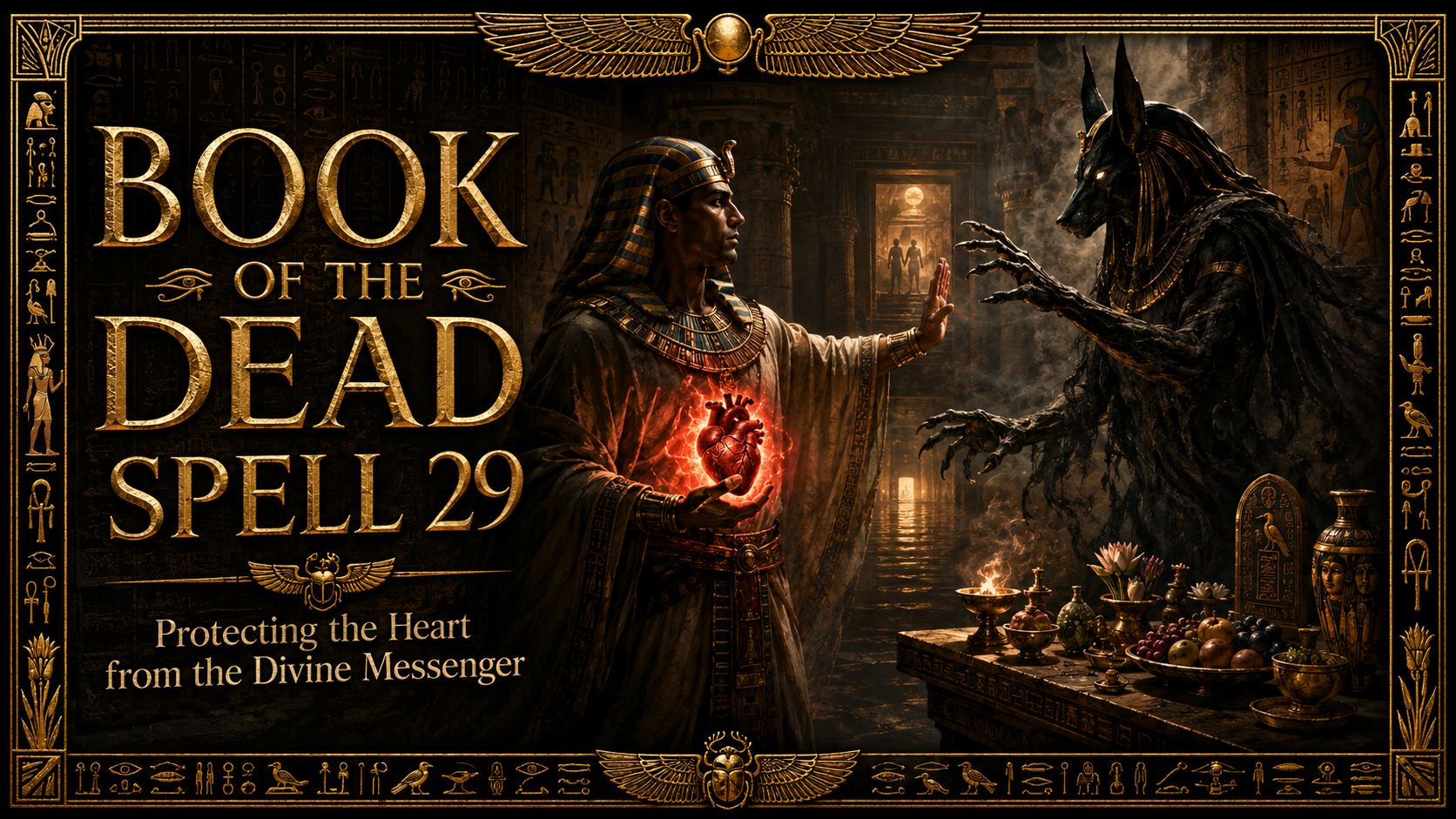
Spell 29 is extremely short, but its imagery is unusually direct. A supernatural messenger approaches with the apparent intention of violently carrying away the deceased’s heart. The deceased immediately confronts the being:
Back, Messenger of your god!
The speaker then refuses to surrender the heart and declares that the gods recognize the deceased’s offerings and bow down upon their own earth.
In simple terms, Spell 29 says:
You have come to take my heart by force, but I will not give it to you. My heart belongs to me, and the gods themselves recognize my rightful place among them.
This makes Spell 29 one of the clearest and most confrontational of the early heart-protection spells.
What Is Book of the Dead Spell 29?
Book of the Dead Spell 29 is a funerary spell designed to prevent a divine or supernatural messenger from carrying away the deceased’s heart.
Renouf and Naville title it:
Chapter whereby the Heart of a person may not be taken from him in the Netherworld.
The spell follows two other chapters with almost the same purpose:
- Spell 27: Prevents gods from seizing or reshaping the heart.
- Spell 28: Prevents the heart from being torn away and surrounds it with additional divine protection.
- Spell 29: Directly confronts a messenger who has apparently arrived to carry the heart away by force.
This creates a clear progression. The deceased is no longer merely asking: Do not take my heart. Spell 29 confronts an actual agent of seizure and tells him: Go back.
English Translation of Book of the Dead Spell 29
The following reader-friendly translation is based closely on Renouf and Naville’s surviving text.
Spell 29: Preventing the Heart From Being Taken
Back,
O messenger of your god!Have you come
to carry away by forcethis whole heart of mine,
the heart of one who lives?I will not surrender to you
this heart of the living.The gods recognize my offerings.
Together they fall upon their faces
upon their own earth.
Spell 29 is remarkably brief. Nearly the entire surviving chapter consists of this direct confrontation.
Historical Translation of Spell 29
Renouf and Naville translate the chapter:
“Back thou Messenger of thy god! Art thou come to carry off by violence this Whole Heart of mine… But I shall not surrender to thee this Heart of the Living.”
The chapter concludes by saying that the gods take notice of the deceased’s offerings and fall upon their faces together upon their own earth.
The historical translation contains several expressions worth explaining:
- Messenger
- By violence
- Whole Heart
- The Living
Renouf’s notes give us more information about each of these terms.
What Does Book of the Dead Spell 29 Mean?
Spell 29 protects the deceased from forcible separation from the heart. Its message is simple: My heart is mine. You may not take it. But within ancient Egyptian funerary belief, this had enormous consequences.
The heart was closely tied to the deceased’s continued personal existence and became especially important in the later heart spells dealing with divine judgment. Spell 29 belongs to a cluster of chapters devoted to ensuring that the heart remains with its owner.
The spell’s basic meaning can be summarized as:
A supernatural being has come to seize my heart, but I reject his authority. I am among the living and justified dead, the gods accept my offerings, and I will not surrender the heart that belongs to me.
Spell 29 Is One of the Shortest Heart Spells
Spell 28 is long, complicated, and textually difficult. Spell 29 is almost the opposite. Its entire argument is essentially:
- A messenger approaches.
- The messenger intends to take the heart.
- The deceased commands him to retreat.
- The deceased refuses to surrender the heart.
- The gods are invoked as evidence of the deceased’s accepted status.
That simplicity gives Spell 29 unusual dramatic force. There is no lengthy mythology. No complicated divine geography. No extended ritual sequence. The confrontation is immediate.
“Back, Messenger of Your God!”
The spell begins with a command: Back thou Messenger of thy god!
The deceased does not plead. The speaker orders the being to retreat.
This is characteristic of many Book of the Dead protective spells, where the deceased gains safety by speaking with magical authority rather than behaving as a powerless victim.
Spell 29 therefore begins with resistance.
Who Is the Messenger in Spell 29?
The text does not provide the messenger’s personal name.
Renouf explains that the Egyptian word is used here and elsewhere in religious texts for a messenger or divine ambassador. He compares its function to the idea of a supernatural envoy carrying out the will of a god.
The important point is not who the messenger personally is. The important point is what he has apparently been sent to do: Take the deceased’s heart.
Is the Messenger a God?
Not necessarily. Renouf distinguishes the messenger from the god who sent him. The spell addresses: Messenger of your god. That suggests a hierarchy: A god issues authority. The messenger carries out the command. The deceased challenges the messenger before the seizure can occur.
Why Would a God Send Someone to Take the Heart?
Spell 29 does not explain the reason. That is important. We should not invent a specific crime, judgment, or mythology that the text itself does not provide.
The surrounding heart spells show a broader fear that the heart could be:
- Taken
- Withheld
- Altered
- Used as evidence
- Made to oppose the deceased
But Spell 29 itself simply presents the danger as an attempted forcible removal.
“Have You Come to Carry Away My Heart?”
The deceased confronts the messenger with a question: Art thou come to carry off by violence this Whole Heart of mine…?
The rhetorical question exposes the messenger’s purpose. The deceased knows what is happening. That knowledge itself provides power. Throughout the Book of the Dead, awareness of a supernatural being’s identity or purpose often allows the deceased to resist it.
“By Violence”
Renouf specifically notes that the Egyptian wording here means: by violence. This is significant. The messenger is not politely requesting the heart. The action is imagined as forcible seizure.
Spell 29 therefore presents the heart as something that hostile or dangerous supernatural forces might attempt to remove against the deceased’s will.
Why Is the Violence Important?
The wording makes clear that the deceased does not consent to separation from the heart. This matters because the heart is repeatedly treated in the surrounding chapters as something that properly belongs with the deceased.
Spell 29 now protects it from forcible confiscation.The sequence resembles increasing layers of magical security.
What Is the “Whole Heart”?
Renouf uses the expression Whole Heart to distinguish one Egyptian heart term from another in this group of chapters. His translations of Spells 26 through 29 repeatedly distinguish between:
- Heart
- Whole Heart
The exact anatomical or theological distinction is not entirely straightforward, and older Egyptological translations do not necessarily map perfectly onto modern anatomical terminology.
For a modern reader, the safest interpretation is:
Spell 29 is protecting the deceased’s complete heart or inner vital center, without requiring us to identify Renouf’s “Whole Heart” with one exact modern anatomical structure.
Why Does the Heart Need to Remain With the Deceased?
The heart was central to ancient Egyptian ideas about personal existence. Within the Book of the Dead sequence, it becomes important for:
- Identity
- Continued life
- Divine judgment
- Moral testimony
- Bodily and spiritual integrity
This importance is visible simply from the number of chapters devoted to it, including Spells 26, 27, 28, 29, 30A, and 30B. Losing the heart therefore meant more than losing a body part.
It threatened the integrity of the deceased person.
“The Heart of the Living”
Renouf’s translation refers to: this Heart of the Living. His note explains that “the Living” refers to those who are alive and saved, in contrast to the dead in the sense of the damned or destroyed. This is a very important distinction. The deceased is biologically dead, but religiously the person claims membership among: the Living.
How Can a Dead Person Be “Living”?
Within Egyptian funerary religion, successful death was not supposed to end existence. The goal was transformation into a continuing form of life.
The deceased wanted to:
- Go forth by day
- Receive offerings
- Travel
- Join divine beings
- Retain identity
- Become an effective spirit
Calling the deceased one of the Living expresses successful survival beyond bodily death.
Spell 29 therefore uses a powerful argument: My heart belongs to one who truly lives. It cannot be treated as the heart of one condemned to destruction.
“I Shall Not Surrender to You”
The central declaration is: I shall not surrender to thee this Heart of the Living. This is arguably the most important line in the spell. The deceased does not merely request divine mercy. The speaker refuses. That makes Spell 29 especially assertive compared with some neighboring heart spells.
Refusal as Magical Protection
Egyptian funerary spells often work by declaring the desired reality as already established.
Spell 29 does not say:
I hope you do not take my heart.
It says:
I will not surrender it.
The statement transforms the deceased from potential victim into active defender.
Spell 29 and Personal Agency
This emphasis on refusal connects Spell 29 with a larger theme throughout the Book of the Dead. The successful deceased must possess agency.
The person must be able to:
- Speak
- Walk
- Remember
- Transform
- Travel
- Resist enemies
- Protect the heart
Spell 29 is therefore about more than possession of an organ. It is about the right to control one’s own continued existence.
Why Do the Gods Matter at the End?
The final sentence says:
The gods have regards to my offerings and fall upon their faces, all together, upon their own earth.
This is one of the stranger parts of the chapter. The exact nuance of the gods falling upon their faces may not be completely obvious to a modern reader.
But the connection with offerings is clear. The deceased claims that the gods recognize the offerings associated with them.
Offerings as Proof of Belonging
Funerary offerings were central to Egyptian mortuary religion. Within Spell 29, the offerings help establish the deceased’s legitimate relationship with the gods.
The logic appears to be:
The gods accept or recognize what belongs to me, so the messenger has no right to seize my heart.
The deceased is not an abandoned or condemned spirit. The speaker exists within the divine system of offerings and ritual recognition.
Why Would the Gods Bow Down?
Renouf’s translation says that the gods: fall upon their faces, all together, upon their own earth. Because the spell is so brief, the precise theological reason for the action is not explained.
A cautious interpretation is that the image emphasizes the deceased’s successful divine status or the power of the offerings.
It would be unwise to claim that every god literally worships the deceased in the modern sense without further evidence. The important point is that the divine reaction supports rather than condemns the speaker.
Spell 29 and the Offerings of the Dead
The mention of offerings also connects Spell 29 with the practical side of Egyptian funerary religion.
The dead needed continued access to:
- Bread
- Beer
- Water
- Meat
- Incense
- Other provisions
Earlier spells in this sequence had already connected successful afterlife existence with nourishment and the Field of Offerings.
Spell 29 uses the recognized offering relationship as part of the speaker’s defense.
Spell 29 Is About Ownership
At its core, the spell is about a very simple question: Who has the right to the deceased’s heart?
The messenger appears to claim the right to take it. The deceased answers:
You do not.
The heart belongs to the deceased.
This same idea appears repeatedly across Spells 26 through 29, where the person tries to recover, retain, and protect the heart.
Spell 26, 27, 28, and 29
These four spells form a particularly clear mini-sequence.
Spell 26
Restore my heart.
The deceased asks for the heart to return and for bodily faculties to become active again.
Spell 27
Do not seize or reshape my heart.
Divine beings who manipulate hearts are told not to interfere.
Spell 28
Protect, strengthen, and return my heart.
The spell invokes a wider network of divine powers.
Spell 29
You have come to take my heart by force. Go back.
The danger becomes personalized as a messenger.
The sequence moves from restoration to increasingly specific forms of defense.
Spell 29 vs. Spell 27
Spell 27 and Spell 29 have almost identical titles, but their approaches are different.
Spell 27
Addresses multiple gods who can:
- Seize hearts
- Reshape hearts
- Respond to wrongdoing
- Act upon hostile accusations
Spell 29
Addresses one:
Messenger of your god
who has apparently arrived to take the heart by force. Spell 27 is a generalized defense against divine manipulation. Spell 29 is a direct confrontation.
Spell 29 vs. Spell 28
Spell 28 is much longer and invokes:
- A Lion-god
- Unbu
- Osiris
- Set
- Heliopolis
- Hermopolis
- Atum
- The Field of Offerings
Spell 29 strips the problem down to its essentials: Someone is trying to take the heart. Stop them. The two chapters serve similar purposes but could hardly be more different in style.
Why Have Three Consecutive Spells With Nearly the Same Title?
This reflects the way the Book of the Dead was formed.
UCL explains that the familiar modern numbering represents a repertoire of individual compositions rather than a single book originally written in that numbered order. Lepsius assigned numbers to the compositions in the nineteenth century based on a later manuscript sequence.
Different spells could therefore address the same danger from different textual traditions. Rather than eliminating duplicates, scribes could preserve several protective formulas. For the deceased, redundancy was useful.
Multiple Protections Meant Greater Security
Modern readers might wonder why the Egyptians needed Spell 27, Spell 28, and Spell 29 when all three protect the heart.
But funerary magic was not necessarily designed for literary efficiency. If the heart was essential to eternal existence, multiple protections made sense. One spell might fail against one threat. Another might address a different supernatural agent. Together they created a more complete defense.
Is Spell 29 About Judgment?
Not directly. Spell 29 does not mention:
Those features belong especially to the famous judgment imagery associated with Spell 125. UCL identifies Spell 125 as the composition famous for the judgment of the dead and the weighing of the heart.
Spell 29 has a simpler purpose: Stop the heart from being taken away.
Spell 29 vs. the Weighing of the Heart
This is an important SEO distinction. People searching for an “Egyptian heart spell” often expect the Weighing of the Heart. But Spell 29 occurs within an earlier cluster concerned with possession and protection of the heart.
Spell 29
Protect the heart from forcible removal.
Spell 125
The heart is weighed in the context of divine judgment. They are related through the importance of the heart, but they are not the same ritual or text.
Is Spell 29 the Heart Scarab Spell?
No. The famous heart scarab formula is Spell 30B.
The British Museum specifically explains that Spell 30B was intended to prevent the owner’s heart from testifying against the deceased during the judgment of the dead and was commonly written on scarab-shaped amulets.
Spell 29 is different. It deals with a messenger trying to carry the heart away by force.
Spell 29 vs. Spell 30B
The distinction is simple:
Spell 29
Do not take my heart.
Spell 30B
My heart, do not speak against me.
The first protects possession. The second protects the deceased from adverse testimony during judgment. This distinction would be useful to explain prominently because Spell 30B is far better known today.
What Comes After Spell 29?
The numbering becomes slightly more complicated.
Renouf and Naville list:
- Spell 29
- Spell 29B
- Spell 30A
- Spell 30B
Spell 29B is a separate heart-related composition associated with a carnelian amulet. It is not simply a longer version of Spell 29.
What Is Spell 29B?
Renouf and Naville title it:
Another Chapter of the Heart; upon Carnelian.
The text identifies the deceased with a heron associated with the soul of Ra and describes the soul’s ability to come forth upon earth and act according to its will.
Renouf notes that Naville designated it 29B because that was considered its natural place within the sequence.
Spell 29B Was Connected With Carnelian
Renouf states that certain heart chapters were written on gemstones and used as amulets, and he specifically associates Spell 29B with carnelian. This is a different ritual tradition from the main Spell 29. Spell 29 itself is a spoken protective confrontation. Spell 29B is associated with a physical gemstone amulet.
Were Heart Spells Written on Amulets?
Yes, at least some heart spells were.
Renouf’s note lists several heart-related chapters associated with gemstones, while the British Museum provides abundant surviving evidence for Spell 30B inscribed on heart scarabs and heart amulets.
This shows how written spells could function in multiple forms:
- Papyrus
- Coffin texts
- Tomb decoration
- Gemstone amulets
- Heart scarabs
The words could be physically placed with the deceased.
How Old Is Spell 29?
Renouf and Naville provide unusually useful information about its textual history. They say that the two most ancient copies known to them came from:
- The coffin of Amamu
- The coffin of Horhotep
They also state that the Papyrus of Ani was the only early-period papyrus known to them containing the chapter.
This reflects the evidence available to the editors when their work was published, so it should be described as their assessment rather than an absolute statement about every discovery made since.
Spell 29 on the Coffin of Amamu
Renouf specifically cites the coffin of Amamu as one of the oldest copies known to him. The copy was incomplete because part of its text had been destroyed.
Even so, enough survived for Renouf to compare it with other early versions. This is important because it shows that Spell 29 belonged to an older funerary tradition and was not merely a late addition to papyrus Books of the Dead.
Spell 29 on the Coffin of Horhotep
The other very early version cited by Renouf was on the coffin of Horhotep. Renouf notes that the Horhotep text itself contains omissions when compared with the damaged Amamu copy.
This tells us something important about textual transmission: There was no single perfectly preserved master text of Spell 29. Different copies could vary.
Spell 29 in the Papyrus of Ani
Renouf and Naville explicitly state that the Papyrus of Ani contains Spell 29 and was, among the early-period papyri known to them, the only one in which they found the chapter.
That makes Spell 29 relevant to one of the world’s most famous surviving Books of the Dead. However, Renouf also warns that the Ani version contains a textual problem.
A Copying Error in the Papyrus of Ani
Renouf argues that one word in Ani’s Spell 29 accidentally slipped into the text from Spell 28 and is out of place. This is fascinating because it gives us a glimpse of the copying process.
Ancient scribes could make mistakes such as:
- Importing words from a neighboring spell
- Omitting phrases
- Reinterpreting unfamiliar words
The manuscripts were sacred, but they were still copied by human beings.
Later Scribes Changed the Text
Renouf also explains that later scribes altered some of the difficult wording in Spell 29. The changes appear to have been attempts to make sense of a text that had become difficult or unfamiliar. This means that Spell 29 had a textual history rather than one perfectly fixed wording.
Why Book of the Dead Spells Have Variants
The Book of the Dead was copied across many centuries.
During that time:
- Language changed
- Scribal conventions changed
- Hieratic signs could be misread
- Different local traditions developed
- Older phrases became obscure
That naturally produced manuscript variation.
Spell 29 is a particularly good example because Renouf explicitly compares the Amamu, Horhotep, and Ani versions and notes their imperfections.
Why the Messenger Makes Spell 29 Visually Unique
The previous heart spells are more abstract. Spell 27 concerns gods who can seize and reshape hearts. Spell 28 involves a complex web of Osiris, Atum, Heliopolis, and other sacred powers.
Spell 29 gives us a single antagonist:
The Messenger.
That makes the chapter unusually easy to visualize.
The core scene is almost dramatic dialogue:
Messenger: I have come for the heart.
Deceased: Back. You are not taking it.
Is the Messenger Evil?
The spell does not explicitly call him evil. This distinction matters. He is described as the messenger of a god who apparently has authority to seize the heart. He may therefore represent a dangerous divine function rather than a demon acting independently. From the deceased’s perspective, however, his mission is unacceptable.
Divine Beings Could Be Dangerous
The Book of the Dead does not divide the supernatural world into a simple modern system of:
- Good gods
- Evil demons
Divine beings could perform dangerous functions.
A god or divine messenger might:
- Guard a gate
- Execute enemies
- Test knowledge
- Restrict passage
- Seize a body part
The deceased survives by possessing the right knowledge and magical authority. Spell 29 is one such defense.
Why Doesn’t the Deceased Attack the Messenger?
Interestingly, the speaker does not destroy the messenger. Instead, the command is: Back. The goal is not necessarily annihilation. The deceased simply needs the messenger to abandon the mission. That is enough.
Spell 29 as a Boundary Spell
One way to understand the chapter is as a magical boundary: You may come this far, but you may not take what belongs to me. The deceased establishes ownership and forbids crossing that boundary. This gives Spell 29 a strikingly personal quality compared with cosmic spells involving solar boats or creation.
The Heart as Property and Identity
Spell 29 treats the heart simultaneously as:
- Something the deceased possesses
- Something essential to the deceased’s identity
- Something another being might attempt to confiscate
The line: this Whole Heart of mine makes ownership explicit. The heart is not available for divine seizure simply because the person has died.
Death Does Not Cancel Ownership of the Self
This is one of the larger themes running through Spells 21 through 29. The deceased repeatedly says, in effect:
- My mouth
- My Words of Power
- My name
- My heart
The funerary spells reassert possession of personal faculties after death. Spell 29 extends that principle: Even a divine messenger cannot take away what makes me myself.
Spell 29 and Personal Identity
Earlier Spell 25 protected the deceased’s memory of the name. Spells 26 through 29 protect the heart.
These protect two different dimensions of identity:
Name
The person’s recognizable identity.
Heart
The person’s internal identity and continued vital center.
Together they help preserve the individual across death.
Spell 29 and the Restoration Sequence
The sequence beginning with Spell 21 can now be seen as a long reconstruction of the person:
- Spell 21: Restore the mouth
- Spell 22: Restore the mouth again
- Spell 23: Open the mouth
- Spell 24: Restore Words of Power
- Spell 25: Restore memory of the name
- Spell 26: Restore the heart
- Spell 27: Protect the heart
- Spell 28: Protect and strengthen the heart
- Spell 29: Repel the messenger trying to take it
The deceased is gradually becoming complete and secure.
Spell 29 and the Next Stage of the Book of the Dead
After this heart-protection cluster, the Book of the Dead increasingly turns toward other external dangers. The index moves from heart spells into chapters protecting against threats such as:
- Crocodiles
- Serpents
- Slaughter
- Beheading
- Second death
- Corruption
The logic is useful.
First:
Rebuild and protect the person.
Then:
Protect that person from the dangerous environment of the Netherworld.
Spell 29 sits near the end of that internal restoration stage.
The Meaning of Spell 29 in Simple Terms
Book of the Dead Spell 29 imagines a supernatural messenger arriving to seize the deceased’s heart. The deceased refuses.
The speaker commands the messenger to retreat, challenges his mission, and declares: I will not surrender this heart.
The deceased then invokes divine recognition through the gods’ response to the funerary offerings.
The spell’s meaning can be summarized as:
My heart belongs to me. Even if a divine messenger comes to remove it by force, I will not surrender it. I remain among the living and successful dead, the gods recognize my offerings, and no supernatural authority may separate me from my heart.
Spell 29 turns heart protection into direct confrontation. There is no negotiation. The answer is simply: Back.
Frequently Asked Questions About Book of the Dead Spell 29
What is Book of the Dead Spell 29?
Spell 29 is a short funerary formula designed to prevent a supernatural messenger from carrying away the deceased’s heart in the Netherworld.
What is the traditional title of Spell 29?
Renouf and Naville call it: Chapter whereby the Heart of a person may not be taken from him in the Netherworld.
What does Spell 29 say?
The deceased orders a divine messenger to retreat, asks whether he has come to carry the heart away by force, refuses to surrender it, and invokes the gods’ recognition of the deceased’s offerings.
Who is the messenger?
The text does not provide a personal name. Renouf interprets the term as a supernatural messenger or divine ambassador acting on behalf of a god.
Why has the messenger come?
According to the spell, he appears to have come to take the deceased’s heart by violence. The text does not explain the divine reason for the mission.
What is the “Whole Heart”?
“Whole Heart” is Renouf’s translation for a particular Egyptian heart term used throughout this group of chapters. The exact anatomical distinction from the other heart term should be treated cautiously.
What does “the Living” mean?
Renouf explains that “the Living” refers to those who are alive and saved, in contrast to the condemned dead.
Why does the deceased refuse to surrender the heart?
The heart is essential to continued identity and successful existence in the afterlife. Spell 29 asserts that it properly belongs with the deceased.
Why are offerings mentioned?
The chapter says the gods recognize the deceased’s offerings. This reinforces the speaker’s accepted relationship with the divine world.
How is Spell 29 different from Spell 28?
Spell 28 is a long and difficult composition involving a Lion-god, Unbu, Osiris, Set, Atum, and several sacred regions. Spell 29 is a short direct confrontation with a messenger trying to seize the heart.
How is Spell 29 different from Spell 27?
Spell 27 addresses gods who can seize and reshape hearts. Spell 29 confronts one divine messenger who has come to take the heart by force.
Is Spell 29 the heart scarab spell?
No. The heart scarab formula is Spell 30B. The British Museum explains that Spell 30B prevented the heart from testifying against its owner during judgment.
Is Spell 29 about the Weighing of the Heart?
No. The famous Weighing of the Heart scene is associated especially with Spell 125.
What is Spell 29B?
Spell 29B is a separate heart chapter associated with carnelian and the ba’s ability to come forth upon earth. Renouf notes that Naville numbered it 29B because of its position in the sequence.
How old is Spell 29?
Renouf and Naville identify early copies on the coffins of Amamu and Horhotep, while also noting a copy in the Papyrus of Ani. This reflects the manuscript evidence known to them.
Is Spell 29 in the Papyrus of Ani?
Yes. Renouf and Naville specifically say that the Papyrus of Ani contains the chapter, though they also identify a textual intrusion from Spell 28.
Did Spell 29 have a vignette?
Yes. Renouf and Naville’s index associates Spell 29 with Plate XII.
Book of the Dead Spell 29 takes the fear of losing the heart and turns it into a direct confrontation. A messenger approaches. His apparent mission is to take the heart by force. The deceased immediately commands: Back.
There is no surrender. The heart belongs to the deceased. The speaker identifies it as the heart of one among the Living, meaning the successful and saved dead rather than one condemned to annihilation. The gods recognize the deceased’s offerings, reinforcing the person’s legitimate place within the divine world.
The spell is short because its purpose requires no complicated argument. The answer to the messenger is simply: You cannot have my heart.
Spell 26 restored the heart. Spell 27 protected it from divine manipulation. Spell 28 surrounded it with further divine protection. Spell 29 confronts the being who actually comes to take it. For the ancient Egyptian deceased, retaining the heart meant retaining a fundamental part of the self. Spell 29 made that possession non-negotiable.