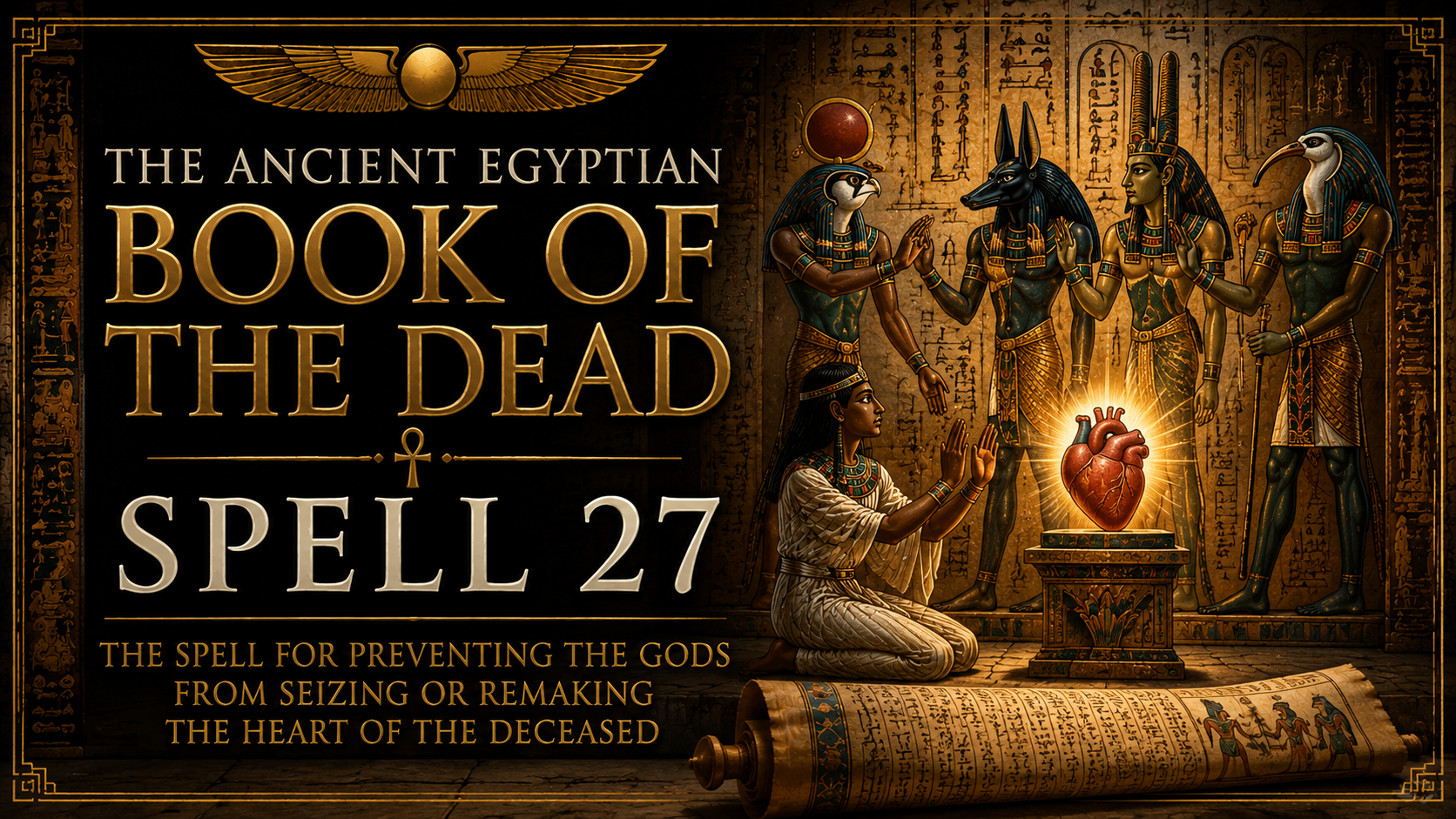
The ancient Egyptian Book of the Dead was a collection of funerary spells intended to restore the deceased after death, protect the different parts of the person, and ensure that the individual could continue living as an effective spirit in the afterlife.
Book of the Dead Spell 27 focuses on one of the most important parts of the ancient Egyptian person: the heart.
Its traditional title is:
Chapter whereby the Heart of a person is not taken from him in the Netherworld.
Spell 26, which immediately precedes it, asks that the heart be returned to the deceased. Spell 27 takes the next logical step: once the heart has been restored, it must not be taken away again. Renouf and Naville’s sequence continues this concern through several more heart spells, including Spells 28, 29, and 30.
In Spell 27, the deceased addresses mysterious gods who can seize hearts, remove what Renouf called the “Whole Heart,” and even reshape a person’s heart according to what that person has done. The deceased asks them not to tear the heart away or reform it according to accusations of wrongdoing. Instead, the speaker identifies the heart with the heart of a powerful god, whom Renouf’s notes identify as Thoth, and ends with a forceful declaration of ownership:
I am in possession of you. I am your master.
Spell 27 is therefore about protecting the deceased’s identity, thought, memory, moral self, and personal agency from supernatural interference.
In simple terms, the spell says:
My heart belongs to me. Do not seize it, do not change it because of accusations against me, and do not separate it from me. I possess my heart, and it must remain under my authority.
What Is Book of the Dead Spell 27?
Book of the Dead Spell 27 is a short funerary formula designed to prevent supernatural beings from taking the heart away from the deceased in the Netherworld. Renouf and Naville list the chapter as: Chapter whereby the Heart of a person is not taken from him in the Netherworld.
The spell addresses gods who have the frightening ability to:
- Seize hearts
- Remove the “Whole Heart”
- Reshape the heart
- Respond to what a person has done
- Act upon accusations made against the deceased
The speaker asks that none of these powers be used against them.
The heart must remain intact because it is fundamental to the deceased’s continued identity and ability to function after death.
English Translation of Book of the Dead Spell 27
The following is a reader-friendly modernization based closely on the translation of Peter Le Page Renouf and Édouard Naville.
Spell 27: Preventing the Heart From Being Taken
O gods who seize hearts,
who tear away the Whole Heart,whose hands reshape the heart of a person
according to what that person has done:let what I have done
be forgiven by you.Hail to you,
Lords of Everlasting Time and Eternity.Do not tear my heart from me
with your fingers.Do not reshape my heart
according to all the evil things
spoken against me.For this heart of mine
is the heart of the god of mighty names,the great god
whose words are within his members,who allows his heart within him
to move freely.His heart is keen in understanding
among the gods.Come to me, my heart.
I possess you.
I am your master,
and you are beside me.Do not fall away from me.
I am the one who commands,
and you shall obey me
in the Netherworld.
This modernization preserves the spell’s central structure while smoothing Renouf’s nineteenth-century English. The original translation specifically says that the gods can seize hearts, pluck out the Whole Heart, and reshape the heart according to a person’s deeds.
Historical Translation of Spell 27
Renouf and Naville translated the chapter: “O ye gods who seize upon Hearts, and who pluck out the Whole Heart; and whose hands fashion anew the Heart of a person according to what he hath done…”
The deceased later commands: “Let not my Heart be torn from me by your fingers.”
And the spell ends with the speaker declaring possession and mastery over the heart. That final change is crucial. The speaker begins by asking the gods not to interfere with the heart. By the end, the deceased asserts: The heart is mine, and I control it.
What Does Book of the Dead Spell 27 Mean?
Spell 27 protects the deceased from losing control of the heart after death. The heart had just been restored in Spell 26. Spell 27 prevents divine or supernatural beings from:
- Removing it
- Altering it
- Reshaping it according to wrongdoing
- Separating it from the deceased
- Using accusations against the deceased to transform it adversely
The spell’s meaning can be summarized as: My heart has been restored to me, and no god, accuser, or supernatural power may now take it away, change it, or separate it from me. My heart belongs to me and must remain with me forever.
This is not merely physical protection.
The heart represented the inner person, so protecting it also preserved the deceased’s identity and agency.
Why Was the Heart So Important?
The importance of the heart is clear from the number of Book of the Dead spells devoted to it.
Renouf and Naville list a sequence including:
- Spell 26: The heart is given back
- Spell 27: The heart must not be taken
- Spell 28: Another spell preventing the heart from being taken
- Spell 29: Another protection against removal
- Spell 29B: Another chapter of the heart
- Spell 30A: The heart must not be kept back
- Spell 30B: The famous heart-protection formula later associated with heart scarabs
The repeated concern shows that the heart was not considered a replaceable body part. It was central to survival after death.
Spell 26 and Spell 27
The relationship between these two spells is particularly clear.
Spell 26
Spell 26 says, in effect: Give me my heart.
It restores the heart and then restores many other faculties of the deceased.
Spell 27
Spell 27 says: Now do not take it away.
This makes the two chapters a natural pair. Spell 26 is about recovery. Spell 27 is about retention.
Who Are the Gods Who Seize Hearts?
Spell 27 begins by addressing gods who seize upon Hearts. The text does not individually name these gods in Renouf’s version. Their defining ability is what matters.
They can:
- Seize the heart
- Pluck out the Whole Heart
- Reshape the heart according to a person’s actions
These are not merely passive judges. They possess direct power over the deceased’s inner self.
Why Would Gods Take a Person’s Heart?
The spell connects the danger with what the person has done. Renouf translates the opening as saying that these gods can reshape a person’s heart: ing to what he hath done.
That suggests a connection between:
- Conduct during life
- Divine assessment
- The condition of the heart after death
The deceased is therefore not only worried about losing an organ. The speaker fears that divine powers may alter the heart in response to wrongdoing or accusations.
The Heart Could Be Reshaped
This is one of the most unusual aspects of Spell 27. The gods are described as having hands that can: fashion anew the Heart of a person.
The heart is therefore treated as something that can be:
- Removed
- Manipulated
- Reconfigured
- Made to reflect the moral condition of its owner
Spell 27 seeks to stop that process.
The speaker does not want hostile testimony or accusations to redefine who they are.
“Let That Be Forgiven”
Renouf’s notes are particularly important here.
He explains that the passage should be understood as asking that what the deceased has done be forgiven by the gods, rather than interpreted through an older reading of the grammar.
That gives Spell 27 a moral dimension.
The deceased is not simply saying: You have no authority over me. Instead, the speaker asks the gods to show clemency regarding past actions.
The request is: Do not let what I have done become the reason my heart is taken or reshaped.
Is Spell 27 a Forgiveness Spell?
Not primarily. Its title and central purpose concern keeping the heart. But forgiveness is part of how that protection is secured.
The structure is:
- The gods can act upon the heart according to a person’s deeds.
- The deceased asks that those deeds be forgiven.
- The gods are then told not to remove or reshape the heart.
- The deceased asserts ownership of the heart.
So Spell 27 combines:
- Heart protection
- Mercy
- Resistance to accusation
- Divine identification
- Personal authority
“Lords of Everlasting Time and Eternity”
The deceased greets the gods as: Lords of Everlasting Time and Eternity. The phrase gives these beings authority over dimensions far beyond ordinary human life. They belong to the eternal divine realm. That makes the request especially important. The speaker is not addressing temporary earthly officials.
These gods could determine what happens to the heart in the realm where the deceased hopes to live forever.
Why Are Time and Eternity Mentioned?
Egyptian funerary theology frequently deals with different kinds of eternal existence. The deceased wants the heart to remain intact not merely for one ritual moment but forever.
If the gods rule everlasting time, then protection granted before them can also become everlasting. The heart must survive the entire afterlife.
“Do Not Tear My Heart From Me”
This is the central request: Let not my Heart be torn from me by your fingers. The language is physical and direct. The heart is imagined as something the gods can literally grasp and remove. The deceased therefore commands them not to touch it.
Why “By Your Fingers”?
The reference to fingers makes the danger vivid. These gods do not merely issue a legal ruling. Their hands can physically manipulate the deceased’s internal being.
The image creates a stark contrast:
- Their fingers can seize.
- The deceased’s magical words stop them.
Spell 27 turns speech into protection against supernatural bodily interference.
“Do Not Reshape My Heart”
The deceased continues: Let not my Heart be fashioned anew according to all the evil things said against me.
This introduces another major concern: hostile speech. The danger is no longer only what the deceased has done. It is also what other beings say about the deceased.
Accusations in the Afterlife
The Book of the Dead repeatedly worries about hostile testimony.
Enemies may:
- Accuse the deceased
- Speak magical words against them
- Challenge their identity
- Oppose their admission
- Attempt to influence divine judgment
Spell 27 prevents those words from changing the heart itself.
In simple terms: Do not let accusations define me.
Why Could Words Affect the Heart?
Speech had magical and legal power in Egyptian religious thought.
Words could:
- Establish guilt
- Establish innocence
- Invoke gods
- Curse enemies
- Create conditions
- Alter supernatural reality
If evil statements against the deceased were accepted, those words could have consequences. Spell 27 neutralizes them before they can alter the speaker’s heart.
Spell 27 and Spell 23
There is a useful connection with Spell 23. Spell 23 ends by protecting the deceased against hostile words and accusations after the mouth has been opened.
Spell 27 addresses a related danger: Do not let evil things spoken against me reshape my heart. The earlier spell protects speech. Spell 27 protects the inner self from hostile speech.
“This Heart of Mine Is the Heart of the God of Mighty Names”
Spell 27 then changes strategy. Rather than merely asking for protection, the deceased identifies the heart with a divine heart: This Heart of mine is the Heart of the god of mighty names.
The speaker’s heart is no longer presented as merely human. It belongs to or participates in the identity of a powerful god.
Who Is the “God of Mighty Names”?
Renouf’s note explicitly identifies the god of mighty names as Thoth. He adds that later versions read: the great god who is in Hermopolis. Hermopolis was the principal cult center of Thoth. So in Renouf’s interpretation, the spell effectively says: My heart is the heart of Thoth. That gives the deceased access to the authority of one of Egypt’s greatest gods of knowledge, speech, writing, and judgment.
Why Thoth?
Thoth is an ideal divine identity for a heart-protection spell. He was associated with:
- Knowledge
- Writing
- Sacred speech
- Divine judgment
- Measurement
- Calculation
- Correct interpretation
Spell 27 is concerned with:
- Deeds
- Accusations
- Moral assessment
- The heart’s intelligence
The heart of Thoth is therefore a powerful model. The deceased claims a heart that understands correctly and cannot be manipulated by false accusations.
Thoth and Divine Judgment
Thoth also appears prominently in later judgment imagery. In the famous Weighing of the Heart scene associated with Spell 125, Thoth records or confirms the result of the weighing. UCL describes Spell 125 as the famous composition concerning the divine judgment of the dead.
Spell 27 does not depict that scene. But identifying the heart with Thoth gives the deceased an especially strong connection with the god of correct judgment.
“Whose Words Are in His Members”
The god is described as one whose words are in his members. This is a strange but powerful phrase. It suggests that divine speech is not separate from the god’s being. Words are embodied. They exist within the god.
Speech Inside the Divine Body
This fits beautifully with the preceding Mouth and Words of Power spells. The Book of the Dead has just restored:
- Mouth
- Magical speech
- Memory
- Heart
Now Spell 27 describes a god whose words exist within his body. The ideal deceased similarly needs speech, thought, and body to function together.
The Heart “Moves Freely”
Renouf translates the god as one who giveth free course to his Heart which is within him. The image contrasts directly with the danger of having the heart seized.
The divine heart is:
- Free
- Active
- Internal
- Under proper control
The deceased wants the same condition.
The heart must remain within the person and move according to the person’s own identity.
“Most Keen of Insight Is His Heart”
Renouf translates the next line as saying that the divine heart is: most keen of insight among the gods. His note also records an alternative reading with meanings such as:
- New
- Fresh
- Young
- Vigorous
This textual variation shows that the phrase was not perfectly fixed. But either reading is favorable.
The heart is either:
- Exceptionally perceptive
or:
- Renewed and vigorous
Both qualities are valuable to the deceased.
The Heart as Intelligence
The “keen insight” reading fits ancient Egyptian ideas about the heart particularly well. The heart was closely connected with:
- Thought
- Understanding
- Judgment
- Intention
Spell 27 therefore does not protect a passive organ. It protects the deceased’s intelligence and inner awareness.
“Come to Me, My Heart”
The spell then becomes intensely personal:
Ho to me! Heart of mine.
The deceased calls directly to the heart. This echoes Spell 26, where the heart is summoned back. Spell 27 reinforces that bond. The heart is not an independent possession of the gods. It belongs with the deceased.
“I Am in Possession of You”
The speaker declares: I am in possession of thee.
This is stronger than asking for protection. The deceased is asserting a legal and magical claim of ownership. The heart belongs to the speaker. No god may legitimately seize it.
“I Am Your Master”
The next declaration is even stronger: I am thy master. This may sound strange to modern readers. Why would a person need to be master of their own heart?
Because later spells reveal a frightening possibility: The heart might act independently during judgment.
Spell 30B famously tries to prevent the heart from opposing its owner. Spell 27 anticipates that danger by establishing the correct relationship now. The deceased rules the heart. The heart does not rule or betray the deceased.
“Do Not Fall Away From Me”
The deceased commands: fall not away from me. Again, the core fear is separation.
Death threatens to separate:
- Body and spirit
- Mouth and speech
- Name and memory
- Heart and person
Spell 27 keeps the heart attached to the self.
Separation as a Form of Death
The Book of the Dead repeatedly treats fragmentation as dangerous. A complete afterlife requires reunion.
The deceased wants:
- The heart inside the body
- The ba able to return
- The name remembered
- The mouth functional
- The limbs active
Spell 27 ensures that the inner center of the person does not drift away after it has been restored.
“You Shall Obey Me in the Netherworld”
The spell ends with authority: I am the dictator to whom thou shalt obey in the Netherworld. “Dictator” is Renouf’s archaic English choice. For a modern audience, a smoother translation would be: I am the one who commands, and you shall obey me in the Netherworld.
The deceased is establishing control over the heart. The spell begins with fear that gods may seize it. It ends with the deceased confidently ruling it.
The Structure of Spell 27
The chapter follows a very clear progression:
1. Recognize the danger
Gods can seize and reshape hearts.
2. Ask for mercy
Let past wrongdoing be forgiven.
3. Forbid interference
Do not remove or reshape my heart.
4. Give the heart divine identity
My heart is the heart of Thoth.
5. Reclaim possession
My heart belongs to me.
6. Establish authority
The heart shall obey me.
The spell moves from vulnerability to control.
Spell 27 and Divine Judgment
Spell 27 has obvious connections with judgment, but it is not the Weighing of the Heart spell.
It mentions:
- Actions
- Evil accusations
- Divine beings who assess the heart
But it does not describe:
- Anubis weighing the heart
- The feather of Ma’at
- Ammit
- The Hall of Two Truths
Those elements are primarily associated with Spell 125. Spell 27 belongs to an earlier stage of preparation. The deceased is protecting the heart before it can become vulnerable during judgment.
Spell 27 vs. Spell 30B
Many people searching for an ancient Egyptian “heart spell” are really thinking of Spell 30B.
Spell 27
Protects the heart from being:
- Taken
- Reshaped
- Separated from the deceased
Spell 30B
Prevents the heart from:
- Opposing the deceased
- Giving damaging evidence
- Causing the scales to turn against its owner
Spell 27 protects possession.
Spell 30B protects testimony.
Spell 27 vs. Spell 28
Spell 28 has almost the same title:
Chapter whereby the Heart of a person is not taken from him in the Netherworld.
But it is a different composition. Spell 28 invokes a lion god, Osiris, Heliopolis, Atum, and other divine powers in a much longer formula.
The existence of multiple spells with essentially the same purpose demonstrates how seriously the Egyptians treated the danger. One protection was apparently not enough.
Spell 27 vs. Spell 29
Spell 29 again prevents the heart from being taken. Renouf’s Spell 29 begins by confronting a divine messenger who has apparently come to carry off the deceased’s Whole Heart by force.
The progression is useful:
- Spell 27 addresses heart-seizing gods generally.
- Spell 28 offers another broader defense.
- Spell 29 directly challenges a messenger who comes to take the heart.
Together they create multiple layers of protection.
Why So Many Redundant Spells?
The Book of the Dead was not designed as a streamlined modern instruction manual. Different funerary compositions developed:
- At different times
- In different places
- Within different traditions
- For similar dangers
A person commissioning a Book of the Dead could include more than one spell addressing the same threat.
Repetition added security. If one formula protected the heart, several formulas could protect it even more thoroughly.
The Heart and Personal Responsibility
Spell 27 contains an interesting tension. The speaker asks that wrongdoing be forgiven, but does not deny that deeds matter.
The gods reshape hearts:
according to what a person has done.
This means the heart is not merely a magical object.
It is tied to conduct.
Spell 27 therefore combines:
- Magic
- Moral responsibility
- Divine mercy
- Personal identity
Is This Like the Weighing of the Heart?
It is related conceptually but not identical. Both involve the heart as a reflection of the person. But Spell 27 focuses on preservation. Spell 125 focuses on judgment.
A useful way to explain it is: Spell 27 makes sure the deceased still possesses the heart that will later matter so greatly in divine judgment.
The Heart as Evidence
The wording about reshaping the heart according to deeds and evil things said against the deceased suggests the heart could function almost like a record of the person’s life.
This anticipates the later fear that the heart could provide evidence during judgment. Spell 30A explicitly asks that there be no adverse evidence and that the scales not move against the deceased.
Spell 27 is part of the same larger concern.
The Heart Must Not Become the Enemy
Perhaps the most frightening possibility in the heart spells is that something belonging to the deceased could turn against them.
The heart knows:
- What the person did
- What the person intended
- What the person remembers
That makes it uniquely dangerous if it becomes independent. Spell 27 solves the problem by establishing: I am your master. The heart must remain loyal.
The Heart and the Name
Spell 25 protected the deceased’s name. Spell 27 protects the heart. Together they preserve two major forms of identity:
The Name
Who the person is publicly.
The Heart
Who the person is internally.
Losing either could threaten continued existence.
The Heart and Words of Power
Spell 24 restored magical speech. Spell 27 identifies the protected heart with a god: whose words are in his members.
This shows that the restored faculties are interconnected.
The deceased requires:
- Heart
- Speech
- Magical knowledge
- Memory
- Identity
The Book of the Dead does not treat these as isolated components. Together they form the effective person.
Who Was Thoth?
Renouf identifies the god of mighty names in Spell 27 as Thoth, later described as the great god of Hermopolis. Thoth was strongly associated with:
- Writing
- Wisdom
- Measurement
- Sacred speech
- Divine judgment
His identification with the heart gives the deceased intellectual and judicial power. It effectively makes the protected heart a divine heart of knowledge.
What Is Hermopolis?
Renouf notes that later versions identify the divine heart as belonging to the great god who is in Hermopolis. Hermopolis was the major cult center of Thoth. This reinforces the identification.
Is Spell 27 the Heart Scarab Spell?
No. This is one of the most important distinctions to make for readers. The famous spell associated with heart scarabs is generally Spell 30B, not Spell 27.
Spell 27 protects the heart from being removed or altered.
Spell 30B is designed to prevent the heart from standing against the deceased during judgment. Renouf’s sequence separates these compositions clearly.
Did Egyptians Literally Fear Their Heart Would Be Removed?
Within the religious world of the funerary texts, the danger is treated as real. The spell directly addresses gods who can seize and manipulate hearts. Whether readers interpret the imagery literally, symbolically, or ritually, the intended magical function is clear: The deceased must retain the heart. The text was designed to make that outcome effective.
Why Is Spell 27 So Short?
Spell 27 solves a narrowly defined problem. The deceased already has the heart. Now the person needs to keep it.
The spell therefore concentrates on:
- The threat
- The prohibition
- Divine identification
- Ownership
- Authority
Its brevity does not make it unimportant.
The heart is so essential that a few lines of concentrated magical language are sufficient to state the desired condition.
The Transformation From Fear to Authority
One of the most compelling things about Spell 27 is its emotional progression. At first, the deceased faces terrifying beings who can tear out and reshape hearts.
By the end, the speaker says:
I possess you.
I am your master.
The victim becomes the authority. That progression is common throughout the Book of the Dead. The deceased begins vulnerable and ends empowered.
The Meaning of Spell 27 in Simple Terms
Book of the Dead Spell 27 prevents the deceased’s heart from being taken away or altered in the afterlife.
The speaker addresses gods who can seize hearts and reshape them according to a person’s deeds. The deceased asks for forgiveness, commands the gods not to remove the heart, and refuses to allow hostile accusations to change it.
The heart is then identified with the heart of a great god whom Renouf identifies as Thoth.
Finally, the deceased calls the heart back and declares total possession of it:
I am your master.
The spell’s meaning can be summarized as:
My heart belongs to me. Whatever I have done, and whatever enemies may say against me, no god may tear it away or change it. My heart is protected by divine knowledge, it remains with me, and it obeys me in the afterlife.
Spell 27 ensures that the inner self restored in Spell 26 cannot be lost again.
Frequently Asked Questions About Book of the Dead Spell 27
What is Book of the Dead Spell 27?
Spell 27 is a funerary formula preventing the deceased’s heart from being taken away in the Netherworld.
What is the traditional title of Spell 27?
Renouf and Naville call it: Chapter whereby the Heart of a person is not taken from him in the Netherworld.
What does Spell 27 say?
The deceased addresses gods who seize and reshape hearts, asks for forgiveness, forbids them from removing or altering the heart, identifies it with the heart of a powerful god, and finally declares ownership and mastery over it.
Why could the heart be taken?
The spell says divine beings could reshape a heart according to what the person had done. The deceased therefore asks that past actions be forgiven and that the heart remain intact.
Who are the gods who seize hearts?
The short text does not individually name them. They are identified by their ability to seize, remove, and reshape hearts.
Who is the “god of mighty names”?
Renouf’s note identifies this deity as Thoth and says later texts call him the great god in Hermopolis.
Why is Thoth connected with the heart?
Thoth was associated with divine knowledge, speech, writing, and judgment, making his heart an ideal divine model for insight and correct understanding. Renouf specifically identifies the deity in Spell 27 with Thoth.
What does “Whole Heart” mean?
Renouf uses “Whole Heart” to translate a second Egyptian heart term distinct from the one he simply renders “Heart.” The exact distinction is complicated and should not be reduced to one certain anatomical interpretation.
How is Spell 27 different from Spell 26?
Spell 26 restores the heart. Spell 27 prevents it from being taken away afterward.
How is Spell 27 different from Spell 28?
Both have essentially the same title, but Spell 28 is a different and longer composition invoking additional divine figures and locations.
Is Spell 27 the heart scarab spell?
No. The famous heart scarab formula is associated with Spell 30B. Spell 27 focuses specifically on preventing the heart from being seized or altered
Is Spell 27 the Weighing of the Heart?
No. The famous Weighing of the Heart belongs especially to Spell 125, where the deceased appears before Osiris and the divine judgment scene.
Why does Spell 27 mention accusations?
The deceased asks that the heart not be reshaped according to evil things spoken against them, showing that hostile testimony could threaten the person’s afterlife status.
Book of the Dead Spell 27 begins with a terrifying possibility. The deceased has regained the heart, but divine beings may still seize it, tear it away, or reshape it according to deeds and accusations. The spell refuses that outcome. The deceased asks for forgiveness for wrongdoing. The gods are forbidden from touching the heart. Hostile words are denied the power to alter it. The heart is identified with the heart of a powerful divine being, which Renouf interprets as Thoth.
Then the deceased stops asking and begins commanding:
I am in possession of you.
I am your master.
The transformation is complete. Spell 26 restored the heart. Spell 27 makes sure it stays. For the ancient Egyptian deceased, eternal life depended not merely on having a body, but on maintaining possession of the inner center of thought, memory, intention, and identity. The heart belonged to the deceased. And Spell 27 was designed to ensure that no power in the Netherworld could take it away.