The ancient Egyptian Book of the Dead was a collection of funerary compositions intended to help the deceased regain the faculties, knowledge, and supernatural abilities required for life after death.
Book of the Dead Spell 24 focuses on something even more important than simply being able to speak: possessing the Words of Power needed to make that speech effective.
Its traditional title is:
Chapter whereby the Words of Power are brought to a person in the Netherworld.
UCL Digital Egypt summarizes the spell similarly as:
Formula for fetching the words of power of a man for him in the underworld.
Spell 24 follows directly after the restoration of the deceased’s mouth in Spells 21 through 23. The sequence is deliberate. First, the deceased receives a mouth. Then it is opened. Now the deceased must recover the powerful sacred speech that makes that mouth useful.
In Spell 24, the speaker identifies with Khepri, gathers their Words of Power from every place where they have been scattered, and claims them with greater speed and persistence than hunting animals or light itself. The text then connects this magical power with the solar boat of Ra and with a mysterious creative force capable of bringing gods into existence from silence.
In simple terms, Spell 24 declares: My mouth is open, and now my magical power returns to me. I gather my sacred words from everywhere they may be, and no force can keep them from me.
What Is Book of the Dead Spell 24?
Book of the Dead Spell 24 is a funerary formula for recovering the deceased’s Words of Power in the afterlife. Peter Le Page Renouf and Édouard Naville titled it:
Chapter whereby the Words of Power are brought to a Person in the Netherworld.
The spell is short, but it contains several powerful ideas:
- Identification with Khepri
- Self-creation
- Speed and determination
- Recovery of magical speech
- The solar boat of Ra
- Passage toward a fiery region
- Creation emerging from silence
- Divine warmth and vitality
The central concern is that the deceased’s magical abilities must not remain lost, scattered, or inaccessible after death.
What Are the “Words of Power”?
Renouf translated the Egyptian concept here as Words of Power. The phrase refers to magically effective speech rather than ordinary conversation. Such words could enable the deceased to:
- Open gates
- Repel hostile beings
- Identify gods
- State divine identities
- Defeat supernatural enemies
- Protect body parts
- Transform into sacred forms
- Command passage through the afterlife
- Establish a desired condition as reality
Spell 24 therefore restores one of the deceased’s most valuable resources. Having a mouth was not enough. The deceased also needed the right words.
English Translation of Book of the Dead Spell 24
The following reader-friendly translation is based closely on the version published by Renouf and Naville. Some expressions are difficult because, as the editors themselves noted, even the early versions were already obscure and variable.
Spell 24: Bringing Back the Words of Power
I am Khepri,
the self-created one,
upon the thigh of his mother.Speed like that of hunting hounds
belongs to those who are in heaven,and the fierce energy of hunting beasts
belongs to those within the divine council.Behold, I bring back
my Word of Power.I gather my Word of Power
from every place where it may be,more persistently than hunting hounds
and more swiftly than light.O you who guide the boat of Ra,
may your rigging remain sound
and free from disasteras you pass onward
toward the Lake of Flame.Behold, I gather
my Word of Powerfrom every place where it may be,
for everyone to whom it belongs,
more persistently than hunting hounds
and more swiftly than light.It is the power
that brings the gods into being
from silence,or reduces them again
to inactivity.It is the power
that gives warmth to the gods.Behold, I gather
my Word of Powerfrom every place where it may be,
more persistently than hunting hounds
and more swiftly than light.
This modernization preserves the repeated structure of the ancient composition while smoothing some of Renouf’s older English.
Historical Translation of Spell 24
Renouf and Naville translated the opening: “I am Chepera, the self-produced, on his Mother’s thigh.”
They then describe the deceased gathering the Word of Power from every region where it exists, “more persistently than hounds of chase and more swiftly than the Light.” The older form Chepera corresponds to Khepri, the scarab-associated deity of becoming and the morning sun.
The historical translation also uses unusual animal imagery involving bloodhounds and hyenas. Renouf’s notes caution that these animals should not necessarily be interpreted literally. He argues that their names represent qualities such as speed, tenacity, courage, and energetic force.
What Does Book of the Dead Spell 24 Mean?
Spell 24 restores the deceased’s ability to use effective magical speech. The mouth has already been restored and opened by the preceding spells. Now the person must recover the magical force contained in sacred words.
The spell’s meaning can be summarized as: My sacred speech belongs to me. Wherever it has gone, I will recover it. I possess the speed, persistence, and divine authority required to reclaim every magical word I need in the afterlife.
The spell is therefore about recovering power through language.
Why Does Spell 24 Follow Spell 23?
The sequence from Spell 21 through Spell 25 is one of the clearest functional sequences in this part of the Book of the Dead. UCL’s modern numerical list gives them in this order: the mouth is restored, the mouth is opened, the Words of Power are fetched, and memory is then restored.
The progression is:
Spell 21
The deceased receives the mouth.
Spell 22
The mouth is restored again through another formula.
Spell 23
Ptah opens the mouth, and Thoth removes its restraints.
Spell 24
The deceased recovers the Words of Power.
Spell 25
The deceased recovers memory.
The logic is simple:
First restore the organ. Then activate it. Then restore the sacred knowledge required to use it.
Spell 23 and Spell 24 Work Together
Spell 23 already hints at what comes next. In Spell 23, Thoth arrives: “full and equipped with Words of Power.”
Immediately afterward, Spell 24 concerns retrieving those Words of Power for the deceased. Spell 23 restores the means of speech. Spell 24 restores its magical effectiveness. That makes these two articles especially strong candidates for internal linking.
Why Does the Deceased Say “I Am Khepri”?
Spell 24 begins: I am Khepri. Khepri was associated with:
- Becoming
- Emergence
- Creation
- The rising sun
- Renewal
- Self-generation
Identifying with Khepri gives the deceased the power of continual renewal. The logic is especially appropriate for a spell about recovering lost magical abilities. Khepri represents the power to come into being again. The deceased’s Words of Power can likewise be brought back into effective existence.
Khepri as the Self-Created One
Renouf’s translation describes Khepri as: “the self-produced.”
This means the god possesses existence through his own divine power rather than depending upon an external creator. The deceased claims this same quality. The speaker is not helplessly waiting for another being to return their magical abilities.
The deceased actively gathers those powers personally.
What Does “On His Mother’s Thigh” Mean?
The opening phrase is difficult.
Renouf noted that “thigh” was the usual translation and connected it with images of the sky goddess Nut, where a divine scarab can appear near or upon her body. He also observed that the Egyptian term may have alternative meanings connected with running water or a canal.
Because the wording was already obscure in early manuscript traditions, it is best not to force one interpretation.
A cautious explanation is: The phrase places the self-created Khepri within a cosmic or maternal setting associated with emergence and rebirth, but its precise meaning remains uncertain.
Why Are Hunting Hounds Mentioned?
The spell says the deceased gathers the Word of Power: more persistently than hounds of chase.
Renouf explains that the animal imagery is primarily about characteristics rather than zoology. The hunting animal represents speed, pursuit, and determination.
The image is easy to understand. A hunting dog does not casually search for its quarry. It:
- Tracks
- Pursues
- Does not give up
- Moves quickly
- Seeks a specific target
The deceased retrieves magical words with the same determination.
What About the Hyenas?
Older translations refer to the “mettle of hyenas.” Renouf notes that the animal names differ significantly between manuscripts and that the intended meaning may be the energetic or fierce qualities associated with animals of the chase rather than literal hyenas.
He interprets the quality positively as:
- High spirit
- Courage
- Energy
- Forcefulness
The deceased requires not only speed but boldness. Recovering the Words of Power is presented almost like a supernatural hunt.
Later Versions Replaced the Animals
Renouf also notes that later versions of the spell substituted the Bennu bird for the animals of the chase. This matters because it shows how Book of the Dead spells changed over time.
Different scribes and traditions could update or reinterpret difficult imagery. The essential idea remained: The deceased possesses extraordinary speed and supernatural vitality.
But the symbolic animal used to express that idea could change.
“I Bring My Word of Power”
The central declaration is:
I bring this my Word of Power.
The possessive pronoun matters.
Just as earlier spells restore:
- My mouth
- My heart
- My name
Spell 24 restores:
- My Word of Power
The deceased is reclaiming something personally belonging to them.
Death may have scattered or separated the person’s abilities, but those powers remain recoverable.
Why Would the Words of Power Need to Be “Gathered”?
Spell 24 repeatedly says the Words of Power must be collected: from every quarter in which it is. This suggests magical power could be imagined as dispersed or separated after death.
The deceased therefore searches everywhere for it. The four quarters may evoke cosmic completeness:
- North
- South
- East
- West
Whether or not the phrase refers literally to four directions, the meaning is comprehensive. No part of the deceased’s magical power is to remain lost.
Death as the Separation of the Person
This fits a wider pattern in Egyptian funerary religion. Death threatened to separate:
- Mouth
- Heart
- Ba
- Ka
- Name
- Memory
- Shadow
- Body
- Magical powers
The Book of the Dead repeatedly reunites these elements. Spell 24 does for magical speech what Spell 21 does for the mouth. It restores something that death has disrupted.
“More Swiftly Than Light”
The spell says the Words of Power are recovered: more swiftly than light. This is intentionally extravagant language.
The deceased’s magical recovery is:
- Immediate
- Irresistible
- Supernatural
- Faster than ordinary movement
Light is especially meaningful within an Egyptian funerary context because the deceased repeatedly seeks association with the sun. The speaker’s magical speech moves with solar speed.
Spell 24 and the Solar Boat of Ra
The spell suddenly addresses the one who guides the Bark of Ra. Ra’s boat was one of the central symbols of Egyptian solar theology.
The sun god traveled:
- Across the sky during the day
- Into the western realm at sunset
- Through the hidden world during the night
- Back toward rebirth at dawn
The deceased hoped to join this journey. By invoking the solar boat, Spell 24 connects recovered magical speech with safe cosmic travel.
“May Your Rigging Be Sound”
The spell wishes that the solar boat’s rigging remain sound and free from disaster. This is practical language applied to a divine vessel. A damaged boat could not complete its journey. Likewise, the deceased requires all personal faculties to remain intact.
The solar boat and the deceased mirror one another:
- The boat needs sound rigging.
- The deceased needs sound magical powers.
- Both must survive dangerous passage.
- Both must reach the next stage of the journey.
What Is the Tank or Lake of Flame?
Renouf translates the destination as the Tank of Flame. Fiery lakes and regions appear repeatedly in Egyptian descriptions of the afterlife.
Fire could be:
- Destructive to enemies
- Protective for gods
- Purifying
- Solar
- Dangerous to the unprepared
- Harmless or even beneficial to the justified
Spell 24 does not explain this fiery region in detail. Its main function is to place the solar boat within a potentially dangerous supernatural landscape.
Spell 24 and Spell 22 Both Mention Fire
In Spell 22, the deceased enters or emerges from a fiery region and declares the ability to extinguish its flame. In Spell 24, Ra’s boat approaches the Tank of Flame. Both spells emphasize that supernatural fire cannot prevent the deceased’s progress. The connection is especially strong because both compositions are concerned with restoring powers needed to function after death.
The Most Mysterious Line in Spell 24
The most striking statement is that the recovered Word of Power is associated with a force that can:
bring the gods into being from Silence
or:
reduce them to inactivity.
Renouf considered this an important theological statement and specifically comments on the concept of Silence as an origin of divine powers.
The exact wording is obscure, but the underlying idea is extraordinary.
Speech and silence are being treated as cosmic forces.
Words Can Create Gods
One possible reading of the passage is that magical utterance has a creative power so fundamental that it can participate in the creation or activation of divine beings. This fits broader Egyptian ideas about sacred speech.
Words could:
- Name
- Define
- Activate
- Create
- Command
- Transform
Spell 24 therefore does not restore ordinary vocabulary. It restores something approaching creative divine speech.
Silence as the Opposite of Magical Speech
The spell’s reference to gods emerging from silence creates a powerful contrast.
Before speech:
Silence.
After speech:
Divine activity.
This makes the restoration of the deceased’s Words of Power even more significant.
Death had imposed silence.
Spell 24 transforms silence back into active sacred language.
“Or Reduce Them to Inactivity”
The same power apparently can also reduce divine beings to inactivity.
This reveals the double nature of magical speech.
It can:
- Activate
- Restrain
- Create
- Neutralize
- Empower
- Immobilize
The deceased therefore needs access to this power both to assist allies and control threats.
The Words of Power “Give Warmth to the Gods”
The spell also associates the recovered power with giving warmth to the gods. Warmth is closely connected with life. A corpse becomes cold. A living being is warm.
Within a solar context, warmth also evokes:
- Sunlight
- Ra
- Vitality
- Renewal
The Words of Power therefore participate not only in speech but in the restoration of life itself.
Speech as Life
Spell 24 presents magical speech as almost a life force. It can:
- Create
- Activate
- Give warmth
- Move faster than light
- Protect the solar journey
This helps explain why losing Words of Power would be such a serious danger. Without them, the deceased might possess a mouth but still lack the supernatural vitality needed to function.
Why Are There Later Spells Protecting the Words of Power?
UCL’s list shows that Spell 31 is specifically intended to repel beings that try to take away the deceased’s Words of Power, while Spell 32 protects them from crocodiles that attempt the same thing.
That tells us how valuable these words were. The Book of the Dead follows a logical pattern:
- Spell 24: Recover the Words of Power.
- Spell 31: Prevent enemies from stealing them.
- Spell 32: Repel crocodiles trying to take them.
The magical language is valuable enough that supernatural enemies want it.
Spell 31 Explicitly Depends on Spell 24
Renouf’s Spell 31 says: “Back, Crocodile Sui! Come not against me, who live by the Words of Power.” The phrase live by the Words of Power is especially revealing. Magical speech is not simply a useful tool. The deceased lives through it. Spell 24 supplies that source of life.
Spell 24 and Heka
The Egyptian concept often translated as heka refers broadly to magical power. Spell 24 does not merely hand the deceased a list of incantations. It restores access to the power that makes sacred utterance effective.
That power depended on:
- Correct words
- Knowledge
- Divine identification
- Authority
- Ritual context
The deceased needs all of these to function successfully.
Was Magic Considered Evil?
No. Within the Book of the Dead, magical power is essential to survival.
The British Museum describes the Book of the Dead itself as a collection of magical spells designed to help the deceased negotiate the hazardous journey through the afterlife. Spell 24 therefore does not represent forbidden or malicious magic. It restores a legitimate sacred ability needed by the justified dead.
Magic and Religion Were Not Separate Categories
Modern readers may instinctively separate:
- Religion
- Prayer
- Magic
Ancient Egyptian funerary practice does not fit neatly into those categories.
The same text may:
- Praise a god
- Identify with a god
- Command an enemy
- Describe a myth
- Perform a magical effect
Spell 24 combines theology and practical magic without treating them as contradictory.
How Old Is Spell 24?
Renouf and Naville considered Spell 24 demonstrably ancient because versions were preserved on the coffins of Horhotep and Queen Mentuhotep. They also warn that even these early copies were difficult to understand and contained significant textual variation.
This means the composition existed before the standardized Book of the Dead tradition familiar from later papyri. It belongs to the long developmental continuum of Egyptian funerary literature.
Why Is the Text So Difficult?
Renouf openly states that the chapter “must have been extremely difficult to understand” even in early periods. Possible reasons include:
- Archaic language
- Corrupted copying
- Obscure animal names
- Symbolic expressions
- Local theological traditions
- Scribal attempts to reinterpret older material
This means modern explanations should be careful not to present every phrase as perfectly understood. The broad purpose is clear. Some individual images are not.
Was Spell 24 in the Papyrus of Ani?
Renouf and Naville’s plate index specifically lists a Chapter XXIV vignette from the Papyrus of Ani. That means Spell 24 was represented in one of the best-known surviving Books of the Dead. The Papyrus of Ani dates to the Nineteenth Dynasty and contains a rich combination of written spells and colored vignettes.
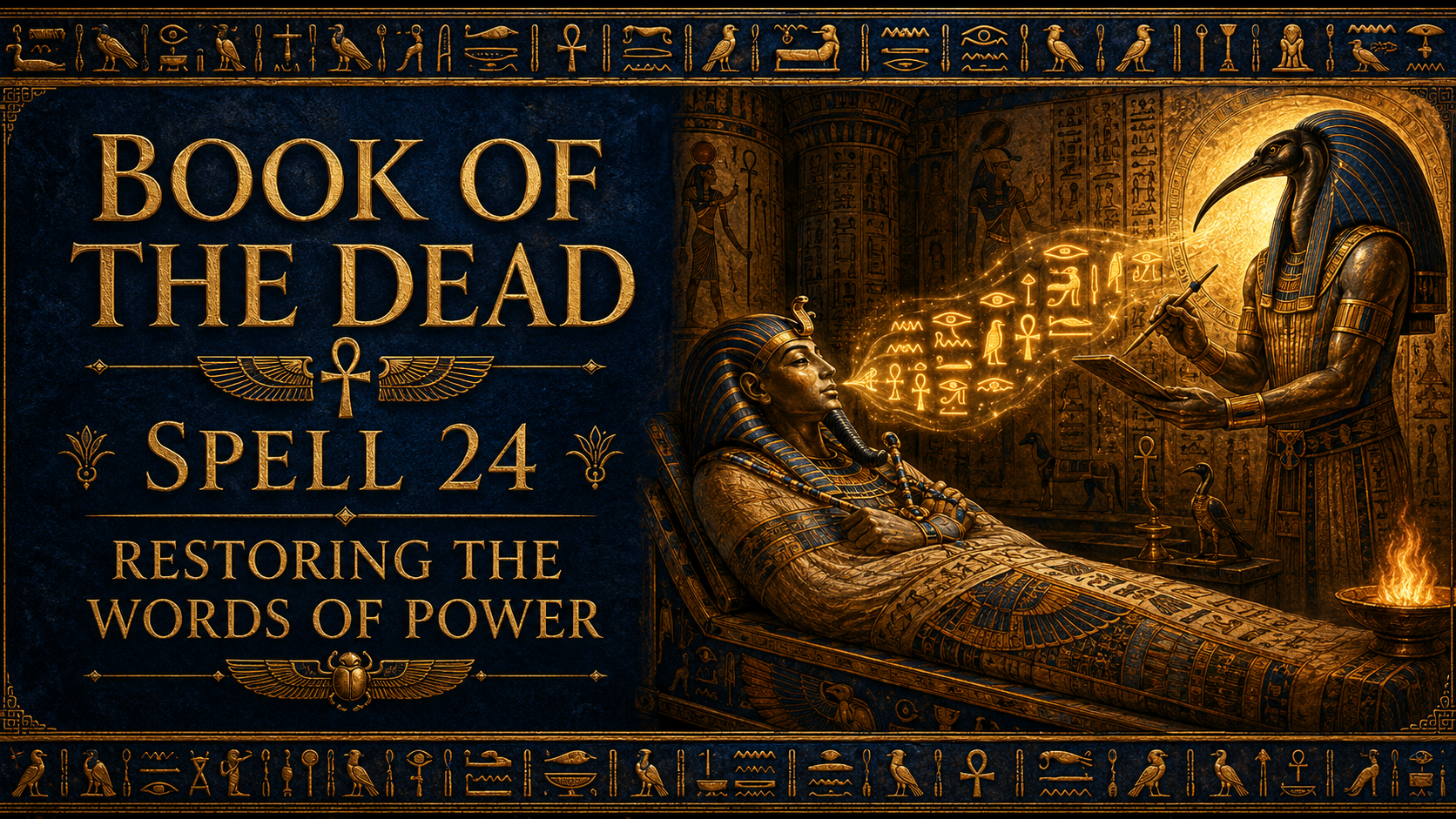
Why Is Khepri a Good Visual Symbol for Spell 24?
Khepri immediately identifies the spell’s opening declaration. A scarab or scarab-headed divine figure would communicate:
- Renewal
- Becoming
- Self-creation
- Solar emergence
Combined with hieroglyphic words moving toward the deceased, it would visualize the spell’s central idea exceptionally well: The magical speech of the deceased is being recreated and gathered back together.
Spell 24 and Spell 25
Spell 25 follows immediately and restores the deceased’s name or memory, depending on the translation tradition. UCL summarizes it as giving memory to the deceased, while Renouf titles it as a chapter for remembering one’s name in the Netherworld.
The relationship is important. Words of Power require memory. The deceased must remember:
- Their own identity
- Divine names
- Magical formulas
- Sacred locations
- Correct responses
Spell 24 restores the words. Spell 25 ensures they can be remembered.
Spell 24 and Spell 26
Spell 26 then restores the heart. This continues the reconstruction of the deceased:
- Mouth
- Speech
- Magical words
- Memory
- Heart
The person is being rebuilt not only physically but intellectually and spiritually.
Spell 24 Is Part of the “Regeneration” Section
UCL notes that modern scholars have sometimes divided the more regular Late Period sequence of the Book of the Dead into thematic sections, with Spells 17 through 63 broadly grouped under regeneration. Spell 24 fits that label especially well. It regenerates one of the person’s defining abilities: effective sacred speech.
Does Spell 24 Give the Deceased Magical Powers?
More precisely, it restores or retrieves powers that already belong to the deceased. The repeated language is possessive:
my Word of Power.
The person is not receiving an arbitrary new magical gift. Something that rightfully belongs to the deceased has become separated and must be recovered.
This parallels the restoration of:
- My mouth
- My name
- My heart
The afterlife spells repeatedly reassemble the person.
Is the “Word of Power” Singular or Plural?
Renouf frequently translates the expression in the singular as Word of Power, while modern summaries often use the plural words of power. For a general audience, Words of Power is probably the clearest phrase because the deceased ultimately needs an entire repertoire of magical utterances. However, when quoting Renouf, preserve his singular wording.
The Meaning of Spell 24 in Simple Terms
Book of the Dead Spell 24 restores the magical language of the deceased. The person identifies with Khepri, the self-created god of renewal, then gathers the Word of Power from every place where it has gone.
The deceased pursues it with the speed and determination of hunting animals and with a swiftness greater than light. The spell connects this recovered speech with the journey of Ra and with a mysterious creative power capable of bringing gods out of silence, restraining them, and giving them warmth.
The meaning can be summarized as:
My sacred power has not been lost in death. I gather every magical word that belongs to me, wherever it may be. With those words I can act, protect myself, join the gods, and continue my journey through the afterlife.
Spell 24 gives the deceased more than a voice. It gives that voice power.
Frequently Asked Questions About Book of the Dead Spell 24
What is Book of the Dead Spell 24?
Spell 24 is a funerary formula for recovering the deceased’s Words of Power in the underworld.
What is the traditional title of Spell 24?
Renouf and Naville title it: Chapter whereby the Words of Power are brought to a Person in the Netherworld.
What are Words of Power?
They are magically effective sacred utterances that allow the deceased to act, protect themselves, identify divine beings, and influence conditions in the afterlife.
Who is Khepri in Spell 24?
The deceased identifies with Khepri, the self-created deity associated with becoming, renewal, and the rising sun.
Why are hunting dogs mentioned?
They symbolize speed, pursuit, persistence, and determination. Renouf notes that the animal imagery should be understood mainly through the qualities associated with the animals.
Why are hyenas mentioned?
Older versions use animal names associated with fierce energy or high spirit. Renouf cautions that the names vary between manuscripts and are symbolic rather than straightforward zoological references.
Why does the spell mention Ra’s boat?
The solar boat connects the deceased’s recovered magical power with safe travel through the cosmic journey of Ra.
What is the Tank of Flame?
It is a fiery supernatural region mentioned as part of the solar boat’s journey. The spell does not explain it in detail.
What does “the gods come into being from silence” mean?
The line is obscure, but it presents sacred power as capable of activating or creating divine beings from a state of silence. Renouf specifically regarded it as a notable theological statement.
Why does the spell say the power gives warmth to the gods?
Warmth is associated with vitality and life. The statement reinforces the idea that sacred speech carries a life-giving divine force.
How is Spell 24 connected to Spell 23?
Spell 23 opens the deceased’s mouth. Spell 24 then retrieves the Words of Power the deceased needs to use that mouth effectively.
What happens after Spell 24?
Spell 25 concerns restoring memory or remembering the deceased’s name, while Spell 26 restores the heart.
Are there later spells protecting the Words of Power?
Yes. Spell 31 protects the deceased from beings attempting to carry away the Words of Power, and Spell 32 protects them from crocodiles seeking to do the same.
How old is Spell 24?
Renouf and Naville cite versions on the coffins of Horhotep and Queen Mentuhotep as evidence of its antiquity. They also warn that early copies were already difficult to interpret.
Was Spell 24 in the Papyrus of Ani?
Yes. Renouf and Naville’s plate index lists a Chapter 24 vignette from the Papyrus of Ani.
Did Spell 24 have an illustration?
Yes. At least some manuscript traditions included a vignette associated with the chapter.
Book of the Dead Spell 24 completes the restoration of speech begun in the preceding spells. Spell 21 gives the deceased a mouth. Spell 23 opens it. But an open mouth is not enough. The deceased also needs the sacred words that can open gates, defeat enemies, invoke gods, and transform supernatural reality. Spell 24 gathers those Words of Power back from every place where they may have been scattered.
The deceased claims the hunting hound’s persistence, the wild beast’s energy, the speed of light, and Khepri’s self-renewing power. The recovered speech is so powerful that the spell associates it with creation itself, with gods emerging from silence and receiving warmth and activity. Death may silence the body. Spell 24 ensures that the silence does not last. The deceased recovers the words. And with the words comes power.