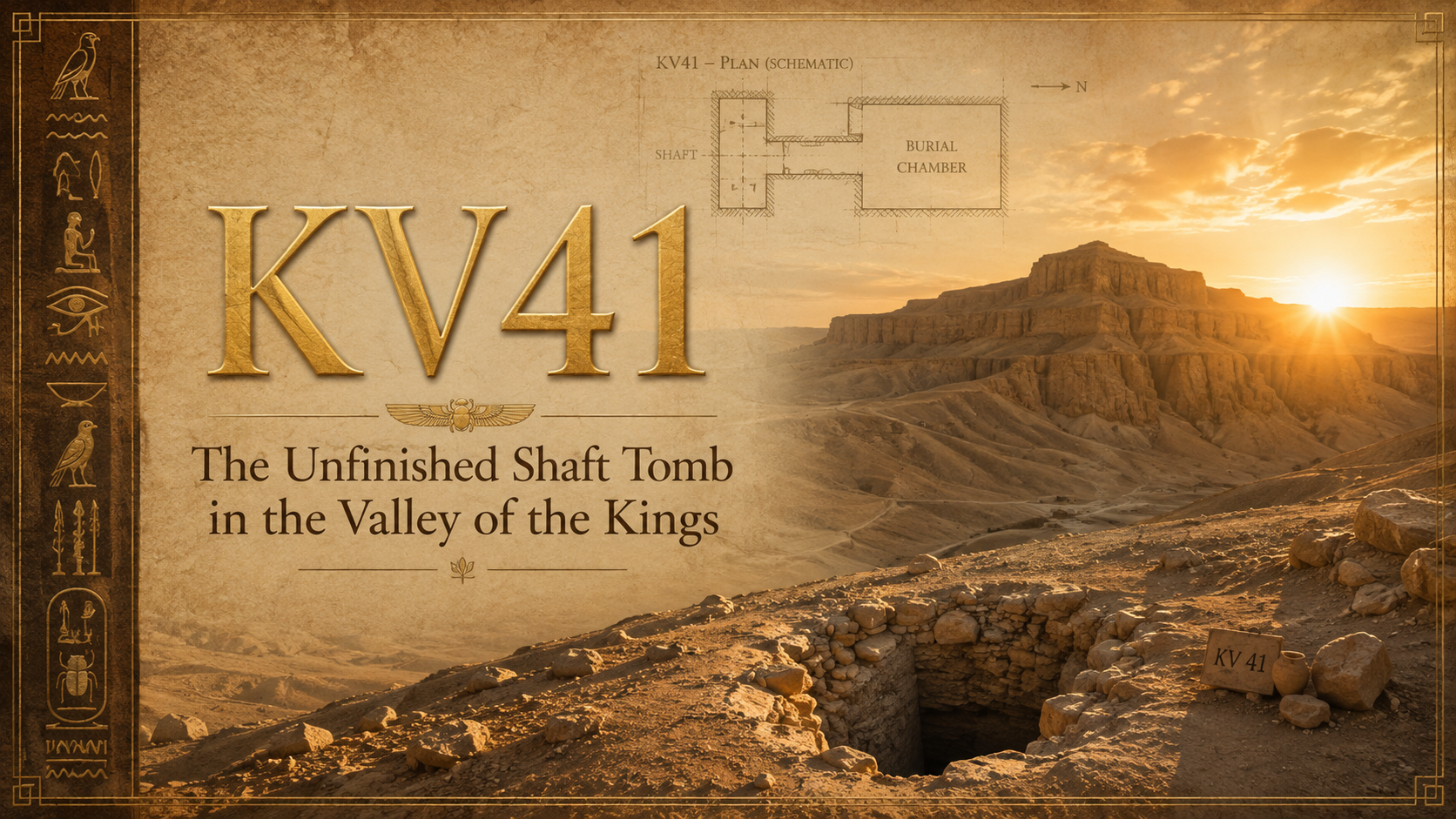
KV41 is one of the most unusual numbered monuments in the Valley of the Kings because it may never have been a tomb at all.
Unlike the sprawling royal monuments of the New Kingdom, KV41 consists only of a single deep vertical shaft cut into the limestone. No burial chamber was ever excavated at its base. No side rooms were created. No wall decoration survives, and no coffin, mummy, pottery assemblage, funerary equipment, or inscription has been found to identify an intended owner.
Victor Loret discovered the shaft in 1899, making KV41 the last of the Valley tombs associated with his extraordinary period of exploration. A more systematic investigation carried out in 1991 by the Institut français d’archéologie orientale and Cairo University confirmed that the monument had been abandoned before completion. The shaft reaches approximately 11.24 meters into the bedrock but simply ends without opening into a chamber.
Despite the almost complete absence of archaeological evidence, KV41 has long been associated with Queen Tetisheri, the powerful matriarch of the royal family that helped establish Egypt’s Eighteenth Dynasty. Egyptologist Elizabeth Thomas suggested that the monument might have been intended for her. If true, KV41 could represent one of the earliest attempts to create a royal burial in the landscape surrounding what later became the Valley of the Kings.
However, no inscription or artifact currently proves that Tetisheri had any connection with KV41. The identification should therefore be treated as an intriguing hypothesis rather than an established fact.
- Structure: KV41
- Location: Valley of the Kings region, behind Deir el-Bahari, Thebes West Bank, Luxor
- Owner: Unknown
- Possible Owner: Queen Tetisheri
- Possible Date: Late Seventeenth Dynasty or early Eighteenth Dynasty
- Site Type: Unfinished shaft, possibly intended as a tomb
- Decoration: None
- Interior Layout: Single deep shaft
- Public Access: Closed
Where Is KV41?
KV41 does not actually lie on the floor of the familiar main Valley of the Kings.
Instead, it is located high in the hills behind Deir el-Bahari in an area sometimes called the Valley of the Pits or Valley of the Well. Its remote position places it outside the core cluster of royal tombs that most visitors associate with the Valley of the Kings.
This unusual location is important.
The burial landscape of western Thebes was still developing during the late Seventeenth and early Eighteenth Dynasties. Before the royal cemetery became concentrated within the main Valley of the Kings, members of the royal family were buried in several different cliffside and desert locations around Dra’ Abu el-Naga, Deir el-Bahari, and the surrounding wadis.
KV41 may belong to that transitional period. Its location therefore helps explain why some Egyptologists have considered it potentially older than many of the better-known tombs inside the main valley.
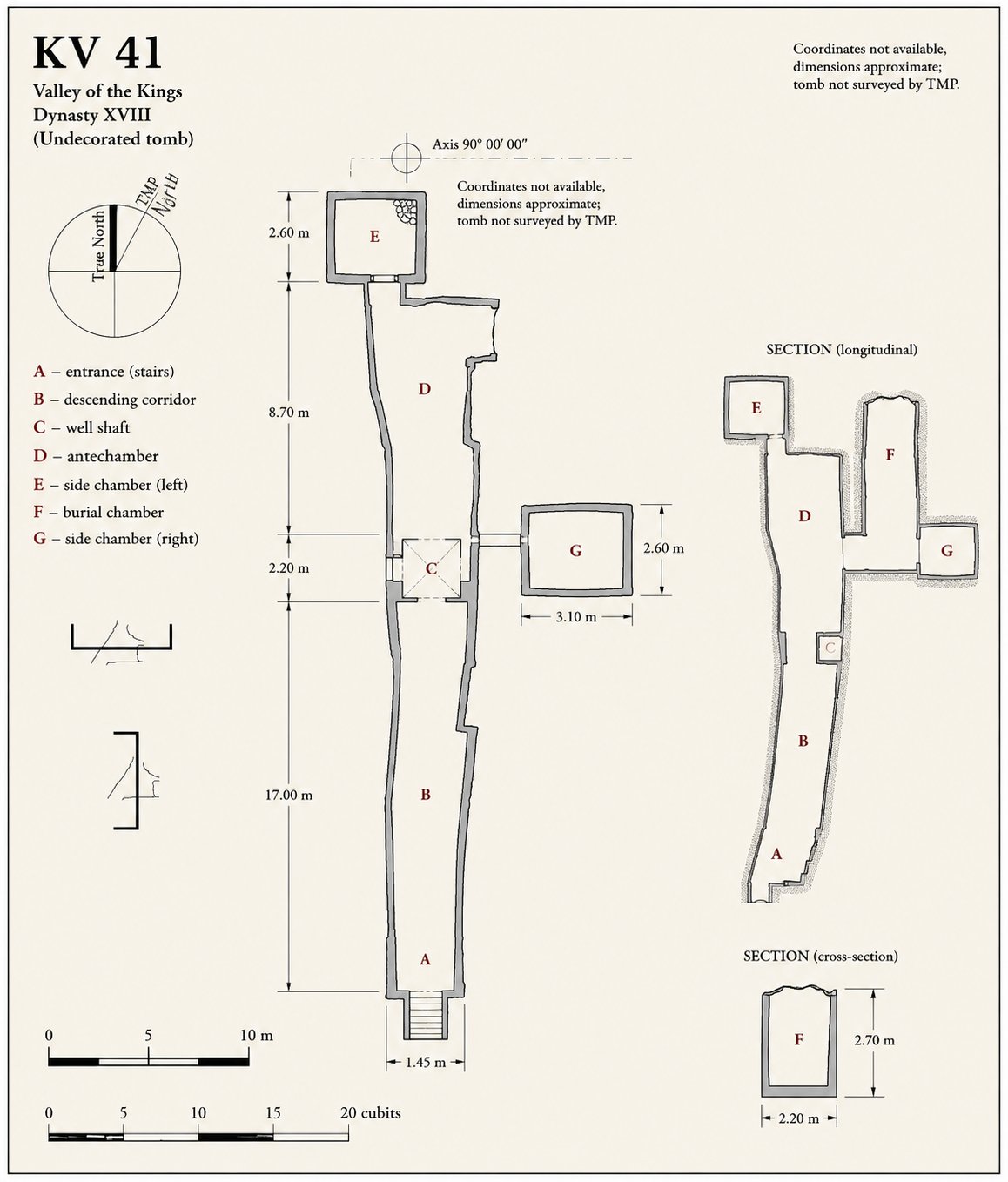
Description
KV41 has perhaps the simplest plan of any numbered monument in the Valley of the Kings system. It consists entirely of a vertical shaft. The shaft is approximately:
- 11.24 meters deep
- 1.82 meters wide
- 1.62 meters long
Its estimated internal volume is approximately 33.13 cubic meters. The shaft is somewhat irregular rather than perfectly rectangular, reflecting the rough, unfinished nature of the excavation.
At the bottom, there is no doorway. There is no burial chamber. There are no side rooms. The ancient quarrymen simply stopped cutting.
Is KV41 Really a Tomb?
This question is more important than it might seem.
Because KV41 was assigned a number in the Valley of the Kings sequence, it is usually called a tomb. Yet archaeologist Donald P. Ryan argued that it should more accurately be described as a deep shaft rather than a completed tomb.
That distinction is useful.
A normal Eighteenth Dynasty shaft tomb would usually contain:
- A vertical entrance shaft
- A doorway at the bottom
- One or more underground chambers
- Space for a coffin and funerary equipment
KV41 contains only the first of those elements.
The absence of an underground room means that the construction process stopped before the monument could actually serve as a burial place.
An Abandoned Construction Project
The simplest explanation for KV41 is that ancient workers began cutting a tomb but abandoned the project. Why they stopped is unknown. Possible explanations include:
- The intended owner received another tomb.
- The person for whom it was being prepared died before the monument could be completed.
- Builders encountered unsuitable or unstable rock.
- Political circumstances changed.
- The royal burial program moved to another location.
- The shaft may have been an exploratory excavation rather than a full tomb project.
No surviving evidence allows archaeologists to choose confidently among these possibilities.
The fact that the shaft descends more than eleven meters does show that a considerable amount of labor had already been invested before work ceased.
Who Was KV41 Intended For?
No ancient name has ever been found in KV41.
There are no:
- Cartouches
- Foundation deposits bearing a royal name
- Coffin fragments
- Shabtis
- Canopic jars
- Pottery dockets
- Mummy labels
- Wall inscriptions
- Human remains
Its intended owner is therefore completely unknown.
Nevertheless, one historical figure has become strongly associated with KV41 in Egyptological literature: Queen Tetisheri.
The Tetisheri Theory
Elizabeth Thomas proposed that KV41 might have been intended for Queen Tetisheri. The suggestion was based largely on the monument’s location and its possible early date rather than on inscribed archaeological evidence.
If Thomas was correct, KV41 would date to approximately the end of the Seventeenth Dynasty or the very beginning of the Eighteenth Dynasty. That would make it extraordinarily early.
It could even represent one of the earliest royal-family burial projects in the broader landscape that eventually developed into the Valley of the Kings.
However, the theory remains unproven.
There is currently no object from KV41 bearing Tetisheri’s name.
Who Was Queen Tetisheri?
Tetisheri was one of the most important women in the royal family at the end of Egypt’s Seventeenth Dynasty.
She was probably the wife of King Senakhtenre Ahmose and became the matriarch of the family that ultimately expelled the Hyksos and established the New Kingdom.
Her children and descendants included members of the Theban royal line that produced:
- Seqenenre Tao
- Queen Ahhotep
- Ahmose I
- Amenhotep I
- Ahmose-Nefertari
Tetisheri therefore stood near the beginning of the dynasty that transformed Egypt into a New Kingdom empire.
Her importance continued after her death. Pharaoh Ahmose I, her grandson, honored her memory and established monuments and estates connected with her funerary cult.
Tetisheri’s Non-Royal Origins
One of the most interesting aspects of Tetisheri’s life is that she apparently came from a non-royal family.
Her parents are named as Tjenna and Neferu, and neither carries a royal title.
Despite this background, Tetisheri became a Great Royal Wife and eventually one of the most revered women of the early New Kingdom royal family.
Her rise demonstrates that royal marriage could sometimes elevate women outside the immediate royal line into positions of extraordinary political and dynastic importance.
Why Would Tetisheri Have Been Buried Here?
If KV41 was intended for Tetisheri, its remote location would fit broader patterns in royal burial before the main Valley of the Kings became established.
The rulers of the late Seventeenth Dynasty were associated primarily with Dra’ Abu el-Naga, while early Eighteenth Dynasty royal women were buried in several locations around the cliffs of western Thebes.
During this transitional era, the royal necropolis had not yet become standardized.
A secluded shaft high behind Deir el-Bahari could therefore have been a plausible burial location for an important queen.
However, because KV41 was never finished and contains no burial material, this remains only an architectural possibility.
Could KV41 Be Older Than the Valley of the Kings?
If KV41 truly dates to Tetisheri’s lifetime, it could predate the establishment of the Valley of the Kings as the principal royal cemetery. This would make its numbering slightly misleading.
“KV41” places the monument within the modern Valley of the Kings cataloging system, but the ancient builders would not necessarily have regarded it as belonging to the same cemetery as the later tombs of Thutmose III, Amenhotep II, Seti I, or Ramesses II.
It may instead represent an experimental or transitional burial project created as royal funerary traditions shifted away from the cemeteries of the Seventeenth Dynasty.
This is one reason KV41 remains archaeologically interesting despite containing almost nothing.
The Earliest Royal Burials
The transition from the Seventeenth to Eighteenth Dynasty changed Egyptian royal burial architecture dramatically. The kings who fought the Hyksos were associated with tombs in the northern Theban necropolis around Dra’ Abu el-Naga.
During the early Eighteenth Dynasty, royal burial increasingly moved toward secluded cliff tombs. By the reign of Thutmose I, royal tomb building had become closely associated with what we now call the Valley of the Kings.
KV41 may belong somewhere within this transition. Its possible early date makes it valuable for understanding how Egyptian architects experimented with burial locations before the Valley developed its familiar form.
Why the Tetisheri Identification Is Uncertain
It is important not to present KV41 as “the tomb of Tetisheri.” Several major problems prevent that identification.
First, no inscription names her. Second, no funerary objects were found. Third, no burial chamber was ever completed. Fourth, there is no mummy or human remains.
Finally, KV41 cannot currently be dated precisely enough from its architecture alone to connect it securely with Tetisheri’s lifetime.
The most accurate description is therefore: KV41 is an unfinished shaft of uncertain date and ownership that has been suggested as a possible tomb project for Queen Tetisheri.
Was Tetisheri Ever Buried There?
There’s no evidence that Tetisheri was buried in KV41. In fact, everything known about the monument indicates that no one was buried there at all. The shaft was unfinished and lacked a burial chamber. Modern investigations recovered no human remains or funerary objects.
If the shaft was originally intended for Tetisheri, the burial plan must have been abandoned before her funeral. Her actual tomb remains unknown.
What Happened to Tetisheri’s Mummy?
Tetisheri’s mummy has traditionally been associated with the great royal cache at Deir el-Bahari, DB320, although identifying individual anonymous royal mummies from the cache can be complicated.
DB320 eventually contained kings, queens, and royal family members whose original burials had been threatened by robbery. These bodies were gathered centuries after the burials themselves.
Even if Tetisheri’s remains ultimately entered the royal cache, that does not reveal where her original tomb was located.
The Valley of the Pits
The area surrounding KV41 has been called the Valley of the Pits because it contains isolated shafts and excavations rather than the densely packed monumental tombs found in the main Valley of the Kings.
The French archaeological team referred to the area as the Vallée du Puits, or “Valley of the Well/Shaft,” in its publication of KV41. This landscape is archaeologically valuable because it preserves evidence of burial experiments outside the better-known royal valley.
KV41 is the most famous numbered monument in this area.
No Decoration
KV41 contains absolutely no wall decoration. There are no traces of:
- Paint
- Plaster
- Hieroglyphic texts
- Divine figures
- Funerary books
- Borders or friezes
- Graffiti
The lack of decoration is unsurprising because the monument never reached the stage at which decorators would have begun preparing a burial chamber.
The workers were still engaged in the basic excavation of the shaft when construction stopped.
No Graffiti
Even ancient graffiti is absent. This is noteworthy because many abandoned or accessible Valley tombs later accumulated inscriptions from:
- Workmen
- Tomb robbers
- Priests
- Ancient visitors
- Greek and Roman tourists
- Coptic occupants
KV41 appears not to have attracted this later activity. Its remote location and shaft-only form may have made it largely useless once abandoned.
No Archaeological Objects
The 1991 investigation found no significant historical objects inside KV41. There were no remnants of burial equipment and no evidence of later reuse. For an archaeological site, this absence is itself important evidence.
It strongly supports the conclusion that construction stopped before a burial was installed. Unlike KV40, where a seemingly anonymous tomb revealed dozens of mummies and thousands of fragments, KV41 appears genuinely empty.
Discovery by Victor Loret
Victor Loret discovered KV41 in 1899 while conducting extensive exploration of the Valley of the Kings for the Egyptian Antiquities Service.
Loret’s work during the late 1890s was extraordinarily productive.
He discovered or investigated tombs including:
KV41 was reportedly the last numbered tomb he discovered during this period. Compared with the discovery of the royal mummy cache in KV35 or the burial of Maiherpri in KV36, the empty shaft attracted little attention.
Georges Bénédite
French Egyptologist Georges Bénédite visited or recorded KV41 in 1900, shortly after its discovery. Bénédite worked extensively in Egyptian museums and archaeological documentation. His visit provides evidence that scholars were aware of the shaft soon after Loret’s exploration, even though no major excavation followed immediately.
Georg Steindorff
German Egyptologist Georg Steindorff visited KV41 in 1902. Again, the monument received little detailed study because there appeared to be no chamber or burial assemblage to investigate. For most of the twentieth century, KV41 remained one of the least-known numbered sites associated with the Valley of the Kings.
The 1991 Excavation
The most important modern investigation of KV41 occurred in 1991. The Institut français d’archéologie orientale worked in cooperation with the Department of Archaeology at Cairo University to explore the area called the Vallée du Puits and re-examine KV41.
The work was directed toward establishing exactly what the monument contained. The conclusion was remarkably simple: KV41 was unfinished.
The ancient workers had excavated a shaft approximately 11.24 meters deep but never created the underground burial rooms necessary for a tomb.
The Gabolde, Amer, and Ballet Study
Luc Gabolde, Hassan Ibrahim Amer, and Pascale Ballet published the investigation in the Bulletin de l’Institut français d’archéologie orientale.
Their article was appropriately titled: “Une exploration de la Vallée du Puits. La tombe inachevée no 41.” In English, this is roughly: “An Exploration of the Valley of the Shaft: The Unfinished Tomb No. 41.”
The wording emphasizes the central archaeological conclusion: KV41 was never completed.
Why Would Workers Dig Eleven Meters and Stop?
This is perhaps the most interesting unanswered question about KV41. Excavating an eleven-meter shaft through limestone required significant labor.
Workmen needed to:
- Mark the intended location
- Quarry the shaft
- Remove stone chips
- Move workers and tools vertically
- Maintain access as the excavation deepened
- Coordinate with officials overseeing the project
The project had therefore advanced well beyond a casual test pit. Something changed after substantial work had already been completed. Unfortunately, without inscriptions or contemporary records, we cannot know what caused the abandonment.
Geological Problems?
One possibility is that the quarrymen encountered unsuitable stone. Ancient Egyptian tomb builders frequently changed plans when they encountered:
- Fractures
- Faults
- Weak limestone
- Unstable shale
- Water-damaged layers
In several Valley tombs, corridors turn unexpectedly or chambers become irregular because builders adapted to geological obstacles.
No evidence currently proves that geological problems caused KV41 to be abandoned, but it remains one plausible explanation.
A Change of Burial Location?
Another possibility is that the intended owner’s burial plans changed. Royal burial projects could be abandoned if:
- The owner received another tomb
- Political circumstances changed
- A king or queen’s status changed
- A more prestigious burial location became available
- The burial took place before construction could be completed
KV41 may therefore represent a plan that became unnecessary before the chamber was excavated.
An Exploratory Shaft?
Donald Ryan’s description of KV41 as simply a deep shaft raises another possibility. Perhaps the excavation was never intended to become a completed tomb. Ancient engineers may have been investigating the bedrock or testing whether the location was suitable for a burial complex.
If the stone proved unfavorable, work could have been abandoned. However, because the shaft resembles the entrance stage of other tombs, most discussions continue to treat it as an unfinished funerary project rather than purely geological exploration.
Comparison With KV36
KV36 provides a useful comparison. Maiherpri’s KV36 consists of a vertical shaft that opens into a single burial chamber. Had the builders of KV41 continued only a little farther and excavated a doorway and room at the bottom, its basic layout might have resembled KV36.
This comparison shows exactly what KV41 lacks. KV36 is a complete shaft tomb. KV41 is essentially the entrance to such a tomb without the tomb itself.
Comparison With Other Unfinished Tombs
The Valley of the Kings contains numerous incomplete monuments. Some, such as KV4 or WV25, progressed far enough to contain corridors and chambers before construction stopped.
Others are little more than pits or shafts.
Egypt’s Ministry of Tourism and Antiquities notes that the Valley contains more than sixty recognized tombs as well as around twenty unfinished excavations that are little more than pits.
KV41 belongs near the extreme end of that spectrum.
It received a KV number because of its location and discovery history, not because it contains a finished burial suite.
Was KV41 Ever Reused?
No evidence shows that KV41 received a later burial. This distinguishes it from many minor tombs in the Valley.
For example:
- KV31 was reused in the Third Intermediate Period.
- KV40 received numerous Twenty-second Dynasty burials.
- KV44 was reused for later burials.
- KV45 was reused during the Third Intermediate Period.
KV41 appears to have remained empty after its abandonment.
No later coffin fragments, mummies, inscriptions, or pottery assemblages indicate secondary burial use.
Why Didn’t Later Egyptians Use It?
An eleven-meter shaft without a chamber was not particularly useful as a burial place. Anyone wishing to reuse it would first have had to excavate new rooms at the bottom. Other abandoned tombs already contained ready-made chambers and were therefore much more attractive for later burials. This practical difference may explain why KV41 escaped the repeated cycles of reuse that affected many other minor tombs.
No Tomb Robbery
KV41 also appears to have escaped tomb robbery for a very simple reason. There was nothing to steal. Without a burial chamber or funerary equipment, the shaft offered no gold, coffins, jewelry, amulets, vessels, or mummies.
Its archaeological emptiness therefore may represent the rare case of a Valley monument whose contents were not removed by thieves because they were never placed there in the first place.
Dating KV41
Dating KV41 is difficult because it contains no diagnostic artifacts. The proposed late Seventeenth or early Eighteenth Dynasty date depends mainly on:
- Its remote location
- Its possible association with Tetisheri
- Comparisons with early royal burial landscapes
- The broader development of funerary architecture around Deir el-Bahari
The Tetisheri theory would place it near the transition between the Seventeenth and Eighteenth Dynasties. Other summaries classify it more generally as Eighteenth Dynasty.
Without archaeological finds, the safest description is: KV41 probably belongs to the late Seventeenth or early Eighteenth Dynasty, but its exact date remains unknown.
Could KV41 Change the History of the Valley?
If the Tetisheri theory were ever confirmed, the implications would be significant. Tetisheri lived before the Valley of the Kings became the established burial place of New Kingdom pharaohs.
A tomb project for her in this landscape would demonstrate that royal burial activity had already begun spreading into the surrounding hills before the reign traditionally associated with the formal creation of the royal necropolis.
KV41 could therefore push the origins of royal burial in the Valley region back into the final years of the Seventeenth Dynasty.
At present, however, the evidence is not strong enough to make that claim confidently.
Noteworthy Features
KV41 is notable for several reasons:
- It is one of the simplest numbered monuments associated with the Valley of the Kings.
- It consists entirely of a deep shaft.
- The shaft is approximately 11.24 meters deep.
- No burial chamber was excavated.
- No side chambers were created.
- The monument is completely undecorated.
- No graffiti have been recorded.
- No mummy or human remains were found.
- No funerary equipment has been recovered.
- The tomb was never used for burial.
- Victor Loret discovered it in 1899.
- It was the last numbered tomb discovered by Loret.
- Elizabeth Thomas proposed Queen Tetisheri as a possible intended owner.
- No evidence confirms the Tetisheri attribution.
- If that theory were correct, KV41 could date to the late Seventeenth Dynasty.
- The Institut français d’archéologie orientale and Cairo University re-examined the monument in 1991.
- Their investigation confirmed that the shaft had been abandoned unfinished.
- Donald P. Ryan has questioned whether KV41 should even be called a tomb.
Measurements
Maximum Depth / Height: 11.24 m
Minimum Width: 1.82 m
Maximum Width: 1.82 m
Total Horizontal Length: Approximately 1.62 m
Total Area: Approximately 2.96 m²
Total Volume: Approximately 33.13 m³
These unusual measurements reflect KV41’s vertical design. The monument has almost no horizontal development because no underground chamber was ever begun.
Additional Tomb Information
Owner Type: Unknown
Possible Owner: Queen Tetisheri
Entrance Type: Vertical shaft
Interior Layout: Shaft only
Decoration: None
Human Remains: None
Funerary Equipment: None
Evidence of Burial: None
Completion Status: Abandoned unfinished
Public Access: Closed
Dating
KV41 may belong to:
- Late Seventeenth Dynasty: If the proposed association with Tetisheri is correct
- Early Eighteenth Dynasty: Alternative broad archaeological dating
- 1899: Discovery by Victor Loret
- 1900: Visit or recording by Georges Bénédite
- 1902: Visit by Georg Steindorff
- 1991: Systematic archaeological investigation
- 1992: Publication of the modern excavation results
The absence of artifacts means that the ancient date remains uncertain.
History of Exploration
- Victor Loret, 1899: Discovery for the Egyptian Antiquities Service
- Georges Bénédite, 1900: Visit and recording
- Georg Steindorff, 1902: Visit
- Institut français d’archéologie orientale and Cairo University, 1991: Systematic excavation and examination
- Luc Gabolde, Hassan Ibrahim Amer, and Pascale Ballet, 1992: Publication of the archaeological investigation in BIFAO
Conservation Concerns
KV41 contains no painted decoration or fragile funerary equipment, so its conservation requirements are very different from those of richly decorated royal tombs.
The primary concerns are:
- Stability of the shaft walls
- Falling rock
- Accumulation of debris
- Safe access
- Erosion
- Protection of the surrounding archaeological landscape
An eleven-meter open shaft can also present an obvious physical hazard, making secure access especially important.
Site Condition
KV41 remains an unfinished archaeological feature rather than a completed tomb.
The shaft itself survives, but no additional underground architecture exists.
Because there is little for visitors to see and because entering such a deep shaft presents safety problems, KV41 is not open to tourists.
Why KV41 Matters
KV41 is important precisely because almost nothing happened there. Most tombs tell us about a burial. KV41 tells us about a burial plan that failed.
Its unfinished shaft preserves a moment in the construction process before chambers were excavated, coffins installed, walls decorated, or funerary rituals performed.
That makes KV41 archaeological evidence for decision-making rather than death.
Someone important enough to justify more than eleven meters of rock excavation may once have been intended for this location. Workers began the project, invested substantial effort, and then suddenly stopped.
Whether that person was Queen Tetisheri remains unknown.
If she was the intended owner, KV41 could represent one of the earliest experiments in royal burial around the Valley of the Kings. If she was not, the monument still demonstrates that the hills behind Deir el-Bahari were being considered for elite funerary projects during a formative period in the development of Egypt’s New Kingdom necropolis.
KV41 may be empty, but the unanswered question at the bottom of its shaft makes it one of the Valley’s most intriguing unfinished monuments.
Interesting Facts About KV41
- KV41 may not technically be a tomb at all.
- It consists only of a vertical shaft.
- The shaft is more than 11 meters deep.
- No burial chamber exists.
- No side chamber was ever begun.
- No wall decoration survives.
- No graffiti were discovered.
- No burial equipment was found.
- No human remains were recovered.
- The site appears never to have been used for burial.
- Victor Loret discovered it in 1899.
- It was the last tomb number associated with Loret’s discoveries.
- Queen Tetisheri has been proposed as the intended owner.
- There is no archaeological evidence proving the Tetisheri theory.
- If it did belong to Tetisheri, KV41 could date to the late Seventeenth Dynasty.
- This would make it one of the earliest royal burial projects in the Valley region.
- A French-Egyptian team systematically investigated the shaft in 1991.
- The excavation confirmed that ancient builders simply stopped work before creating a burial chamber.
Meta Description
Explore KV41, the mysterious 11-meter unfinished shaft near the Valley of the Kings that may have been intended for Queen Tetisheri.