Among the surviving stories of ancient Egypt, few are as mysterious as The Tale of the Herdsman. Only a tiny portion of the original narrative remains, preserved on a single Middle Kingdom papyrus. The beginning is missing, the ending is missing, and even some of the surviving words have been interpreted differently by modern scholars. What remains is just enough to introduce a frightened herdsman, a herd of cattle moving through the flooded landscape, magical spells against dangers in the water, and a strange female being encountered in the marshes.
The herdsman believes that the woman he has seen is no ordinary human. Her appearance terrifies him so completely that his hair stands on end, and he later tells his companions that he will not do what she has asked of him. The surviving fragment never clearly explains what she wanted, who she truly was, or what happened when the herdsman prepared to encounter her again.
Was she a beautiful goddess appearing naked among the reeds? Was she a terrifying supernatural creature covered in animal-like hair? Was she a dangerous form of Hathor or Sekhmet who needed to be pacified before she would protect the cattle? Egyptologists have proposed all of these possibilities. The original audience presumably knew the answer, but the papyrus has left us with one of the most tantalizing unfinished encounters in Egyptian literature.
The Herdsmen of the Nile
The story takes place in the wet landscape created by the Nile inundation. Each year, the river overflowed its banks and spread across the surrounding fields. For farmers, the flood brought fertility, but for those responsible for cattle it could also create difficulties. Familiar routes disappeared beneath the water, low pastures became marshes, and animals had to be guided through areas where dangerous creatures might be hiding.
Egyptian tomb scenes frequently show herdsmen driving cattle through shallow water. Men walk or travel in small boats beside the animals, while crocodiles lurk beneath the surface. The cattle must be kept together, calves protected, and the herd brought safely to dry ground before nightfall. Magical protection could be as important as practical skill, and the surviving story actually includes what appears to be an incantation intended to protect the herd as it crosses the flooded landscape.
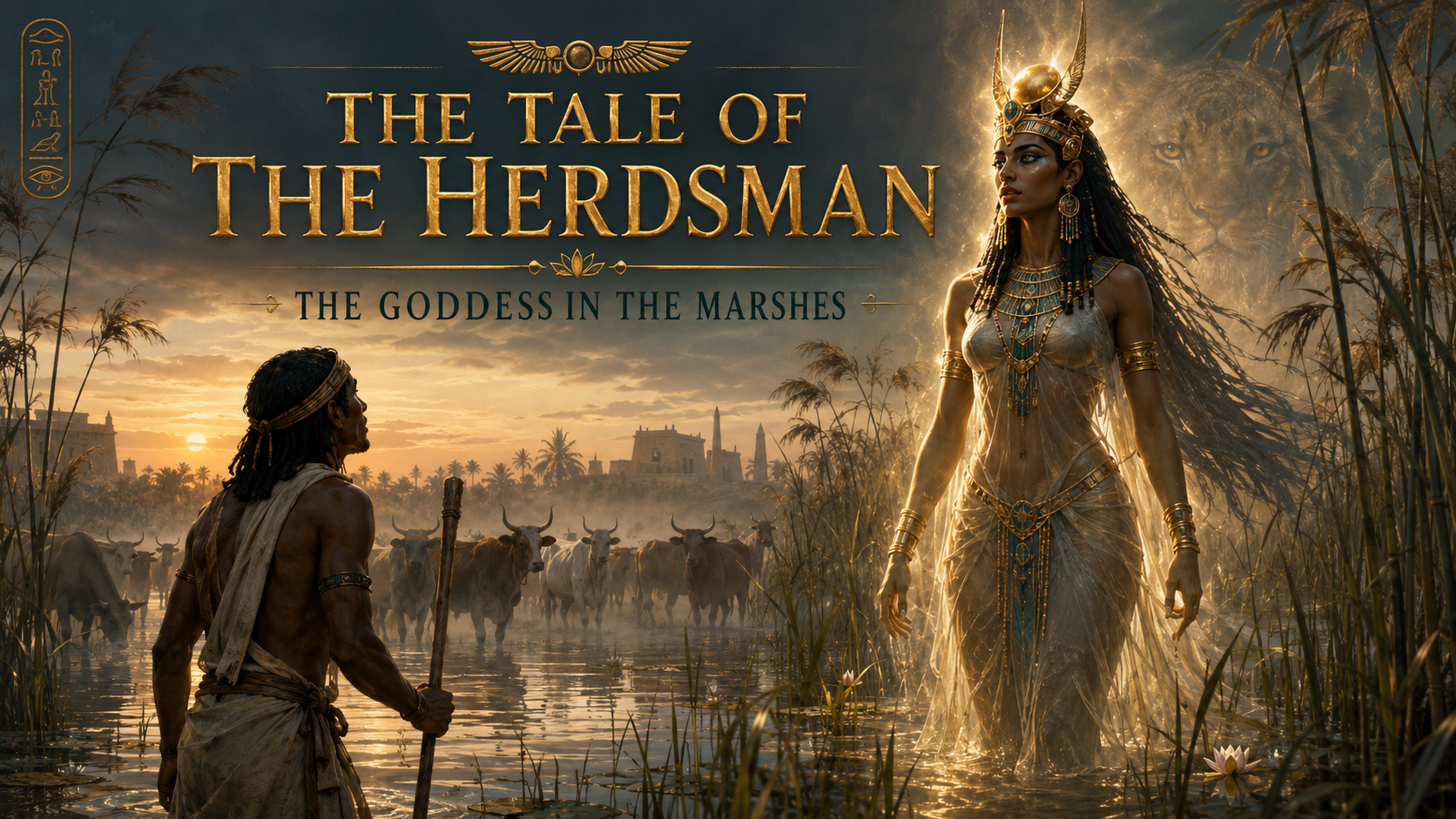
One of these herdsmen had gone down into a marsh beside a low-lying pasture when something unexpected happened. There, among the reeds and floodwater, he saw a woman.
The sight filled him with terror.
The Woman in the Marsh
The surviving text has been translated in sharply different ways because several of its words are difficult to read. Earlier interpretations imagined the herdsman seeing a beautiful woman, perhaps naked and displaying smooth skin and ornaments. Another scholarly reading produces an almost opposite image. According to that interpretation, the herdsman sees a female being whose appearance is unlike that of ordinary humans and whose body seems to possess coarse, animal-like hair.
Whatever she looked like, the herdsman was frightened rather than delighted.
His hair stood on end. Dread filled his entire body, and the encounter left him desperate to escape. The female spoke to him, but the surviving fragment does not preserve her demand clearly enough for us to know what she wanted.
Later, when recounting what happened, the herdsman declares that he will never do what she told him to do.
That single statement makes the mystery even greater. She had asked something of him. He had refused. And now he feared what might happen next.
The Herdsman Warns His Companions
The frightened man returned to the other herdsmen and told them what he had seen. Whatever had happened in the marsh convinced him that their normal route was no longer safe.
He urged the other men to change the path of the herd. The bulls were to be driven away from the dangerous area, the calves brought across by another route, and the cattle taken to a protected pasture or enclosure where they could spend the night safely.
This detail suggests that the mysterious woman was not merely a threat to the herdsman himself. He seems to have feared for the cattle as well.
The men therefore prepared to move the herd.
Some remained behind the animals while others took positions in a small boat. The bulls would be guided through the shallow water, with guards watching for danger.
Then the herdsmen began to recite a spell.
The Water Spell
The middle of the surviving tale contains an incantation associated with crossing the floodwater. Earlier interpretations sometimes treated it as a spell directed against the water itself, but a later analysis argues that its real purpose was to protect the cattle from dangerous creatures hiding in the flooded marsh, especially crocodiles.
This fits what we know from Egyptian art. Tomb scenes show men driving cattle through waterways while crocodiles wait beneath the surface. In some scenes, herdsmen appear to use magical words while guarding the animals.
For an Egyptian herdsman, the boundary between practical protection and magical protection was not necessarily sharp. A man could carry a staff, steer a boat, watch the water for crocodiles, and recite an incantation at the same time.
The surviving spell calls for fear to disappear and for danger to pass. It also refers to a powerful goddess whose rage must eventually subside.
That reference may be the most important clue to the identity of the mysterious woman.
Was She Hathor?
Some scholars have proposed that the female in the marsh represents a form of the dangerous or “distant” goddess, a mythological figure who appears in several Egyptian traditions. This goddess could be identified at different times with Hathor, Sekhmet, Mut, or Tefnut. She possessed two opposing natures: she could be beautiful, loving, and protective, but she could also become a raging lioness capable of slaughter.
You already encountered this idea in The Eye of the Sun. In that myth, the divine Eye becomes furious, abandons Egypt, and wanders in a dangerous animal form until she is eventually pacified and persuaded to return. The goddess is terrifying while enraged but beneficial once her anger has been calmed.
A similar pattern may lie behind The Tale of the Herdsman.
The woman in the marsh seems to possess both human and animal characteristics. She inspires extraordinary fear, yet the surviving text later appears to anticipate the moment when the rage of a powerful goddess will pass. Some scholars therefore suspect that the herdsman is not simply trying to escape her. He may eventually need to approach her, pacify her, and transform her from a threat into a protector.
If that interpretation is correct, the story becomes much more than a strange encounter in the reeds.
It becomes another Egyptian story about bringing dangerous divine power under control.
The Goddess Returns
The final surviving portion of the papyrus appears to move to the following morning.
The herdsman has survived the night, and the cattle have been protected. Instead of fleeing permanently from the mysterious woman, however, he seems to prepare for another encounter.
Unfortunately, the text becomes increasingly difficult to interpret, and the story disappears before the confrontation can be understood. We do not know whether the herdsman approached the goddess willingly, whether she came looking for him, or whether some ritual act was intended to calm her.
One scholarly reconstruction suggests that the herdsman intended to pacify the goddess so that she would stop threatening the cattle and instead extend her protection over the herd and the people tending it. This interpretation would explain why the men first secure the cattle, recite protective spells, and wait for the goddess’s anger to subside before the protagonist faces her again.
The ancient conclusion has been lost.
The following section is therefore a modern reconstruction inspired by that interpretation of the surviving text.
A Possible Ending
At dawn, mist lay across the marshes.
The Nile flood had spread so widely that the river and the fields seemed to have become one body of water. Papyrus reeds rose from the shallows, and birds called from hidden places among them.
The herdsman stood at the edge of the pasture and listened.
Behind him, the cattle were safe within the enclosure. The other herdsmen had remained awake through much of the night, guarding the animals and reciting spells against the crocodiles that moved silently beneath the water.
Now the sun was rising.
The herdsman’s fear had not disappeared.
He remembered the woman standing in the marsh. He remembered the strange texture of her body, the terrible power in her eyes, and the words she had spoken to him.
Most of all, he remembered his own answer.
He had refused her.
Now he wondered whether the cattle would pay for his defiance.
His companions tried to persuade him to remain with them, but the herdsman shook his head.
“If she is a goddess,” he said, “we cannot escape her merely by changing our path. If she is angry, she will find us wherever we take the herd.”
The oldest of the herdsmen nodded.
“Then do not go to her as an enemy.”
The men prepared an offering.
They filled a shallow bowl with fresh milk. Beside it they placed bread, green plants from the pasture, and flowers gathered near the water. The herdsman carried the gifts alone toward the marsh.
With every step, his courage weakened.
The reeds closed around him until he could no longer see the cattle or his companions. Mud pulled at his feet, insects buzzed beside his ears, and somewhere in the distance a hippopotamus gave a low grunt.
Then the birds became silent.
The herdsman stopped.
She was there.
The Lady of the Marsh
The woman stood knee-deep in the water.
In the morning light, she seemed different from the creature he remembered. Her body was that of a woman, but something wild remained in her face. Her hair hung loose around her shoulders, and her eyes possessed the golden brightness of a lioness watching prey.
The herdsman lowered himself to the ground.
“Lady,” he said, “I did not know you.”
The woman said nothing.
He placed the milk, bread, flowers, and green plants before her.
“I feared you because I did not understand what stood before me. If I offended you, let your anger fall upon me and not upon the cattle. They have done nothing against you.”
The marsh remained silent.
Then the woman stepped closer.
The herdsman trembled, but he did not run.
“You fled from me yesterday,” she said.
“I was afraid.”
“You refused what I asked.”
“I did.”
“And yet you have returned.”
The herdsman raised his eyes.
“I returned because a man responsible for a herd cannot save himself while abandoning those placed in his care.”
For the first time, the woman’s expression changed.
Her anger softened.
She reached down and lifted the bowl of milk.
The Goddess Is Pacified
The woman drank.
As she did, the strange wildness surrounding her began to fade. The herdsman no longer saw the shadow of a predator behind her human form.
The reeds moved again in the morning breeze.
Birds began calling across the water.
The goddess looked toward the pasture where the cattle waited.
“No crocodile shall take them while they cross my marsh,” she said. “No lion shall scatter them while they sleep. The calves shall reach the pasture, and the bulls shall return to their pens.”
The herdsman pressed his forehead against the earth.
“Who are you, Lady, so that we may honor your name?”
The woman smiled.
“You have already known me in fear. Now know me in peace.”
When the herdsman looked up again, she had disappeared.
Only the bowl remained beside the water.
He returned to his companions and told them what had happened. From that day forward, whenever they drove cattle through the marshes, the herdsmen left milk, bread, and flowers for the Lady of the Reeds.
The dangerous goddess had become their protector.
They never again crossed her waters without remembering that the same divine power capable of destroying the herd could also guard it.
What Really Survives of the Tale?
The reconstructed ending above is not part of the ancient papyrus.
Only 25 short lines of The Tale of the Herdsman survive, and even those lines contain significant uncertainties. Four columns before the surviving section appear to have been erased, and additional material after the preserved section has also been lost. The sheet containing the tale was later attached to the papyrus that preserves The Dialogue of a Man and His Ba, possibly simply to reinforce the roll.
The surviving portion gives us only a handful of secure events. A herdsman is in or near flooded pastureland. He encounters a mysterious female whose appearance terrifies him. He tells other herdsmen about the encounter, measures are taken to protect and move the cattle, a magical water incantation is recited, and the story seems to be moving toward another encounter with the female when the surviving evidence ends.
Almost everything beyond those points remains debated.
Beautiful Woman or Terrifying Creature?
One of the strangest scholarly disputes concerns what the herdsman actually sees.
Some earlier readings produced an erotic encounter. The woman was imagined with beautiful, smooth skin and perhaps jewelry. The herdsman’s reaction could then be interpreted as astonishment at encountering an alluring supernatural woman alone in the marsh.
Other scholars have argued that this reading does not explain why the herdsman reacts with such extreme fear. An alternative reading suggests that he describes her as unlike any human being and sees coarse hair or bristles upon her body. In that interpretation, she looks partly human and partly animal.
That would fit the Egyptian concept of a dangerous goddess who could move between human and leonine forms.
The text does not allow us to settle the argument with certainty.
What we can say is that the herdsman recognizes something supernatural about her and is terrified by the encounter.
The Marsh as a Dangerous Border
The setting may be just as important as the mysterious woman.
The story does not place its supernatural encounter inside a temple or palace. It happens in a marsh, a landscape where dry land and water blend together and where domesticated cattle meet the dangers of the wild.
Marshes were productive environments filled with fish, birds, reeds, and grazing land, but they also concealed crocodiles, snakes, and other dangers. During the Nile flood, familiar landscapes could become temporarily transformed as water spread across fields and low ground.
The herdsman therefore works on a boundary.
Behind him lies the controlled world of cattle, pasture, and human settlement. Before him lies water, reeds, predators, and a mysterious goddess.
This boundary between the ordered and the wild is deeply Egyptian.
Many Egyptian myths concern dangerous forces existing at the edges of civilization. Seth inhabits deserts and foreign lands. The Eye of Ra wanders far from Egypt. Crocodiles wait beneath the Nile. Apophis attacks the Sun Boat from the darkness beyond creation.
The mysterious woman of The Tale of the Herdsman may belong to this same world of dangerous boundaries.
Magic and the Herdsmen
The story also provides a valuable glimpse of ordinary people using magic.
The surviving text refers to knowledgeable men among the herdsmen reciting an incantation connected with the dangerous water crossing. Another scholarly discussion notes that these reciters can be understood as ritual specialists within the herding group rather than temple priests performing an elaborate state ceremony.
Magic in ancient Egypt was not restricted to priests or royal magicians. Protective words could be used in everyday situations involving childbirth, illness, snakebite, dangerous animals, travel, and other uncertainties.
A cattle crossing might therefore involve both experience and magic. The men knew how to steer the herd. They also knew what words to speak when crocodiles waited beneath the water. To them, those were not competing explanations of safety. Both were part of surviving a dangerous landscape.
Was the Goddess Hathor, Sekhmet, or Someone Else?
The surviving text never gives us a secure name for the woman.
The suggestion that she was a Hathor-like goddess is therefore an interpretation, not a fact.
Still, the idea has intriguing parallels. Egyptian goddesses such as Hathor, Sekhmet, Mut, and Tefnut could share characteristics in myths involving the raging Eye of Ra. The divine female might appear as a beautiful woman, a lioness, or another dangerous form before being pacified and transformed into a benevolent protector.
One scholarly interpretation connects the herdsman’s mysterious female with traditions concerning a fierce goddess associated with Egypt’s frontiers. In these stories, the goddess inhabits a wild or distant region and must be approached carefully. Once her anger is calmed, she can protect the same people who once feared her.
That framework fits the surviving herdsman story remarkably well, but the missing beginning and ending prevent certainty.
Perhaps she was Hathor. Perhaps she was another manifestation of the Eye. Perhaps she belonged to a local cult whose name has disappeared entirely.
Or perhaps the ancient story was stranger than any reconstruction we can make today.
Why the Story Matters
The Tale of the Herdsman is easy to overlook because so little survives. It lacks the complete adventures of The Shipwrecked Sailor, the emotional power of The Tale of Sinuhe, and the elaborate speeches of The Eloquent Peasant. Yet its very incompleteness gives us something valuable.
For a few lines, we leave the palace and the royal court behind. We stand with ordinary cattle herders in the flooded landscape of Middle Kingdom Egypt.
Their concerns are immediate. They must protect their animals, find safe pasture, cross dangerous water, and survive whatever waits among the reeds. Into that recognizable world steps something supernatural.
The herdsman does not know whether to flee, obey, fight, or worship. Neither do we.
The papyrus ends before the mystery is solved, leaving the strange woman forever standing somewhere in the Egyptian marshes, half hidden among the reeds and floodwater.
Perhaps she was beautiful. Perhaps she was monstrous. Perhaps she was both. For the ancient Egyptians, there would have been nothing impossible about that.