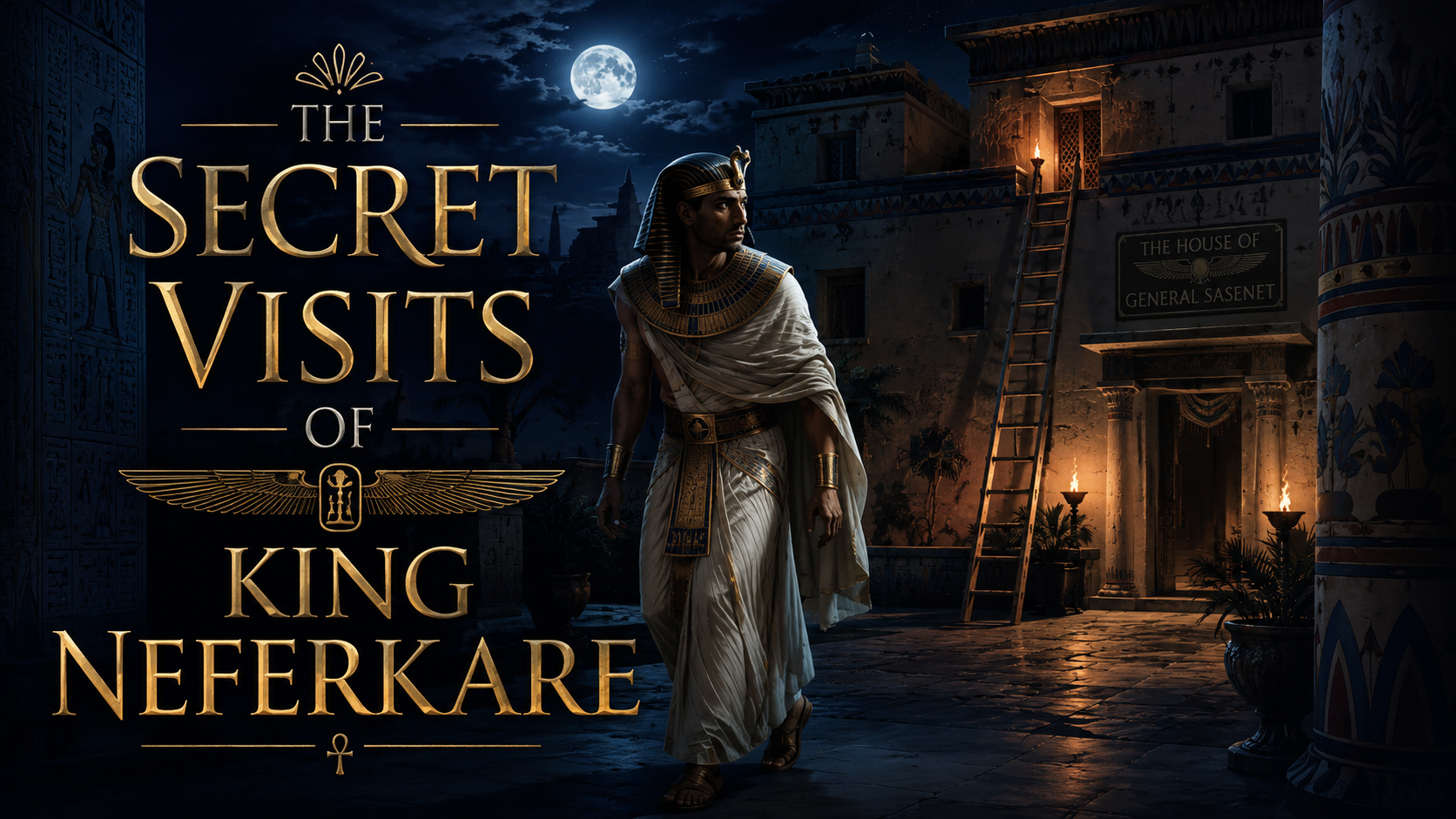
Thousands of years ago, Egyptian storytellers whispered of a king who left his palace after dark.
He did not travel in a royal procession. No musicians announced his arrival, no soldiers marched before him, and no servants carried torches to illuminate the road. Instead, King Neferkare slipped through the night alone and made his way secretly to the house of one of his highest-ranking officials, a man named Sasenet.
The king remained inside for hours before quietly returning to the palace before dawn.
Someone was watching.
The ancient tale that preserves these mysterious visits survives only in fragments, and much of its beginning and ending has been lost. What remains has fascinated modern historians because it offers a rare glimpse of Egyptian literature portraying a pharaoh not as an untouchable divine ruler, but as a man whose private actions could become the subject of gossip, suspicion, and perhaps even scandal.
The story is commonly known as King Neferkare and General Sasenet. The ruler Neferkare has traditionally been identified with Pepi II Neferkare of the Sixth Dynasty, although that identification is not certain. Whatever the historical identity of its characters, the story was literature rather than a straightforward royal chronicle.
It is a tale of secrecy, curiosity, royal power, and a relationship that ancient scribes deliberately left wrapped in suggestion.
King Neferkare
The name Neferkare was used by more than one Egyptian king, but the ruler in the story has often been identified as Pepi II Neferkare, one of the last major kings of Egypt’s Old Kingdom.
If that identification is correct, the tale is set during the Sixth Dynasty, more than four thousand years ago. Pepi II became the subject of later traditions and was remembered as a ruler from Egypt’s distant past. The surviving copies of the story, however, were written much later, which means the tale should not be treated as evidence that the events actually happened during Pepi II’s reign.
Egyptian authors frequently set stories in earlier periods. A famous king could become a literary character centuries after his death, just as later storytellers in other cultures turned historical rulers into heroes, villains, lovers, and fools.
In this tale, Neferkare is not presented primarily as a warrior or monument builder. Instead, the surviving fragments focus upon his private behavior and the unusual journeys he makes after nightfall.
That alone makes the story remarkable.
Egyptian royal inscriptions normally showed kings defeating enemies, making offerings to the gods, building temples, or maintaining Ma’at, the order upon which society depended. Kings were represented as powerful and idealized figures.
The Secret Visits of King Neferkare takes us somewhere very different. It follows the king when he believes no one is looking.
A Man With a Complaint
The beginning of the story is badly damaged, and several apparently separate episodes survive only in fragments.
One part concerns a man who has a grievance and wishes to bring his complaint before the king. The exact nature of his problem has been lost, but he appears determined to receive justice directly from Neferkare.
This should have been one of the king’s most important responsibilities. The ruler of Egypt was supposed to defend Ma’at, hear legitimate grievances, punish wrongdoing, and prevent powerful officials from oppressing the weak.
Yet the petitioner cannot obtain the hearing he wants.
Instead of being received properly, he is frustrated and ignored. At one point, noise and music apparently prevent his complaint from being heard. The surviving fragments create the impression of a royal court in which access to justice has become difficult.
Again and again the man tries. Again and again he fails. Eventually his frustration leads him to a man named Tjeti, son of Henet.
The petitioner tells Tjeti what has happened and asks for his help. Tjeti has apparently heard disturbing rumors about the king. Rather than dismiss them, he decides to discover the truth for himself.
Tjeti Watches the Palace
Tjeti begins observing Neferkare. This changes the tale from a story about a frustrated petitioner into something resembling an ancient mystery. Tjeti waits and watches the royal palace after dark.
At night, when Egypt’s towns become quiet and most people have gone to sleep, he sees something extraordinary. The king leaves the palace. Neferkare is alone.
There is no royal escort surrounding him and no procession announcing that the ruler of Egypt is passing through the streets. The king appears to be deliberately avoiding attention.
Tjeti follows. He keeps enough distance to avoid being discovered, moving through the darkness behind the king.
Neferkare eventually reaches a house belonging to Sasenet, an important royal official generally described in modern translations as a general or military commander.
The king does not simply knock openly at the door. According to the surviving account, he uses a signal, and a ladder is lowered for him. Neferkare climbs into the house. Tjeti remains hidden outside. Then he waits.
Four Hours in the House of Sasenet
The king remains inside Sasenet’s home for approximately four hours.
The surviving text uses deliberately suggestive language to describe what happens there. It says, in effect, that the king did what he desired with Sasenet.
The precise meaning has generated centuries of modern discussion because the wording is not explicit enough to eliminate every possible interpretation.
Many scholars have understood the passage as implying a sexual relationship between Neferkare and Sasenet. The secrecy of the visit, the length of time the king spends inside, and the phrasing used after the visit all support that interpretation.
Others have cautioned against treating a fragmentary literary story as a simple record of the sexual life of a historical pharaoh.
The distinction matters.
Even if the surviving passage describes sex between the two men, that does not prove that Pepi II himself had such a relationship. Neferkare is a literary character in a story copied long after the period in which Pepi II lived.
The text tells us what ancient Egyptian storytellers were willing to write about a king. That is fascinating in its own right.
The King Returns Before Dawn
After approximately four hours, Neferkare leaves Sasenet’s house. He climbs down and begins the journey back to the royal residence.
Tjeti secretly follows him once again. The timing of the visit is important to the story.
The king spends part of the night in Sasenet’s house but returns to the palace while several hours of darkness remain. His movements seem carefully calculated so that he can enter and leave without the royal court discovering where he has been.
Tjeti now knows that the rumors were true, at least in part. The King of Egypt is secretly visiting Sasenet.
More importantly, this is not an isolated event. The surviving tale indicates that Neferkare repeats the journey.
Night after night, the king leaves the palace, goes to Sasenet’s house, remains there for hours, and returns before morning.
Tjeti continues watching. Then, frustratingly, the story disappears. The papyrus is broken. The ending has been lost.
We do not know what Tjeti intended to do with the information, whether the petitioner finally received justice, whether Sasenet discovered that the king was being followed, or whether Neferkare’s secret became public.
Ancient readers knew the answer.
We do not.
Were Neferkare and Sasenet Lovers?
This is the question that has made the story famous in modern discussions.
The most straightforward interpretation of the surviving passage is that the king’s nocturnal visits had a sexual or romantic element. Neferkare enters Sasenet’s house secretly, remains there for four hours, and leaves after having done what he desired with him.
For this reason, the story is sometimes described as one of the earliest surviving literary references to a sexual relationship between two men.
But there are several important cautions. First, the story is incomplete. We cannot read the passages that originally explained the relationship more fully, and we do not know how the ancient story concluded.
Second, this is literature.
It cannot be used as straightforward proof that a historical pharaoh named Pepi II had a relationship with a military commander named Sasenet.
Third, Egyptian ideas about sexuality did not map perfectly onto modern categories such as gay, bisexual, or heterosexual. Those labels describe identities developed in much later societies and should not automatically be imposed upon ancient individuals.
The safest conclusion is therefore that the surviving story appears to imply an intimate relationship between King Neferkare and Sasenet, while the exact nature and intended meaning of that relationship remain debated.
Was the Story Criticizing the King?
The secret visits may not have been the only thing the author wanted readers to notice.
The story also appears to contrast Neferkare’s attention to Sasenet with his failure to properly address the grievances of an ordinary petitioner.
That could be significant.
A king’s primary obligation was to maintain Ma’at. He was expected to protect justice, keep society properly ordered, and ensure that wrongs were corrected.
If Neferkare repeatedly ignores someone seeking justice while slipping out of the palace at night to satisfy his own private desires, the author may be criticizing something larger than the king’s sexuality.
The problem may be neglect.
The ruler is devoting his time and attention to a secret personal relationship while someone who needs royal justice cannot even make himself heard.
Read this way, the tale becomes political satire.
The king is not necessarily mocked simply because he desires Sasenet. He may be mocked because his private desires have become more important than the duties of kingship.
That interpretation also helps explain why the petitioner and Tjeti appear in the story at all.
If the only purpose were to describe a secret romance, the frustrated petitioner would be unnecessary. By placing both episodes together, the author may have created a contrast between the king’s public responsibilities and private behavior.
Unfortunately, because so much of the text is missing, we cannot know whether the original ending confirmed this interpretation.
The Meaning of the Four Hours
The four hours Neferkare spends inside Sasenet’s house may also carry symbolic meaning.
Egyptian religious texts divided the night into stages through which the Sun God traveled before rebirth at dawn. Ra entered the hidden world after sunset and united with the powers of the underworld before emerging renewed in the east.
Some scholars have noticed possible echoes between this nocturnal divine cycle and Neferkare’s secret nighttime journey.
That does not necessarily transform his visit into a religious ritual. It may instead be literary irony.
The pharaoh was the earthly representative of divine kingship. The gods moved through darkness for cosmic purposes, renewing creation and ensuring the return of the sun.
Neferkare also moves through darkness. But his purpose is personal.
If the parallel was intentional, an Egyptian audience may have found the contrast amusing, scandalous, or deeply critical.
The divine king who should uphold the universe is wandering through the streets at night to visit Sasenet.
Who Was Sasenet?
Very little can be said with confidence about Sasenet himself.
The surviving tale identifies him as an important man associated with the king, and he is normally described as a general or military commander. The fragments do not provide anything approaching a complete biography.
There is no secure historical evidence connecting a real General Sasenet with Pepi II.
Like Neferkare, he may have been a literary character, a distorted memory of an actual official, or someone whose identity was obvious to ancient readers but has been lost to us.
His role in the surviving section is also surprisingly passive.
The story focuses on the king approaching his house and on Tjeti watching what happens. We do not possess enough of the text to know Sasenet’s thoughts, his feelings toward Neferkare, or how much danger he believed the relationship carried.
He remains one of the great unknowns of the tale.
A Possible Ending
Because the surviving manuscript breaks off, the conclusion below is a modern reconstruction rather than part of the ancient Egyptian text.
Night after night, Tjeti watched the king leave the palace.
Each time Neferkare followed the same path. Each time the ladder descended from Sasenet’s house, and each time the king disappeared inside until the deepest hours of darkness had passed.
Tjeti finally returned to the man whose complaint had first caused him to investigate.
“What you told me was true,” he said. “The king hears one man willingly while refusing to hear another.”
The petitioner understood.
He had come before Neferkare asking for justice and had been turned away, yet the king found hours each night for his secret visits.
On the following day, the petitioner went once again to the royal court.
This time, when musicians began playing loudly enough to drown out his voice, he refused to leave.
He raised his hands and shouted above them.
“O King, defender of Ma’at, how can justice sleep while the ruler of Egypt walks through the night?”
The hall became silent. Neferkare stared at him. The petitioner continued.
“I have waited outside your court while others enter your presence. I have called for justice while songs conceal my words. Yet there are doors in Memphis that open for you even in the deepest darkness.”
The king’s face changed. He knew immediately what the man meant.
“Who has told you this?” Neferkare demanded.
“No one needed to tell me, Majesty. The night itself has witnesses.”
Tjeti stepped forward.
Neferkare looked from one man to the other and understood that his secret was no longer entirely his own.
For a moment, anger filled the throne room.
Then the king remembered what his office demanded.
A ruler could punish men for insulting him, but a king who claimed to uphold Ma’at could not silence every truthful word merely because it caused embarrassment.
“Speak your complaint,” Neferkare finally commanded.
The petitioner told his story.
This time the king listened.
When the man had finished, Neferkare ordered his judges to investigate the wrong and restore whatever had been unjustly taken from him.
The petitioner bowed.
“I asked only that my king hear me.”
Neferkare dismissed him and then turned toward Tjeti.
“You have followed the King of Upper and Lower Egypt through the streets like a thief.”
“I followed because justice could not enter the palace by daylight,” Tjeti replied.
The courtiers waited for Neferkare’s anger.
Instead, the king dismissed the court. That night, Memphis became quiet again.
Tjeti waited beside the road. The palace doors remained closed. Whether Neferkare ever returned to Sasenet’s house, no one could say.
Was King Neferkare Really Pepi II?
Neferkare was the throne name of Pepi II, which explains why the literary king has usually been identified with the famous Sixth Dynasty ruler.
But the identification is not certain.
More than one Egyptian ruler used the name Neferkare, and scholars have proposed alternative possibilities. Some have even suggested that the surviving material could belong to a later period and refer to another king entirely.
The dates of the surviving manuscripts add another difficulty. The tale survives only in later copies and fragments rather than a contemporary Old Kingdom document.
For your purposes, the most accurate wording is that the story traditionally identifies or is commonly associated with Pepi II Neferkare, rather than claiming that historians know the character was definitely Pepi II.
Why the Story Matters
The Secret Visits of King Neferkare is valuable precisely because it is so unlike formal Egyptian royal monuments.
Temple inscriptions present kings as perfect rulers. They defeat foreign enemies, honor the gods, preserve order, and stand larger than everyone around them.
Literature could do something monuments rarely did.
- It could imagine the king making mistakes.
- It could follow him into the darkness.
- It could gossip about him.
It could question whether the man occupying the throne always lived up to the divine ideal of kingship.
The surviving fragments also remind us how much ancient Egyptian literature has disappeared. We possess enough of this story to understand its basic intrigue, but not enough to know its ending or exactly how its original audience interpreted the relationship between the two men.
Perhaps it was a scandalous love story. Perhaps it was political satire. Perhaps it was a criticism of a king who neglected justice for private pleasure. Most likely, it contained elements of more than one.
What remains is one of the strangest and most intimate portraits of an Egyptian king preserved in ancient literature: a ruler slipping silently from his palace, walking through the darkness, and climbing into the house of a man named Sasenet while another man watches from the shadows.