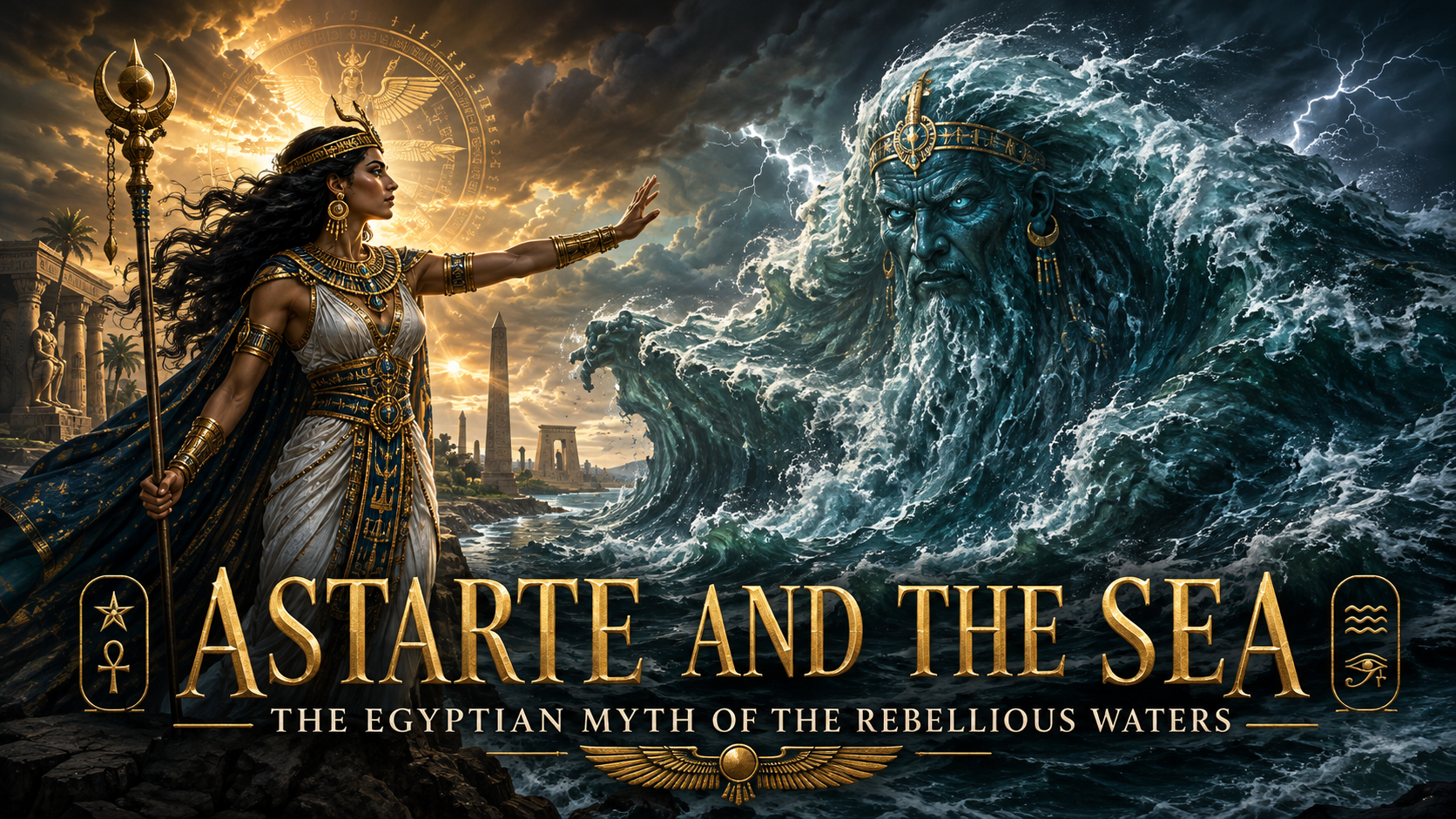
Long ago, according to a strange and badly damaged Egyptian myth, the Sea rose against the gods.
The Sea was not simply an expanse of water. He was a divine power, vast, unpredictable, and hungry for authority. He demanded tribute from the gods and threatened that if they refused him, his waters would overwhelm the ordered world. The heavens, the earth, and even the mountains would lie beneath his power.
The gods were troubled. They had faced enemies before, but the Sea was different. He could not easily be imprisoned behind walls or defeated by ordinary weapons. His strength stretched beyond the horizon, and his waves reached every shore.
At last the gods turned to Astarte, a foreign goddess who had found a place within Egyptian religion. Fierce in battle, beautiful, and associated with the divine powers of the Levant, Astarte was chosen to approach the Sea and discover what might satisfy him.
What followed survives only in fragments. The ancient papyrus is torn, entire sections are missing, and the ending has largely vanished. Yet enough remains to reveal one of the most unusual stories preserved from ancient Egypt: a myth in which Egyptian and Canaanite gods meet within the same divine world and the forces of the Sea threaten the order of creation.
A Foreign Goddess in Egypt
Astarte did not originate in Egypt. She belonged to the religious traditions of the Levant, where she was worshipped as a powerful goddess associated with war, kingship, fertility, sexuality, and royal power. Her worship spread widely throughout the eastern Mediterranean, and by the New Kingdom she had become familiar enough in Egypt to appear in royal inscriptions, magical texts, and religious imagery.
Egypt’s growing empire helped bring such foreign gods into the Nile Valley. Egyptian armies campaigned throughout Canaan and Syria, while soldiers, merchants, diplomats, craftspeople, captives, and immigrants moved between Egypt and the Levant. Ideas traveled with them, including stories about the gods.
Astarte was particularly attractive to New Kingdom Egyptians because of her martial character. She could be represented as a warrior goddess, sometimes standing or riding on horseback and carrying weapons. She was also associated with other foreign deities worshipped in Egypt, especially Anat, Resheph, and Baal.
The Egyptians did not necessarily abandon their own gods when they adopted foreign ones. Instead, they frequently placed new deities within an already crowded divine world. Foreign gods could be compared with Egyptian gods, associated with them, or given roles within Egyptian mythology.
That process appears vividly in Astarte and the Sea.
The Sea Demands Tribute
The beginning of the surviving story is damaged, but the conflict is already underway when the readable text begins.
The Sea has become powerful and threatening. Rather than remaining within his proper boundaries, he demands tribute from the divine council. If the gods refuse, he threatens destruction on a cosmic scale.
The Sea in this tale is often identified with the West Semitic god Yam, whose name simply means “Sea.” In myths from the ancient Levant, Yam is not merely water but a divine enemy associated with the uncontrolled forces of the ocean and with challenges to the authority of the gods.
The Egyptian story appears to have adapted this tradition rather than simply copying it word for word. Egyptian deities appear alongside foreign ones, and the divine council is described through Egyptian religious language.
The Sea demands gifts.
The gods apparently attempt to appease him by sending tribute, but this does not satisfy his ambition. His appetite grows greater rather than smaller.
The Sea does not merely want wealth. He wants authority.
The Gods Search for an Answer
The gods gather together and consider what to do.
Direct confrontation appears dangerous, so they first attempt negotiation. Tribute is prepared, and divine messengers become involved in carrying the gods’ response to the Sea.
Among the Egyptian deities mentioned in connection with the story are Ptah, Nut, and Renenutet. Their appearance alongside Astarte and the Sea shows just how thoroughly the foreign myth had been adapted to an Egyptian religious setting.
The surviving passages are difficult to reconstruct in exact sequence, but the central idea is clear. The gods hope that offerings will prevent the Sea from attacking them.
The Sea remains unsatisfied.
Eventually Astarte is called.
When she learns what the gods intend, the surviving text suggests that she reacts emotionally. She weeps before undertaking the journey, perhaps because she understands the danger she faces or because she realizes that the gods may intend to offer her as part of their bargain.
Whatever the exact circumstances, Astarte prepares to confront the Sea.
Astarte Goes to the Sea
Astarte travels to the shore and approaches the divine Sea.
The meeting must have been one of the central scenes of the original story, but much of it has been lost. What survives presents Astarte as more than a helpless messenger. She approaches the dangerous god with her own divine authority and appears before him singing or behaving with deliberate confidence.
The Sea sees her.
He addresses her as a powerful and tempestuous goddess.
For a moment, the story brings two immense forces face to face: the rebellious waters of the Sea and a warrior goddess whose own nature could be fierce and unpredictable.
Astarte has come to negotiate.
The Sea responds by increasing his demands.
The tribute offered by the gods is not enough. The surviving fragments indicate that he desires Astarte herself, or at least demands that she be surrendered to him in connection with the settlement.
The bargain has changed.
The gods are no longer being asked merely for gold, silver, food, or divine treasures.
The Sea wants one of their own.
Astarte Returns to the Gods
Astarte returns to the divine council carrying the Sea’s demand.
The gods now face a far more serious decision. If they refuse, the Sea threatens to unleash his power against creation. If they agree, they must surrender Astarte to a being who has already shown that no amount of tribute will satisfy him.
The surviving papyrus becomes increasingly fragmentary here, making it impossible to reconstruct every stage of the negotiations with confidence.
There are indications that the gods continue discussing tribute and divine valuables. The Sea’s ambition seems to extend beyond possession of Astarte. He wants the signs and privileges of supreme authority, perhaps including divine ornaments or regalia that would symbolize his domination over the world.
What began as extortion has become rebellion.
The Sea is attempting to place himself above the gods.
Negotiation can no longer solve the crisis.
Someone must fight him.
Seth Enters the Story
A fragment associated with the myth mentions Seth, suggesting that the Egyptian storm god ultimately became the champion who confronted the Sea.
This would have made perfect sense to an Egyptian audience familiar with foreign religion.
During the New Kingdom, Seth was often associated with the West Semitic storm god Baal. Both were powerful, violent gods connected with storms, foreign lands, kingship, and warfare. In Canaanite mythology, Baal famously battles Yam, the Sea, for divine supremacy.
An Egyptian adaptation could therefore substitute Seth for Baal without completely changing the structure of the older myth.
Seth was already one of the most complicated gods in Egyptian religion. In the Osiris cycle he became the murderer and enemy of Osiris, yet in solar mythology he could be a heroic protector of Ra. Each night Seth stood in the Solar Boat and fought Apophis, the serpent of Chaos.
He was dangerous precisely because he possessed the strength required to fight dangerous enemies.
If the Sea represented a force too violent for the peaceful gods to control, Seth was the obvious divine warrior to oppose him.
The Egyptian version of the story may therefore have transformed an originally Canaanite battle between Baal and Yam into a conflict between Seth and the Sea.
The Battle Against the Sea
The papyrus does not preserve a complete description of the final battle.
Because of this, the following section is a reconstruction based on the surviving fragments and the wider Near Eastern mythological tradition that appears to stand behind them.
When the gods realized that the Sea would never be satisfied, they summoned Seth.
The storm god listened as they told him of the tribute already demanded, of Astarte’s journey, and of the Sea’s attempt to claim authority over the divine world.
Seth laughed.
“You offer gifts to one who understands only strength,” he said. “You send gold to a god who wants your crowns. You send messengers to a power that intends to become your master.”
The gods asked whether he would fight.
Seth rose.
Thunder rolled across the heavens.
“If the Sea wishes to rule the world,” he answered, “then let him first rule over me.”
Astarte stood beside him.
She had faced the Sea and knew his arrogance. Perhaps she now revealed what she had learned about his strength. Perhaps she encouraged Seth to attack before the waters could rise against the divine realm.
Together they went toward the coast.
The Sea saw them approaching and lifted himself into enormous waves. His voice shook the shore.
“You have returned, Astarte,” he roared. “Have the gods accepted my demands?”
Astarte did not bow.
“They have given you their answer.”
Seth stepped forward.
The sky darkened behind him.
The Sea surged toward the land.
Storm Against Water
Seth raised his weapon, and the heavens erupted.
Wind tore across the coast. Lightning flashed through the black clouds, and thunder crashed so violently that the earth trembled beneath the feet of the gods.
The Sea answered with waves taller than temple pylons. Water crashed against the shore and swept inland, uprooting trees and tearing stones from the ground.
Seth did not retreat.
He struck the waters again and again, while the Sea tried to swallow him beneath the waves. The battle stretched from the shore to the horizon, storm fighting water as the gods watched from a distance.
Astarte remained nearby, fierce and unafraid.
The Sea had demanded her as tribute.
Now she stood among those who defied him.
At last Seth raised his weapon for one final blow.
The storm broke over the Sea with such force that the waves collapsed upon themselves.
The waters withdrew.
The rebellious Sea had been defeated.
The Sea Returns to His Boundaries
The gods rejoiced when they saw the waters retreat.
The Sea had not been destroyed. Such a thing would have been impossible. The oceans were part of creation and would always possess dangerous power.
Instead, the Sea was forced back into the boundaries established for him.
He could rage during storms and destroy ships. He could flood coastlines and swallow careless sailors. Yet he could no longer claim the throne of the gods or demand that the divine world submit to him.
Order had been restored.
Astarte had survived the danger and returned to her place among the gods.
Seth had once again demonstrated the strange necessity of violent power. The very god who could represent disorder had become the weapon used to defend divine order against something even more dangerous.
The gods had learned another lesson.
Chaos could not always be bribed.
Sometimes it had to be confronted.
Where the Ancient Story Actually Ends
The reconstruction above should not be mistaken for a surviving Egyptian conclusion.
The papyrus known as the Astarte Papyrus is badly damaged, and the original ending is missing. Scholars reconstruct the general direction of the story by comparing the surviving Egyptian fragments with other ancient Near Eastern myths about a storm god battling the Sea.
The clearest parallel comes from the mythology of Ugarit, a Late Bronze Age city on the Syrian coast. Texts discovered there describe a struggle between Baal, the storm god, and Yam, the Sea. Yam demands power over the gods, and Baal eventually fights him.
The Egyptian Astarte and the Sea is not identical to the Ugaritic story, but the similarities are striking.
A dangerous Sea demands tribute and authority. Astarte becomes involved in negotiations. A storm god, apparently Seth in the Egyptian version, ultimately becomes associated with the conflict.
Rather than viewing the tale as a purely Egyptian myth, it is better understood as an Egyptian adaptation of a broader eastern Mediterranean tradition.
Who Was Yam?
Yam was the divine Sea in West Semitic religion.
His name means “Sea,” but ancient storytellers treated him as a conscious supernatural power. The ocean was one of the most frightening forces in the ancient world, especially for people living along the Mediterranean coast.
The Sea supplied fish, trade routes, and access to distant lands, but it could also kill without warning. Storms sank ships, waves destroyed harbors, and deep water remained mysterious and uncontrollable.
Transforming the Sea into a god gave personality to that danger.
Yam could demand tribute because rulers demanded tribute.
He could attack the gods because kings attacked rival kingdoms.
He could seek divine authority because mythology often imagined the world of the gods as a royal court filled with alliances, rivalries, negotiations, and battles.
In the Egyptian version, this foreign divine Sea entered a culture that already possessed its own powerful ideas about dangerous water.
Before creation, according to Egyptian mythology, there had been the infinite waters of Nun.
The ordered world had risen from those waters.
The threat that uncontrolled water might once again cover creation therefore carried particular meaning in Egypt.
The Sea was not merely a foreign enemy.
He represented the possibility that the ordered world could disappear beneath Chaos.
Why Was Astarte Important?
Astarte’s role is one of the most fascinating parts of the story.
She is not simply a passive prize fought over by male gods. She acts as an intermediary between the divine council and the Sea, entering dangerous territory when other gods hesitate to confront him directly.
Her involvement also preserves the foreign character of the original tradition.
Astarte belonged to the same broad religious world as Baal and Yam. Even after the story was translated or adapted into Egyptian, she remained central enough that Egyptian scribes did not replace her with Isis, Hathor, Neith, or another native goddess.
That tells us something important about religious exchange in the New Kingdom.
Egyptians could adopt foreign stories without stripping away every foreign element.
Astarte remained Astarte.
The Sea remained a foreign-style divine enemy.
At the same time, Egyptian gods such as Ptah, Nut, Renenutet, and Seth could enter the story.
The result was not entirely Egyptian or entirely Canaanite.
It belonged to both worlds.
Astarte in Ancient Egypt
Astarte became particularly prominent in Egypt during the Eighteenth and Nineteenth Dynasties, when Egyptian power extended deeply into the Levant.
She was admired as a warrior goddess and could be associated with horses, chariots, weapons, and royal victory. New Kingdom kings who celebrated their own military abilities had good reason to value foreign warrior deities.
Astarte also became associated with Seth.
This connection probably reflects Seth’s identification with Baal, whose mythological world already included Astarte and Anat. Egyptian religious texts could therefore place Seth beside foreign goddesses without considering the combination unusual.
In The Conflict of Horus and Seth, Neith even proposes giving the foreign goddesses Anat and Astarte to Seth as wives while the gods settle the dispute over the throne of Osiris.
By the New Kingdom, these foreign deities had become sufficiently integrated into Egyptian religious imagination to appear naturally in Egyptian-language stories.
Egypt and the Gods of Foreign Lands
The Egyptians did not generally believe that their own country contained the only real gods.
Foreign peoples had gods, and those gods could possess genuine divine power.
As Egypt conquered territories abroad, foreign deities entered Egyptian temples, settlements, military communities, and magical practices. Soldiers stationed in Canaan and Syria encountered local cults. Foreign soldiers serving Egypt brought their gods with them. Merchants and immigrants carried religious traditions across borders.
The process worked in both directions.
Egyptian gods were worshipped outside Egypt, while Levantine gods appeared along the Nile.
This exchange became especially visible during the New Kingdom.
Astarte, Anat, Baal, Resheph, and Qadesh all acquired worshippers in Egypt. Some retained clearly foreign characteristics while also becoming connected with Egyptian gods.
The myth of Astarte and the Sea may be one of the clearest literary products of that world.
It shows mythology crossing borders just as soldiers, merchants, diplomats, and ships crossed them.
What Does Astarte and the Sea Mean?
At its simplest level, the story concerns a rebellion against divine order.
The Sea refuses to remain within his proper place. He demands tribute, increases his demands, and eventually seeks authority over the gods themselves.
That makes him more than a natural force.
He becomes a political rebel.
The gods initially try diplomacy. They send offerings and messengers because negotiation is preferable to a cosmic war. Astarte becomes essential because she can cross the boundary between the divine council and the threatening Sea.
Yet compromise fails.
Every concession encourages the Sea to demand more.
The myth therefore reaches a familiar ancient conclusion: order sometimes depends upon a champion willing to fight.
In the Levantine version that champion was Baal.
In the Egyptian adaptation, Seth appears to have filled that role.
This is especially interesting because Seth was himself associated with Chaos in other Egyptian stories.
Egyptian religion rarely divided gods into simple categories of good and evil. Seth could murder Osiris and challenge Horus, yet the same violent strength made him indispensable when Ra needed someone powerful enough to spear Apophis.
In Astarte and the Sea, that principle appears again.
Only a dangerous god may be strong enough to defeat a dangerous enemy.
The Rebellious Waters
Water always occupied an ambiguous place in Egyptian thought.
The Nile created life. Its annual inundation nourished the fields and made civilization possible. Without water, Egypt would become desert.
Yet water also existed before creation.
Nun, the endless primordial ocean, surrounded the ordered world. Egyptian religious texts sometimes imagined the boundaries of creation as fragile, with Chaos waiting beyond them.
The rebellious Sea of Astarte’s story fits naturally into this worldview even though the myth itself came from abroad.
The Sea provides life and trade, but when he refuses his boundaries he becomes a threat to creation.
Order does not require destroying water.
It requires putting water in its proper place.
The defeated Sea therefore returns to his boundaries rather than disappearing.
The lesson resembles many Egyptian creation myths.
Chaos never vanishes forever.
It is restrained.
The Importance of the Story
Astarte and the Sea survives in such poor condition that it will probably never become as famous as The Tale of Sinuhe, The Shipwrecked Sailor, or The Conflict of Horus and Seth.
Yet historically it may be even more revealing.
The papyrus demonstrates that Egyptian mythology was never completely isolated from the cultures surrounding it. Egyptian scribes encountered foreign gods and foreign stories, translated them, reshaped them, and inserted their own deities into them.
The borders between religious traditions were more flexible than modern categories sometimes suggest.
Astarte could be foreign and still be worshipped in Egypt.
Seth could be Egyptian and still take the role of a Canaanite storm god.
The Sea could belong to a Levantine myth and still become part of an Egyptian story about cosmic order.
The result is one of the strangest surviving products of New Kingdom literature: a tale in which a foreign goddess stands before a rebellious Sea, the gods struggle to preserve their authority, and Egyptian and Canaanite mythology flow together until it becomes difficult to tell where one tradition ends and the other begins.
The papyrus is broken, but its surviving fragments preserve something extraordinary.
They show that stories, like the Sea itself, did not respect borders.