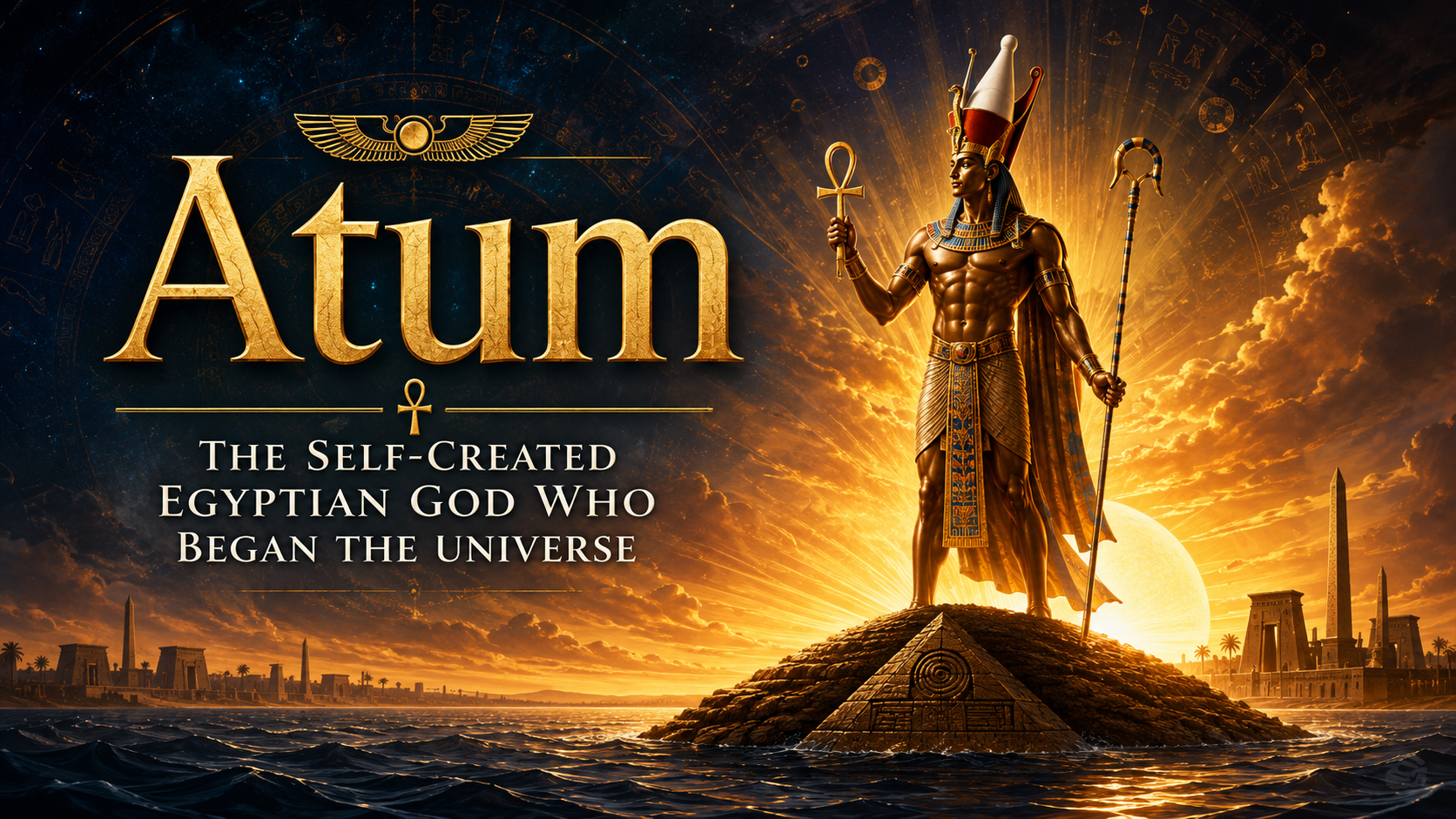
Atum was one of the oldest and most important creator gods in Ancient Egyptian religion. According to the creation tradition developed at Heliopolis, he was the first god to emerge from the darkness and waters that existed before the ordered world.
Before there was land, sky, sunlight, or life, there was only the endless primordial water known as Nun. From this dark and limitless expanse, Atum brought himself into existence and stood upon the first mound of dry land.
From Atum came the first divine family. He created Shu, the god of air, and Tefnut, the goddess of moisture. Their descendants became the Ennead of Heliopolis, a group of deities whose relationships explained the origins of the natural world, Egyptian kingship, death, and the afterlife.
Atum was therefore more than a god who participated in creation. He was the original source from whom the ordered universe and many of Egypt’s greatest gods descended.
What Does the Name Atum Mean?
The name Atum is connected with the ancient Egyptian word tm, which can convey the ideas of completion, totality, or finishing. For this reason, Atum is often described as “The Complete One,” “The All,” or “He Who Is Complete.”
The name reflected his unusual nature. Atum existed before the world contained separate beings or forces. Everything that would eventually appear in creation was already contained within him. He represented both the beginning and the completion of existence.
This double meaning also helps explain why Atum was associated with the setting sun. Sunset marked the completion of the sun’s daily journey, but it was not a permanent ending. The sun would travel through the night and rise again the following morning.
Atum therefore represented creation, completion, transformation, and the promise that every ending could lead to another beginning.
Atum and the Primordial Waters
Ancient Egyptians developed several different accounts of creation. The version associated with Atum came from Heliopolis, known to the Egyptians as Iunu.
According to this tradition, the universe began as an endless expanse of dark, silent water called Nun. Nun was not an evil force. It represented the unformed state that existed before the world had boundaries, light, movement, or order.
Atum appeared within these waters without parents or a creator. He brought himself into being through his own divine power. His emergence marked the first moment of creation.
The appearance of Atum also introduced distinction into the universe. For the first time, there was something separate from the surrounding waters. From that first distinction, the rest of creation could unfold.
The Benben and the First Land
After emerging from Nun, Atum stood upon the first mound of land. This mound was called the benben.
The image may have been inspired by the annual Nile flood. When the waters receded, raised patches of dark soil appeared first, followed by the return of vegetation and human activity.
To the Egyptians, this familiar natural cycle provided a powerful model for the beginning of the universe. Just as fertile land emerged from the floodwaters each year, the first land had risen from the waters of Nun.
The benben became one of the most important symbols of the solar cult at Heliopolis.
A sacred stone representing the primeval mound was kept there, although the original object has not survived. The shape and meaning of the benben may also have influenced the development of pyramids, pyramid-shaped stones, and obelisks.
Each sunrise could be understood as a repetition of the first creation, when light and order emerged from darkness.
How Did Atum Create Shu and Tefnut?
Atum was alone at the beginning of creation. Because no other beings existed, he had to produce the first generation of gods from himself. Egyptian texts preserve several versions of how this happened.
In one account, Atum brought forth Shu and Tefnut by spitting or expelling them from his body. Shu became the god of air, while Tefnut became the goddess of moisture.
Another tradition describes Atum generating the divine pair through masturbation. In this version, his hand could be personified as a female creative principle that helped complete the act of creation.
These accounts may sound unusual to modern readers, but they expressed an important theological idea. Atum contained both masculine and feminine creative potential within himself.
He required no partner because all the forces necessary for creation already existed inside him.
From a single divine being came the first pair, allowing life and creation to continue through later generations.
Atum and the Ennead of Heliopolis
Atum stood at the head of the Ennead, the family of gods worshipped at Heliopolis.
The Ennead consisted of:
Atum created Shu and Tefnut. Shu and Tefnut then produced Geb, the god of the earth, and Nut, the goddess of the sky. Geb and Nut became the parents of Osiris, Isis, Set, and Nephthys.
Through these generations, the Egyptians explained the formation of the world. Air and moisture emerged first, followed by the separation of earth and sky. The final generation introduced gods connected with kingship, death, resurrection, magic, protection, and disorder.
Horus was later closely connected with this divine family, particularly through his role as the son of Isis and Osiris.
The Ennead was not the only Egyptian creation tradition, but it became one of the most influential.
The Eye of Atum
One myth tells how Shu and Tefnut became separated from Atum in the darkness of Nun. Concerned for his children, Atum sent out his divine Eye to search for them.
The Eye was not merely part of the god’s body. In Egyptian religion, a divine eye could possess its own personality and power. It could travel independently, protect its owner, punish enemies, and return with information.
When the Eye found Shu and Tefnut and brought them back, Atum rejoiced.
According to the myth, he wept with happiness. His tears fell upon the newly formed earth, and human beings emerged from them.
This story made humanity part of the creator god’s emotional response to the return of his children.
The myth also reflects Egyptian wordplay linking the words for tears and people. Such wordplay frequently shaped Egyptian religious stories because spoken language was believed to possess creative power.
Atum and the Creation of Humanity
The story of humanity emerging from Atum’s tears was one of several Egyptian explanations for the origin of human life.
In this tradition, humans were not created as enemies or servants destined only to labor for the gods. They appeared from the tears of the creator at a moment of relief and joy.
The story established a direct relationship between humanity and Atum.
People were part of his creation and depended upon the cosmic order he had established. In return, humans maintained temples, performed rituals, made offerings, and lived according to Ma’at.
By preserving truth, balance, and justice, humans helped sustain the world that Atum had begun.
Atum and the Sun
Atum became closely associated with the sun and the daily solar cycle.
He was particularly connected with the evening sun as it descended toward the western horizon. The sun god Khepri commonly represented the rising morning sun, while Ra represented the sun in its full daytime power. Atum could represent the aging or setting sun at the completion of its journey.
These distinctions were never completely rigid. Egyptian gods frequently shared identities and could represent different stages of the same natural process.
Atum’s connection with sunset did not make him a god of final death. The setting sun entered the unseen world, traveled through the night, and returned at dawn.
As a result, Atum represented the completion of one cycle and preparation for the next.
Atum and Ra
Atum and Ra became closely connected at Heliopolis.
Ra was the visible sun god, while Atum was the self-created deity who existed at the first moment of creation.
The two were eventually combined as Ra-Atum or Atum-Ra.
This composite deity united:
- Atum’s role as the original creator
- Ra’s power as the visible sun
- The birth of the cosmos
- The sun’s daily journey
- The renewal of life
The merger did not mean that Atum ceased to exist as an independent god. Egyptian religious thought allowed gods to combine while retaining their distinct identities.
Atum could still be worshipped separately, depicted in his traditional form, and invoked in funerary texts.
Atum and Khepri
Atum was also connected with Khepri, the scarab god of the rising sun.
Khepri represented the sun’s morning appearance and the beginning of a new cycle. Atum represented the sun’s descent and the completion of that cycle.
Together, they expressed the full journey of transformation:
- Khepri was becoming and emergence.
- Ra was visible solar power.
- Atum was completion and return.
The sun did not simply vanish each evening. It transformed, entered the hidden world, and prepared to be reborn.
This cycle reflected one of the central beliefs of Egyptian religion: death could lead to renewal rather than permanent destruction.
Atum and Egyptian Kingship
Atum was closely connected with Egyptian kingship.
As the first divine ruler and father of the Ennead, he stood at the beginning of the sacred line from which royal authority descended.
The pharaoh was associated with Horus during life and Osiris after death, but both gods belonged to the divine order that began with Atum.
Kings made offerings to Atum and commissioned monuments in his honor. Royal inscriptions could describe a pharaoh as beloved of Atum or as receiving life, authority, and protection from him.
Atum’s association with the Double Crown reinforced his relationship with the united kingdom of Upper and Lower Egypt.
By honoring Atum, the king connected his reign with the original creation and the establishment of cosmic order.
What Did Atum Look Like?
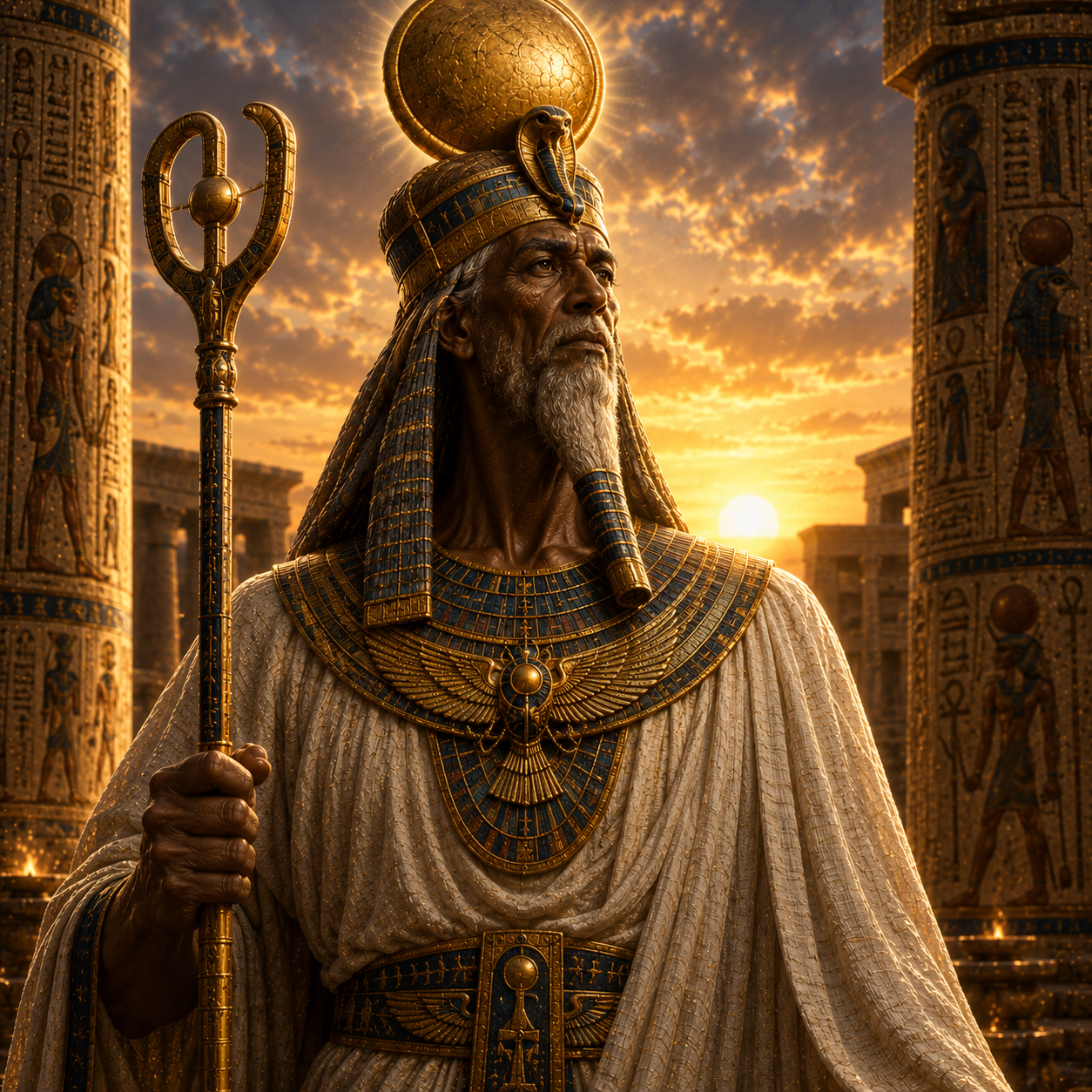
Atum was most commonly represented as a human man wearing the Double Crown of Upper and Lower Egypt.
The Double Crown combined:
- The White Crown of Upper Egypt
- The Red Crown of Lower Egypt
This headdress emphasized his universal authority and his close connection with kingship.
Atum frequently carried:
- An ankh, representing life
- A was-scepter, representing power and dominion
Unlike many Egyptian deities, he was normally shown with a human head rather than the head of an animal.
In some images, he appears as an older man, reflecting his association with the evening sun and the completion of the solar cycle.
Atum as a Serpent
Atum could also appear as a serpent.
The serpent form was particularly significant because snakes seemed to renew themselves by shedding their skin. This made them symbols of regeneration, transformation, and continued existence.
In funerary texts, Atum could describe himself as the serpent who survived when the ordered world eventually returned to the primordial waters.
This produced a striking theological idea.
Atum existed before creation, and he would remain after creation had ended. Everything else might dissolve back into Nun, but the creator would continue in another form.
He therefore stood beyond ordinary time.
The Mongoose and Other Animals of Atum
The Egyptian mongoose, also called the ichneumon, was associated with Atum.
Mongooses were known for fighting snakes, which may have connected them with the defense of the solar order against dangerous serpentine forces.
Atum could also be associated with other solar animals and manifestations, including the serpent and certain forms of the bull, lion, or lizard.
These animal connections did not replace his usual human form. Instead, they revealed different aspects of his identity, such as protection, regeneration, solar power, or primeval creation.
The Hand of Atum
Because Atum created the first divine pair without a separate partner, Egyptian theologians sometimes treated his hand as a feminine creative principle.
The goddesses Iusaaset and Nebethetepet could both be called the Hand of Atum in different traditions.
They represented the female element within the creator’s act.
This did not contradict the belief that Atum was self-created. Instead, it explained how one complete being could contain the complementary powers required to produce life.
The divine hand also reinforced Atum’s identity as a god who was complete within himself.
Heliopolis: The City of Atum
Atum’s principal cult center was Iunu, later called Heliopolis by the Greeks.
The Greek name means “City of the Sun.”
Heliopolis stood in the region of modern Cairo and became one of the most important religious centers in Egyptian history. Its priests developed influential ideas about creation, solar worship, kingship, and the divine family of the Ennead.
The city contained a major temple dedicated to the solar creator in his forms as Atum and Ra.
Although little of ancient Heliopolis survives above ground today, its religious influence spread throughout Egypt.
Kings constructed obelisks, temples, and solar monuments inspired by Heliopolitan beliefs. Priests from other cities adopted and adapted its theology, while funerary texts carried its creation traditions into tombs throughout the country.
Worship of Atum
Atum was worshipped from the earliest periods of Egyptian history through the Greco-Roman era.
His worship included:
- Temple offerings
- Hymns
- Royal rituals
- Solar ceremonies
- Funerary prayers
- Invocations for rebirth
Because he represented the source of the Ennead, Atum appeared frequently in temple scenes involving other major gods.
He also held an important place in royal and funerary religion, where his powers of creation and renewal could help the deceased begin a new existence.
Atum in the Pyramid Texts
Atum appears repeatedly in the Pyramid Texts, the collection of religious spells inscribed inside royal pyramids beginning near the end of the Fifth Dynasty.
These texts sought to help the deceased king rise from death and join the gods.
Atum could welcome the king, protect him, identify him with the creator, or help him ascend into the sky.
The deceased ruler might also be joined with Atum so that he could share in the god’s self-renewing power.
Atum’s presence in these texts shows that his role extended beyond explaining the first creation. The same power that began the universe could also recreate the dead.
Atum and the Afterlife
Atum’s connection to the setting sun gave him an important place in beliefs about death and resurrection. Just as the sun entered the western horizon each evening, the deceased entered the hidden world.
The journey did not have to end in destruction. Through ritual knowledge, divine protection, and proper burial, the dead could be renewed like the sun.
Atum represented the successful completion of earthly life and the transition into another state of existence. His creative power could restore breath, identity, movement, and life to the deceased.
Atum and Ma’at
Atum’s act of creation established order within the previously undifferentiated waters. That order was expressed through Ma’at, the principle of truth, balance, justice, and cosmic harmony.
Creation did not remain secure automatically. Gods, kings, priests, and ordinary people all had responsibilities within the cosmic system.
The pharaoh upheld Ma’at through just rule, temple rituals, offerings, and defense of Egypt. When Egyptians lived according to Ma’at, they helped preserve the structure Atum had created.
Disorder, violence, and injustice threatened to return the world toward chaos.
Was Atum the Same as Ra?
Atum and Ra were closely connected, but they were not originally identical. Atum began as the self-created god of Heliopolitan theology. Ra represented the visible sun traveling across the sky.
As solar religion developed, their identities overlapped, and they were worshipped together as Ra-Atum.
It is useful to remember the distinction:
- Atum represented completeness, primeval creation, and often the setting sun.
- Ra represented the visible solar force and its daily journey.
- Ra-Atum united the creator with the sun.
Egyptian religion did not require worshippers to choose only one interpretation. All three identities could be valid at the same time.
Was Atum the same as Amun?
No. Amun and Atum were separate Egyptian gods, although both became major creator deities and were sometimes connected with Ra.
Atum was the creator god of Heliopolis. In the Heliopolitan creation myth, he created himself from the primordial waters of Nun, stood upon the first mound of land, and produced Shu and Tefnut. Through their descendants, he became the ancestor of the Ennead.
Amun began as a local god of Thebes. His name means “The Hidden One,” and he represented an invisible divine force associated with air, creation, kingship, and hidden power. As Thebes became politically dominant, Amun rose to become king of the gods.
Atum was associated with:
- The first moment of creation
- The primeval mound
- The Heliopolitan Ennead
- The setting sun
- Completion and totality
- Shu and Tefnut as his first children
He was usually shown as a man wearing the Double Crown of Upper and Lower Egypt.
Amun was associated with:
- Hidden or invisible divine power
- Air and wind
- Creation
- Kingship
- The city of Thebes
- The Theban Triad with Mut and Khonsu
He was usually shown as a man wearing a tall crown with two long feathers. His sacred animals included the ram and the goose.
They may seem similar because Egyptian religion had several different creation traditions. Different cities promoted different creator gods:
- Heliopolis: Atum
- Memphis: Ptah
- Thebes: Amun
- Hermopolis: the Ogdoad
These traditions did not always cancel each other out. Egyptian priests often treated them as different ways of describing creation.
Both Amun and Atum were also merged with Ra:
- Atum-Ra connected Atum’s role as the first creator with the sun.
- Amun-Ra connected Amun’s hidden power with the visible power of the sun.
So they could share solar and creator qualities without becoming the same god. A simple way to remember it is that Atum was the self-created god who began the universe while Amun was the hidden god who rose from Thebes to become king of the gods.
Was Atum the First Egyptian God?
Calling Atum the “first Egyptian god” can be misleading. Egypt had several creation traditions, and different religious centers placed different deities at the beginning of existence.
- At Heliopolis, Atum was the self-created source of the Ennead.
- At Memphis, Ptah could be described as the supreme creator.
- At Hermopolis, creation began with the eight primordial beings of the Ogdoad.
- At Thebes, Amun could be presented as the hidden power that existed before all other gods.
These traditions were not always treated as competing claims. Egyptian theologians could combine them or understand each as revealing a different aspect of creation.
Atum was therefore the first god within the influential Heliopolitan tradition, not necessarily the sole creator recognized throughout all of Egypt.
Legacy of Atum
Atum remained one of the most influential creator gods in Ancient Egyptian religion.
He was:
- The self-created god
- The first being to emerge from Nun
- The god who stood upon the primeval mound
- The creator of Shu and Tefnut
- The ancestor of the Ennead
- A god of the setting sun
- A symbol of completion and renewal
- A protector of kings and the dead
His mythology gave the Egyptians a divine family tree connecting the natural world, royal authority, death, resurrection, and cosmic order.
Atum began creation alone, but everything that followed existed within his original completeness. From the first mound rising above the waters to the setting sun disappearing in the west, he represented the eternal cycle in which creation reaches completion and begins again.