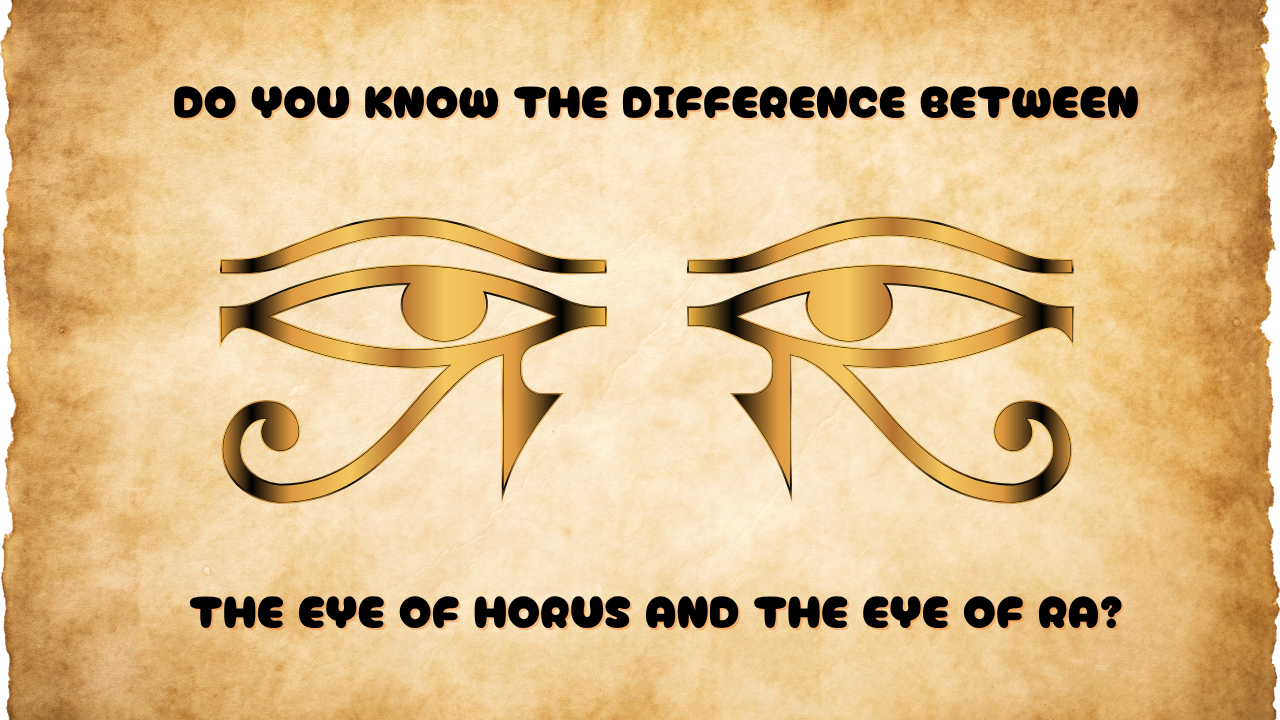
The Eye of Ra and the Eye of Horus are two of the most recognizable symbols from ancient Egypt, but they have different meanings. The Eye of Ra represents the sun god’s power, divine authority, and protection, while the Eye of Horus (the Wedjat) symbolizes healing, restoration, and wholeness after Horus’s eye was restored following his battle with Set. Although both served as protective symbols, they originated from different myths and fulfilled different religious roles.
The easiest way to remember the distinction is this:
The Eye of Ra defended divine order through power, while the Eye of Horus represented the restoration of what had been damaged.
Both symbols could protect people, temples and the dead. Their meanings also overlapped, however, and ancient Egyptian religion was too complex to reduce them to a simple rule about which direction an eye faces.
Eye of Ra and Eye of Horus at a Glance
| Feature | Eye of Ra | Eye of Horus |
|---|---|---|
| Principal deity | Ra, the sun god | Horus, the falcon god |
| Main association | Solar power and divine authority | Healing and restoration |
| Common symbolism | Protection, kingship, fury and destruction of enemies | Protection, health, regeneration and wholeness |
| Mythic form | Often personified as a goddess | The injured and restored eye of Horus |
| Associated deities | Hathor, Sekhmet, Tefnut, Bastet, Wadjet and others | Horus, Set and Thoth |
| Celestial connection | Usually the sun | Frequently connected with the moon |
| Ancient name | The Eye of Ra was a divine concept rather than one single amulet type | Wedjat, meaning “the sound one” or “the restored one” |
| Main difference | An active extension of Ra’s power | An eye made whole after injury |

What Is the Eye of Ra?
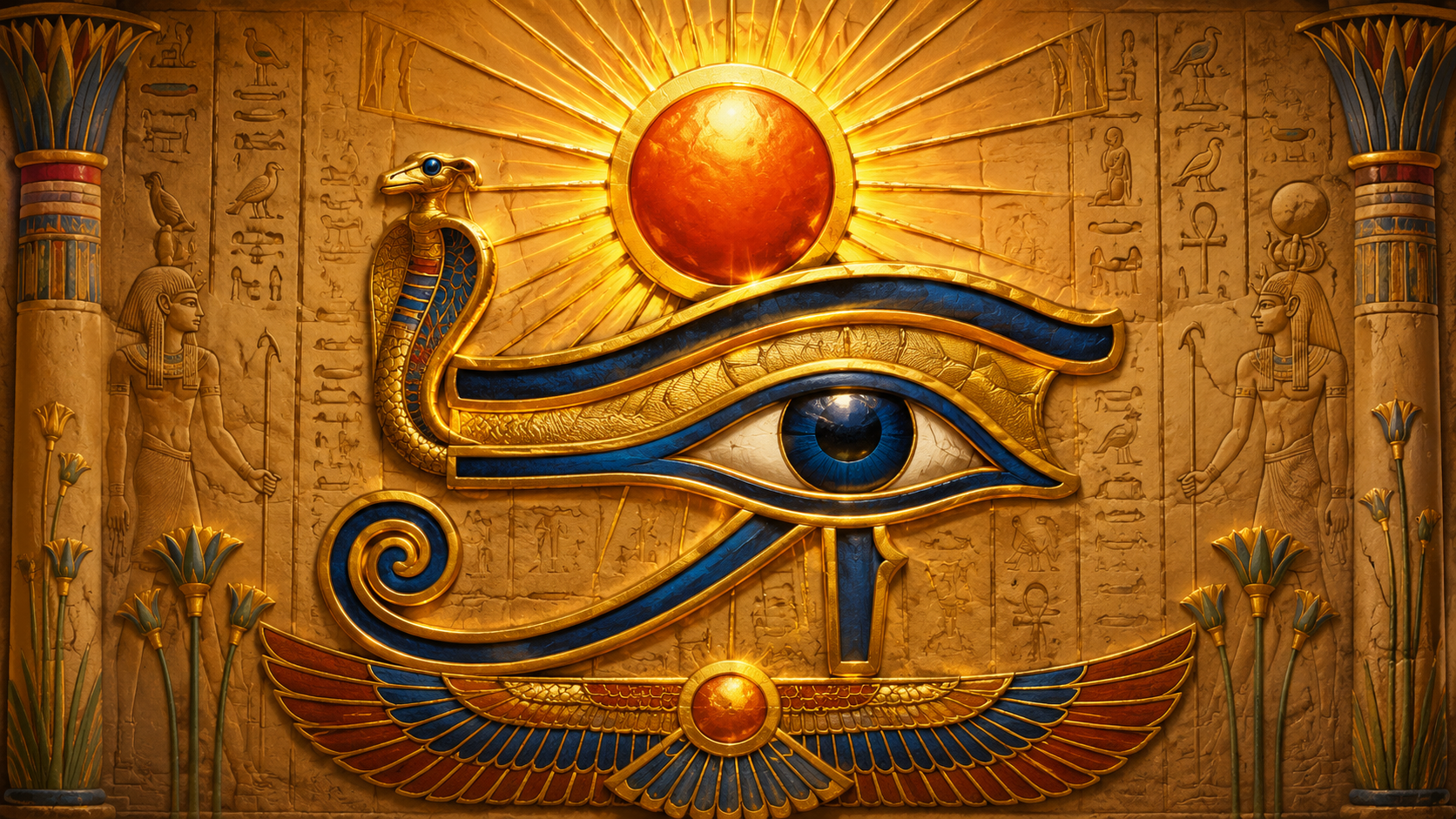
The Eye of Ra was more than a drawing of a human eye. In Egyptian mythology, it was an extension of the sun god’s divine power.
Ra could send his Eye out into the world to search for something, defend his authority or punish those who threatened the order of creation. The Eye could behave like an independent being, frequently taking the form of a powerful goddess.
This is one reason the Eye of Ra should not be understood merely as Ra’s physical right eye. It was also a divine force with its own personality, desires, and destructive potential.
What Did the Eye of Ra Represent?
The Eye of Ra could represent:
- The heat and brilliance of the sun
- Divine authority
- Royal power
- Protection of Ra and the pharaoh
- The destruction of enemies
- The restoration of cosmic order
- The dangerous and protective power of goddesses
The Eye defended Ma’at, the divinely ordered state of truth, balance and justice. When rebellion or disorder threatened creation, the Eye could respond with overwhelming force.
Was the Eye of Ra a Goddess?
The Eye of Ra was frequently personified as a goddess, but it was not limited to one particular deity. In fact, in the earliest story of creation (The Waters of Chaos), the Eye of Ra was Hathor. Several goddesses could embody the Eye in different temples, periods, and myths, including:
- Hathor
- Sekhmet
- Tefnut
- Bastet
- Wadjet
- Mut
- Mehit
These goddesses did not all represent identical personalities. Each expressed a different aspect of the solar Eye’s power.
Sekhmet emphasized its destructive heat and fury. Hathor could embody both its dangerous and nurturing dimensions. Bastet expressed a more protective and domesticated form of solar power. Tefnut appeared prominently in myths about the Eye leaving Ra and later returning.
The ability of several goddesses to become the Eye of Ra was normal within Egyptian religion. Egyptian gods could merge, share titles, and assume overlapping roles without losing their individual identities.
The Eye of Ra and the Destruction of Humanity
One of the most famous appearances of the Eye occurs in the story commonly known as the Destruction of Humanity, preserved in the Book of the Heavenly Cow.
In the story, humanity rebels against the aging sun god Ra. Ra sends his Eye against the rebels, and the Eye takes the form of Hathor or Sekhmet.
The goddess begins killing humanity with such ferocity that Ra eventually decides the destruction must stop. He orders large quantities of beer to be stained red and poured across the land. Mistaking the red liquid for blood, the goddess drinks it, becomes intoxicated, and abandons her slaughter.
The story reveals the double nature of the Eye of Ra. It protected divine order, but its power could become so violent that even Ra had to restrain it.
Another version of the story describes the Eye in this myth as a separate daughter or offshoot sent by Ra to punish humanity, taking the form of Sekhmet before returning to a gentler character associated with Hathor.
The Distant Goddess and the Wandering Eye
Another group of Egyptian myths tells how the Eye of Ra became angry with Ra and departed for a distant land, often identified with Nubia or the desert.
Without his Eye, Ra was weakened or incomplete. Another god had to persuade the wandering goddess to return to Egypt.
When she returned, she brought renewed power, fertility, and celebration. Her dangerous energy was calmed and reintegrated into the ordered world.
These stories are sometimes called Distant Goddess myths. They help explain why the Eye could represent both danger and renewal. Its departure threatened order, while its return restored vitality to Egypt.
Is the Eye of Ra the Right Eye?
The Eye of Ra is often described in modern guides as the right eye, representing ☀️ the sun, while the Eye of Horus is described as the left eye, representing the 🌙 moon. That distinction can be useful as a memory aid, but it is not a dependable rule for identifying every ancient Egyptian image.
In some traditions, the celestial god’s right eye was associated with the sun and the left with the moon. A British Museum description, for example, explains that the two eyes of the celestial falcon Horus could represent the sun and moon.
Ancient Egyptian symbols were not governed by one universal orientation system, however. Images could be reversed for artistic, ritual, or compositional reasons. The Eye of Ra was also a theological concept that could be represented by a goddess, a cobra, a solar disk, or other forms rather than a single standardized eye symbol.
The safest way to identify an Eye is therefore to examine its context, inscription, and associated deity rather than relying only on whether it appears to face left or right.
What Is the Eye of Horus?
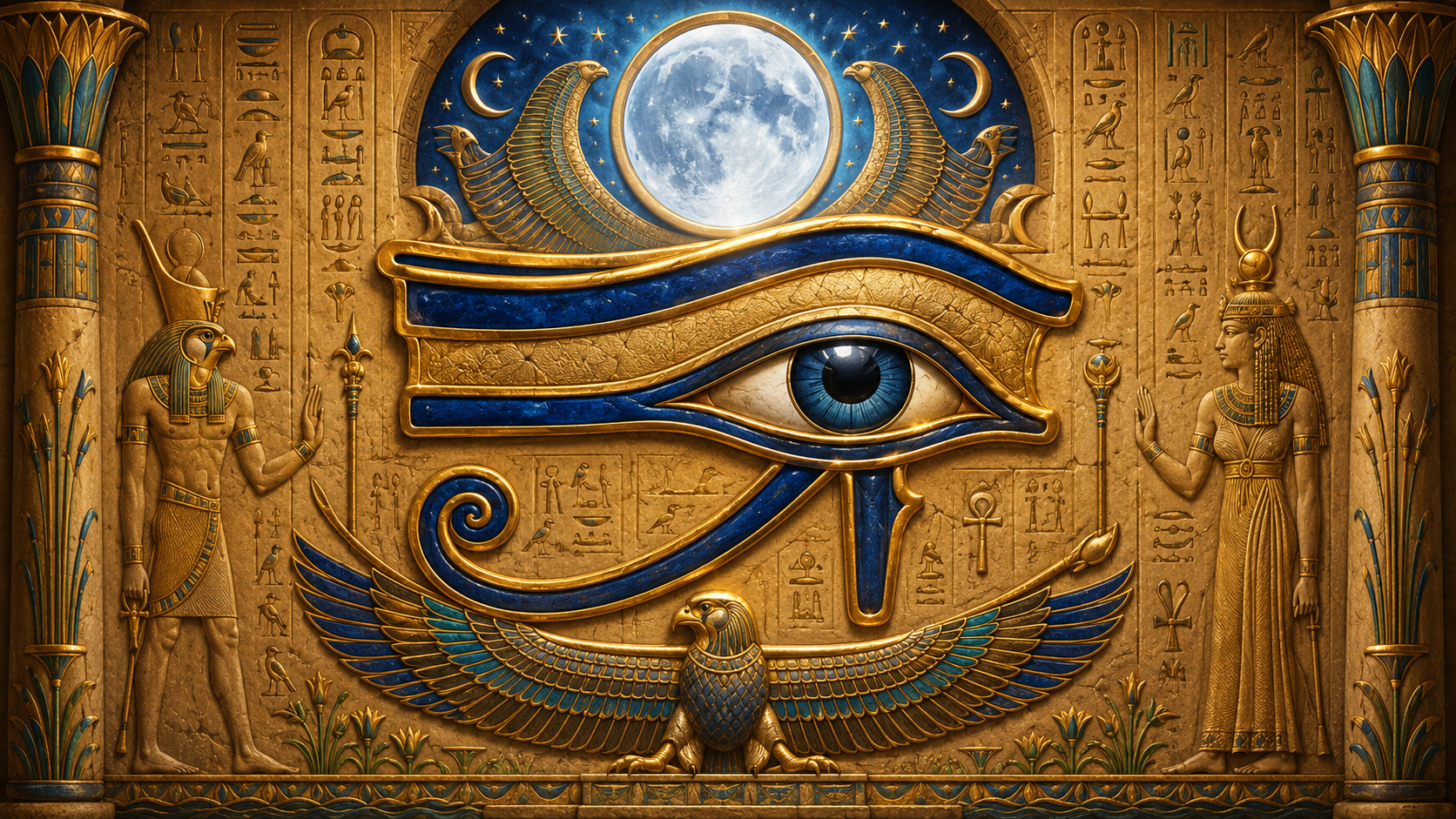
The Eye of Horus was one of ancient Egypt’s most important protective symbols. It represented the eye of the god Horus, injured during his struggle with Set and later restored. Because the damaged eye was made whole again, it became associated with:
- Healing
- Restoration
- Protection
- Regeneration
- Completeness
- Well-being
- Resurrection
Its Egyptian name was the wedjat, often translated as “the sound one,” “the intact one,” or “the restored one.”
The Metropolitan Museum of Art describes the wedjat as the healed eye of Horus and explains that it embodied healing power, regeneration, and rebirth.
How Did Horus Lose His Eye?
The story belongs to the long conflict between Horus and Set. After Set murdered Horus’s father, Osiris, Horus challenged his uncle for the kingship of Egypt. Their struggle appeared in multiple Egyptian traditions and took many forms, including contests, transformations, legal arguments, and acts of violence.
During the conflict, Set injured, removed, or destroyed one of Horus’s eyes. The precise details vary among surviving texts.
The damaged eye was eventually restored, often by the god Thoth, who was associated with wisdom, writing, calculation, and the moon. Other traditions could involve Hathor or additional divine powers in its recovery.
Once restored, the Eye became the wedjat, the Eye made complete again.
Why Was the Eye of Horus Connected with the Moon?
Horus was an ancient sky god whose two eyes could be understood as the sun and moon. The injury to his Eye could be symbolically connected to the moon’s disappearance or waning, while its restoration echoed the waxing moon as it returned to fullness.
The British Museum notes that the wedjat was often regarded as the moon-eye of the celestial falcon, injured during the moon’s waning and restored as it waxed.
This lunar interpretation was important, but it was not the Eye’s only meaning. The wedjat also represented physical healing, royal legitimacy, offerings, resurrection, and the restoration of order after conflict.
How Was the Eye of Horus Used?
Wedjat-eye amulets were among the most popular protective objects in ancient Egypt.
They were worn by the living, placed among mummy wrappings, incorporated into jewelry, and painted or carved onto funerary objects. Their purpose was to transfer the Eye’s powers of healing, protection and regeneration to the person carrying it.
The Metropolitan Museum explains that wedjat amulets were used by both the living and the dead and were believed to pass the Eye’s restorative power to their owners.
Some amulets were made from faience, stone, glass, precious metals, or other materials. Blue and green were particularly appropriate colors because they could evoke life, fertility, renewal, and regeneration.
What Does the Eye of Horus Look Like?
The wedjat combines features of a human eye with markings associated with a falcon. Its familiar features include:
- A curved eyebrow
- A dark line extending from the outer corner
- A vertical or curving mark beneath the eye
- A spiral-like lower marking
Horus was strongly associated with the falcon, so these markings helped identify the symbol as the falcon’s eye rather than a human eye.
The design was not merely decorative. Its recognizable form allowed the healed Eye of Horus to function as a visual sign of divine protection.
Did the Eye of Horus Inspire the Medical Symbol “Rx”?
A popular internet claim says that the modern prescription abbreviation Rx was derived from the Eye of Horus. There is no persuasive historical evidence for that connection. The medical abbreviation is generally connected with the Latin word recipe, meaning “take,” which traditionally appeared at the beginning of prescriptions.
The Eye of Horus was certainly associated with healing and protection in ancient Egypt, but that does not mean its shape became the modern Rx symbol. The claim should therefore be treated as a modern visual comparison rather than an established historical fact.
Was the Eye of Horus Used as Fractions?
Another familiar claim states that the individual parts of the Eye of Horus represented the fractions:
- 1/2
- 1/4
- 1/8
- 1/16
- 1/32
- 1/64
Ancient Egyptians did use fractional systems, and eye-like signs appear in mathematical notation. However, the tidy, modern diagram that assigns a fraction to each anatomical part of the wedjat is less certain than it is often presented.
It shouldn’t be treated as the symbol’s primary ancient meaning without qualification. The Eye’s best-supported religious associations remain healing, restoration, protection, and completeness.
What Is the Main Difference Between the Eye of Ra and the Eye of Horus?
The principal difference lies in the myths behind them.
The Eye of Ra was an active force
It went out from Ra, defended his authority, and attacked the enemies of cosmic order. It could become a fierce goddess and unleash destructive solar power.
The Eye of Horus was a restored force
It had been injured during the conflict with Set and was then healed. It symbolized recovery, regeneration and the return of completeness.
In the simplest terms: The Eye of Ra destroys the threat. The Eye of Horus heals the wound left behind.
That comparison captures their most familiar distinction, although both Eyes could protect, both could possess solar associations, and both belonged to a much larger network of Egyptian ideas about kingship, sacrifice, and cosmic order.
Eye of Ra vs. Eye of Horus: Which One Represents Protection?
Both symbols represented protection. The difference is the kind of protection each emphasized.
The Eye of Ra protected through:
- Solar power
- Divine authority
- Aggression against enemies
- The defense of kingship
- The destruction of disorder
The Eye of Horus protected through:
- Healing
- Restoration
- Regeneration
- Magical safeguarding
- The recovery of wholeness
Ancient Egyptians used protective imagery in flexible ways, so these categories were not absolute. A wedjat amulet might guard a living person against illness or protect a dead person on the journey to the afterlife. The Eye of Ra might destroy an enemy but also bring fertility and renewal after the wandering goddess returned.
Can You Tell Them Apart by Their Direction?
Modern illustrations frequently present the following rule:
- Eye facing one direction: Eye of Ra
- Eye facing the opposite direction: Eye of Horus
This system is convenient for jewelry sellers, tattoo designs, and modern diagrams, but it oversimplifies ancient Egyptian evidence.
The symbols can appear reversed, paired or adapted to fit the orientation of an inscription or object. A single wedjat amulet might also have the Eye depicted on both sides.
Ancient viewers relied on context, accompanying gods, inscriptions, and ritual function. Direction alone is not enough to identify an ancient example with certainty.
Are the Eye of Ra and Eye of Horus the Same Symbol?
They are not exactly the same, but they are closely related. Both emerged from Egyptian ideas about divine eyes as active sources of power. Both could be connected with celestial bodies, kingship, and protection. Their identities could overlap as Egyptian religious traditions changed over thousands of years.
The difference is clearest in narrative context:
- The Eye of Ra acts as the power or daughter of the sun god.
- The Eye of Horus is damaged, restored, and offered as a sign of renewed order.
The overlap should not be mistaken for confusion. Ancient Egyptian religion allowed several meanings to coexist.
Why Was the Restored Eye Offered to Osiris?
In some traditions, Horus offered his restored Eye to his father Osiris. The offering helped revive, sustain, or strengthen Osiris, who had become ruler of the dead. This act connected the wedjat with funerary offerings and resurrection.
An offering made to a deceased person could itself be called an Eye of Horus because it restored strength and nourishment, just as the divine Eye had been restored. This idea helped make the symbol especially important in tombs and funerary rituals.
Where Does Bastet Fit In?
Bastet was one of several goddesses associated with the Eye of Ra.
As a daughter of Ra and a protective goddess, she could express the solar Eye’s power in a form connected with household safety, fertility, health, and protection. Earlier forms of Bastet may have possessed a more formidable leonine character before her later cat imagery became dominant.
Bastet should therefore be linked most directly with the Eye of Ra, not treated as a principal embodiment of the Eye of Horus. The broader themes of protection and healing overlap, but that does not make the two theological roles interchangeable.
Which Symbol Is More Powerful?
Ancient Egyptians did not rank these symbols as though they were competing magical logos. Each represented a different expression of divine power.
The Eye of Ra emphasized:
- Royal authority
- Solar energy
- Divine wrath
- Victory over enemies
The Eye of Horus emphasized:
- Recovery
- Health
- Ritual completeness
- Regeneration
Which was more important depended on the ritual, myth, temple, or personal need involved.
What Do the Symbols Mean Today?
Today, both Eyes appear in jewelry, tattoos, art and modern spiritual practices.
Modern interpretations often describe the Eye of Ra as a symbol of confidence, strength, independence and fierce protection. The Eye of Horus is frequently used to represent healing, intuition, recovery and spiritual protection.
Those meanings are inspired by ancient Egyptian religion, but they should be identified as modern interpretations rather than exact reconstructions of ancient practice.
For the ancient Egyptians, these symbols belonged to a complex religious world involving gods, temples, kingship, ritual offerings, death and rebirth.
Frequently Asked Questions
Is the Eye of Ra evil?
No. The Eye of Ra could be destructive, but its violence protected Ra and defended cosmic order. Egyptian deities could be dangerous without being understood as evil in the modern sense.
Is the Eye of Horus good luck?
Ancient Egyptians used wedjat amulets for protection, healing and regeneration. Calling it a good-luck charm is a modern simplification, but it does capture part of its protective function.
Is the Eye of Horus left or right?
It is commonly associated with the left eye and the moon, but orientation alone is not a reliable way to classify all ancient images.
Is the Eye of Ra right or left?
It is commonly associated with the solar right eye. However, the Eye of Ra was a broader religious concept and could not always be reduced to a standardized right-facing symbol.
What does wedjat mean?
Wedjat means approximately “the sound one,” “the intact one,” or “the restored one.” It refers to the Eye of Horus after it had been healed.
Who restored the Eye of Horus?
Thoth most commonly restores the Eye in modern summaries, although Egyptian traditions varied and other divine figures could participate in its healing.
Are the Eye of Ra and Eye of Horus interchangeable?
No. They have overlapping protective meanings, but their central myths and theological roles are different.
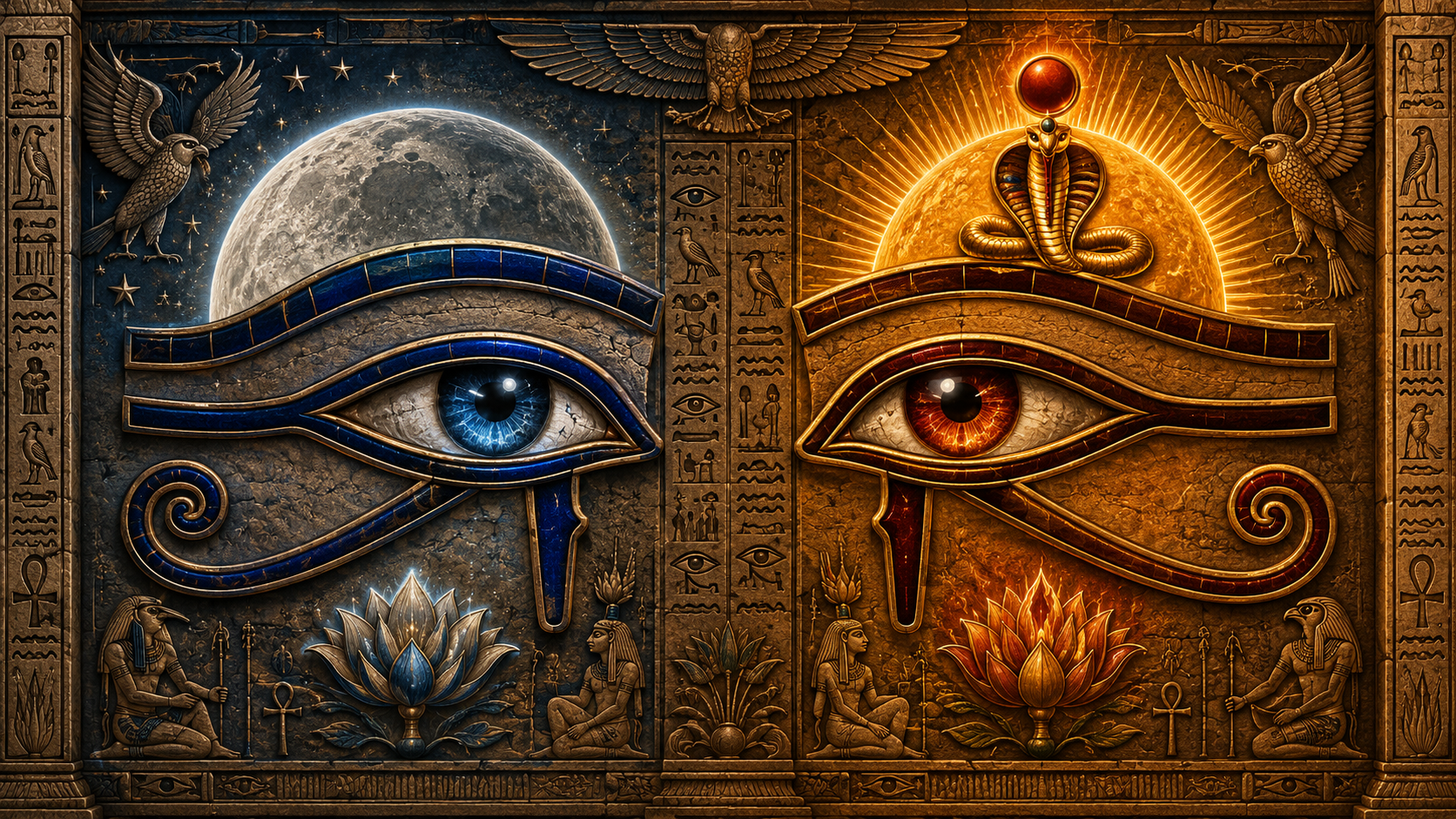
What is the difference between the Eye of Ra and the Eye of Horus?
The Eye of Ra and the Eye of Horus grew from the same ancient Egyptian fascination with divine sight, celestial power and protection, but they told different stories.
The Eye of Ra was the blazing force of the sun god, capable of defending creation and destroying those who threatened divine order. It could take the form of a goddess such as Hathor, Sekhmet, Tefnut or Bastet.
The Eye of Horus was the injured Eye restored after the conflict between Horus and Set. Known as the wedjat, it represented healing, completeness, protection and regeneration.
One confronted danger. The other restored what danger had broken.
Together, the two Eyes reveal an essential idea within ancient Egyptian religion: preserving order required both the power to defeat chaos and the power to make the world whole again.
Ancient Egyptian mythology is filled with rich symbolism, cosmic drama, and layers of meaning that evolved over thousands of years. Among its most iconic emblems, two symbols stand out not only visually but spiritually: the Eye of Ra and the Eye of Horus. They may look similar at first glance, but their histories and meanings diverge in fascinating ways.
The Eye of Ra and the Eye of Horus are sister symbols, connected yet distinct. One burns with solar fury; the other glows with lunar healing. Together, they reflect a complete vision of protection: one that destroys what threatens and one that restores what’s broken.
And that is why they remain two of the most compelling symbols in the ancient world and why people still feel drawn to them today.
