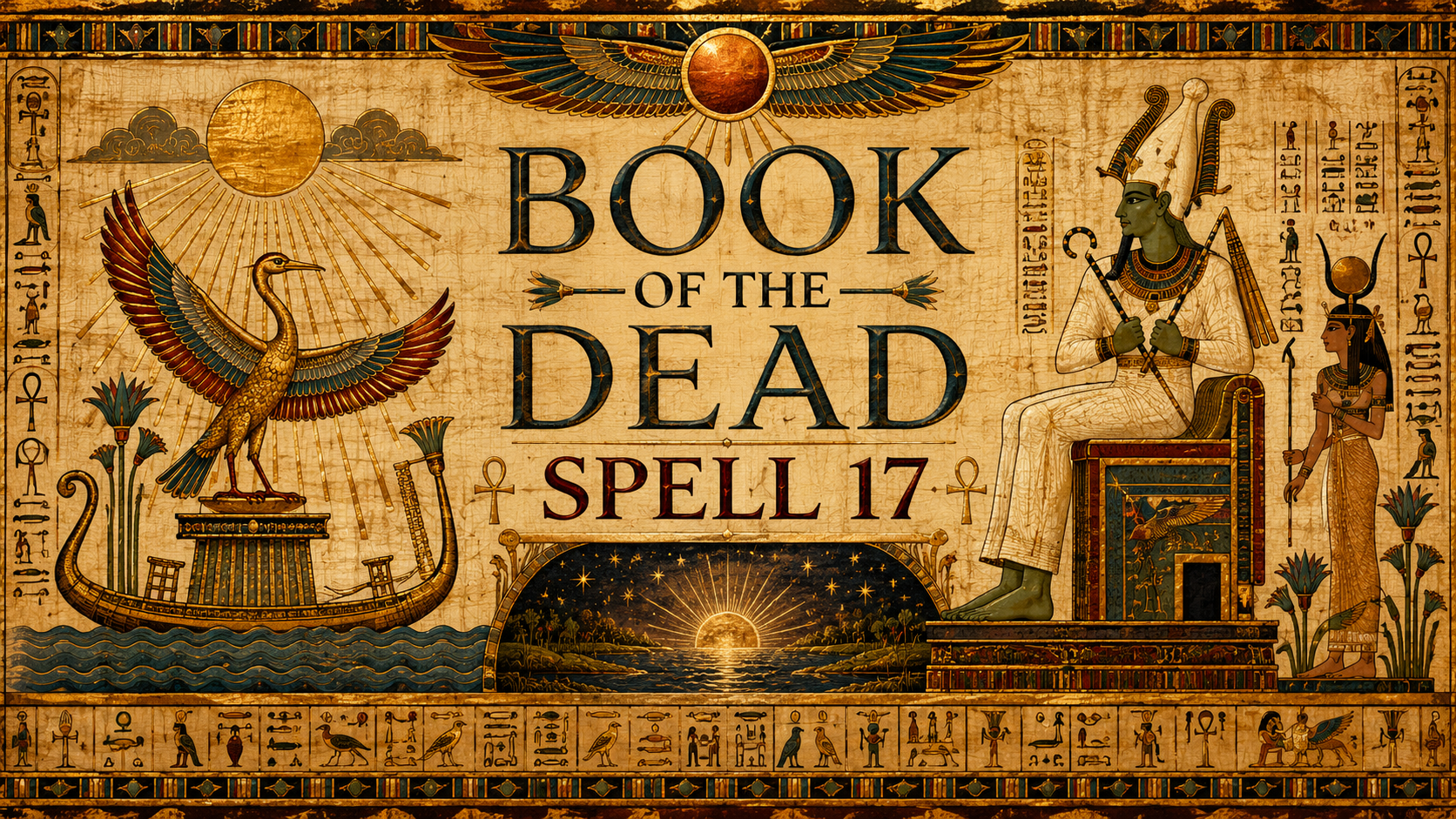
The ancient Egyptian Book of the Dead was a collection of funerary spells designed to help the deceased awaken, travel through the afterlife, overcome hostile beings, and become an effective spirit among the gods.
Book of the Dead Spell 17 is one of the collection’s longest, oldest, and most complicated compositions. Unlike a simple protection spell, it presents a sweeping explanation of creation, divine identity, time, death, resurrection, purification, judgment, and the geography of the afterlife.
The spell is especially unusual because many of its declarations are followed by questions such as:
What does it mean?
The manuscript then supplies one or more explanations, sometimes offering several different interpretations of the same mysterious statement.
Spell 17 was not only intended to protect the deceased. It demonstrated that the speaker possessed knowledge of the gods’ secret identities and the hidden meanings behind Egyptian religious traditions.
Its purpose can be summarized as:
A spell for going forth by day and proving knowledge of the mysteries of creation, resurrection, and the divine world.
What Is Book of the Dead Spell 17?
Book of the Dead Spell 17 is a long funerary composition containing declarations spoken in the identities of Ra, Atum, Osiris, Horus, the Bennu bird, Medjed, and other divine beings.
The text moves through several connected themes:
- Creation from the primeval waters
- Ra’s first rising
- Atum’s self-creation
- Osiris as yesterday
- Ra as tomorrow
- The struggle between Horus and Set
- The restoration of the Eye of Horus
- Purification in sacred lakes
- Travel through Rosetau and the Field of Reeds
- Protection from executioners and devourers
- Admission among the gods
- Eternal survival
Spell 17 is also one of the clearest examples of an Egyptian funerary text containing its own commentary. A difficult statement is made, followed by an explanation beginning with “What does it mean?” Some passages preserve more than one answer, introduced as an “alternative version.”
The Traditional Title of Spell 17
Peter Le Page Renouf and Édouard Naville titled the spell:
A chapter whereby one comes forth by day out of the Netherworld
The title places Spell 17 within the larger purpose of the Book of the Dead, whose ancient designation referred to “going forth by day.” That phrase described the deceased person’s ability to leave the tomb, emerge into daylight, and join the sun god’s journey rather than remain permanently confined in death.
A descriptive modern title could be:
A spell for going forth by day through knowledge of creation and the divine mysteries
Why Is Spell 17 So Important?
Spell 17 is important because it preserves a collection of religious ideas that were already ancient when New Kingdom scribes copied them into Book of the Dead manuscripts.
The composition developed from Coffin Text Spell 335, a Middle Kingdom funerary text. It was expanded, rearranged, and supplied with explanatory glosses as it entered the Book of the Dead tradition.
Rather than telling one continuous myth, Spell 17 combines many separate traditions. It moves from creation to Osiris, from the Bennu bird to Horus, from sacred lakes to hostile executioners, and from the Eye of Horus to the Field of Reeds.
Its purpose was not necessarily to teach the reader a single systematic theology. It gave the deceased access to a broad network of sacred knowledge.
Does Spell 17 Have One Standard Translation?
No. Spell 17 survives in different manuscripts with variations in:
- Wording
- Order
- Divine names
- Explanatory glosses
- Alternative interpretations
- Illustrations
- The length of individual sections
The composition is so long that modern scholars often divide it into parts and numbered sections. The UCL Digital Egypt edition follows the sectional organization used by Egyptologist Thomas George Allen and supplies transliteration and translation for numerous passages.
Any English version should therefore be identified as a translation of a particular recension or as a reader-friendly composite rendering.
English Translation of Book of the Dead Spell 17
The following is a modern, reader-friendly rendering of the principal sections of Spell 17. It is based on the structure preserved in the UCL Digital Egypt translation and the historical edition of Renouf and Naville.
Because the full spell is extremely long and contains manuscript variations, this translation focuses on its major declarations and explanations while preserving the text’s characteristic question-and-answer structure.
The word [Name] represents the name of the deceased.
Spell 17: Going Forth by Day and Knowing the Divine Mysteries
The First Rising of Ra
All existence is mine while I remain alone in Nun.
I am Ra at his first rising,
when he began to rule what he had created.What does this mean?
It means Ra at his first appearance,
when he first ruled what he had made.It also means the first rising of Ra at Heracleopolis,
when the supports of Nun came into being
and the enemies of the god were destroyed.
The spell opens at the beginning of creation. Nun was the limitless primeval water that existed before the ordered world. The speaker does not merely witness creation. The deceased claims the identity of the god present at the first sunrise.
The Self-Created God
I am the great god
who came into being by himself.Nun is the primeval water,
the father of the gods.What does this mean?
It means Ra creating his own body
before the gods in his following had taken form.I am the one whom none among the gods can oppose.
What does this mean?
It means Atum within his solar disk.
Another explanation:
It is Ra within his disk,
shining from the eastern horizon of heaven.
This section identifies the deceased with Ra and Atum, two closely connected creator and solar forms.
The god is self-created and does not depend on another being for existence. By assuming this identity, the deceased claims an origin beyond ordinary human birth.
Yesterday and Tomorrow
Yesterday belongs to me,
and I know tomorrow.What does this mean?
Yesterday is Osiris.
Tomorrow is Ra.
Yesterday is the day when the enemies
of the Lord of All were destroyed
and his son Horus was appointed.Another explanation:
Yesterday is the burial of Osiris
by his father Ra.Tomorrow is the day
when Ra rises renewed.
This is one of Spell 17’s best-known passages.
Osiris represents the completed past, death, burial, and existence within the western realm. Ra represents the coming day, renewal, and rebirth.
The deceased claims knowledge of both conditions.
The Battle of the Gods
A battle arose among the gods
when I gave the command.What does this mean?
It is the conflict that occurred
after Osiris entered the western mountain.It is the struggle of the gods
over the inheritance of Horus.I know the great god who is there.
What does this mean?
It is Osiris.
Another explanation:
His name is the Acclamation of Ra.
Another:
He is the soul of Ra
through whom the god renews himself.
Spell 17 repeatedly presents several explanations for one statement. This reflects the Egyptian belief that a divine being could possess many names, forms, relationships, and levels of meaning.
The Bennu Bird
I am the great Bennu bird
who is in Heliopolis.I determine what exists.
What does this mean?
The Bennu bird is Osiris in Heliopolis.
What exists is his body.
Another explanation:
It is cyclical time and eternity.
Cyclical time is the day.
Eternity is the night.
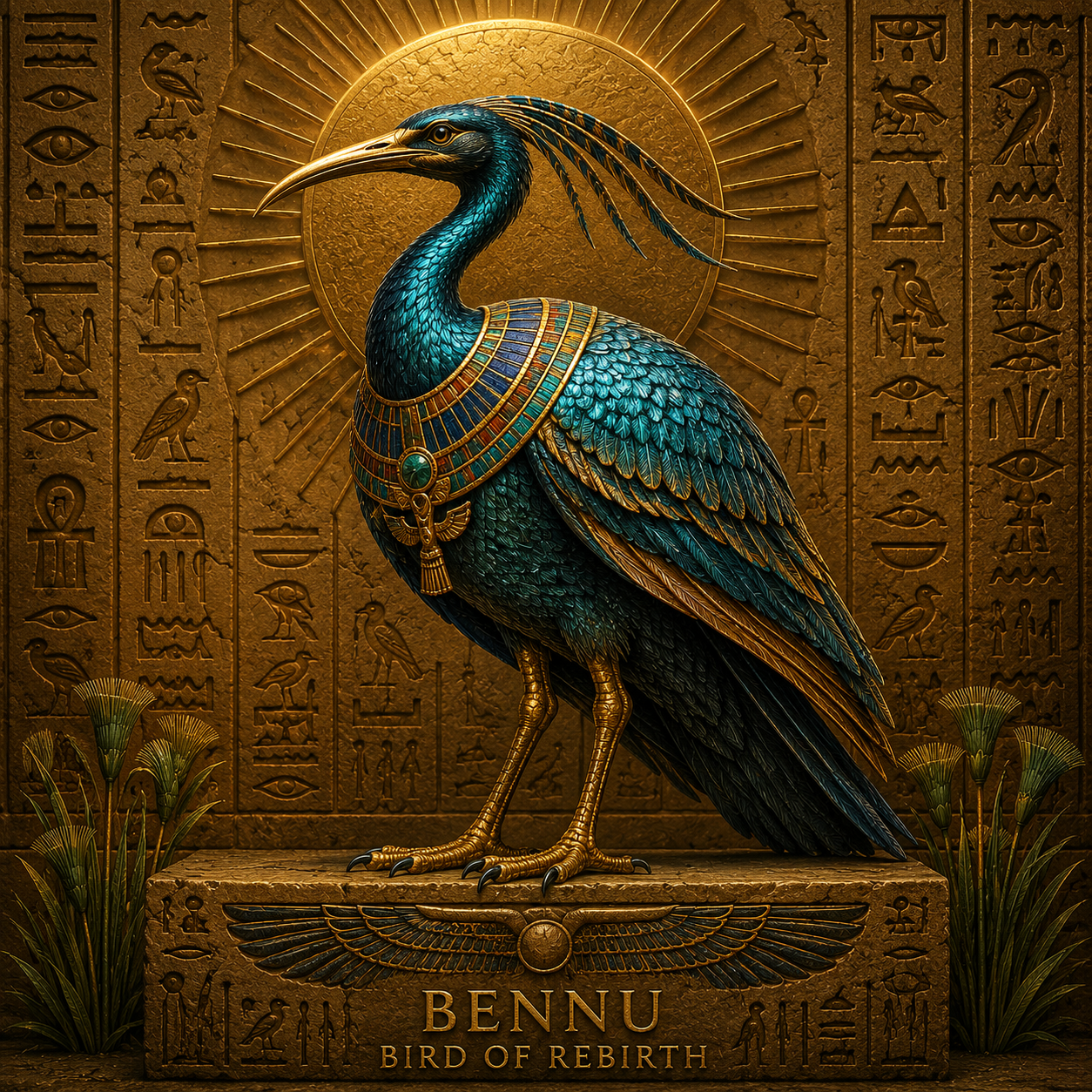
The Bennu bird was associated with creation, solar renewal, and emergence. In this passage, the Bennu is identified not only with solar rebirth but also with Osiris, the divine body, day, night, and the two forms of time.
Horus and the Double Plume
I am the divine child
at the moment of his emergence,when the double plume
was placed upon his head.What does this mean?
It is Horus defending his father Osiris.
His emergence is his birth.
The double plume represents Isis and Nephthys
when they came as two kites
and stood behind him.Another explanation:
It is the great double cobra
before Atum.Another:
The two plumes are his two eyes.
Horus is born as the champion of Osiris. The double plume can represent the goddesses Isis and Nephthys, divine cobras, or the two eyes of Horus. Spell 17 preserves these interpretations side by side rather than choosing only one.
Coming From the Divine City
I exist upon the earth.
I have come from my city.
What does this mean?
It is the horizon of my father Atum.
The deceased claims both an earthly presence and a divine origin. The “city” is interpreted as the horizon of Atum, the place of solar transition and divine emergence.
Purification and the Removal of Evil
My offenses are removed.
Evil is destroyed.What does this mean?
It means that the umbilical cord
of the Osiris [Name] has been cut
and every evil attached to it has been removed.What does it mean?
The Osiris [Name] is purified
on the day of birthin the two great lakes
at Heracleopolis,on the day when the people
make offerings to the great god.What are the lakes?
One is called Guide of Millions.
The other is called the Great Green.
They are the Lake of Natron
and the Lake of Ma’at.Another explanation:
One is called the Seed of Eternity.
The other is called the Great Green.
The great god within them is Ra himself.
This is another famous portion of Spell 17.
Purification is compared with a second birth. The cutting of the umbilical cord separates the deceased from impurity and from the limitations of mortal existence.
Natron was used in purification and mummification. The Lake of Ma’at represents cleansing through truth and divine order.
The Road to Rosetau
I travel upon the road I know
toward the Lake of Ma’at.What does this mean?
It is Rosetau.
It is the southern gate at Naref
and the northern gate
at the mound of Osiris.The Lake of Ma’at is Abydos.
Another explanation:
It is the road traveled by Atum
when he journeys to the Field of Reeds.I reach the land of the horizon.
I enter the sacred Duat.
What does this mean?
It is the Field of Reeds,
which produces the offerings of the gods
around the divine shrine.The northern gate is the gate of the Duat.
Another explanation:
It is the great doorway
through which Atum travels
toward the eastern horizon of heaven.
The afterlife is presented as a sacred geography containing roads, gates, lakes, mounds, and divine fields. Knowing how these places relate to one another proves that the deceased is not an ignorant intruder.
Joining the Ancestors
O ancestors, extend your hands to me.
I am the one
who has come into being among you.What does this mean?
It is the divine substance of Ra
from which the ancestral gods came into being.It is Ra, Hu, and Sia
who follow their father Atum
through the course of every day.
Hu represented authoritative utterance, while Sia represented perception or divine understanding.
The deceased joins the gods who embody creative speech and knowledge.
The Eye of Horus Restored
The Osiris [Name] has filled the Eye of Horus
after it was damaged
on the day of the conflict between the two companions.What does this mean?
It is the day of the battle
between Horus and Set,when Set injured Horus
and Horus seized the power of Set.Thoth restored the Eye
with his own fingers.The Osiris [Name] has bound the hair
with the Eye of Horus
during the time of rage.What does this mean?
It is the right Eye of Ra
when it became enraged.Thoth restored and secured it.
The damaged and restored Eye of Horus symbolized healing, completeness, protection, and the reversal of injury.
By restoring the Eye, the deceased participates in the repair of cosmic order.
Seeing Ra Reborn
The Osiris [Name] has seen Ra
born yesterday
from the body of the Great Flood.The Osiris [Name] is well,
and Ra is well.What does this mean?
It refers to the celestial waters.
Another explanation:
It is the image of the Eye of Ra at dawn,
when the sun is born every day.The Great Flood is the Eye of Ra.
The daily birth of Ra becomes a guarantee of the deceased’s own renewed health.
The speaker’s well-being is directly connected with the successful sunrise.
The Four Sons of Horus
I am one of the gods
who follow Horus,one who speaks with authority
and is loved by his lord.What does this mean?
They are Imsety, Hapy, Duamutef,
and Qebehsenuef.
The Four Sons of Horus protected the deceased and were associated with the organs preserved during mummification.
By joining them, the deceased gains protection for the body and admission to the company of Horus.
Protection From the Secret Executioner
O Ra within his egg,
shining in his disk
and rising from his horizon,traveling through heaven
and rejecting evil,raised upon the supports of Shu,
illuminating the Two Lands,
rescue the Osiris [Name]
from the god whose form is hidden,whose eyebrows are the arms of the balance,
on the night when wrongdoing is counted.
What does this mean?
He is the one who seizes with his arm.
The night of counting wrongdoing
is the night of the fiery serpent and sacrifice.
The deceased asks Ra for protection during divine judgment and against supernatural executioners.
The balance imagery connects the passage with the assessment of wrongdoing, although Spell 17 predates the fully developed judgment scene familiar from Spell 125.
The God Who Casts the Lasso
Rescue me from the one
who throws his lasso against evildoersand drags them toward his slaughtering place,
the one who destroys souls.What does this mean?
It is Shesem,
the one who cuts apart Osiris.Another explanation:
It is Apep,
bearing Ma’at upon one head.Another:
It is Horus with two heads,
one carrying Ma’at
and the other carrying wrongdoing.Another:
It is Thoth.
Another:
It is Nefertem, son of Bastet.
This section shows how dramatically the glosses can differ.
One threatening figure may be identified as an executioner, Apep, Horus, Thoth, or Nefertem.
Spell 17 does not always resolve these contradictions. It preserves multiple theological traditions.
Freedom From Destruction
The Osiris [Name] is well upon the earth
in the presence of Ra.The Osiris [Name] has a safe mooring
in the presence of Osiris.The guardians of the braziers
shall not make an offering of his body.He follows the Lord of All
through the writings of transformation.The Osiris [Name] flies as a falcon
and calls out as a goose.He shall never perish,
like Nehebkau.What does this mean?
It is Anubis.
Another explanation:
It is Horus, foremost of Khem.
Another:
It is the tribunal
that punishes the enemies
of the Lord of All.They cannot rage against me.
I shall not fall into their cauldrons.
This passage guarantees that the deceased will not be butchered, burned, cooked, or annihilated by the executioners of the afterlife.
The speaker can also take different forms, including a falcon and a goose.
The Dog-Faced Devourer
O Lord of the Great Temple,
ruler of the gods,rescue the Osiris [Name]
from the god with the face of a dog
and the eyebrows of a human,who lives upon sacrifices,
who guards the bend
of the Lake of Fire,who consumes corpses
and tears out hearts
without being seen.What does this mean?
His name is Swallower of Millions.
He dwells in the Lake of Wenet.
The Lake of Fire is the lake at Naref.
The afterlife contains dangerous beings that consume corpses and hearts.
Knowing their names and locations gives the deceased a measure of control and provides the divine knowledge needed to avoid them.
The Lord of Blood
O Lord of Terror,
ruler of the Two Lands,lord of blood
who flourishes at the slaughtering place
and lives upon entrails:What does this mean?
It is the chest of Osiris.
It is he who consumes the slain.
He receives the crown of greatness
and rejoices at Heracleopolis.What does this mean?
It is Osiris.
Rule over the gods was granted
on the day of confirmation
before the Lord of All.What does this mean?
It is Horus, son of Osiris,
when he was placed upon the throne
of his father.The day of confirmation
was the gathering of the Two Lands
for the burial of Osiris.
Spell 17 moves between threatening imagery and royal vindication. Death, dismemberment, burial, succession, and kingship are parts of the same mythological process.
Protection From the Seizer of Souls
O effective soul of Heracleopolis,
giver of nourishment
and remover of evil,to whom the road of eternity leads:
What does this mean?
It is Ra himself.
Rescue the Osiris [Name]
from the god who seizes souls,devours hearts,
lives upon decay,and guards the darkness of Sokar,
the one feared by the helpless.
What does this mean?
It is Set.
Another explanation:
It is Horus, son of Geb.
Once again, a dangerous being is given more than one identity.
Set may represent the hostile force threatening the deceased, while an alternative tradition identifies the figure differently.
The Final Promise of Spell 17
The closing sections vary between manuscripts, but the overall result is consistent. The deceased declares divine knowledge, defeats impurity, survives judgment, passes through the gates, joins the followers of Ra and Osiris, and avoids destruction.
A reader-friendly summary of the concluding promise would be:
I know the names, roads, lakes, gods, and mysteries
of the divine realm.I have been purified.
My enemies have been defeated.
My body and spirit are protected.
I travel with Ra
and rest securely with Osiris.No executioner shall seize me.
No flame shall consume me.
No devourer shall destroy my heart.
I shall go forth by day
and live among the gods.
What Does Book of the Dead Spell 17 Mean?
Spell 17 gives the deceased power through religious knowledge.
The speaker repeatedly identifies with gods, places, cosmic events, and sacred objects. Each identification transforms the deceased from an ordinary dead person into someone who belongs within the divine world.
The text’s main message can be summarized as:
I know how creation began, how Ra rises, how Osiris was restored, how Horus defeated Set, how the divine Eye was healed, and how the roads of the afterlife are arranged. Because I possess this knowledge, I cannot be excluded or destroyed.
Knowledge is not merely intellectual information. It is a form of magical identity and authority.
Why Does Spell 17 Ask “What Does It Mean?”
The repeated question is one of the spell’s defining features.
A declaration such as “Yesterday belongs to me” is followed by:
What does it mean?
The spell then explains:
Yesterday is Osiris. Tomorrow is Ra.
These explanations are usually called glosses.
A gloss could:
- Clarify an obscure statement
- Identify a hidden god
- Connect a phrase with a sacred location
- Offer an alternative tradition
- Demonstrate the deceased’s knowledge
- Preserve interpretations from different priestly communities
UCL notes that some passages contain more than one gloss, showing that several interpretations could coexist.
Were the Glosses Added Later?
Many scholars believe that at least some of the explanations were added as the text developed. The core declarations came from earlier funerary traditions, especially Coffin Text Spell 335. As the language became older and more obscure, scribes or priests supplied explanations. However, the glosses did more than make the text easier to read. They became part of its religious power. A deceased person who knew not only the declaration but also its hidden interpretation possessed deeper access to the mysteries.
Why Are There Contradictory Explanations?
Spell 17 sometimes gives several different answers to the same question. A being may be identified as:
- Osiris
- Ra
- Horus
- Thoth
- Apep
- Set
- Another divine form
This does not necessarily mean the scribes considered the text defective. Egyptian deities could overlap, merge, appear in different forms, or share functions. One symbol might legitimately carry several meanings depending on the ritual or theological context. The alternative explanations also preserve traditions from different regions and periods.
Spell 17 and Secret Knowledge
The deceased needed more than moral innocence.
The afterlife required knowledge of:
- Divine names
- Hidden forms
- Sacred roads
- Gates
- Lakes
- Cities
- Mythological events
- Dangerous beings
- Correct interpretations
Spell 17 demonstrates that the speaker possesses this information.
The deceased is therefore not an outsider who can be challenged or deceived.
“I Am Ra” and Divine Identification
Spell 17 repeatedly uses declarations beginning with:
I am…
The deceased says:
- I am Ra.
- I am the self-created god.
- I am the Bennu bird.
- I am the divine child.
- I am one of the followers of Horus.
These identifications do not necessarily mean the deceased permanently becomes one single god.
Instead, the person gains the relevant powers of each divine identity.
From Ra comes rebirth.
From Atum comes self-creation.
From Osiris comes resurrection.
From Horus comes victory.
From the Bennu comes renewal.
Osiris as Yesterday and Ra as Tomorrow
The statement that yesterday is Osiris and tomorrow is Ra compresses Egyptian funerary theology into one short formula.
Osiris represents:
- The completed past
- Death
- Burial
- The preserved body
- The western realm
- Resurrection within the Duat
Ra represents:
- The coming day
- Dawn
- Light
- Movement
- Solar renewal
- Emergence from the horizon
The deceased participates in both.
The person is Osiris in death and Ra in renewed life.
Time and Eternity in Spell 17
The spell distinguishes between two forms of time often represented by the Egyptian concepts neheh and djet. They are difficult to translate precisely, but they can be understood broadly as:
- Repeated, cyclical time
- Enduring, completed eternity
The daily solar cycle belongs to repeated renewal.
The stable existence of Osiris belongs to enduring eternity.
The deceased seeks both forms of immortality:
- To rise repeatedly with Ra
- To remain permanently established with Osiris
The Role of Atum
Atum appears as the self-created god within the sun disk and as the divine father whose road leads toward the Field of Reeds.
Atum represents:
- The first act of creation
- Completeness
- Self-generation
- The totality of existence
- The setting sun
- The transition into the hidden world
By identifying with Atum, the deceased claims the ability to generate renewed existence from within.
The Bennu Bird and Creation
The Bennu bird is connected with Heliopolis, solar creation, and renewal.
In Spell 17, the Bennu can be explained as:
- Osiris in Heliopolis
- The body of Osiris
- Day and night
- Cyclical time and eternity
This broad range of meanings shows how solar and Osirian resurrection were blended. The Bennu is both the bird of dawn and a symbol of the restored dead.
The Conflict Between Horus and Set
Spell 17 refers to the day when Horus and Set fought.
During the struggle:
- Horus’s Eye was injured.
- Set suffered a corresponding loss.
- Thoth repaired the Eye.
- Divine order was eventually restored.
- Horus inherited the throne of Osiris.
The myth provided a model for healing and vindication. If the damaged Eye could be restored, the deceased’s damaged body and disrupted identity could also become whole.
Thoth as Healer and Interpreter
Thoth is central to the restoration of the Eye of Horus. He also represents the kind of knowledge expressed by Spell 17 itself.
Thoth was associated with:
- Writing
- Divine speech
- Interpretation
- Healing
- Judgment
- Calculation
- Sacred knowledge
The spell’s glosses perform a Thoth-like function by explaining the hidden meanings behind divine statements.
Purification as Rebirth
Spell 17 describes the deceased being purified on the day of birth. This is not the person’s original human birth. It is rebirth after death. The umbilical cord is cut, evil is removed, and the deceased is cleansed in sacred lakes. The imagery presents funerary transformation as a second beginning.
The Lake of Natron and the Lake of Ma’at
Natron was used in purification and in the preparation of the mummy. Ma’at represented truth, justice, balance, and cosmic order. The two lakes therefore purify the deceased in complementary ways:
- Natron cleanses ritually and physically.
- Ma’at cleanses morally and cosmically.
The deceased must be both pure and aligned with divine order.
Rosetau and the Roads of the Afterlife
Spell 17 identifies roads and gates associated with Rosetau, Abydos, the Field of Reeds, and the Duat. Rosetau was connected with the necropolis and with secret regions of the afterlife. The deceased’s knowledge of the route proves readiness to travel.
The person knows:
- Which road to take
- Which gate is northern or southern
- Where Osiris is located
- How to reach the Field of Reeds
- How the route connects with Atum’s journey
Protection From Executioners
Large portions of Spell 17 ask to be rescued from terrifying beings.
These include:
- Soul-seizers
- Heart-devourers
- Dog-faced guardians
- Lords of fire
- Executioners with lassos
- Beings who cook bodies in cauldrons
- Creatures that live upon corpses or entrails
These figures personify the risk of complete destruction. The deceased does not merely fear physical pain. The greatest danger is annihilation, loss of identity, or a second death.
Why Does Knowing a Demon’s Name Matter?
In Egyptian magic, knowing the name of a being gave the speaker power to recognize, address, and resist it. Spell 17 supplies names and identities for dangerous figures.
Once the deceased knows what a being “means,” the creature is no longer completely mysterious. Knowledge creates control.
Spell 17 and the Papyrus of Ani
The Papyrus of Ani contains Spell 17 in several frames. The British Museum identifies frame 7 as containing lines 1 through 35 of the spell. The manuscript dates to the Nineteenth Dynasty and includes colored vignettes accompanying the composition.
The Papyrus of Ani is only one witness, however. Spell 17 appears in numerous other papyri, tombs, coffins, linen bandages, and funerary objects.
Why Is Spell 17 So Long?
Spell 17 brings together material from several religious traditions.
It includes:
- Creation theology
- Solar theology
- Osirian mythology
- Horus and Set traditions
- Purification rituals
- Afterlife geography
- Divine judgment
- Protective magic
- Transformation formulas
Its length reflects its ambition.
The spell attempts to equip the deceased with knowledge covering almost every major stage of transformation.
Is Spell 17 a Creation Myth?
Spell 17 contains creation mythology, but it is not one continuous creation story.
It refers to:
- Nun
- Ra’s first rising
- Atum’s self-creation
- The appearance of the gods
- Heliopolis
- Heracleopolis
- The creation of cosmic supports
These ideas are used to establish the deceased’s identity with the beginning of the universe.
The speaker is powerful because they claim to have existed with the creator before the ordinary world was formed.
Is Spell 17 a Judgment Spell?
It contains judgment imagery but is not identical to Spell 125.
Spell 17 mentions:
- The balance
- The counting of wrongdoing
- Executioners
- Punishment of enemies
- Divine tribunals
- Ma’at
- Vindication of Horus and Osiris
Spell 125 later presents the more familiar Hall of Two Truths and the Weighing of the Heart. Spell 17’s judgment imagery is embedded within a much broader collection of creation and resurrection mysteries.
Spell 17 and Coffin Text Spell 335
Book of the Dead Spell 17 developed from Coffin Text Spell 335.
The earlier Coffin Text already contained many of the central declarations, including:
- Identification with the creator
- Knowledge of yesterday and tomorrow
- The Bennu bird
- The Eye of Horus
- Purification
- Sacred geography
As the text entered the Book of the Dead tradition, it was expanded and increasingly supplied with explanatory glosses.
This makes Spell 17 an important bridge between Middle Kingdom and New Kingdom funerary literature.
Is Book of the Dead Spell 17 the Same as Coffin Text Spell 17?
No. The Book of the Dead and the Coffin Texts use separate numbering systems created by modern scholars.
Book of the Dead Spell 17 developed primarily from Coffin Text Spell 335, not Coffin Text Spell 17.
Matching modern numbers do not indicate that two spells are related.
The Meaning of Spell 17 in Simple Terms
Book of the Dead Spell 17 gives the deceased power by revealing the hidden meanings of creation and the afterlife.
The speaker claims to know:
- How Ra first rose
- How Atum created himself
- Why Osiris is yesterday
- Why Ra is tomorrow
- How Horus defeated Set
- How Thoth restored the divine Eye
- Where the sacred lakes and roads are located
- Who the dangerous guardians truly are
- How to enter the Field of Reeds
- How to avoid destruction
The spell’s meaning can be summarized as:
I know the gods, their names, their histories, their secret forms, and the roads they travel. I have been purified and restored. No enemy, executioner, or hidden guardian can exclude me, because I possess the knowledge of creation itself.
Spell 17 transforms knowledge into immortality.
Frequently Asked Questions About Book of the Dead Spell 17
What is Book of the Dead Spell 17?
Spell 17 is a long funerary composition concerning creation, Ra, Atum, Osiris, Horus, the Bennu bird, purification, sacred geography, divine judgment, and protection from afterlife dangers.
What is the title of Spell 17?
Renouf and Naville call it: A chapter whereby one comes forth by day out of the Netherworld.
Why does Spell 17 repeatedly ask, “What does it mean?”
The questions introduce glosses explaining the hidden meanings of difficult declarations. Some passages preserve several alternative explanations.
What does “Yesterday is Osiris, tomorrow is Ra” mean?
Osiris represents death, burial, and the completed past. Ra represents the new day, sunrise, and renewed life.
Who is the self-created god?
The spell identifies the self-created god with Ra or Atum, the creator who emerged from the primeval waters.
What is Nun?
Nun is the limitless primeval water believed to exist before the creation of the ordered world.
What is the Bennu bird?
The Bennu was a sacred bird associated with creation, solar rebirth, Heliopolis, Osiris, and the renewal of time.
Why is the Eye of Horus important?
The Eye was damaged in the conflict between Horus and Set and restored by Thoth. It symbolizes healing, completeness, and the restoration of divine order.
What are the two sacred lakes?
They are described as the Lake of Natron and the Lake of Ma’at, although alternative names appear. They purify the deceased for rebirth.
What is Rosetau?
Rosetau is a sacred necropolis region and mythological landscape containing hidden roads leading toward Osiris and the Duat.
Why are so many dangerous beings described?
They represent the risk of punishment, dismemberment, burning, loss of the heart, and complete spiritual destruction.
Did Spell 17 have illustrations?
Yes. It was frequently accompanied by a long series of vignettes, although their arrangement changed between manuscripts and periods.
Was Spell 17 included in the Papyrus of Ani?
Yes. The British Museum identifies frame 7 of the Papyrus of Ani as containing the opening lines of Spell 17.
Where did Spell 17 come from?
It developed largely from Coffin Text Spell 335.
Is Spell 17 the same as Coffin Text Spell 17?
No. The matching number is coincidental. The collections were numbered independently.
Book of the Dead Spell 17 is one of the most ambitious texts in ancient Egyptian funerary literature. It begins before creation, when the creator existed alone within Nun. It follows Ra into sunrise, Osiris into death, Horus into battle, Thoth into restoration, and the deceased into the sacred roads of the afterlife. The speaker is purified, reborn, healed, equipped, and protected. Every mysterious declaration has a hidden meaning. Every dangerous being has a name. Every road has a destination. For the deceased, this knowledge was not abstract theology. It was survival. Spell 17 promised that someone who understood the mysteries of creation and resurrection could not easily be deceived, excluded, or destroyed in the world beyond death.