The ancient Egyptian Book of the Dead was a collection of funerary spells intended to help the deceased awaken, travel through the afterlife, receive nourishment, overcome hostile forces, and join the gods in eternal life.
Book of the Dead Spell 15 differs from many of the spells that come before it. It is not a single, short magical formula with one fixed text. Instead, Spell 15 became a collection of solar hymns praising Ra and Atum at sunrise and sunset.
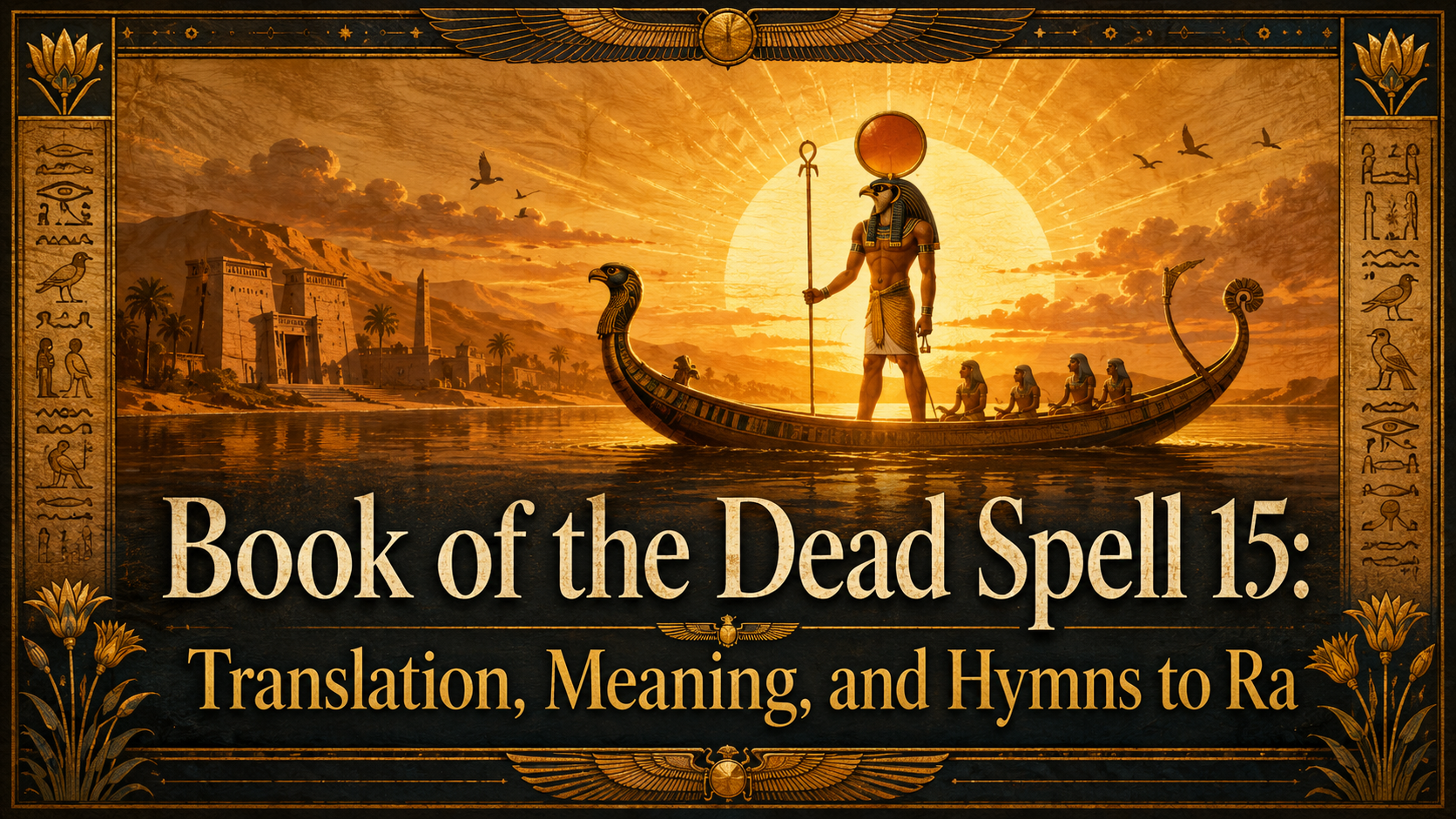
The spell celebrates the sun god’s daily journey across the sky, his entrance into the western realm at night, his victory over Apep, and his renewal at dawn. The deceased asks to accompany Ra in his sacred boats, enter the community of glorified spirits, receive food and drink, and avoid being rejected in the afterlife.
Its contents are commonly summarized as:
Hymns to the sun god Ra
More specifically, the later form of Spell 15 contains:
- A hymn to Ra at his rising
- A litany to Ra as he sets in the Land of Life
- A hymn to Ra at sunset
- A hymn to Atum at sunset
- A concluding statement about the spiritual benefits of possessing the text
Spell 15 united the deceased with the complete solar cycle. Sunrise promised rebirth, the daytime voyage promised divine companionship, and sunset opened the road into the hidden realm where regeneration took place.
What Is Book of the Dead Spell 15?
Book of the Dead Spell 15 is a collection of hymns addressed to the sun god during different stages of his daily journey.
Peter Le Page Renouf and Édouard Naville divide it into four principal compositions:
- Hymn I: A Hymn to Ra at His Rising
- Litany: Adoration of Ra as He Sets in the Land of Life
- Hymn II: A Hymn to Ra at His Setting
- Hymn III: A Hymn to Atum at His Setting
The arrangement familiar from later Books of the Dead was assembled from texts that had originally circulated independently. Renouf and Naville observed that the later version represented in the Turin Book of the Dead was not an ancient, fixed composition. It brought several separate solar hymns together under one chapter number.
This makes Spell 15 fundamentally different from a spell such as Spell 6, whose purpose and wording center on one clear command to a shabti.
Spell 15 is better understood as a solar hymn collection.
Is There One Standard Version of Spell 15?
No. Different Book of the Dead manuscripts contain different hymns, arrangements, and wording under the number now called Spell 15.
Renouf and Naville explain that the chapter in its later form was assembled from four previously independent texts. They found enough variation among the surviving copies to publish four forms of the sunrise hymn and three forms of the sunset hymn.
This means there was no single universal version recited by every ancient Egyptian.
A manuscript might contain:
- One sunrise hymn
- Several solar hymns
- A litany
- A sunset hymn
- A hymn to Atum
- A selection arranged differently from another papyrus
- A personalized version using the deceased’s name
The title Spell 15 is therefore a modern organizational label covering a family of related solar compositions.
How Old Is Spell 15?
The ideas within Spell 15 are older than the final arrangement of the chapter.
Renouf and Naville note that the solar imagery and expressions are common in religious texts of the Eighteenth and Nineteenth Dynasties. The sunrise hymn, litany, and sunset hymn survive in forms dating back at least to the Nineteenth Dynasty. The hymn to Atum at sunset was not represented by an equally early copy in the material available to them.
The later standardized chapter was therefore assembled from traditions with different histories.
This is common in the Book of the Dead. Its spells developed over centuries and could be expanded, combined, rearranged, or rewritten by different scribal workshops.
The Papyrus of Ani and Spell 15
The Papyrus of Ani preserves an important version of the sunrise hymn.
Renouf and Naville used the Papyrus of Ani as the primary basis for their translation of Hymn I because it was the only early copy available to them that presented the hymn in the form later treated as standard.
This does not mean Ani’s version was the original form of Spell 15. It means that its arrangement most closely resembles the version adopted in later recensions.
The Papyrus of Ani is especially valuable because it demonstrates that solar hymns were personalized for an individual deceased person. Wherever a translation uses [Name], the manuscript would insert the name and titles of its owner.
The Title of Book of the Dead Spell 15
Unlike many earlier spells, Spell 15 does not have one simple title describing a single action.
Its principal headings include:
A Hymn to Ra at His Rising
Adoration of Ra as He Sets in the Land of Life
A Hymn to Ra at His Setting
A Hymn to Atum at His Setting
Spell 15 (or chapter 15 of the Book of the Dead) can accurately be described as: Hymns to Ra at sunrise and sunset.
The title reflects the central purpose of the composition. The deceased praises the sun god at the beginning and end of his visible journey and asks to participate in the divine cycle.
English Translation of Book of the Dead Spell 15
The following reader-friendly translation is based on the composite version published by Renouf and Naville. It preserves the structure of their chapter while modernizing its language. Because surviving manuscripts vary, this should be described as a translation of one composite form of Spell 15, not the only possible version.
Would you like to hear what Hymn I might have sounded like (the translated version).
The word [Name] represents the deceased person named in an individual manuscript.
Hymn I: A Hymn to Ra at His Rising
Praise to you, Ra,
when you rise upon the eastern horizon.Those who worship you rejoice at your appearance.
You rise, shine, and bring light to the Two Lands.Your mother Nut receives you,
and the gods welcome your beauty.May the soul of [Name] go forth with you into heaven.
May [Name] travel in the morning boat
and complete the journey in the evening boat,until reaching the imperishable stars of heaven.
The Deceased Addresses the Rising Sun
Hail to you, Horus of the Two Horizons,
Khepri who came into being by himself.Beautiful is your rising from the horizon
as your rays illuminate the Two Lands.All the gods rejoice when they see you,
king of heaven, crowned in divine power.Thoth stands at the prow of your boat
to destroy your enemies.Those who dwell in the Duat
come forward to meet your majesty
and behold your beautiful form.I also come to you
so that I may be with you
and see your solar disk every day.Do not detain me.
Do not drive me away.Let my limbs be renewed
as I behold your glory,just as the limbs of those
who served you upon earth are renewed.I am one of those
who honored you during life.Let me reach the Land of Ages.
Let me enter the Land of Eternity,for you, my lord,
have prepared them for me.
Ra’s Daily Journey
Hail to you who rise from the horizon
as Ra united with Ma’at.You cross heaven in peace,
and all people see you
as you move forward.After being hidden from them,
you reveal yourself again
at the dawn of every day.Swift is the boat beneath your majesty.
Your rays shine upon human faces.
Your golden brilliance cannot be counted,
and your beams cannot be fully described.You rise alone in the sky.
Let me advance as you advance,
without being stopped,O Ra, whom no one can overtake.
Your journey is mighty.
In a single moment
you cross millions of measures
before entering your rest.You complete the hours of the night
according to the order you established.When the hours are complete,
the day begins.You appear in your appointed place
as Ra rising from the horizon.
The Deceased Asks for Eternal Life
I worship you when you shine
and praise your appearance at dawn.You come forth in glory,
creating and forming your own body,giving birth to yourself
without weariness,as Ra rising in heaven.
Let me reach the eternal sky
and the dwelling of your servants.Let me be united
with the venerable and powerful spirits
of the Netherworld.Let me come forth with them
to behold your glory.When you shine at evening
and your mother Nut embraces you,I raise my hands in worship
as you turn your face toward the West.You are the one who created eternity.
I have placed you within my heart forever,
for you are mightier than all the gods.
Ra as Creator and Sustainer
Praise to you
who rise from the Golden One
and give light to the earth
on the day of your birth.Your mother brings you forth in her hands
so that you may illuminate
everything reached by the solar disk.Mighty illuminator,
you rise into the sky
and sustain humankind through your waters.You bring celebration
to every district, town, and temple.You bring forth food, nourishment,
and everything pleasing.Mighty one, ruler of rulers,
you protect your dwelling places from evil.Glorious are you in the evening boat.
Radiant are you in the morning boat.Glorify [Name] in the Netherworld.
Let [Name] enter Amenta
without fault and free from wrongdoing.Place [Name] among the faithful
and venerable spirits.Unite [Name] with the souls of the Netherworld.
Let [Name] sail through the Field of Reeds
after a joyful journey.
The Deceased Joins the Solar Boat
Come forth into heaven.
Sail across the firmament
and join the company of the stars.May greetings be offered to you in the boat.
May invocations be spoken for you
in the morning boat.Behold Ra within his sacred vessel,
and worship his disk every day.See the fish that travel before his boat
through the emerald waters.Let Apep fall helpless
when he plans destruction against me.Let his spine be struck and broken.
Ra comes forth with a favorable wind.
The evening boat moves swiftly
and reaches its harbor.The crew of Ra rejoices
when they behold him.The Mistress of Life is pleased
when the enemy of her lord is defeated.Behold Horus standing at the lookout of the boat,
with Thoth and Ma’at beside him.
All the gods rejoice
when they see Ra arriving in peace
to restore life to the hearts
of the glorified spirits.[Name] is among them.
This sunrise hymn presents the deceased as a member of Ra’s divine company. The person is no longer confined to the tomb but travels with the solar god through heaven and the Duat.
The Litany: Ra Setting in the Land of Life
The hymn is followed by a series of invocations praising Ra in his evening form.
Praise to you
who come as Atum
and create the company of the gods.Praise to you,
Soul of Souls,
majestic in Amenta.Praise to you
who stand above the gods
and illuminate the Duat with your glory.Praise to you
who appear in splendor
and travel within your solar disk.Praise to you,
mightier than the gods,
crowned in heaven
and king within the Duat.Praise to you
who open the Duat
and arrange all its doors.Praise to you,
chief among the gods
and judge of words in the Netherworld.Praise to you
who dwell within your hidden place
and stir the Duat with your radiance.Praise to you,
great and mighty one,
before whom enemies fall.Praise to you
who slaughter the rebels
and destroy Apep.
After each invocation, the litany asks:
Give the sweet northern breeze
to [Name].
The chapter then describes the western sun illuminating the Duat and shining into the tombs of the dead:
Horus opens the way.
The great and mighty one
divides the lands
and rests within the Mountain of the West.He lights the Duat with his glory
and shines into the burial chambers
of the hidden souls.By casting destruction against the enemy,
you have defeated every adversary of [Name].
The northern breeze represented fresh air, relief, and renewed life. Asking Ra to provide it ensured that the deceased could breathe and enjoy the pleasant conditions of eternal existence.
Hymn II: A Hymn to Ra at His Setting
Praise to you, Ra.
Praise to you, Atum,
when you come in beauty,
in manifestation, and in power.You sail across heaven.
You travel across the earth
and reach the height of the sky in glory.The two divisions of heaven bow before you
and worship you.All the gods of Amenta rejoice
at the sight of your glory.Those whose dwelling places are hidden
worship you.The great gods present offerings to you.
Those who stand upon the horizon carry you.
Those within the evening boat transport you.
They cry:
“Praise at the approach of your majesty.
Come in peace.
Welcome, lord of heaven
and king of the hidden earth.”Your mother Isis embraces you.
She recognizes you as her son,
the lord of terror and possessor of power,when you set at night
in the Land of Life.Your father Tatenen carries you.
His arms are extended behind you,
and your place upon earth is made secure.Awaken from your rest.
Your dwelling is within the western mountain.
Let me be entrusted
to the protection given to Osiris.Come, Ra-Atum,
and receive worship.Accomplish your will each day.
Grant me success
before the company of the mighty gods.Beautiful are you, Ra,
upon your western horizon,lord of Ma’at
within the horizon.Powerful and awe-inspiring are you.
Great is your love
for those who dwell in the Duat.
A rubric following the hymn states that it was to be recited when Ra set in the Land of Life, with the hands turned downward.
Why Were the Hands Turned Downward?
The gesture probably distinguished worship at sunset from other forms of adoration.
Ancient Egyptian ritual gestures could express:
- Praise
- Submission
- Mourning
- Reception of divine power
- Direction toward a particular realm
At sunset, the solar god was descending toward the western earth and the Duat. Hands directed downward may have reflected that movement.
The text confirms that Spell 15 was not merely literary. At least some versions were connected with a physical act of worship.
Hymn III: A Hymn to Atum at His Setting
Praise to Atum
as he sets in the Land of Life.I worship Atum
when he enters the western realm
and sends his rays into the Duat.Hail to you
who set in the Land of Life,father of the gods.
You are united with your mother
in the western mountain.Her hands receive you every day.
Your majesty enters
the house of Sokar.Rejoice,
for the doors of the horizon are opened
when you set in the Mountain of the West.Your rays travel across the earth
and illuminate those who dwell in Amenta.Those in the Duat worship you loudly
and are filled with hope
when they see you each day.You permit the gods
who follow in your company
to sit upon the earth.O majestic soul
who brings forth the gods
and clothes them in your powers,unknowable and ancient one,
mighty in mystery,let your beautiful face
show favor toward [Name],O Khepri, father of the gods.
The Closing Promise of Spell 15
The chapter ends with a statement about the power of possessing the text:
Through this book,
freedom from destruction is granted forever.Upon it I take my stand.
The one who wrote it
also spoke its words,
and his heart rests upon its reward.Let bread and drink
be given to me in abundance.Let this book accompany me
after my life.
The ending transforms the hymns themselves into funerary protection.
The deceased does not merely praise Ra. Possessing, knowing, and speaking the hymns provides:
- Protection from destruction
- Bread and drink
- Access to Ra
- A place among the glorified spirits
- Safe travel in the solar boats
- Continued existence after death
What Does Book of the Dead Spell 15 Mean?
Spell 15 unites the deceased with the sun’s complete daily cycle. The sun appears to be born each morning, travels through the sky, enters the western horizon at sunset, crosses the hidden realm, and returns at dawn.
For ancient Egyptians, this repeated journey demonstrated that disappearance did not mean final destruction.
The deceased hoped to share in the same pattern:
- Rise with Ra at dawn
- Travel in the solar boat
- Receive recognition from the gods
- Enter the West without harm
- Cross the Duat safely
- Defeat hostile forces such as Apep
- Receive renewal during the night
- Emerge again with the morning sun
The hymns transform the deceased from an observer of the sun into one of Ra’s companions.
Why Is Spell 15 a Hymn Rather Than a Command?
Many Book of the Dead spells command an object or hostile being:
- A shabti is ordered to work.
- Apep is ordered to retreat.
- An enemy is told that escape is impossible.
- A gate is required to open.
Spell 15 follows a different strategy.
The deceased praises Ra, describes his divine powers, and asks to share in the benefits of his journey.
Praise creates a relationship between the speaker and the god.
By accurately describing Ra’s identity and cosmic role, the deceased demonstrates religious knowledge and alignment with divine order.
The hymn says, in effect:
I know who you are, what you do, and how you sustain creation. Accept me among those who travel with you.
Why Was Sunrise Important to the Deceased?
Sunrise represented visible proof of rebirth.
Each morning:
- Darkness ended
- The sun returned
- The world became visible
- Human activity resumed
- Temples opened
- Life continued
- Ma’at was restored
The deceased wished to experience the same renewal.
The sunrise hymn asks that the person’s limbs be renewed and that they be allowed to see Ra’s disk every day.
This restores both the body and the senses.
The deceased can:
- See
- Travel
- Worship
- Receive light
- Join the gods
- Participate in the new day
Why Was Sunset Also Sacred?
Sunset was not simply the death of the sun.
It was the beginning of Ra’s hidden journey.
When the sun entered the West, Ra moved into the Duat, where he encountered Osiris, protected the dead, fought Apep, and prepared for renewal.
Spell 15 therefore praises Ra at sunset as well as sunrise.
The deceased needed divine help during both stages:
- Sunrise provided emergence and visible life.
- Sunset provided entry into the regenerative hidden world.
Eternal existence depended on successfully completing the entire cycle.
Why Is the West Called the “Land of Life”?
The hymns call the western realm the Land of Life, even though the West was associated with burial and death. This apparent contradiction expresses a central principle of Egyptian funerary religion.
The West contained:
- Tombs
- The entrance to the Duat
- Osiris
- The blessed dead
- The place of solar regeneration
- The realm from which renewed life emerged
For those who failed in the afterlife, the West could be dangerous. For the justified deceased, it became the region where death was transformed into life. Calling it the Land of Life emphasizes the successful outcome rather than the condition of burial.
Ra, Atum, Khepri, and Horus of the Horizons
Spell 15 addresses the sun through several divine names and forms.
Ra
Ra represents the visible sun and the divine power traveling through heaven.
Atum
Atum, called Tmu in older translations, is associated with the setting sun, completion, creation, and the western phase of the solar cycle.
Khepri
Khepri represents emergence and becoming, especially the morning sun rising anew.
Horus of the Two Horizons
Horus of the Two Horizons represents the sun’s movement between the eastern and western horizons.
These are not necessarily four unrelated gods within the hymn. They are different expressions of the solar power at different moments.
The deceased praises the sun as:
- Khepri at dawn
- Ra during the day
- Horus across the horizons
- Atum at sunset
Why Does the Spell Mention the Solar Boats?
Spell 15 refers to the sun god traveling in a morning boat and an evening boat. Renouf and Naville identify these as the boats used during different stages of Ra’s journey. The deceased asks to travel in both so the entire solar cycle can be completed.
The boats are commonly known as:
- The Mandjet or morning boat
- The Mesektet or evening boat
Older translations and transliterations vary.
Traveling in the solar boat gave the deceased:
- Divine protection
- A recognized place among the gods
- Transportation through heaven and the Duat
- Participation in Ra’s rebirth
- Protection against hostile beings
Who Traveled With Ra?
Spell 15 places several gods around the solar boat.
These include:
- Thoth, standing at the prow and defeating enemies
- Ma’at, representing truth and cosmic order
- Horus, standing as lookout
- Divine sailors and attendants
- Glorified spirits
- Beings who transport the sun through the sky and Duat
The boat was a moving divine community.
The deceased asks to become one of its accepted members.
Why Does Thoth Stand at the Prow?
Thoth was associated with:
- Sacred knowledge
- Effective speech
- Judgment
- Calculation
- Celestial cycles
- Defeat of divine enemies
At the prow, he helps guide and protect the boat.
His presence means the journey is supported by knowledge, correct order, and magical authority.
The deceased benefits from that protection by joining Ra’s company.
Why Are Thoth and Ma’at Beside Horus?
The hymn describes Horus at the lookout with Thoth and Ma’at beside him.
Together they represent:
- Horus: Royal and protective power
- Thoth: Knowledge, speech, and judgment
- Ma’at: Truth, justice, and cosmic balance
Ra’s journey succeeds because strength, knowledge, and order work together.
The deceased seeks a place within that same structure.
Apep in Spell 15
Spell 15 refers to the defeat of Apep, the serpent who attempted to stop Ra’s journey. The deceased asks that Apep fall when he plans destruction and celebrates the gods who slaughter the rebels and annihilate the serpent.
Apep represents:
- Chaos
- Darkness
- Obstruction
- Spiritual paralysis
- The collapse of cosmic order
- The possibility that sunrise might fail
Ra’s victory over Apep guarantees that the solar journey continues. For the deceased, this victory also ensures that personal rebirth cannot be blocked.
How Is Spell 15 Connected to Spell 7?
Spell 7 directly confronts Apep and prevents his poison or power from immobilizing the deceased.
Spell 15 places that conflict within Ra’s larger daily journey.
Spell 7
The deceased personally declares that Apep cannot paralyze or poison them.
Spell 15
The deceased joins the company of Ra and celebrates the divine defeat of Apep.
Spell 7 provides individual protection. Spell 15 places the deceased on the victorious side of the cosmic battle.
Why Does the Deceased Ask for Renewed Limbs?
The sunrise hymn asks that the speaker’s limbs be renewed by beholding Ra’s glory.
Death had rendered the body still.
Renewed limbs meant that the deceased could:
- Stand
- Walk
- Sail
- Raise the hands in worship
- Receive offerings
- Participate in divine life
The sun’s light is presented as regenerative.
Seeing Ra does not merely inspire the deceased. It restores the person physically and spiritually.
Why Does the Spell Ask for Bread and Drink?
The closing lines ask for armfuls of bread and drink. Food remained essential after death. The deceased hoped to receive:
- Bread
- Beer
- Water
- Meat
- Fowl
- Fruit
- Incense
- Other funerary offerings
Nourishment proved that the person continued to exist as an active being rather than as an empty shadow.
The spell connects solar companionship with material abundance. By joining Ra, the deceased gains both divine status and the food necessary to sustain eternal life.
What Is the Field of Reeds?
The sunrise hymn asks that the deceased sail through the region called Aarru, commonly known as the Field of Reeds.
This was an idealized afterlife landscape resembling a perfected Egypt.
It offered:
- Fertile fields
- Abundant crops
- Waterways
- Food and drink
- Peace
- Familiar forms of life
- Freedom from ordinary suffering
The deceased wished to reach it after a joyful journey.
Spell 15 therefore connects the cosmic solar voyage with the more personal hope of living in an abundant afterlife.
What Are the Imperishable Stars?
The deceased asks to reach stars that do not set.
These were stars near the northern celestial pole that remained visible throughout the year and did not disappear below the horizon.
Ancient Egyptians associated them with permanence and immortality.
To join the imperishable stars meant becoming:
- Eternal
- Unchanging
- Free from destruction
- Present in the divine sky
- Beyond the ordinary cycle of human death
Spell 15 combines two forms of immortality:
- Repeated renewal with the sun
- Permanent existence among the imperishable stars
Ra and Osiris in Spell 15
Although Spell 15 is primarily solar, Osiris remains important. The deceased is repeatedly called the Osiris [Name], identifying the person with the resurrected ruler of the dead.
The sunset hymn also refers to protection entrusted to Osiris. The chapter therefore combines two major models of eternal life:
Solar Rebirth
Ra disappears, crosses the Duat, and rises again every morning.
Osirian Resurrection
Osiris dies, is restored, and rules eternally in the realm of the dead.
The deceased seeks both.
The person becomes Osiris through death and resurrection while traveling with Ra through repeated solar renewal.
Did Spell 15 Have Illustrations?
Yes. Unlike the immediately preceding spells, Spell 15 could be accompanied by solar vignettes. The Renouf and Naville index associates the chapter with several illustrated plates.
Ancient illustrations could show:
- The deceased worshipping the rising sun
- Ra traveling in a solar boat
- The solar disk
- Baboons praising the sunrise
- Ra in morning or evening forms
- The western horizon
- Divine beings accompanying the boat
Because Spell 15 varied across manuscripts, its illustrations also differed. There was no single mandatory image representing every version.
Was Spell 15 Recited at Sunrise and Sunset?
The hymns are explicitly connected with sunrise and sunset. One rubric instructs that the sunset hymn be spoken when Ra sets in the Land of Life, accompanied by a hand gesture. This strongly suggests ritual performance tied to a particular time of day.
The hymns may have functioned:
- During funerary ceremonies
- As daily temple or tomb recitations
- As words spoken by the deceased in the afterlife
- Through their permanent written presence on papyrus
Not every surviving copy includes identical performance instructions, so one universal ritual should not be assumed.
Is Spell 15 Really a Magical Spell?
Modern readers often separate prayer, hymn, and magic into distinct categories. Ancient Egyptian funerary religion did not always make those divisions in the same way. Spell 15 is a hymn because it praises the god. It is also magically effective because its words are intended to produce results.
Through praise, the deceased gains:
- Access to Ra
- A place in the solar boat
- Protection from enemies
- Renewed limbs
- Food and drink
- Entrance into Amenta
- Membership among the glorified spirits
- Freedom from destruction
The hymn does not merely describe salvation. It helps bring that salvation into existence.
Why Is Spell 15 Important?
Spell 15 brings together many of the Book of the Dead’s central themes:
- Going forth by day
- Solar rebirth
- Eternal movement
- Divine companionship
- Defeat of Apep
- Renewal of the body
- Food and drink
- Admission to the Duat
- The union of Ra and Osiris
- Life among the stars
- Freedom from destruction
It also demonstrates that the Book of the Dead was not a single fixed composition. Spell 15 grew from several independent hymns and could differ substantially between manuscripts. Its history reveals how Egyptian funerary texts remained adaptable while preserving familiar theological ideas.
Is Book of the Dead Spell 15 the Same as Coffin Text Spell 15?
No. The Book of the Dead and the Coffin Texts use independent modern numbering systems. Book of the Dead Spell 15 consists of hymns to Ra and Atum at sunrise and sunset. Coffin Text Spell 15 is a separate Middle Kingdom composition.
A shared number does not indicate that the texts are the same. The solar beliefs found in Spell 15 have older roots in the Pyramid Texts and Coffin Texts, but that general continuity does not make the independently numbered spells identical.
How Reliable Is the Translation of Spell 15?
The overall themes are clear, but there is no single definitive translation applying to every manuscript.
The reasons include:
- Spell 15 contains several originally independent texts.
- Surviving copies use different arrangements.
- Sunrise and sunset hymns exist in multiple forms.
- Some later wording was corrected by editors using earlier manuscripts.
- Divine names and obscure phrases vary.
- Scribes composed or adapted parts of the hymns freely.
Renouf and Naville based their composite translation on the later arrangement while correcting it with earlier texts where possible. They used the Papyrus of Ani as the foundation of the sunrise hymn.
Spell 15 Untranslated Transliteration
The translated version of the text above is a modern English version, often referred to as pseudo-Egyptian. But what did they look (and sound) like?
The original texts were written primarily in hieroglyphic or hieratic script. I thought you might like to see a version that is an untranslated transliteration. A pronounceable form of the original text.
- Scholarly transliteration: dwꜣ Rꜥ ḫft wbn.f
- Transliteration: Dua Ra khefet weben-ef
For the purpose of this hymn, I used the name Tira; they would insert the name of the deceased.
Spell 15: Hymn 1 (Hymn to Ra at His Rising)
Dua Ra khefet weben-ef
Em akhet iabetet net pet
In Wesir sesh netjer-hetep
En netjeru nebu, [Tira]
Djed-ef:
Inedj her-ek
Iti em Khepri
Khepri em qema netjeru
Kha-ek
Weben-ek
Pesed mut-ek
Kha-ti em nesu netjeru
Iri en-ek mut Nut
Awy-es em irit nini
Shesep-tu Manu em hetep
Hept-tu Ma’at em terewy
Di-ef akh
User
Em maa-kheru
Peret em ba ankh
Er maa Heru-Akhety
En ka en Wesir
Sesh [Tira]
Maa-kheru kher Wesir
Djed-ef:
Ia netjeru nebu
Nu Het-Ba
Wedjau pet ta
Em mekhati
Diu kau
Djefau
Ia Ta-Tjenen
Wa
Iri remetju
Pesedjet netjeru
Resi
Mehetet
Imentet
Iabetet
Ima dua en Ra
Neb pet
Ity
Ankh
Wedja
Seneb
Qema netjeru
Dua-ten su
Em iriw-ef nefer
Em kha-ef
Em Manedjet
Imyu heru
Dua-tu
Iriyu ta
Dua-tu
Sesh en-ek Djehuty
Ma’at
Hru neb
Khefti-ek
Redit en sedjet
Sebi kher
Dawy-ef kesu
Nehem en Ra
Redwy-ef
Mesu bedjesh
Nen wen-sen
Het Ser
Em heb
Kheru nehemu
Em aset weret
Netjeru em haa
Maa-en-sen Ra
Em kha-ef
Setut-ef
Her bah tawy
Wedja hem-netjer pen shepes
Khenem-ef ta en Manu
Hedj ta
Er meset-ef
Ra neb
Peh-ef
Er aset-ef en sef
Hetep-ek en-i
Maa-i neferu-ek
Wedja-i her ta
Hu-i Apep
Em at-ef
Maa-i Abtu
Em sep-ef
Maa-i Ant
Em shenu-ef
Maa-i Heru
Em demu
Djehuty
Hena Ma’at
Her idwy-ef
Seshep-i hatu
En Mesektet
Seshep-i pehwy
En Manedjet
Di Ra maa-i Aten
Maa-i Iah
Nen hetem
Ra neb
Per ba-i
Er shemet
Er bu neb
Merer-ef
Neset ren-i
Gem-ef
Em sekhau
Redit en-i hetep
Em-bah
Mi shemsu Heru
Iri en-i aset
Em wiya
Em hru
Peret netjer
Shesep-i
Em-bah Wesir
Em ta en maa-kheru
En ka en Wesir [Tira]
Maa-kheru
The Meaning of Spell 15 in Simple Terms
Book of the Dead Spell 15 connects the deceased with Ra at every stage of the sun’s journey. At dawn, the deceased praises Ra’s rebirth and asks for renewed limbs. During the day, the speaker seeks a place in the solar boat and among the imperishable stars. At sunset, the deceased follows Ra into the western realm, where gods and spirits welcome him.
During the hidden journey, Apep and the forces of chaos are defeated. The deceased then shares in the sun’s renewal, receives food and drink, and is protected from eternal destruction.
The spell’s message can be summarized as:
As Ra rises, travels, sets, and rises again, I will follow him. I will not be rejected or destroyed. I will journey with the gods, receive renewed life, and return from darkness with the sun.
Spell 15 turns the daily movement of the sun into a promise of personal immortality.
Frequently Asked Questions About Book of the Dead Spell 15
What is Book of the Dead Spell 15?
Spell 15 is a collection of hymns praising Ra and Atum at sunrise and sunset. It asks that the deceased be allowed to accompany the sun god and share in his daily renewal.
What is the title of Spell 15?
There is no single short title. Its principal sections include A Hymn to Ra at His Rising, A Hymn to Ra at His Setting, and A Hymn to Atum at His Setting.
Is Spell 15 one fixed hymn?
No. The later chapter combines several originally independent compositions. Manuscripts preserve different sunrise hymns, sunset hymns, and arrangements.
Was Spell 15 included in the Papyrus of Ani?
Yes. The Papyrus of Ani contains an important form of the sunrise hymn and served as the basis for Renouf and Naville’s translation of Hymn I.
Why does the spell praise Ra at sunrise?
Sunrise represented rebirth, renewed light, restored movement, and the defeat of darkness.
Why does it praise Ra at sunset?
Sunset marked Ra’s entrance into the Duat, where he underwent regeneration and prepared to rise again.
Who is Atum in Spell 15?
Atum is the creator god associated here with the setting sun and the completion of the solar journey.
Who is Khepri?
Khepri is the form of the sun connected with becoming, emergence, and rebirth at dawn.
Why does the deceased want to enter Ra’s boat?
The solar boat provides safe travel through heaven and the Duat, divine companionship, and participation in Ra’s rebirth.
Why is Apep mentioned?
Apep is the serpent of chaos who tries to stop the solar journey. His defeat ensures that Ra and the deceased can continue toward renewal.
What are the imperishable stars?
They are northern stars that never appeared to set. Egyptians associated them with permanence and eternal life.
Why does the spell ask for bread and drink?
Nourishment allowed the deceased to continue living as an active spirit and benefit from funerary offerings.
Did Spell 15 have illustrations?
Yes. Solar vignettes could accompany the hymns, although their form varied between manuscripts.
Is Book of the Dead Spell 15 the same as Coffin Text Spell 15?
No. They belong to different collections with separate modern numbering systems.
Book of the Dead Spell 15 celebrates the sun as the clearest visible model of life after death. Ra rises from the eastern horizon, crosses the sky, enters the West, travels through the hidden realm, defeats Apep, and returns at dawn.
The deceased asks to follow every part of that journey. The speaker wishes to see Ra’s disk, sail in his boats, stand among the stars, enter Amenta without wrongdoing, receive bread and drink, and live among the glorified spirits.
The hymns promise that darkness is only one stage of the journey. As long as Ra rises again, the deceased can rise with him.