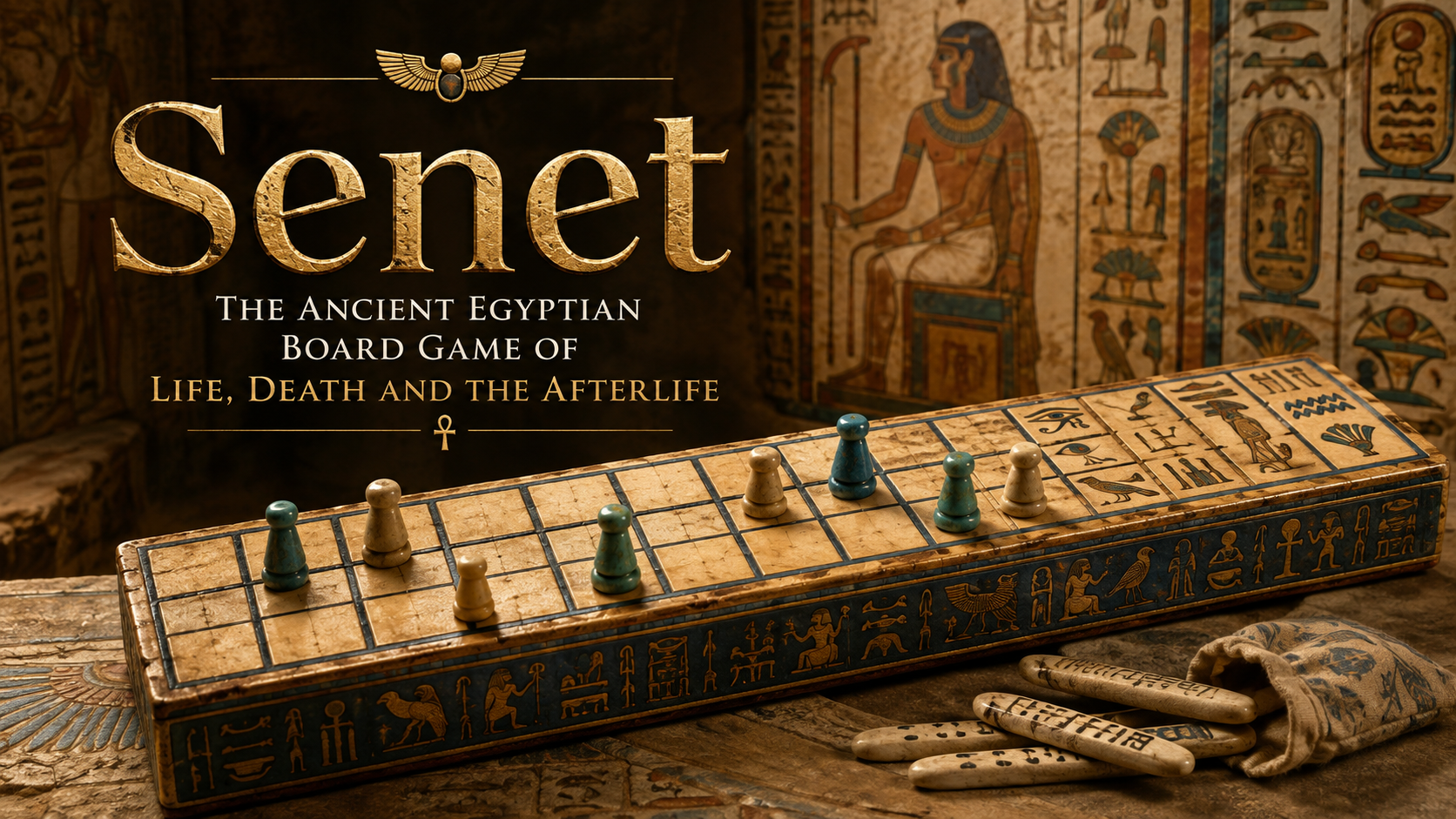

Senet is often described as the oldest board game in the world, though that claim needs some qualification. It is unquestionably one of humanity’s earliest known board games.
Fragmentary evidence associated with Senet has been discovered in First Dynasty contexts around 3100 BCE. Scholar Walter Crist notes ivory squares from Tomb M1 at Abu Rawash dating to the First Dynasty as probably the earliest archaeological appearance of Senet in Egypt.
That means Egyptians were playing something recognizable as Senet roughly 5,000 years ago.
Some popular sources assign even earlier dates to the game, but identifying the world’s single “oldest board game” is difficult. Other ancient Egyptian games, particularly Mehen, also have extremely early archaeological evidence. It is therefore more accurate to describe Senet as one of the world’s oldest known board games.
The Earliest Picture of Senet
One of the most important pieces of evidence comes from the tomb of Hesy-Re, a high-ranking Egyptian official of the Third Dynasty. His tomb at Saqqara contained a representation of a Senet board accompanied by game pieces and throwing sticks.
This dates to roughly the 27th century BCE, making it the earliest secure and detailed representation of Senet.
Senet continued appearing in Egyptian tomb scenes during the Old Kingdom. A Fifth Dynasty tomb belonging to the official Rashepses, for example, also includes people playing the game.
By this point, Senet was clearly well established.
Senet During the Middle and New Kingdoms
More Senet boards survive from the Middle and New Kingdoms, and the game boxes themselves became increasingly elaborate.
Some were beautifully decorated objects made for wealthy owners. Others combined two different games in a single box.
One side might contain the familiar 30-square Senet board while the opposite side contained a 20-square game that had been introduced into Egypt from the ancient Near East. A drawer inside the box could hold the gaming pieces, casting sticks and knucklebones.
This is also when something remarkable happened. Senet stopped being merely a board game. It became a model of the afterlife.
Senet and the Egyptian Afterlife
During the New Kingdom, Senet acquired increasingly strong religious significance.
To understand why, imagine the board not simply as 30 spaces but as a miniature version of the dangerous journey awaiting a person after death.
Ancient Egyptians believed that death was followed by a complicated passage through another realm. The deceased had to overcome obstacles, encounter gods and supernatural beings, avoid destruction, and ultimately achieve a transformed state of eternal existence.
That sounds remarkably similar to a game in which pieces must travel along a dangerous path, survive hazardous spaces, and finally escape the board.
Senet became a metaphor for that journey.
The Metropolitan Museum notes that the game’s obstacles came to correspond with hazards encountered during the journey into the afterlife.
The symbolism became increasingly explicit. Religious interpretations connected individual spaces with gods and stages in the deceased person’s journey.
Winning Senet could therefore represent something far greater than defeating another player. It could represent defeating death.
Senet in the Book of the Dead
Senet is even connected with one of ancient Egypt’s most famous collections of funerary texts: the Book of the Dead.
Spell 17 contains a reference to playing Senet as part of the deceased person’s ability to go forth and exist as a living ba after death.
Research published by the Institute for the Study of Ancient Cultures at the University of Chicago explains that the Senet ritual associated with Spell 17 was connected with the ba’s ability to move through the necropolis and between the realms of the living and the dead.
By the later New Kingdom, the symbolism became even more detailed. Senet could mirror the sun god’s nocturnal journey through the underworld and his triumphant rebirth.
The game had become a miniature cosmic drama.
Queen Nefertari Playing Senet
Perhaps the most famous ancient image of Senet comes from the magnificent tomb of Queen Nefertari, the Great Royal Wife of Ramesses II.
On the wall of her tomb in the Valley of the Queens, Nefertari is shown sitting before a Senet board. But something is unusual. There is nobody sitting across from her. She appears to be playing against an invisible opponent.
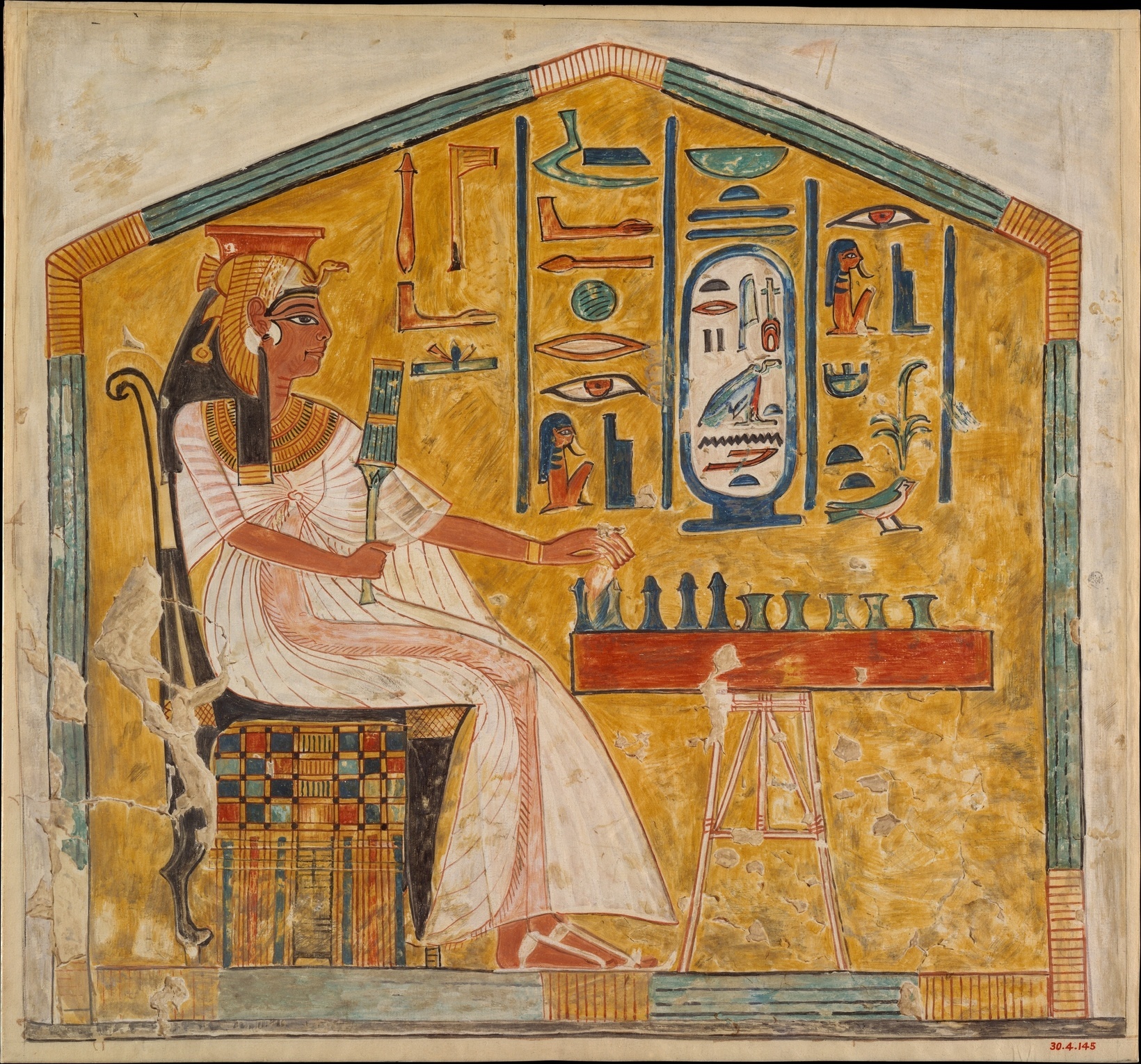
The scene was not simply intended to show one of Nefertari’s favorite hobbies. In its funerary setting, the game represented the queen’s passage into the afterlife and her ability to overcome the obstacles standing between her and eternal existence.
It is one of the clearest examples of how an everyday Egyptian pastime had transformed into a religious symbol.
Senet Games Found in Tutankhamun’s Tomb
The most famous actual Senet games are associated with Tutankhamun. When Howard Carter discovered Tutankhamun’s tomb in the Valley of the Kings in 1922, gaming equipment was among the thousands of objects preserved inside.
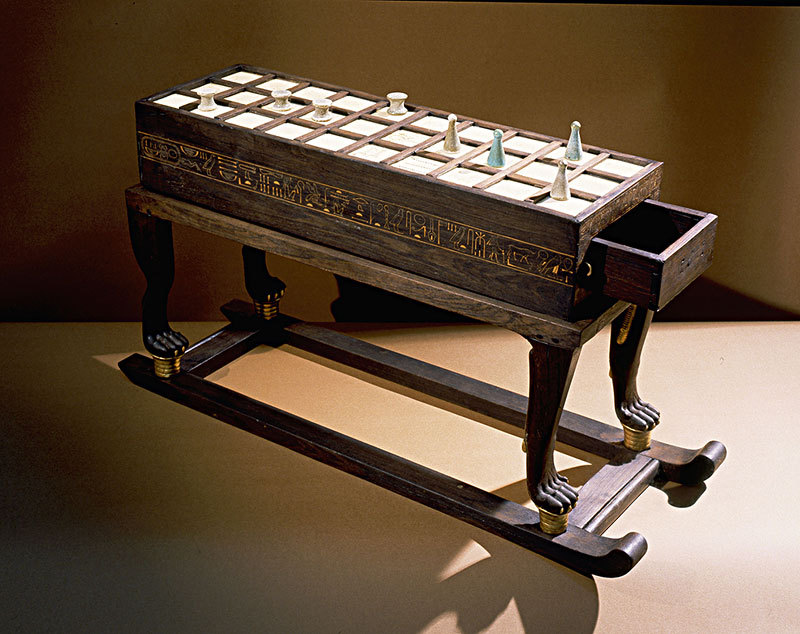
The Metropolitan Museum states that Tutankhamun was buried with no fewer than five game boxes associated with these ancient board games.
One particularly spectacular example combines a Senet board with another game on its reverse.
The Senet surface contains the standard 30 squares. The board stands on an elaborate ebony support with animal-shaped legs attached to sled-like runners. Ivory, ebony, faience, and gold were incorporated into the object, and a drawer stored the gaming pieces and casting equipment.
Tutankhamun’s Senet games demonstrate that the game could be a luxury possession worthy of a king. Their presence inside his tomb also suggests something deeper.
The young pharaoh had been provided with almost everything he might require in eternity, from furniture and clothing to food, weapons, chariots, and ritual equipment.
Senet belonged there too.
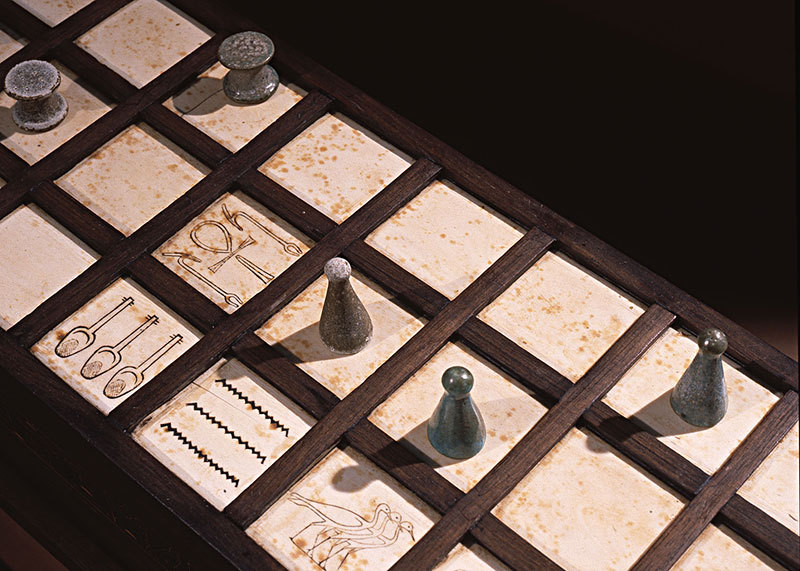
This is from the Tomb of Tutankhamun (KV62), in the Valley of the Kings, West Thebes. This Senet board is now in the Egyptian Museum in Cairo.
Other Senet Boards Found in Egyptian Tombs
Tutankhamun’s games are the most famous, but archaeologists have discovered Senet equipment in many other Egyptian burials.
A Senet Board From Abydos
A New Kingdom Senet game now in the Metropolitan Museum was discovered in a tomb at Abydos.
The surviving board contains blue faience inlays, and gaming pieces were found with it. One group is spool-shaped while another is conical, allowing the pieces belonging to opposing players to be distinguished.
The burial also contained a scarab bearing the cartouche of Thutmose III.
The original wood had largely disappeared, so conservators mounted the ancient faience elements on a modern reconstruction.
A Senet Game Found Inside a Coffin at Thebes
Another gaming box, dating to approximately 1580 to 1458 BCE, was discovered at Thebes in the Asasif. Remarkably, it was found inside a coffin.
One side contained the Egyptian Senet board of 30 squares, while the other was designed for Twenty Squares. Eight original game pieces and two gaming bones survived. The box also had a drawer that could be secured with an ivory bolt.
Gaming Pieces From the Tomb of Neferkhawet
The Metropolitan Museum’s excavations of Neferkhawet’s family tomb at Thebes produced another intriguing discovery. Inside the coffin of an unidentified woman were ten gaming pieces, five conical and five spool-shaped.
They were probably used for Senet and Twenty Squares.
No recognizable game box remained, but the coffin had suffered serious damage from rot and insects. The wooden board may simply have decayed beyond recognition.
These discoveries help explain why Senet is so valuable to archaeologists. It survives not merely in royal treasures but in different forms across Egyptian burial culture.
Did Ordinary Egyptians Play Senet?
Almost certainly.
Elaborately decorated Senet boxes naturally survive more visibly in museums, particularly those associated with wealthy Egyptians. But ancient evidence suggests that the game was played much more widely.
Some Senet boards were extremely simple. Instead of owning an expensive wooden box, a person could scratch the grid into another surface.
The Metropolitan Museum specifically contrasts elaborate gaming boxes with grids scratched into floors by Egyptians who could not afford such luxurious equipment.
Senet appears to have crossed social boundaries.
- Kings played it.
- Queens played it.
- Officials played it.
- Ordinary Egyptians played it.
And apparently ancient Egyptian artists could joke about animals playing it too.
A Lion and Gazelle Playing Senet
One of the strangest surviving images associated with Senet comes from a Ramesside papyrus discovered at Deir el-Medina. The papyrus, dating to approximately 1250 to 1150 BCE, depicts a topsy-turvy world in which animals behave like humans.
Among the scenes, a lion sits across from a gazelle playing what is probably Senet. Instead of attacking the gazelle, the lion calmly plays a board game with her.
The papyrus is now in the British Museum.
Aside from being amusing, the image demonstrates something important. Senet was so familiar to Egyptians that an artist could use it as part of a visual joke and expect viewers to understand exactly what was happening.
Was Senet a Religious Game or Just Entertainment?
It was both, depending on when and where it was being played. The earliest evidence suggests Senet began primarily as a game. Over centuries, its meaning evolved.
By the New Kingdom, religious symbolism had become deeply integrated into some Senet boards and game representations. The player’s journey could represent the ba traveling through the Duat, overcoming supernatural dangers and ultimately joining the gods.
But that does not mean Egyptians suddenly stopped playing it for fun.
A board game can have symbolic importance while remaining entertaining.
Senet’s extraordinary longevity may partly come from this combination. It could be competitive enough for two living friends to enjoy and meaningful enough to take with them into eternity.
Why Don’t We Know the Original Rules of Senet?
Ancient Egyptians left behind thousands of texts explaining religion, medicine, administration, magic, mathematics, and daily life.
Unfortunately, nobody has yet discovered The Official Rules of Senet.
The game may have been so familiar that writing down the basic instructions seemed unnecessary. Modern people rarely explain the complete rules of familiar games every time they mention chess, checkers, or backgammon.
When Senet eventually disappeared from regular use, much of that shared knowledge disappeared with it.
What survives are clues:
- Senet boards
- Playing pieces
- Throwing sticks
- Knucklebones
- Tomb paintings
- Religious texts
- Images showing games in progress
- Markings on individual board squares
Researchers combine those clues to reconstruct probable rules.
Modern Senet is therefore best understood as a scholarly reconstruction of an ancient game, not a perfectly preserved rule set handed down unchanged from the pharaohs.
Why Is Senet Important?
Senet gives us something ancient monuments often can’t. It shows ancient Egyptians playing. We usually encounter ancient Egypt through pyramids, temples, mummies, tombs, and gods. These things can make ancient Egyptian civilization seem impossibly distant.
A board game changes that.
Imagine two people sitting opposite one another more than 4,000 years ago. One throws the casting sticks. The other watches the result. A piece advances. Another gets sent backward. Someone is lucky. Someone complains.
Suddenly, ancient Egypt feels considerably more human. But Senet also captures something uniquely Egyptian. The Egyptians transformed a familiar game about successfully navigating a board into a metaphor for successfully navigating death itself.
A piece moved through danger, reached the final spaces, and left the board. The deceased moved through the Duat, overcame danger, and emerged into eternal life.
Few artifacts unite ordinary life and Egyptian religion as perfectly as Senet.
