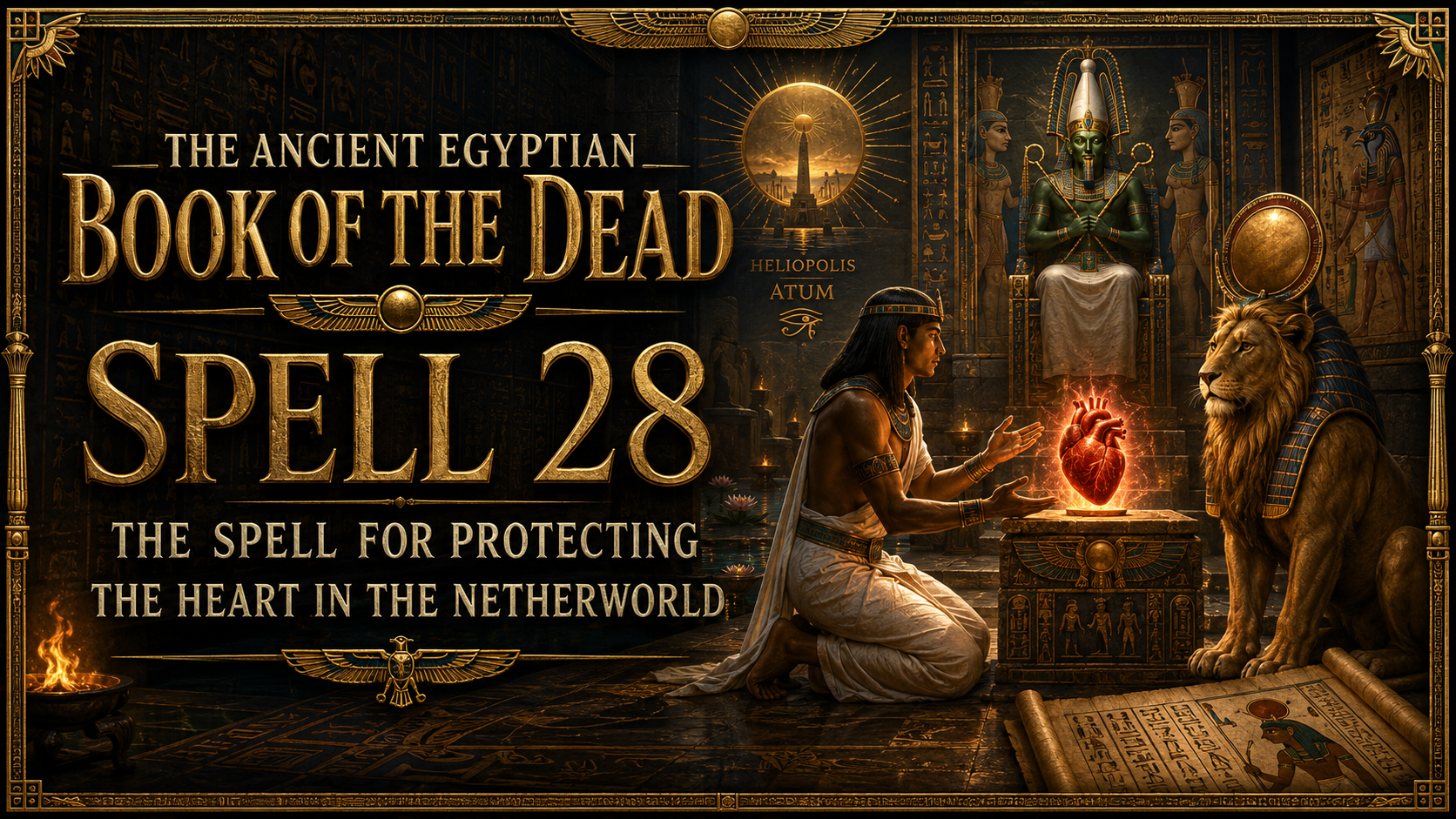
The ancient Egyptian Book of the Dead was a collection of funerary compositions intended to help the deceased survive the afterlife, recover lost faculties, avoid supernatural dangers, and remain a complete, effective being after death.
Book of the Dead Spell 28 is part of a cluster of spells devoted to one of the most important parts of the ancient Egyptian person: the heart.
Its traditional title is: Chapter whereby the Heart of a person is not taken from him in the Netherworld.
That title is almost identical to Spell 27, but Spell 28 is a different composition. It invokes a mysterious Lion-god, identifies the deceased with a solar being called Unbu, rejects the execution block, appeals to powers in Heliopolis, refers to Osiris and Set, and asks repeatedly that the deceased’s “Whole Heart” not be torn away.
Spell 28 is also unusually difficult to translate. Renouf and Naville explicitly warn that the latter half of the chapter is badly corrupt and that even ancient scribes appear to have struggled with it.
That makes it especially important to separate what the text clearly says from what remains uncertain.
In simple terms, Spell 28 declares:
My heart must not be taken from me. I reject execution, I stand under divine protection, my heart receives strength from Osiris, and it must be returned to me after accomplishing its purpose before the gods.
What Is Book of the Dead Spell 28?
Book of the Dead Spell 28 is a funerary formula designed to prevent the deceased’s heart from being removed in the Netherworld.
Renouf and Naville list it as: Chapter whereby the Heart of a person is not taken from him in the Netherworld.
It follows directly after Spell 27, which has essentially the same title, and before Spell 29, another heart-protection formula. This sequence shows how important the heart was considered. The deceased did not rely on only one spell to keep it safe. Instead, the Book of the Dead contains several different protective formulas addressing the same fundamental danger.
English Translation of Book of the Dead Spell 28
The following is a reader-friendly modernization based closely on Renouf and Naville’s text.
Because the final portion of Spell 28 is textually corrupt, this version preserves the broad meaning while avoiding pretending that every difficult phrase is certain. Renouf himself states that the chapter is “hopelessly corrupt” in places.
Spell 28: Preventing the Heart From Being Taken
O Lion-god!
I am Unbu,
and what I detest
is the block of execution.Let not this Whole Heart of mine
be torn from meby the divine powers
who are in Heliopolis.O you who clothe Osiris
and who have seen Set,O you who turned back
after striking himand accomplished his overthrow:
this Whole Heart of mine
mourns over itselfin the presence of Osiris.
Its strength comes from him,
and through prayer
it has received strength from him.The warmth and vigor of heart
have been granted to itat the appointed divine hour.
I have offered
the sacred cakes in Hermopolis.Let not this Whole Heart of mine
be torn from me.Its place is entrusted
among the gods,and may their hearts
be moved favorably toward itin the Field of Offerings,
through the years of triumph
over everything it hates,while it receives its provisions
at the appointed time.This Whole Heart of mine
is placed upon the records of Atum,who guides me
toward the caverns of Setand gives my Whole Heart back to me
after it has accomplished its desire
before the divine council
in the Netherworld.Let the sacrificial offering
and the funerary clothingbe buried by those who find them.
The first half of this translation is comparatively secure. The latter passages are far less certain because the surviving manuscript traditions became confused and contradictory.
Historical Translation of Spell 28
Renouf and Naville begin: “O Lion-god! I am Unbu, and what I abominate is the block of execution.”
The deceased then asks that the “Whole Heart” not be torn away by divine beings in Heliopolis and invokes a being connected with Osiris and the defeat of Set.
Later, the text says that the heart receives strength from Osiris and is eventually given back after accomplishing its desire before the divine council in the Netherworld.
The broad theme is therefore clear even when individual phrases are not:
The heart must remain protected, receive divine strength, complete its required role before the gods, and return safely to the deceased.
What Does Book of the Dead Spell 28 Mean?
Spell 28 protects the deceased against losing the heart after death. Its central message is similar to Spell 27, but the imagery is different.
Spell 28 connects heart protection with:
- A Lion-god
- Solar identity
- Rejection of execution
- Heliopolis
- Osiris
- The defeat of Set
- Hermopolis
- The Field of Offerings
- Atum
- A divine council
- The eventual return of the heart
The spell can be summarized as: My heart must not be seized or destroyed. It is strengthened by Osiris, recognized by the gods, recorded under Atum, and returned to me after it has fulfilled its purpose.
Why Was the Heart So Important?
The ancient Egyptian heart was closely associated with the inner person.
It could represent:
- Thought
- Memory
- Intention
- Emotion
- Moral character
- Personal identity
This helps explain why the Book of the Dead contains a whole sequence of heart spells.
Renouf and Naville’s index lists:
- Spell 26: The heart is given back
- Spell 27: The heart is not taken
- Spell 28: Another spell preventing the heart from being taken
- Spell 29: Another protection against removal
- Spell 29B: Another chapter of the heart
- Spell 30A: The heart is not kept back
- Spell 30B: The famous heart-protection formula later associated with heart scarabs
The repetition shows that losing the heart was considered a major threat to successful existence after death.
Spell 27 vs. Spell 28
Because both chapters have almost the same traditional title, readers can easily confuse them.
Spell 27
Spell 27 addresses gods who seize and reshape hearts.
It focuses on:
- Divine beings taking the heart
- Wrongdoing and forgiveness
- Hostile accusations
- The heart being identified with the heart of Thoth
- The deceased declaring mastery over the heart
Spell 28
Spell 28 has a different set of images.
It focuses on:
- A Lion-god
- Unbu
- The execution block
- Divine powers at Heliopolis
- Osiris and Set
- Strength coming from Osiris
- The Field of Offerings
- Atum’s records
- The return of the heart from the divine council
The purpose is similar. The theology and imagery are not.
Why Are There Several Spells for the Same Danger?
The Book of the Dead was not created as a single unified book by one author.
UCL explains that the modern term “Book of the Dead” refers to a repertoire of many individual compositions that were later assigned numbers by modern scholars.
Different spells could therefore address the same problem in different ways. A manuscript owner might include:
- One heart spell
- Several heart spells
- Different versions of the same general protection
Redundancy could provide additional magical security.
“O Lion-god!”
Spell 28 opens with:
O Lion-god!
The text does not make the deity’s identity entirely explicit in Renouf’s translation. Lion imagery in Egyptian religion could be associated with:
- Solar power
- Fierce protection
- Royal strength
- Destruction of enemies
What matters most here is the protective authority of the figure.
The deceased addresses a powerful divine being capable of helping prevent the loss of the heart.
Is the Lion-god Sekhmet?
The text does not say so. Sekhmet is one of Egypt’s best-known lioness deities, but Spell 28 simply invokes a Lion-god in Renouf’s translation.
It would therefore be inaccurate to identify the figure with Sekhmet as a certainty.
For an article or illustration, the safest wording is: Spell 28 opens by invoking an unnamed lion deity.
“I Am Unbu”
The deceased then declares: I am Unbu.
Renouf explains that Unbu is one of the names or epithets of a solar deity and notes that the word can also refer to a hawthorn or another flowering bush. He admits that the exact sense of the divine name is uncertain.
This uncertainty should be preserved.
A cautious interpretation is:
By identifying with Unbu, the deceased assumes a solar or regenerative divine identity, although the exact meaning of the name is unclear.
Unbu and the Sun
Renouf notes that Unbu appears as a solar divine name and even cites an older reference to “the golden Unbu.”
That makes solar symbolism plausible.
The heart is being protected within a wider framework of:
- Renewal
- Divine vitality
- Solar rebirth
- Continued life
This fits the broader Book of the Dead, where the deceased repeatedly identifies with solar gods in order to participate in the daily cycle of rebirth.
“I Abominate the Block of Execution”
The deceased says: what I abominate is the block of execution.
This is a strong declaration. Execution imagery appears elsewhere in the Book of the Dead as a threat against condemned or hostile beings.
For the deceased to reject the execution block means: I am not one of those who should be destroyed.
The speaker claims separation from the fate of divine enemies.
What Was the Execution Block?
The Book of the Dead contains imagery of supernatural punishment in which enemies may be:
- Beheaded
- Burned
- Cut apart
- Bound
- Slaughtered
The “block of execution” belongs to that larger punitive imagery. Spell 28 does not describe an earthly legal execution. It uses afterlife symbolism to express annihilation or punishment. The deceased rejects that fate.
Why Is the Execution Block Connected With the Heart?
The heart is essential to personal survival. If the deceased is treated as a condemned enemy, the heart could be seized or destroyed. By declaring hatred of the execution block, the speaker distinguishes themselves from beings destined for punishment.
The implication is: I belong among the justified dead, not among those marked for destruction.
The Divine Champions of Heliopolis
The deceased asks:
Let not this Whole Heart of mine be torn from me by the divine Champions in Heliopolis.
Renouf’s note points out that the exact Egyptian term behind “divine Champions” varies between earlier and later manuscripts. He even cautions that the signs do not necessarily imply especially warlike beings. This is another place where the English label should not be overinterpreted. The essential point is that divine beings at Heliopolis possess authority over the heart.
Why Heliopolis?
Heliopolis was one of ancient Egypt’s most important centers of solar and creation theology.
It was particularly associated with:
- Atum
- Ra
- The Ennead
- Creation
- Solar kingship
Spell 28 later mentions Atum directly, so the Heliopolitan setting is especially appropriate. The deceased seeks protection before gods associated with one of Egypt’s most authoritative divine centers.
“O You Who Clothe Osiris”
The spell then invokes a being whom Renouf translates as:
O thou who clothest Osiris and hast seen Sutu.
Renouf himself warns that the verb translated “clothest” has many meanings and that the context does not allow certainty. Some later manuscripts contain a sign associated with clothing, which influenced his translation.
For a modern article, it is better to say: The text addresses a divine figure connected with Osiris, although the precise action described in this line is uncertain.
Who Is Sutu?
Sutu is Renouf’s older spelling of Set. Set was the principal adversary of Osiris in the Osirian myth. The spell refers to a being who has seen Set and then:
turns back after striking him and accomplishing the overthrow.
The implication is victory over a hostile power.
The Defeat of Set
The Osiris myth gave the deceased one of the most important divine precedents in Egyptian funerary religion.
Osiris was:
- Killed
- Restored
- Vindicated
- Protected from his enemies
Set represented the force opposing that restoration.
By invoking his defeat, Spell 28 connects the deceased’s heart with the successful fate of Osiris. The logic is: As the enemy of Osiris was defeated, so the powers threatening my heart must also fail.
“My Heart Remains Weeping Before Osiris”
The spell says: This Whole Heart of mine remaineth weeping over itself in presence of Osiris. This is unusual imagery. The heart is almost personified.
It appears to:
- Grieve
- Plead
- Exist independently before Osiris
The heart is not simply an organ. It behaves as an active part of the deceased’s identity.
Why Is the Heart Weeping?
The text does not explicitly explain. A reasonable interpretation is that the heart is in a vulnerable state and seeks divine protection or restoration from Osiris.
The next line supports this: Its strength proceedeth from him, it hath obtained it by prayer from him. The heart is weak or endangered. Osiris gives it strength.
Osiris Gives Strength to the Heart
This is one of the clearest theological ideas in Spell 28. The heart’s strength: comes from Osiris.
That makes sense within funerary religion. Osiris is the god who himself survived death. His resurrection becomes the model for the deceased. If Osiris can restore and sustain the heart, then the deceased’s own inner life can survive as well.
The Heart Receives Strength Through Prayer
The spell says the heart obtained strength: by prayer from him.
This is interesting because it shows the spell combining magical command with devotional appeal. The deceased does not rely only on forceful declarations. The heart also receives divine aid through prayer.
Egyptian funerary religion could blend:
- Prayer
- Magical identification
- Command
- Ritual
- Divine assistance
without treating those categories as contradictory.
“The Glow of Heart”
Renouf says that a “glow of heart” is granted at a particular divine hour. The expression is not perfectly transparent.
It may suggest:
- Vitality
- Warmth
- Joy
- Courage
- Renewed life
Because the phrase is obscure, it is safest to describe it broadly as renewed vitality of the heart. The key idea is that the heart is not merely preserved. It becomes active and strong again.
The God of the Broad Face
Spell 28 mentions: the hour of the god of the Broad Face.
The surviving translation does not provide enough certainty to identify this figure confidently. This is another example of why Spell 28 should not be over-explained.
A strong article can say:
The text refers to a divine figure called the god of the Broad Face, but the precise identity and significance of the title are uncertain.
That is more accurate than inventing a specific deity.
Sacrificial Cakes in Hermopolis
The deceased says: I have offered the sacrificial cakes in Hermopolis.
Hermopolis was strongly associated with Thoth. The offering therefore places the deceased within another major sacred center. The geography of Spell 28 moves through several divine locations:
- Heliopolis
- Hermopolis
- The Field of Offerings
- The Netherworld
The heart is protected across multiple sacred jurisdictions.
Why Are Offerings Important?
Offerings sustained gods and the dead.
They could include:
- Bread
- Beer
- Cakes
- Meat
- Incense
- Water
By stating that the proper sacrificial cakes have been offered, the deceased demonstrates ritual participation. The speaker is not an outsider. They belong within the system of divine exchange.
“Let Not This Heart Be Torn From Me”
The central request is repeated: Let not this Whole Heart of mine be torn from me. Repetition strengthens the magical purpose. The spell repeatedly returns to the same essential condition: The heart must remain with the deceased. Everything else serves that goal.
The Field of Offerings
Renouf’s translation refers to Sechit-hotepit, commonly understood as the Field of Offerings or Field of Peace.
This was one of the idealized afterlife landscapes where the deceased hoped to receive nourishment and enjoy a successful existence.
The heart’s protection is therefore linked not only with avoiding danger but with enjoying the benefits of eternal life.
Why Mention Provisions?
Spell 28 refers to receiving provisions at the appointed time. A successful afterlife required more than mere survival.
The deceased also needed:
- Food
- Drink
- Offerings
- Access to divine fields
If the heart were taken away, none of these benefits would matter. Protecting the heart preserves the person who receives them.
“Years of Triumph”
The spell also refers to: years of triumph over all that it abhors. This suggests a continuing state of victory rather than a single moment of success.
The deceased wants:
- Lasting protection
- Lasting nourishment
- Lasting victory over enemies
The heart must survive not only one judgment but eternity.
Atum and the Divine Records
One of the most interesting later lines says: This Whole Heart of mine is laid upon the tablets of Tmu. Tmu is the older form of Atum. Renouf notes that the word translated “tablets” can mean records and that a related term appears in older Egyptian texts with the sense of memory. This raises the possibility that the heart is being formally recorded or registered before Atum.
What Are the “Tablets of Atum”?
The exact meaning is uncertain. Possible senses include:
- Records
- Tablets
- Written registers
- A symbolic record of memory or status
Renouf himself notes that the Egyptian word has more than one possible meaning. For a modern explanation, the safest phrasing is: The heart is placed upon or entered into a divine record associated with Atum.
That suggests official recognition within the divine world.
Why Atum?
Atum was the great creator god of Heliopolis. He represented:
- Creation
- Completion
- Divine authority
- The beginning and totality of existence
Because Spell 28 begins with Heliopolis, Atum’s later appearance creates thematic continuity. The heart is protected within the authority of the creator himself.
Atum Guides the Deceased
The spell says Atum: guideth me to the caverns of Sutu. Again, Sutu means Set. The precise meaning of these caverns is not explained. They appear to belong to a dangerous or hostile underworld region associated with Set. The important point is that the deceased does not enter alone. Atum guides them.
The Caverns of Set
These caverns likely symbolize a dangerous area connected with hostile power. Because Set is associated with opposition to Osiris, the deceased’s passage through this region could represent confronting or passing beyond forces of disorder.
The spell does not give enough detail to reconstruct a precise geography. It is best understood as part of the supernatural landscape of danger.
The Heart Is Given Back
The most important part of the final sentence is that Atum: giveth me back my Whole Heart. This confirms the spell’s central goal.
The heart may undergo:
- Divine scrutiny
- Prayer
- Ritual strengthening
- Placement on divine records
But in the end: It returns to its owner. That is the successful outcome.
“It Has Accomplished Its Desire”
The heart is returned after it: hath accomplished its desire in presence of the divine Circle which is in the Netherworld.
This suggests the heart has some role before a divine assembly.
The phrase could imply:
- Judgment
- Recognition
- Ritual completion
- Fulfillment of a divine task
The text does not explain exactly what the “desire” is. Because the chapter is corrupt, a cautious interpretation is best.
The Divine Circle
A Divine Circle or council appears frequently throughout the Book of the Dead. Such assemblies can act as:
- Judges
- Witnesses
- Divine authorities
- Councils confirming a verdict
Spell 28 seems to imagine the heart appearing before such a council before being safely returned. This creates an obvious connection with the broader theme of divine judgment.
Is Spell 28 About the Weighing of the Heart?
No. This distinction is important. Spell 28 does mention:
- A heart
- A divine council
- Osiris
- Divine evaluation
But it does not describe the famous scene in which the heart is weighed against the feather of Ma’at. That scene belongs primarily to Spell 125. UCL describes Chapter 125 as the composition famous for the judgment of the dead and the weighing of the heart. Spell 28 is about keeping the heart, not weighing it.
Spell 28 vs. Spell 30B
Spell 30B is the famous heart scarab spell. The British Museum explains that Spell 30B was intended to prevent the heart from testifying against the deceased during judgment and was commonly written on heart scarabs.
Spell 28 has a different purpose.
Spell 28
Prevents the heart from being taken away.
Spell 30B
Prevents the heart from opposing or testifying against its owner. That distinction is useful both historically and for SEO.
Is Spell 28 a Heart Scarab Spell?
No. There is no evidence in the sources reviewed here that Spell 28 was the standard text inscribed on heart scarabs. The British Museum specifically associates the classic heart scarab formula with Spell 30B. Spell 28 belongs to the broader sequence of heart-protection spells but should not be labeled “the heart scarab spell.”
Why Does the Heart Appear to Act Independently?
The spell says the heart:
- Weeps
- Receives strength
- Has desires
- Appears before the divine council
- Returns to the deceased
This personification reflects the heart’s special status. The heart could be treated almost as an active component of the person rather than a passive organ. That helps explain why later spells worry that it might even speak against its owner.
The Heart as a Separate but Essential Part of the Self
Egyptian ideas of personhood were composite. A person could include multiple interrelated components such as:
- Body
- Heart
- Name
- Ba
- Ka
- Shadow
- Akh
Spell 28 focuses on the danger that one crucial component might become separated. Its magical purpose is reunion.
Why Is Spell 28 Difficult to Translate?
This is one of the most important scholarly points about the chapter. Renouf states that the latter half of Spell 28 is: hopelessly corrupt
and says the scribes themselves probably did not understand it. He suggests that different textual recensions may have been mixed together without regard to grammatical sense.
This means modern readers should be cautious about highly confident interpretations of every line.
Ancient Scribes Also Struggled With Spell 28
Renouf notes that one earlier translator stopped partway through the chapter because the final section was considered unintelligible, even when manuscript variants were compared.
This is fascinating because it shows that textual corruption is not simply a modern problem. Ancient copyists themselves may have inherited material they no longer fully understood.
Why Would an Egyptian Spell Become Corrupt?
Book of the Dead compositions were copied for centuries.
Over that time:
- Words could be misread
- Hieratic signs could be confused
- Alternative versions could be combined
- Archaic language could become obscure
- Scribes could “correct” passages incorrectly
- Local traditions could alter wording
Spell 28 appears to preserve exactly this kind of complicated transmission.
Different Recensions Were Mixed Together
Renouf specifically suggests that scribes probably combined different recensions of Spell 28. A recension is a particular textual version or tradition. Imagine two slightly different ancient copies being merged into one.
The result might:
- Change grammatical person
- Duplicate material
- Create contradictions
- Produce phrases that no longer make sense
That appears to have happened here.
Why the Translation Should Be Labeled Carefully
Because of this textual corruption, an article should avoid presenting a smoothed translation as if it were perfectly literal. The best approach is to label it: Reader-friendly reconstruction based on Renouf and Naville
and then explain which passages are uncertain. That gives readers both accessibility and historical honesty.
What Are the Final “Sacrificial Joint” and “Funerary Raiment”?
The spell ends with a puzzling sentence about:
- A sacrificial joint
- Funerary clothing
- Burial by those who find them
Renouf explains that later scribes found this passage extremely difficult and altered it in many different ways. He argues that the older text refers to an actual sacrificial joint rather than a verb, based partly on older parallels.
The precise ritual significance remains uncertain.
Is the Ending a Ritual Instruction?
Possibly, but the text is too corrupt to be certain.
The mention of:
- Sacrificial meat
- Funerary clothing
- Burial
could preserve traces of an older ritual instruction.
However, because the manuscript tradition is confused, it is better not to reconstruct a detailed ceremony that the sources do not securely support.
Spell 28 Has an Older Textual Background
Renouf notes that the final wording borrows from an older text found on the sarcophagus of Horhotep. This indicates that parts of Spell 28 drew on funerary traditions older than the later Book of the Dead manuscripts. The composition therefore preserves layers of textual history.
Spell 28 and the Coffin Text Tradition
The older Horhotep parallel demonstrates continuity between earlier funerary literature and the Book of the Dead. However, the source does not establish that Book of the Dead Spell 28 is simply identical to “Coffin Text Spell 28.” Those numbering systems are independent.
A safer statement is:
Spell 28 incorporates material with roots in older funerary traditions.
Spell 28 and Spell 29
Spell 29 follows immediately afterward with yet another heart-protection formula. Its opening directly confronts a messenger who comes to carry away the deceased’s heart by force.
The progression is useful:
Spell 27
Do not let divine beings seize or reshape my heart.
Spell 28
Do not let divine powers tear away my heart. Let it receive strength and return to me.
Spell 29
Drive back the messenger who has come specifically to carry it off.
These spells create overlapping magical defenses.
Why the Heart Spells Build Upon Each Other
The sequence from Spell 26 onward can be understood as layers of security:
- Spell 26: Restore the heart.
- Spell 27: Do not seize it.
- Spell 28: Protect and strengthen it.
- Spell 29: Repel a messenger trying to carry it away.
- Spell 30A: Do not hold it back or let judgment go against me.
- Spell 30B: Do not let the heart oppose me.
The deceased moves from basic restoration toward increasingly specialized protection.
Spell 28 and Osirian Resurrection
Osiris is central to the spell because his fate provides the divine model.
Osiris experienced:
- Death
- Assault by Set
- Restoration
- Divine vindication
- Continued rule in the afterlife
The deceased’s endangered heart receives strength in his presence.
That is the essence of Osirian funerary theology:
What succeeded for Osiris can succeed for the deceased.
Spell 28 and Solar Rebirth
The identification with Unbu introduces a solar dimension alongside the Osirian one.
Egyptian funerary religion frequently combines:
- Osirian resurrection
- Solar rebirth
Osiris represents continued life after death.
The sun represents daily renewal.
Spell 28 appears to draw on both symbolic systems.
The Heart Must Survive Both Judgment and Journey
The spell places the heart before:
- Osiris
- Divine powers in Heliopolis
- Atum
- A divine council
- Dangerous regions associated with Set
The heart therefore needs protection through multiple stages of the afterlife.
It must survive both:
- Divine evaluation
- Supernatural travel
The Meaning of Spell 28 in Simple Terms
Book of the Dead Spell 28 prevents the deceased’s heart from being taken away in the Netherworld.
The speaker invokes a Lion-god, identifies with the solar figure Unbu, rejects the execution block, and asks that divine powers at Heliopolis not tear away the heart.
The heart appears before Osiris, receives strength from him, and is connected with offerings at Hermopolis and provisions in the Field of Offerings.
Finally, it is placed upon divine records associated with Atum, appears before the divine council, and is returned to the deceased after accomplishing its purpose.
The meaning can be summarized as:
I am not condemned, and my heart must not be destroyed or taken from me. Osiris gives it strength, the gods recognize it, Atum guides and records it, and after it has fulfilled its purpose before the divine council, it returns safely to me.
Spell 28 protects the deceased’s heart not only from seizure but through an entire process of divine recognition and restoration.
Frequently Asked Questions About Book of the Dead Spell 28
What is Book of the Dead Spell 28?
Spell 28 is a funerary formula designed to prevent the deceased’s heart from being taken away in the Netherworld.
What is the traditional title of Spell 28?
Renouf and Naville call it: Chapter whereby the Heart of a person is not taken from him in the Netherworld.
Is Spell 28 the same as Spell 27?
No. They have almost identical titles but contain different texts and imagery. Spell 28 invokes a Lion-god, Unbu, Heliopolis, Osiris, Set, Hermopolis, and Atum.
Who is Unbu?
Renouf identifies Unbu as a name associated with a solar deity, but says the exact meaning of the term is uncertain.
Who is the Lion-god?
The text does not clearly identify the Lion-god by a more familiar name in Renouf’s translation. It is safest to leave the deity unnamed.
What is the block of execution?
It represents supernatural punishment or destruction. The deceased rejects it, declaring that such a fate is abhorrent.
Why is Heliopolis mentioned?
Spell 28 places divine powers there and later invokes Atum, the great creator deity of Heliopolis.
Why is Osiris important?
The heart receives strength from Osiris. His resurrection provides the model for the deceased’s own successful survival after death.
Who is Sutu?
Sutu is an older Egyptological spelling of Set, the adversary of Osiris.
Why is Hermopolis mentioned?
The deceased says sacrificial cakes have been offered there. Hermopolis was a major sacred center, especially associated with Thoth.
What is the Field of Offerings?
It is an idealized afterlife region associated with nourishment, peace, and successful eternal existence.
What are the tablets of Atum?
Renouf translates the term as tablets or records and notes that a related word can be associated with memory. The precise meaning remains uncertain.
Does Atum return the heart?
Yes. The spell says Atum guides the deceased and gives the Whole Heart back after it has accomplished its desire before the divine council.
Is Spell 28 about the Weighing of the Heart?
No. The famous Weighing of the Heart is primarily associated with Spell 125.
Is Spell 28 the heart scarab spell?
No. The British Museum identifies Spell 30B as the classic heart scarab formula.
Is the entire text of Spell 28 clearly understood?
No. Renouf explicitly states that the latter part of the chapter is badly corrupt and suggests that ancient scribes mixed different textual recensions.
Did ancient scribes understand Spell 28 perfectly?
Apparently not. Renouf argues that the scribes themselves struggled with the text and produced many contradictory variants.
Did Spell 28 have a vignette?
Yes. Renouf and Naville’s index associates Spell 28 with Plate XII and lists illustrated examples from several papyri.
Book of the Dead Spell 28 is another layer of protection around the deceased’s heart. The speaker rejects execution. Divine beings at Heliopolis are forbidden from tearing the heart away. Osiris gives the heart strength. Sacred offerings are made.
The heart receives provisions and triumph. Atum places it within the divine order, guides the deceased through dangerous regions, and ultimately gives the heart back after it has completed its task before the divine council.
Not every line of Spell 28 can be translated with confidence. Even the ancient manuscript tradition became confused, and Renouf and Naville openly acknowledged that parts of the chapter were badly corrupt.
But the central purpose is unmistakable: The heart must survive. Spell 26 restored it. Spell 27 prevented others from seizing it. Spell 28 surrounds it with yet another network of solar, Osirian, ritual, and divine protection. For the deceased, keeping the heart meant keeping the inner self. And Spell 28 was designed to make sure that self could never be torn away.