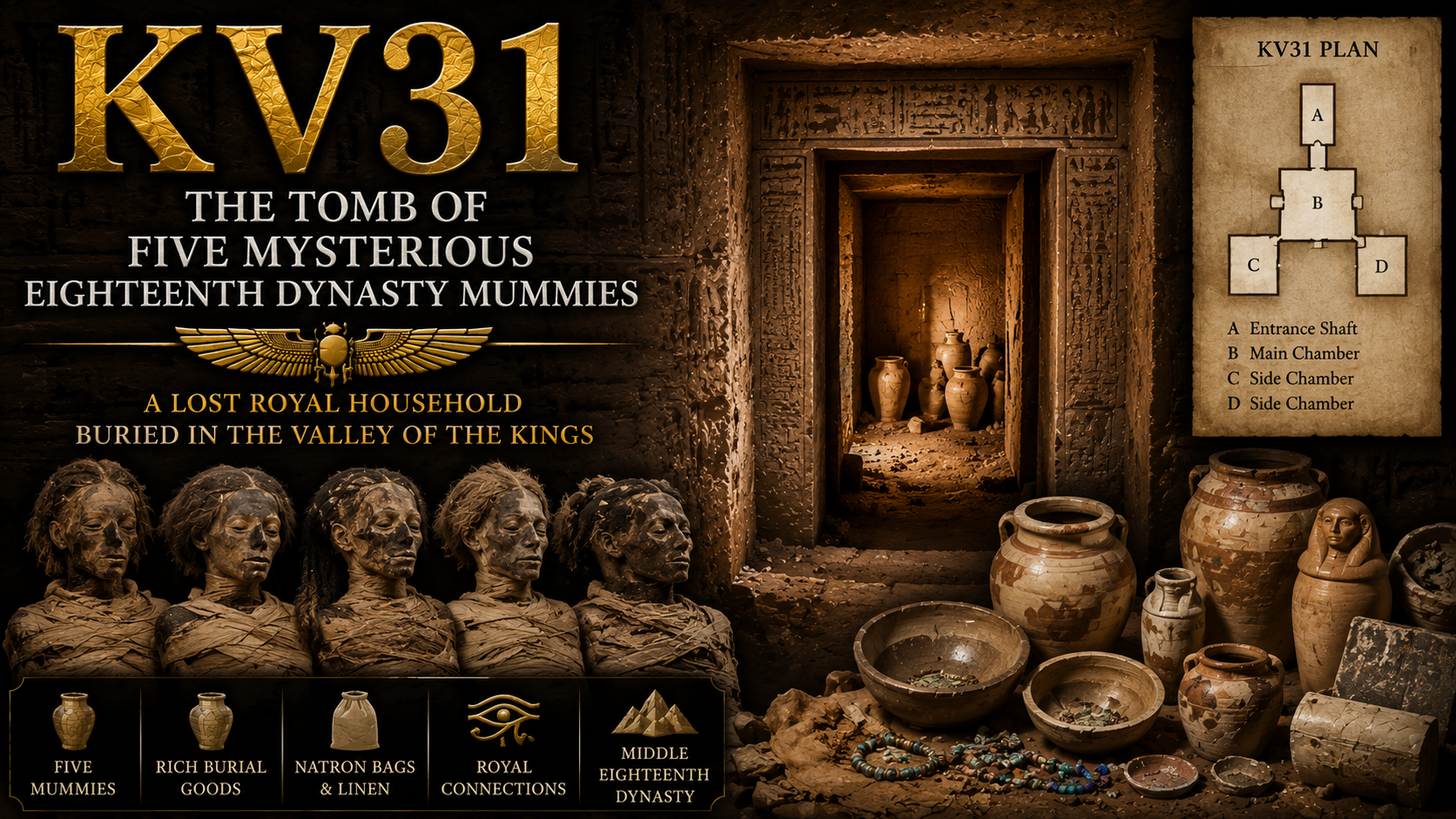
KV31 is one of the most fascinating anonymous tombs in the Valley of the Kings. For generations, Egyptologists knew little more than the location of its entrance shaft. That changed in 2010, when archaeologists from the University of Basel began clearing the tomb and uncovered the disturbed remains of five carefully mummified people.
The group consisted of young adults who appeared to belong to the highest levels of Eighteenth Dynasty society. Their bodies had been expertly embalmed, and the tomb contained large quantities of funerary pottery, coffin fragments, linen, natron bags, stone vessels, beads, and other burial materials. Yet no surviving inscription identifies any of the five people by name.
The tomb’s position near KV34, the royal tomb of Thutmose III, and KV35, the tomb of Amenhotep II, suggests that its occupants belonged to the inner circle of the royal court. They may have been princes, princesses, royal relatives, trusted attendants, or members of a prominent household. The quality of their mummification and burial equipment confirms their elevated status, but their identities remain unknown.
KV31 matters not because of monumental decoration or royal treasure, but because it preserves a rare collective burial of people who lived close to Egypt’s throne.
Structure: KV31
Location: Valley of the Kings, East Valley, Thebes West Bank, Luxor
Owner: Unknown
Possible Occupants: Five unidentified members of the Eighteenth Dynasty elite
Probable Date: Middle Eighteenth Dynasty
Site Type: Undecorated shaft tomb
Public Access: Closed
KV31 lies in a side valley leading toward KV34, the tomb of Thutmose III. This area contains a concentration of undecorated tombs associated with the Eighteenth Dynasty royal family and court.
Nearby monuments include:
- KV26, an anonymous elite tomb
- KV30, known as Lord Belmore’s Tomb
- KV32, the tomb of Queen Tiaa
- KV34, the tomb of Thutmose III
- KV35, the tomb of Amenhotep II
- KV40, a large burial complex for members of the royal household
- KV42, a royal-scale tomb associated with the Thutmosid court
- KV59, a small unidentified shaft tomb
The University of Basel project describes these tombs as part of a group clustered along the route to KV34. Their architecture and location generally connect them with the Thutmosid period of the Eighteenth Dynasty.

KV31 has a relatively simple but substantial underground plan. A vertical entrance shaft, designated A, descends approximately five meters through layers of conglomerate and limestone bedrock. At the bottom, a doorway leads into the main chamber, B.
Two additional rooms open from Chamber B:
- Chamber C
- Chamber D
The side chambers contained the disturbed mummies and much of the surviving funerary material.
The tomb’s good-quality limestone helped preserve wood, textiles, and other organic remains that would normally decay. The University of Basel notes that KV31 was among the tombs in the area that escaped the worst flood damage, allowing significant quantities of original burial material to survive.
The Entrance Shaft
The entrance shaft was carefully cut and descended through both accumulated conglomerate and solid bedrock.
During excavation, the upper portion contained modern rubbish, followed by limestone chips, sand, and rocky debris. Near the base, archaeologists found three pottery vessels containing Nile mud. This material had probably been used to seal the ancient doorway after the burials were placed inside.
Although the original blocking had been breached, the surviving sealing material provided evidence of how the tomb was closed following the funerals.
Chamber B
Chamber B serves as the central room of KV31.
It connects the shaft to the two burial chambers and was excavated partly through limestone bedrock and partly through less stable conglomerate. The 2010 and 2011 seasons documented structural features, steps, mason’s marks, and the relationships between the rooms.
The debris in Chamber B contained the same general mixture found throughout the tomb:
- Broken pottery
- Linen bandages
- Coffin fragments
- Wooden objects
- Natron bags
- Mummy remains
- Funerary equipment
The distribution of matching pottery fragments among all three rooms demonstrates that robbery and later disturbance scattered objects far from their original positions.
Chambers C and D
Chambers C and D contained the remains of five mummified individuals.
The bodies had been unwrapped and broken apart, probably during more than one episode of robbery. Some damage was ancient, while the removal of heads and hands may have occurred during more recent centuries, when body parts were sometimes sold to collectors and travelers.
Despite this destruction, the dry conditions preserved enough soft tissue, hair, linen, and skeletal material for researchers to estimate the occupants’ ages and sexes and study their embalming techniques.
Researchers assigned the five individuals archaeological designations based on the rooms where they were found rather than personal names.
The Five Mummies
Scientific examination concluded that KV31 contained two women and three men or probable men, all of whom were young adults. Their embalming methods and funerary context match high-status burials of the Middle Eighteenth Dynasty.
Mummy C1
C1 was a young woman who died between approximately 18 and 25 years of age.
Her mummy measured about 159 to 160 centimeters, with an estimated living height between approximately 155 and 165 centimeters. Short, silky black hair remained attached to her head.
Her ears had been plugged with linen. Her internal organs were removed through an embalming incision, and her torso was densely packed with material. Her brain appears to have been left in place, which was not unusual during this period.
Tomb robbers inflicted extensive damage. Her face was smashed, parts of the body were separated, and several fingers and toes were missing. Cut marks show that robbers sliced through the wrappings while searching for jewelry and amulets.
Mummy C2
C2 was probably a young man aged approximately 20 to 25.
His mummy measured about 159 centimeters, with a reconstructed living height near 165 centimeters. Linen still covered the front of his head, while the missing rear bandages revealed braided hair.
His brain also appears not to have been removed. The survival of braided hair provides a rare glimpse of elite grooming and hairstyling during the Eighteenth Dynasty.
Mummy C3
C3 was a young man who probably died between approximately 18 and 25 years of age.
He was the tallest of the group, measuring approximately 175 centimeters. His arms had been placed across the chest, a posture strongly associated with royal and high-ranking male burials.
This position has encouraged speculation that C3 could have been a prince or another member of the royal family. However, arm placement alone cannot identify him, and no inscription confirms his status or name.
Mummy C4
C4 was probably male and appears to have died while still relatively young.
The mummy measured approximately 154 centimeters, with an estimated living height near 160 centimeters. Most of the hair was short, but longer strands on one side may represent a sidelock of youth.
In ancient Egypt, the sidelock was frequently worn by royal children and young people. Its possible presence on C4 has led to suggestions that he may have been a prince.
His teeth showed only limited wear, and his wisdom teeth had not fully emerged. The lower jaw and right arm were missing, while other limbs had been damaged or dislocated by robbers.
Mummy D1
D1 was the most fragmentary of the five bodies.
The surviving remains included a skull, portions of the spine and pelvis, one arm, and one leg. The individual probably died between approximately 20 and 30 years of age.
The sex remains uncertain, although the body has often been described as possibly female. Short reddish hair survived on the skull, but the color may have resulted from embalming chemicals or age rather than reflecting its original appearance.
The scattered condition made reconstruction difficult, and some remains may have been mixed during ancient robbery.
Were the Five People Related?
It is possible that the five individuals belonged to the same family or royal household. Several clues support this interpretation:
- They were buried in the same tomb.
- All were young adults.
- Their mummification was of consistently high quality.
- Large quantities of matching pottery and burial equipment were deposited for the group.
- Their tomb stood near the royal burials of Thutmose III and Amenhotep II.
- Some bodies preserve hairstyles or arm positions associated with royal status.
However, no published DNA analysis has established a biological relationship among them. They could have been siblings, cousins, royal attendants, members of one household, or unrelated people buried together because of shared court status.
The safest description is that KV31 contained five unidentified members of the Eighteenth Dynasty elite.
A Possible Royal Burial Group
Several features make a connection with the royal family particularly tempting.
C3’s crossed arms resemble a posture used for kings, while C4’s possible sidelock may indicate a prince. The young ages of the entire group could fit members of an extended royal family who died before reaching senior positions.
Nearby KV40 was later shown through inscribed mummy labels and vessel dockets to have held royal children and members of the “household of the royal children” during the reigns of Thutmose IV and Amenhotep III. This confirms that groups of royal relatives and palace residents were buried in this area of the Valley.
KV31 may have served a similar function slightly earlier, during the reigns of Thutmose III and Amenhotep II. Nevertheless, no individual in KV31 can currently be assigned a known royal name.
Dating the Tomb
KV31 probably dates to the middle Eighteenth Dynasty, particularly the reigns of Thutmose III and Amenhotep II.
This dating is based on:
- The tomb’s location
- Its architectural style
- The mummification techniques
- Pottery forms
- Coffin fragments
- Funerary equipment
- Comparisons with nearby tombs
The University of Basel excavation recovered pottery characteristic of the Thutmosid period, including globular jars, small plates, jugs, ritual vessels, flowerpots, and more than 50 large whitewashed jars.
Pottery
Pottery formed one of the largest categories of material recovered from KV31.
The assemblage included:
- More than 50 large whitewashed jars
- At least 12 hes-vessels
- Flowerpots
- Globular jars
- Small plates
- Jugs
- Decorated vessels
- Storage containers
- Ritual pottery
Whitewashed jars were commonly used to hold food, wine, oils, resins, linen, natron, embalming debris, and other materials associated with burial and mummification.
Fragments belonging to individual jars were found scattered across Chambers B, C, and D, showing that robbers had broken and moved the vessels throughout the tomb. Some missing fragments may have been removed from KV31 entirely.
Natron and Mummification Materials
Large amounts of linen and natron bags were found among the debris.
Natron, a naturally occurring mixture of salts, was used to dry the body during mummification. Bags containing natron could be placed around or inside the deceased to absorb moisture.
The preservation of these materials provides rare evidence of the practical embalming process. Rather than representing only objects intended for eternal use, KV31 also contained the remains of materials used while the bodies were being prepared.
The University of Basel identifies KV31 as one of the tombs that preserved substantial quantities of original tomb equipment and mummification remains.
Coffins and Wooden Objects
The tomb contained many fragments of wooden coffins and other funerary objects.
Most had been broken apart by robbers searching for valuable metal fittings, gilding, amulets, and decorative inlays. Although the surviving pieces were incomplete, the quality of the wood, paint, and workmanship supported the conclusion that the occupants belonged to the elite.
Organic materials survived unusually well because KV31 escaped the severe flooding that affected many other tombs in the Valley.
Canopic Equipment
Archaeologists recovered fragments from at least two canopic jars:
- One made from calcite
- One made from limestone
The limestone jar preserved part of an inscription, but the space intended for the owner’s name had been left blank.
A fragment from a dummy canopic jar bearing the name Sennefer was also found. Sennefer was a high-ranking official associated primarily with nearby KV42, and the fragment may have entered KV31 through robbery, movement of debris, or later activity.
Its presence does not prove that Sennefer was buried in KV31.
Animal Remains
Animal bones were recovered alongside the human burials.
These may have represented food offerings intended to nourish the deceased in the afterlife. Ancient Egyptian funerals regularly included cuts of meat, birds, and other provisions.
The University of Basel arranged specialist analysis of the animal remains from KV31 to determine their species and possible funerary purpose.
Later Objects
Not everything found inside KV31 belonged to the original Eighteenth Dynasty burials.
Later material included:
- Ostraca
- A linen fragment embroidered with the cartouche of Ramesses III
- A shabti dating to the Twentieth Dynasty
- Material associated with the Third Intermediate Period
These objects demonstrate that the tomb was entered and used again long after its original occupants were buried.
The University of Basel found evidence that KV31 was reused during the Third Intermediate Period. The later burial appears to have been introduced without clearing away all the remains of the earlier Eighteenth Dynasty interments.
Ancient Tomb Robbery
KV31 was extensively robbed. The bodies were unwrapped, coffins were smashed, and pottery was broken and scattered. Robbers appear to have targeted metal objects in particular, since little metal burial equipment remained.
The University of Basel suggests that major looting may have occurred during the late Nineteenth or Twentieth Dynasty. Later intrusion during the Third Intermediate Period added further disturbance.
The mummies also show cut marks made by blades used to slice through linen and body cavities in search of hidden jewelry.
Modern Damage
Some destruction may date to more recent centuries. Heads and hands were highly desirable to nineteenth-century collectors and tourists, and several KV31 mummies were missing these body parts. Researchers have proposed that this particular damage may have been caused by relatively modern robbers rather than ancient thieves.
Early visitors may also have moved objects among KV30, KV31, and neighboring tombs without recording their original locations.
Discovery and Early History
KV31 was numbered by Victor Loret in 1898, but its earlier history remains uncertain.
It may have been one of two tombs excavated in 1817 by Giovanni Battista Belzoni while working for the second Earl Belmore. The other possibility is KV30.
A stone sarcophagus later donated to the British Museum by Lord Belmore has sometimes been attributed to either KV30 or KV31. The lack of documentation prevents its origin from being established securely.
Before the University of Basel excavation, only the upper portion of the shaft was visible, and no reliable record of the tomb’s contents existed.
University of Basel Excavation
The University of Basel Kings’ Valley Project began excavating KV31 in January 2010.
The team cleared the shaft and documented the three underground chambers. They discovered that all the rooms contained a mixed deposit of funerary objects, textiles, pottery, and human remains.
Excavation and architectural surveying continued during the 2011 season. Researchers established an internal coordinate system, recorded steps and mason’s marks, mapped the rooms, and documented the exact locations of debris and objects.
The human remains were examined in the tomb using portable X-ray equipment. This allowed researchers to study sex, age, embalming methods, injuries, and possible health conditions without transporting the fragile bodies.
Scientific Study
The multidisciplinary research involved Egyptologists, archaeologists, anatomists, mummy specialists, textile conservators, and animal-bone experts.
The five mummies underwent:
- Visual examination
- Osteological study
- Portable radiography
- Age estimation
- Sex assessment
- Study of embalming methods
- Examination of injuries and postmortem damage
- Analysis of hair and soft tissue
- Documentation of wrappings and packing materials
The study showed that all five people received sophisticated mummification appropriate for elite individuals during the Middle Eighteenth Dynasty.
Noteworthy Features
KV31 is notable for several reasons:
- It contained five unidentified mummies.
- The group included two women and three men or probable men.
- All were young adults.
- Their mummification indicates high social status.
- One male had crossed arms resembling a royal burial posture.
- Another may have worn the sidelock of youth.
- The tomb probably dates to the reigns of Thutmose III and Amenhotep II.
- Large quantities of pottery and mummification material survived.
- More than 50 whitewashed jars were represented.
- Linen, natron bags, coffin fragments, and canopic equipment were recovered.
- KV31 escaped the severe flood damage suffered by many Valley tombs.
- The tomb was robbed repeatedly.
- It was reused during the Third Intermediate Period.
- Its occupants remain unidentified.
Additional Tomb Information
- Owner Type: Unknown members of the royal household or elite
- Entrance Type: Vertical shaft
- Interior Layout: Shaft, central chamber, and two side chambers
- Axis Type: Straight shaft-and-chamber plan
- Decoration: None
- Probable Period: Middle Eighteenth Dynasty
- Principal Use: Collective elite burial
- Public Access: Closed
Dating
KV31 was used during the following periods:
- New Kingdom, Middle Eighteenth Dynasty: Original construction and burial
- Late Nineteenth or Twentieth Dynasty: Probable major robbery
- Twentieth Dynasty: Later objects and activity
- Third Intermediate Period: Reuse and additional disturbance
- Modern period: Archaeological excavation and scientific examination
History of Exploration
- Giovanni Battista Belzoni, 1817: Possible early excavation for Lord Belmore
- Victor Loret, 1898: Numbered and recorded the tomb
- University of Basel Kings’ Valley Project, 2010: First documented excavation
- University of Basel, 2011: Continued clearance, architectural survey, and artifact study
- 2012 and later seasons: Scientific examination, conservation, pottery reconstruction, and analysis of the mummies
Conservation History
Following excavation, KV31 was secured with a protective iron door and low surrounding structure.
The recovered textiles, wood, coffin fragments, and human remains required careful conservation because they were fragile despite their good overall preservation.
Researchers documented the mummies in situ to minimize unnecessary movement. Organic materials were stabilized and stored for continued study.
Site Condition
KV31’s architecture is generally stable, and the tomb avoided the catastrophic floods that damaged many neighboring monuments.
However, its original burials suffered severe destruction from repeated robbery. The mummies are fragmentary, coffin pieces are scattered, and nearly all valuable objects were removed.
The tomb is closed to visitors.
Why KV31 Matters
KV31 provides an unusually intimate look at the people who lived within ancient Egypt’s royal world but whose names disappeared from history.
The five occupants were young, carefully mummified, and buried with substantial quantities of funerary equipment. Their tomb’s location near Thutmose III and Amenhotep II strongly suggests that they belonged to the pharaoh’s inner circle.
They may have been royal children, siblings, cousins, favored attendants, or members of one elite family. C3’s crossed arms and C4’s possible sidelock are particularly suggestive, but neither feature is enough to identify them.
KV31 also demonstrates the value of investigating small, undecorated tombs. What appeared from the surface to be an unremarkable shaft contained five human lives, evidence of ancient embalming, a rich ceramic assemblage, and clues to how the royal court buried its own.
Interesting Facts About KV31
- KV31 contained five mummified people.
- All five were young adults.
- Two were women, and three were male or probably male.
- One man may have been buried with his arms in a royal posture.
- Another may have worn a prince’s sidelock.
- The tomb dates to the middle of the Eighteenth Dynasty.
- Its occupants may have lived during the reigns of Thutmose III or Amenhotep II.
- The mummies were studied with portable X-ray equipment inside the tomb.
- More than 50 large whitewashed jars were represented.
- Natron bags and linen provide evidence of the mummification process.
- The tomb was robbed repeatedly but escaped major flood damage.
- A later burial was introduced during the Third Intermediate Period.
- No personal name securely identifies any of the five occupants.