The ancient Egyptian Book of the Dead was a collection of funerary texts and images created to help the deceased survive death, move through the afterlife, and attain renewed existence among the gods.
Book of the Dead Spell 16 is unusual because it is not truly a written spell.
There is no standard passage to translate, no speech placed in the mouth of the deceased, and no set of ritual instructions comparable to the surrounding chapters. What later scholars numbered as Spell 16 is a large sunrise vignette illustrating the daily rebirth of the sun god Ra. Peter Le Page Renouf and Édouard Naville explained that when Karl Richard Lepsius organized the Book of the Dead into numbered chapters, he treated the image associated with Spell 15 as a separate Chapter 16. In other words, Spell 16 was originally the concluding illustration of the solar hymns now called Spell 15.
Its purpose can be summarized as:
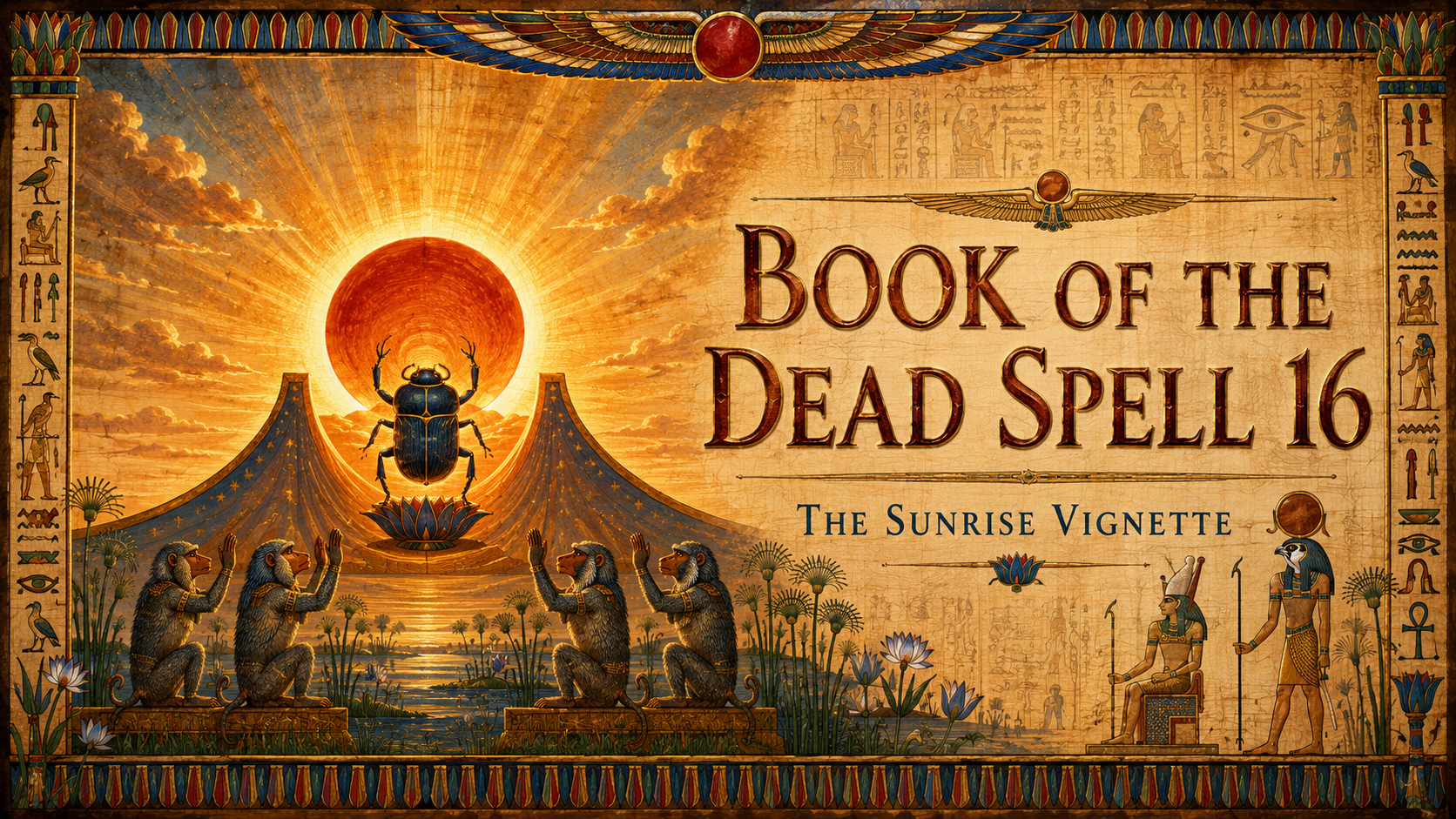
A vignette showing the rising sun and the daily rebirth of Ra.
Because Spell 16 is an image rather than a written composition, it cannot be translated in the normal sense. Instead, its figures and symbols must be read visually.
What Is Book of the Dead Spell 16?
Book of the Dead Spell 16 is the modern number assigned to a large illustration of sunrise.
The vignette usually represents the sun emerging from the eastern horizon after completing its journey through the hidden realm during the night. The image could accompany the hymns to Ra preserved as Spell 15, especially the hymn praising the sun god at his rising.
The scene expresses several interconnected ideas:
- Ra is reborn at dawn.
- Darkness and the dangers of night have been overcome.
- Cosmic order has been restored.
- The deceased can share in the sun god’s renewal.
- The passage through death can lead back into light.
- Images can carry magical power even without an accompanying recitation.
Spell 16 should therefore be understood as a visual resurrection formula.
Is Spell 16 Actually a Spell?
Not in the same sense as most Book of the Dead chapters. Most spells contain words spoken by the deceased, a priest, or a divine figure. Spell 16 consists primarily of an image.
Renouf and Naville state: “That portion of it which was numbered as Chapter 16, was in fact merely the Vignette of Chapter 15.” They therefore published the rising and setting sun illustrations from a large Book of the Dead papyrus in Leiden alongside their discussion of Spell 16.
This means Spell 16 is better described as:
The sunrise vignette associated with the hymns of Spell 15
rather than as an independent written incantation.
Why Was the Vignette Given Its Own Number?
The familiar numbering of the Book of the Dead was created by modern Egyptologists rather than by the ancient Egyptians.
Karl Richard Lepsius introduced a numbered sequence when he published a Ptolemaic Book of the Dead in 1842. In that arrangement, the large image following the solar hymns was treated as an independent chapter and assigned the number 16.
The original manuscripts did not necessarily label the scene “Spell 16.”
Book of the Dead papyri varied in:
- Their selection of spells
- The order of compositions
- The placement of illustrations
- The relationship between text and image
- The size and complexity of vignettes
No surviving manuscript contains every known Book of the Dead spell, and the collection did not possess one universal arrangement for most of its history.
The number 16 is therefore useful for modern reference, but it should not be mistaken for an ancient title.
Does Book of the Dead Spell 16 Have a Translation?
There is no standard written text to translate. Unlike Spell 15, which contains hymns to Ra and Atum, Spell 16 is principally an illustration. A responsible article should not invent a spoken formula or present lines from another chapter as though they belonged to Spell 16.
Instead, the image can be given a visual translation.
Visual Translation of Spell 16
A modern verbal rendering of the scene might read:
Ra rises from the eastern horizon after passing safely through the darkness of the Duat.
The solar disk is lifted into the renewed sky.
The gods and blessed spirits recognize the return of divine light.
Night, danger, and disorder have been overcome.
As Ra is reborn at dawn, the deceased may also emerge from death into renewed life.
This is not an ancient translation. It is a plain-English explanation of the vignette’s symbolism.
What Does the Spell 16 Vignette Show?
The exact arrangement varies among manuscripts, but sunrise vignettes can contain several common elements. These may include:
- The solar disk
- The eastern horizon
- Ra or one of his solar forms
- A solar boat
- Divine worshippers
- Baboons greeting the sun
- The sky goddess Nut
- The sun emerging from darkness
- Symbols associated with rebirth and divine protection
The British Museum identifies sunrise imagery in Book of the Dead papyri and connects such vignettes with the solar compositions of Spells 15 and 16. The image should not be interpreted as a literal snapshot of one event. It compresses an entire cosmic process into a single visual composition.
The Sunrise as the Rebirth of Ra
The central subject of Spell 16 is the daily rebirth of Ra.
Each evening, the sun appeared to disappear beneath the western horizon. During the night, Ra traveled through the Duat, the hidden realm inhabited by gods, spirits, guardians, and hostile beings.
At dawn, Ra emerged from the eastern horizon and illuminated the world again.
This daily sequence provided a visible model of resurrection:
- The sun disappears.
- Ra enters the hidden realm.
- He passes through darkness and danger.
- His divine power is renewed.
- He rises again at dawn.
- Light and ordered life return.
Spell 16 presents that final stage visually.
The deceased hoped that personal death would follow the same pattern.
What Did Sunrise Mean to the Ancient Egyptians?
Sunrise represented much more than the beginning of another day.
It signified:
- Rebirth
- Renewal
- The restoration of light
- Victory over darkness
- The continuation of time
- The renewal of Ma’at
- The survival of the gods
- The return of life to the world
Every dawn confirmed that the forces threatening creation had failed. The sun had not been permanently swallowed, imprisoned, or destroyed. For the deceased, this meant that entering darkness did not have to result in permanent annihilation.
How Does Spell 16 Help the Deceased?
Spell 16 connects the deceased with Ra’s successful return. The person placed within the tomb had entered a condition resembling the sun’s nightly disappearance:
- The body was enclosed.
- The visible world had been left behind.
- Darkness surrounded the burial chamber.
- Movement had stopped.
- The person had entered the realm of death.
The sunrise vignette reversed these conditions. Through association with Ra, the deceased could:
- Emerge from darkness
- Regain movement
- Enter daylight
- Join the solar god
- Participate in cosmic renewal
- Avoid a second death
- Continue living as a transformed spirit
The image promised that the tomb was not necessarily a permanent prison.
Why Could an Image Function Like a Spell?
Ancient Egyptian funerary images were not merely decorative. The Book of the Dead combined written formulas with vignettes because both words and images could make a desired reality present.
Hieroglyphs, divine figures, ritual scenes, and symbolic objects could carry religious and magical force. Even when a text was abbreviated or omitted, an accompanying image might preserve the composition’s intended effect.
Spell 16 is an especially clear example. The image itself shows the desired outcome: The sun rises again.
By placing that image in a funerary manuscript, the owner sought to participate in the depicted renewal.
The Difference Between Illustration and Decoration
Modern readers may think of an illustration as something added to make a text more attractive. In the Book of the Dead, the relationship was often more powerful.
A vignette could:
- Depict a ritual result
- Identify the deceased with a god
- Show a successful journey
- Present enemies as defeated
- Provide divine protection
- Make an event continually present
- Reinforce or even replace a written formula
The Spell 16 sunrise scene did not simply explain Spell 15.
It visually enacted the rebirth promised by the solar hymns.
How Does Spell 16 Relate to Spell 15?
Spell 15 contains hymns praising Ra at sunrise and sunset. The deceased asks to see the solar disk, travel in Ra’s boats, enter the divine company, and share in the sun god’s repeated renewal.
Spell 16 turns those words into an image.
Spell 15
Spell 15 expresses solar rebirth through hymns and prayers.
It describes:
- Ra rising in the east
- The illumination of Egypt
- Travel in the solar boats
- Defeat of Apep
- Entry into the West
- Renewal during the night
- Return at dawn
Spell 16
Spell 16 presents the rising sun visually.
It shows the result:
- The darkness has ended.
- Ra has returned.
- The horizon has opened.
- Divine life continues.
- Rebirth has succeeded.
The two should therefore be read together.
Spell 15 is the verbal celebration of solar renewal. Spell 16 is its visual confirmation.
Was Spell 16 Originally Part of Spell 15?
According to Renouf and Naville, yes. They state that the section Lepsius numbered as Chapter 16 was actually the vignette belonging to Chapter 15. That does not make the image unimportant.
It means the division between the two chapters is a modern editorial choice. For your series, it is still appropriate to give Spell 16 its own article because readers searching modern Book of the Dead numbering will encounter it as a separate entry. The article should simply explain that historical complication clearly.
Ra, Khepri, and the Morning Sun
The rising sun could be associated with Khepri, the divine form representing becoming, emergence, and morning renewal. Khepri was commonly represented as:
- A scarab beetle
- A scarab-headed deity
- A solar disk pushed or lifted into the sky
- A manifestation of the morning sun
The scarab became a symbol of spontaneous renewal because Egyptians observed beetles moving balls across the ground and associated the action with the movement of the solar disk. When Khepri appears in sunrise imagery, he represents the sun coming into being again. The deceased hoped to share in that continual process of becoming.
Ra and the Solar Disk
Ra could be represented directly as a god or indirectly through the solar disk. The disk was not merely the physical sun. It could express:
- Divine presence
- Light
- Heat
- Kingship
- Life
- Protection
- Cosmic order
- The visible manifestation of Ra
In Spell 16, the rising disk announces that the hidden nighttime journey has reached a successful conclusion. The sun is once again visible, and creation remains intact.
The Eastern Horizon
The eastern horizon was the gateway through which the renewed sun entered the visible world. The Egyptian horizon symbol, commonly called the akhet, shows the sun appearing between two mountain peaks.
The horizon represented:
- A boundary between worlds
- The entrance and exit of the sun
- A place of transformation
- The meeting of earth and sky
- The passage between darkness and daylight
The western horizon admitted Ra into the Duat. The eastern horizon released him at dawn. Spell 16 focuses on the successful opening of that eastern gateway.
The Two Horizons
The complete solar journey connected two sacred boundaries:
The Western Horizon
The sun entered the hidden realm at sunset. It was associated with:
- Burial
- Osiris
- Amenta
- The Duat
- Death
- Regeneration
The Eastern Horizon
The sun emerged at sunrise.
It was associated with:
- Birth
- Khepri
- Light
- Renewal
- Visibility
- The beginning of the day
The deceased needed power over both horizons. Entering the West without emerging in the East would mean remaining trapped in death. Spell 16 guarantees the second half of the cycle.
Does Spell 16 Show the Solar Boat?
Some versions of the sunrise imagery may include Ra’s solar boat, while others emphasize the sun disk or the worship of the rising sun. The solar boat represented the vessel in which Ra traveled through heaven and the Duat.
Its crew could include:
- Horus
- Thoth
- Ma’at
- Protective gods
- Divine sailors
- Blessed spirits
The deceased frequently asked to join this company. A solar boat in Spell 16 would therefore represent both transportation and membership within the divine community.
The Morning and Evening Boats
Egyptian solar traditions could distinguish between boats used during different stages of Ra’s journey. The morning boat carried the renewed sun into the visible sky. The evening boat carried the setting sun toward the West and into the hidden realm.
The imagery reinforced the cyclical nature of existence:
- Departure
- Travel
- Descent
- Regeneration
- Return
Spell 16 centers on the moment of return.
Why Are Baboons Sometimes Shown Greeting the Sun?
Baboons appear in several forms of Egyptian sunrise imagery.
They may be shown:
- Standing upright
- Raising their paws
- Facing the solar disk
- Calling out in praise
- Participating in the sun’s emergence
Their loud activity at dawn may have reminded Egyptians of worshippers greeting the rising sun. In religious imagery, they could represent divine beings associated with Thoth or spirits welcoming Ra’s return. When present in a sunrise vignette, they confirm that the cosmos recognizes and celebrates the renewed sun.
Who Is Nut in the Sunrise Scene?
Nut was the goddess of the sky. She was commonly shown as a woman arching over the earth, sometimes covered with stars. Solar mythology described Nut as receiving the sun in the evening and giving birth to it again in the morning. Her body could therefore represent the sky through which the solar cycle took place.
If Nut appears in or is implied by Spell 16 imagery, she represents:
- The celestial realm
- The mother of the sun
- Nighttime protection
- The passage through darkness
- Birth at dawn
- The enclosure from which Ra emerges
The rebirth of Ra could be imagined as the sun being born from Nut each morning.
Sunrise as Divine Birth
The morning sun was not merely the same old sun returning unchanged. It could be understood as newly born. This gave sunrise a powerful funerary meaning.
The deceased did not simply hope to wake up in the same condition as before death. The person hoped to become:
- Renewed
- Purified
- Transformed
- Divinized
- Effective as an akh
- Capable of joining the gods
Spell 16 therefore represents rebirth rather than simple resuscitation.
What Is an Akh?
An akh was a successfully transformed and effective spirit. A deceased person did not automatically become an akh merely by dying.
Successful transformation depended on:
- Proper burial
- Preservation of the body
- Funerary rites
- Divine acceptance
- Magical knowledge
- Offerings
- Reunion of spiritual components
- Victory over hostile forces
The sunrise scene supports this transformation by associating the deceased with Ra’s renewed divine state.
Spell 16 and Ma’at
The return of the sun restored Ma’at, the principle of truth, justice, balance, and cosmic order. Each night, hostile forces threatened the solar journey. Apep attempted to stop Ra, while darkness temporarily covered the world. Each sunrise proved that order had prevailed. Spell 16 therefore communicates more than personal rebirth.
It announces that:
- The gods remain powerful.
- Time continues.
- Creation has not collapsed.
- Chaos has been defeated.
- The deceased can exist within the renewed order.
Personal salvation and cosmic stability are joined.
Where Is Apep in Spell 16?
Apep may not appear directly in every sunrise vignette. His defeat is often implied. The sun could not rise unless the powers that attempted to stop the solar journey had failed.
The sunrise therefore demonstrates:
- Apep did not swallow the sun.
- The solar boat was not stranded.
- Darkness did not become permanent.
- Chaos did not defeat Ma’at.
Spell 16 shows the outcome of the struggle rather than necessarily depicting the battle itself.
The Deceased and the Rising Sun
Some vignettes include the deceased worshipping the rising sun. This places the manuscript owner inside the scene.
The deceased may be shown:
- Raising the hands in praise
- Kneeling before Ra
- Standing beside an offering table
- Greeting the solar disk
- Participating in the divine procession
This is not simply a portrait of religious devotion. It demonstrates that the deceased is present, active, recognized, and capable of worship. Those abilities are signs of successful life after death.
Seeing the Sun After Death
The ability to see Ra was a major funerary hope. Death threatened vision and access to daylight. The deceased wanted to:
- Open the eyes
- See the solar disk
- Be illuminated by divine rays
- Avoid permanent darkness
- Recognize gods and spirits
- Participate in each new day
Spell 16 visually grants that wish. The sun is visible, and the deceased belongs within its light.
Why Is There No Spoken Formula?
The absence of a surviving standard recitation does not mean the image lacked power.
The vignette may have worked through:
- Its connection with Spell 15
- The identity of the figures shown
- The visual presence of the solar disk
- The magical effectiveness of Egyptian art
- The deceased’s inclusion in the scene
- The repetition of sunrise for eternity
The picture states the result more directly than words might: Ra has risen. That completed event becomes the promise offered to the deceased.
Can Spell 16 Be Quoted?
Spell 16 itself cannot be quoted as a written passage because it is not a standard text. However, an article may quote or summarize the associated sunrise hymns from Spell 15, provided they are clearly labeled as belonging to Spell 15 rather than Spell 16. For example, the related hymns praise Ra when he rises upon the eastern horizon and ask that the deceased travel with him. A careful article should never place those words under a heading such as “Full Translation of Spell 16” without explaining that they come from the accompanying Spell 15 tradition.
A Visual Reading of the Main Symbols
Because Spell 16 is an image, the closest equivalent to a line-by-line interpretation is a symbol-by-symbol reading.
The Rising Solar Disk
Meaning: Ra has survived the nighttime journey and is reborn.
The Eastern Horizon
Meaning: The boundary between the Duat and the visible world has opened.
Khepri or the Scarab
Meaning: Becoming, transformation, and the renewed morning sun.
The Solar Boat
Meaning: Safe divine travel through the sky and hidden realm.
Nut
Meaning: The sky goddess receives the sun at night and gives birth to it at dawn.
Worshipping Baboons
Meaning: Divine beings celebrate and announce the return of the sun.
The Deceased in Adoration
Meaning: The tomb owner has regained sight, movement, speech, and access to Ra.
Divine Attendants
Meaning: The renewed sun and the deceased are recognized within the community of the gods.
Is Spell 16 the Same in Every Manuscript?
No. Book of the Dead vignettes could vary greatly in:
- Size
- Color
- Number of figures
- Artistic style
- Divine identities
- Placement within the papyrus
- Connection with nearby texts
Some manuscripts contain lavish full-width scenes. Others use smaller or simpler illustrations. The basic idea of sunrise remains consistent, but the composition is not visually identical in every copy.
Was Spell 16 Included in the Papyrus of Ani?
The Papyrus of Ani contains solar hymns and imagery associated with Ra, although modern chapter labels and manuscript frames do not always correspond neatly to the later standardized sequence. Because Spell 16 is fundamentally the vignette attached to Spell 15, identifying one isolated panel as “the complete text of Spell 16” would be misleading. The important point is that illustrated New Kingdom papyri such as Ani’s preserve the same broader tradition of solar worship and rebirth represented by the sunrise vignette.
Is Spell 16 Found in the Coffin Texts?
Book of the Dead Spell 16 is not a written composition with a direct numbered Coffin Text equivalent. Earlier Egyptian funerary literature certainly contains solar rebirth imagery and hopes of joining the rising sun.
However:
- Book of the Dead Spell 16 is a modern number assigned to a vignette.
- Coffin Text Spell 16 is a separately numbered written composition.
- The matching number does not indicate that they are the same.
The Spell 16 sunrise vignette belongs to a long tradition of solar resurrection imagery, but it should not be casually equated with Coffin Text Spell 16.
Why Is Spell 16 Important?
Spell 16 demonstrates that understanding the Book of the Dead requires more than translating written words. The ancient Egyptian manuscript was both text and image.
Spell 16 shows that an illustration could communicate:
- Theology
- Magical protection
- Resurrection
- Cosmic order
- Divine identity
- The desired fate of the deceased
It also warns modern readers against assuming that every numbered “spell” contains a recitation. Sometimes the image was the spell.
The Meaning of Spell 16 in Simple Terms
Book of the Dead Spell 16 is a large vignette showing the rising sun. It represents Ra’s successful return from the darkness of the Duat and the renewal of the created world at dawn. The deceased hoped to share in this transformation.
The image’s meaning can be summarized as: Ra has passed through darkness and risen again. As the sun is reborn each morning, I too can emerge from death, return to the light, and live within the renewed order of the gods.
Spell 16 does not need a long recitation to communicate its promise. The sunrise itself is the message.
Frequently Asked Questions About Book of the Dead Spell 16
What is Book of the Dead Spell 16?
Spell 16 is a large sunrise vignette showing the daily rebirth of Ra. It is primarily an image rather than a written funerary formula.
What is the title of Spell 16?
There is no standard ancient title comparable to most written spells. It is generally described as the vignette of the rising sun or sunrise vignette.
Does Spell 16 have a translation?
No standard text survives because Spell 16 is an image. It should be interpreted visually rather than translated line by line.
Was Spell 16 originally part of Spell 15?
Yes. Renouf and Naville explain that the image later numbered Chapter 16 was actually the vignette belonging to Chapter 15.
Why was it numbered separately?
Karl Richard Lepsius treated the vignette as its own chapter when organizing a Book of the Dead manuscript into a numbered sequence.
What does the image represent?
It represents Ra emerging from the eastern horizon, the defeat of darkness, the restoration of Ma’at, and the deceased’s hope for rebirth.
Who is Khepri?
Khepri is the morning form of the sun associated with becoming, emergence, and renewal. He is commonly represented as a scarab or scarab-headed deity.
Why is sunrise connected with resurrection?
The sun appeared to die in the West each evening but returned at dawn. This daily cycle provided a visible model for life returning after death.
Why might baboons appear in the scene?
Baboons could represent divine beings greeting and praising the rising sun.
Does the vignette show Apep?
Not necessarily. Apep’s defeat may be implied by the successful sunrise even when the serpent is not shown.
Did ancient Egyptians believe pictures had magical power?
Images in funerary papyri could help make the events they showed effective for the deceased. Vignettes were religious and magical components of the manuscript, not merely decoration.
Is Spell 16 the same in every Book of the Dead?
No. The imagery and composition varied among manuscripts, although the central subject remained solar rebirth.
Is Book of the Dead Spell 16 the same as Coffin Text Spell 16?
No. They belong to independently numbered collections, and Book of the Dead Spell 16 is primarily a vignette rather than a written text.
Book of the Dead Spell 16 is one of the clearest examples of ancient Egyptian visual theology. There are no standard lines to recite and no conventional passage to translate. Instead, the rising sun communicates the entire promise. Ra has entered darkness, survived the hidden journey, and returned. The horizon opens. Light spreads across creation. Ma’at is restored, and the gods recognize the beginning of another day. For the deceased, the image transforms sunrise into a personal guarantee. Death may resemble sunset, but sunset is not the end of the solar journey. Beyond the darkness lies rebirth.