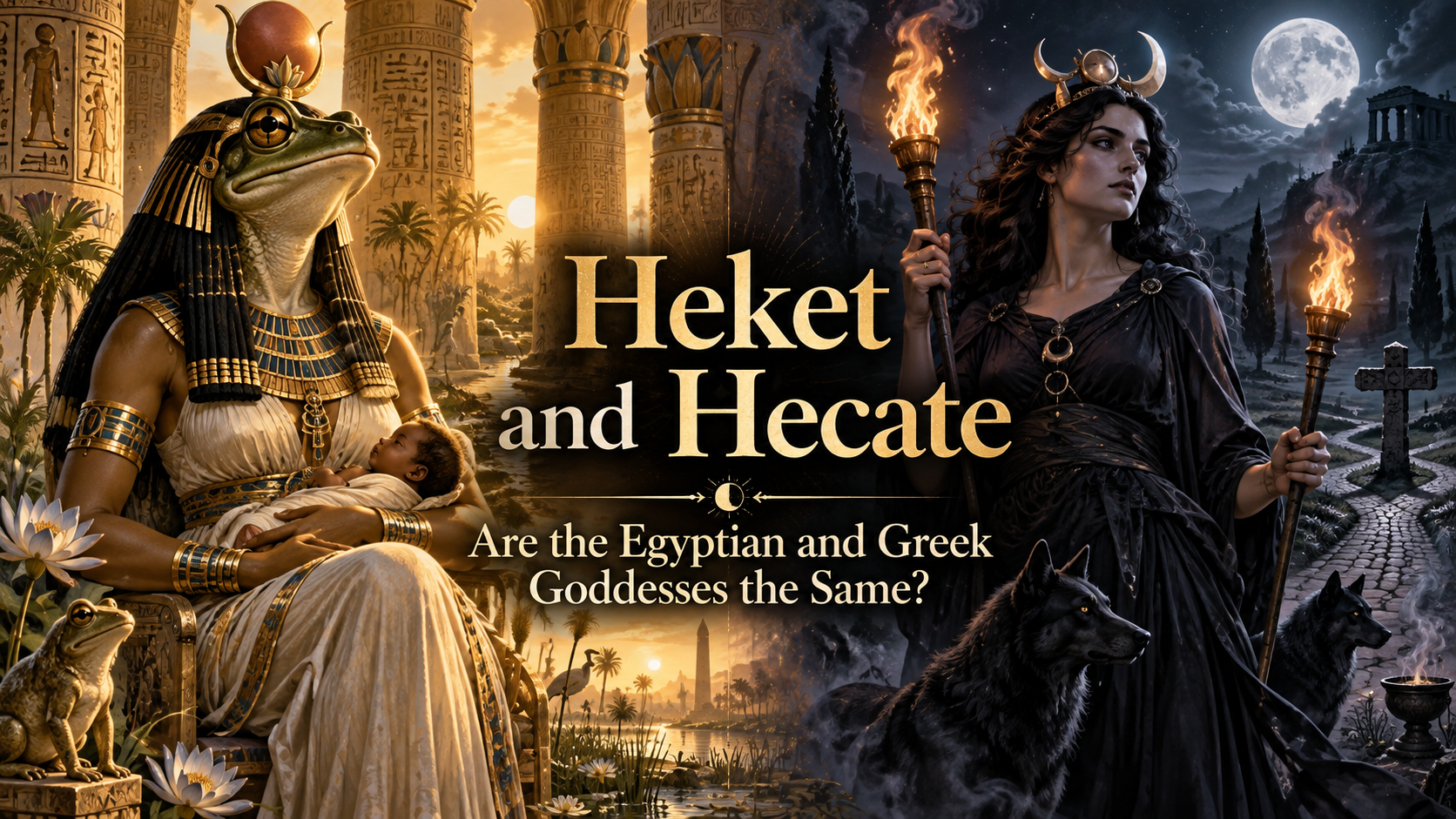
Heket and Hecate are not the same goddess. Heket, also written Heqet, is an ancient Egyptian goddess associated primarily with birth, generation, new life, and the frog. Hecate, or Hekate, belongs to the Greek religious tradition and became associated with crossroads, boundaries, torches, ghosts, the night, and eventually magic and witchcraft.
The confusion between Heket and Hecate is understandable because their names look and sound remarkably similar in English. Both goddesses can also be connected to transitions between different states of existence, and theories linking their names have circulated for generations. However, similarity in name and symbolism does not make them the same deity. Their histories, cultures, iconography, mythology, and primary religious functions differ significantly.
Heket was already part of Egyptian religion thousands of years ago, long before our major surviving Greek literary descriptions of Hecate. Although cultural exchange between Egypt, Greece, and the eastern Mediterranean eventually became extensive, no convincing evidence shows that the Egyptian goddess Heket and the Greek goddess Hecate were originally one goddess worshipped under different names.
Who Was Heket in Ancient Egypt?
Heket, more precisely transliterated as Heqet, was an ancient Egyptian goddess associated with childbirth, fertility, generation, and the creation of new life. Her Egyptian name is conventionally transliterated as ḥqt, while modern spellings include Heket, Heqet, Heqat, and Hekit because the exact pronunciation of ancient Egyptian cannot be perfectly reconstructed.
Heket belonged to the Egyptian religious tradition from a very early period and continued to appear for thousands of years. Unlike some Egyptian deities who became prominent mainly during a particular dynasty or region, Heket’s presence extended from the earliest periods of Egyptian civilization into the Greco-Roman era.
Her most recognizable feature was the frog. Heket could be represented as a frog or as a woman with a frog head, making her one of the most visually distinctive goddesses in the Egyptian pantheon.
Why Was Heket Represented as a Frog?
The frog was an appropriate symbol for a goddess of birth because frogs were closely connected with fertility and the appearance of new life in the Egyptian environment. After the Nile inundation, enormous numbers of frogs could appear in the newly flooded landscape, creating a natural association between frogs, water, fertility, reproduction, and regeneration.
Ancient Egyptians did not choose animal forms for their gods randomly. An animal’s natural behavior or characteristics could express something important about a deity’s power, and the frog’s association with sudden abundance and reproduction made it a powerful symbol of life emerging from the fertile landscape.
Heket’s frog form therefore represented far more than an unusual artistic choice. It reflected one of the goddess’s central ideas: the transformation of potential life into living existence.
Heket, Khnum, and the Creation of Human Life
Heket was closely associated with Khnum, the ram-headed creator god who was believed in some Egyptian traditions to fashion human beings on a potter’s wheel. Khnum could shape a child’s body before birth, while Heket supplied the vital force needed to bring that creation to life and help it enter the world.
Together, Khnum and Heket represented complementary parts of creation. Khnum formed the physical being, while Heket was associated with animation, birth, and the transition from the hidden world of the womb into the world of the living.
This relationship helps explain why Heket should not simply be described as a generic fertility goddess. Her role focused on the actual emergence of life, giving her an important place in Egyptian ideas about pregnancy, childbirth, and divine creation.
Heket and Childbirth
Heket appears directly in Egyptian traditions involving childbirth, including the story preserved in the Westcar Papyrus concerning the miraculous births of future kings. In the story, divine beings come to assist a woman giving birth, and Heket is among the goddesses who help ensure the safe arrival of the children.
Her appearance in a birthing story confirms that ancient Egyptians themselves connected Heket directly with childbirth. Modern scholars did not create this association simply because frogs are fertile animals; it was part of Heket’s religious identity in Egyptian tradition.
Childbirth was an especially dangerous moment in the ancient world, so Egyptians relied on supernatural protection as well as practical assistance. Goddesses connected with pregnancy and birth could therefore have enormous personal importance to women and families, even if those deities did not receive the monumental temples associated with gods such as Amun or Ra.
Heket and the Breath of Life
Heket is sometimes described as a goddess who gave a newly created child the breath of life. This idea fits naturally with her association with Khnum, because the physical body the divine potter created still needed life before it could become a living human being.
Representations and later interpretations sometimes show Heket holding an ankh, the Egyptian sign representing life. This further reinforces her identity as a deity concerned with the moment when life is bestowed rather than merely with sexual fertility or conception.
This distinction matters because it gives Heket broader theological significance. She stands at the threshold between what has been created and what has truly become alive.
Heket and Resurrection
Heket’s life-giving abilities may have extended beyond ordinary human childbirth. Egyptian religion repeatedly connected birth, death, regeneration, and resurrection, so a goddess capable of bringing life into existence could also be relevant to restoring life after death.
Heket consequently developed associations with regeneration and resurrection, including traditions surrounding Osiris. Her presence in funerary contexts should therefore not be interpreted as evidence that she was an Egyptian goddess of the Underworld comparable to later conceptions of Hecate. Heket’s connection with death remained rooted primarily in the possibility of renewed life after death.
This distinction is central to understanding her. Heket was not primarily a deity of darkness, ghosts, or the dead; she was a deity of life emerging again, whether through childbirth or divine regeneration.
Who Was Hecate?
Hecate, commonly spelled Hekate when representing the Greek Ἑκάτη, belonged to the religious world of ancient Greece. Her earliest origins remain debated, and some scholars have suggested connections with Anatolia, particularly Caria in southwestern Asia Minor, rather than regarding her as a deity who necessarily originated within mainland Greece.
One of the earliest major literary descriptions of Hecate appears in Hesiod’s Theogony. There she is described as the daughter of the Titans Perses and Asteria, and Zeus allows her to retain extensive honors involving the earth, sea, and heavens.
This early version of Hecate matters because she differs markedly from the dark goddess of witchcraft that dominates many modern depictions. Hesiod’s Hecate can grant prosperity, victory, success, and abundance, and he describes her as assisting kings, warriors, athletes, fishermen, and herdsmen.
Hecate therefore had a complex religious identity that changed considerably over the centuries. Her eventual association with ghosts, magic, witchcraft, nighttime, and frightening supernatural forces reflects part of her development rather than the goddess’s full story from the beginning.
Hecate and Crossroads
One of Hecate’s most enduring associations was with crossroads, especially places where three roads met. Shrines and images of Hecate could be placed at crossroads and entrances, locations that symbolically stood between one place and another.
This connection with boundaries helps explain many of Hecate’s later attributes. A doorway separates the interior from the outside world, a crossroads separates multiple possible paths, night forms a boundary between day and night, and death separates the world of the living from the realm of the dead.
Hecate therefore became strongly associated with liminality, meaning the condition of existing at a boundary or threshold. Her power was especially appropriate in places where one state, path, or world gave way to another.
Hecate, Demeter, and Persephone
Hecate appears in the story of Demeter and Persephone, one of the most important myths involving the relationship between the living world and the Underworld. When Persephone is abducted, Hecate hears her cries and later approaches the grieving Demeter carrying torches.
After Persephone’s return, Hecate becomes closely associated with her, reinforcing Hecate’s position at the boundary between the upper world and the realm below. The torch consequently became one of Hecate’s most recognizable symbols because it represented illumination and guidance through darkness.
This connection helped strengthen Hecate’s later associations with nighttime, the dead, ghosts, and travel between different realms. Yet these characteristics developed within a specifically Greek mythological framework and differ greatly from Heket’s Egyptian association with childbirth and the creation of life.
How Hecate Became Associated With Magic
Hecate’s reputation as a goddess of magic and witchcraft became increasingly important during later periods of Greek religion. By the Classical and Hellenistic periods, she could be associated with spells, ghosts, nighttime rituals, necromancy, supernatural beings, and practitioners of magic.
Figures such as Medea became especially connected with Hecate in literature, strengthening the goddess’s reputation for magic. Later Greek and Roman sources expanded these associations until Hecate became one of the ancient deities most readily associated with magic.
Modern popular culture often emphasizes this aspect of Hecate almost exclusively. However, describing her simply as the Greek goddess of witchcraft overlooks her earlier roles involving protection, prosperity, boundaries, young people, and transitions.
Was Hecate a Triple Goddess?
Hecate is famous for being represented in a triple form, but she was not always portrayed this way. Earlier representations could show her simply as a single woman, while later Greek art increasingly portrayed three female bodies or forms facing different directions.
The triple form made particular sense for a goddess associated with crossroads. Three bodies could watch multiple paths simultaneously, making the image a powerful representation of Hecate’s control over boundaries and directions.
Modern descriptions sometimes identify Hecate’s three forms as the Maiden, Mother, and Crone. That specific framework should not be projected backward onto ancient Greek religion because it is primarily a much later interpretation rather than a standard ancient explanation of Hecate’s triple appearance.
Are Heket and Hecate the Same Goddess?
No. Heket and Hecate are separate deities from different religious traditions. Heket belongs to ancient Egypt and is primarily associated with childbirth, new life, regeneration, frogs, and the creator god Khnum. Hecate belongs to the Greek religious world and eventually became particularly associated with crossroads, thresholds, torches, ghosts, nighttime, magic, and journeys between realms.
Their names are similar, and they share broad themes of transition, but those similarities are not enough to identify them as a single goddess. Ancient religions repeatedly developed gods with overlapping responsibilities without those gods necessarily being historically related.
The differences become particularly obvious when their iconography is compared. Heket is recognized through the frog and the frog-headed woman, while Hecate is typically represented as a human woman with torches and, in later periods, as a triple-bodied figure associated with crossroads.
Heket vs. Hecate
| Feature | Heket / Heqet | Hecate / Hekate |
|---|---|---|
| Culture | Ancient Egyptian | Ancient Greek |
| Ancient name | ḥqt | Ἑκάτη |
| Primary role | Birth, creation, new life | Boundaries and transitions |
| Later associations | Regeneration and resurrection | Magic, ghosts, night, witchcraft |
| Major animal | Frog | Dog, among other associations |
| Common appearance | Frog or frog-headed woman | Human woman, sometimes triple-bodied |
| Important symbol | Frog, ankh | Torches, keys, crossroads |
| Divine connections | Khnum | Persephone, Demeter, Artemis |
| Underworld connection | Regeneration after death | Strong association with the dead and Underworld |
| Magical association | Not her primary function | Became extremely important |
| Religious tradition | Egyptian | Greek and later Greco-Roman |
The comparison shows why identifying them as the same goddess creates more problems than it solves. Their central functions, artistic representations, mythology, and religious settings are substantially different even though certain themes overlap.
Why Do People Think Heket and Hecate Are the Same?
The biggest reason is the similarity between the names Heket and Hecate. In modern English, Heket, Heqet, Hekate, and Hecate can easily appear to be alternate spellings of the same ancient name, especially to readers unfamiliar with Egyptian and Greek languages.
Once readers connect the names, other similarities can seem more significant than they are. Heket is associated with birth and rebirth, while Hecate can be associated with childbirth, boundaries, death, and movement between worlds. Both therefore connect to transitions from one state of existence to another.
Those parallels make the comparison interesting, but they do not prove direct descent. Similar religious themes appear independently in many ancient cultures because birth, death, fertility, darkness, protection, and the afterlife were universal human concerns.
Did the Name Hecate Come From Heket?
Scholars have suggested a possible connection between the Egyptian name Heket and the Greek name Hecate, but they have never conclusively demonstrated it. Hecate’s name has an uncertain origin, and several competing explanations have been proposed, including Greek linguistic interpretations and theories connecting the goddess with Caria in southwestern Anatolia.
The Egyptian comparison is therefore best described as a hypothesis, not an established fact. Saying that Hecate definitely came from Heket goes beyond the available evidence.
Even if a linguistic connection between the names were someday demonstrated, that still would not prove the two goddesses were originally identical. Ancient Mediterranean cultures frequently borrowed names, religious ideas, titles, symbols, and rituals from one another while transforming them into something quite different.
Heket Is Older Than the Surviving Greek Evidence for Hecate
Heket appears in Egyptian religion extremely early and is attested from the earliest periods of Egyptian civilization. Hecate appears much later in our surviving Greek literary evidence, including her prominent description in Hesiod’s Theogony.
This chronological gap makes Egyptian influence theoretically possible, especially because Egypt maintained contacts with peoples throughout the eastern Mediterranean for centuries. It does not, however, establish that Hecate developed directly from Heket.
Chronology can tell us which tradition is older, but it cannot by itself demonstrate the direction of religious influence. To establish that Hecate evolved from Heket, we would need clearer historical, linguistic, cultic, or archaeological evidence showing the goddess’s transmission from Egypt into the Greek world.
Heket, Heka, and Hecate Are Three Different Things
Another source of confusion is a similar-sounding Egyptian religious term: Heka. Heka was the ancient Egyptian concept of magical power and could also be personified as the god Heka.
This creates three easily confused names: Heket, the Egyptian goddess associated with childbirth and new life; Heka, the Egyptian concept and personification of magical power; and Hecate, the Greek goddess eventually strongly associated with magic and crossroads.
Heket and Heka are not alternate spellings of the same Egyptian name. Their Egyptian forms, religious identities, and functions within Egyptian theology differ.
Heka is particularly important when discussing claims that Heket must be connected with Hecate because Hecate became a goddess of magic. Ancient Egypt already had an entirely different word and divine personification for magical power.
Was Heket an Egyptian Goddess of Magic?
Heket could certainly exist in a religious world where divine power and magic were inseparable, but magic was not her defining function. Her primary associations were birth, creation, generation, fertility, and animating new life.
Calling Heket the Egyptian goddess of magic largely results from confusing her with Heka or attempting to make her resemble Hecate. That interpretation obscures what makes Heket distinctive within Egyptian religion.
Heket’s power is fundamentally creative. She belongs at the moment when life enters the world, which is why childbirth, frogs, Khnum, fertility, and regeneration are much more useful for understanding her than witchcraft or sorcery.
Heket’s Frog Is Not Evidence That Hecate Was Heket
The frog is one of the strongest identifying features of Heket. Egyptian art could portray her completely as a frog or as a frog-headed woman, and the animal’s association with fertility and the Nile environment fits naturally with her life-giving function.
Frogs are not comparably central to the ancient Greek identity of Hecate. Hecate’s characteristic imagery instead includes torches, dogs, crossroads, keys, serpents, and later triple-bodied representations.
Modern spiritual traditions sometimes assign additional animals and symbols to ancient gods, and those modern associations can become widely repeated online. Using a modern association with frogs to demonstrate that ancient Hecate was originally Heket would create circular reasoning rather than historical evidence.
Didn’t Egyptians and Greeks Combine Their Gods?
Egyptian and Greek religions influenced one another, particularly after Alexander the Great’s conquest of Egypt and throughout the Ptolemaic and Roman periods. Greek settlers lived alongside Egyptians, religious traditions interacted, and gods from different cultures could be identified with one another through a process known as syncretism.
Some of these combinations became extraordinarily important. The Ptolemaic god Serapis, for example, emerged within a religious environment where Greek and Egyptian ideas were deliberately brought together, while deities such as Isis eventually became enormously popular throughout the wider Mediterranean world.
Religious syncretism makes comparisons between Heket and Hecate worth investigating. However, it does not mean every Egyptian and Greek deity with similar characteristics should automatically be identified as the same god.
No strong ancient tradition equates Heket specifically with Hecate, unlike certain other Egyptian, Greek, and Roman gods that were explicitly identified with one another.
The Most Important Difference Between Heket and Hecate
The easiest way to distinguish Heket from Hecate is to identify the central religious idea each goddess represents. Heket is fundamentally associated with the arrival and renewal of life, especially childbirth, divine creation, fertility, and regeneration.
Hecate is fundamentally associated with boundaries and transitions, particularly crossroads, thresholds, nighttime, journeys between worlds, and eventually the boundary separating the living from the dead. Her association with magic developed naturally within this broader identity because supernatural practices were often tied to dangerous or uncertain boundaries.
These ideas occasionally overlap because birth and death are themselves transitions. A newborn child passes from the womb into the world, while the deceased passes from life into another state of existence.
That conceptual similarity makes Heket and Hecate fascinating to compare. It does not make them the same deity.
Heket and Hecate: Two Goddesses of Transition
Although Heket and Hecate should not be merged into one goddess, their similarities reveal something interesting about how ancient people understood major changes in human existence. Both could be associated with moments when a person crossed from one condition into another, although each culture developed that idea in very different directions.
Heket stood close to the transition into life. She represented creation, birth, fertility, animation, and the possibility of life being renewed after death.
Hecate stood close to boundaries themselves. She guarded crossroads, entrances, nighttime spaces, and eventually the uncertain border between the living world and the supernatural world.
The similarity lies in crossing a threshold. The difference lies in what each culture believed was waiting at that threshold and what role the goddess played there.
Heket and Hecate FAQ
Is Heket another name for Hecate?
No. Heket, or Heqet, is an ancient Egyptian goddess associated primarily with birth and new life, while Hecate, or Hekate, is a Greek goddess associated with boundaries, crossroads, torches, the dead, and eventually magic. Their similar modern names have caused considerable confusion, but their religious identities are distinct.
Was Heket the Egyptian goddess of magic?
No. Heket’s primary role involved childbirth, fertility, creation, and the giving of life. The ancient Egyptian concept of magical power was called heka, which was also personified as a deity named Heka, and Heka should not be confused with either Heket or Hecate.
Was Hecate the Greek goddess of magic?
Hecate eventually became one of the Greek deities most strongly associated with magic, witchcraft, ghosts, necromancy, and nighttime ritual. However, her earliest surviving Greek descriptions give her a much broader range of powers, including protection, prosperity, victory, and assistance to people in many different areas of life.
Is Heket older than Hecate?
Heket is documented in Egyptian religion from a much earlier period than the major surviving Greek literary evidence for Hecate. This chronological difference makes Heket considerably older in the surviving historical record, but it does not prove that Hecate developed directly from her.
Did Hecate’s name come from Heket?
Scholars have proposed a connection between the names, but have not conclusively established it. The origin of Hecate’s name remains debated, and theories include Greek linguistic explanations as well as possible connections with Anatolia.
What animal represents Heket?
The frog is Heket’s principal animal symbol. She could be represented as an actual frog or as a woman with the head of a frog, reflecting Egyptian associations between frogs, fertility, water, abundance, regeneration, and new life.
What symbols are associated with Hecate?
Hecate became particularly associated with torches, crossroads, dogs, keys, serpents, doorways, and triple-bodied imagery. These symbols developed over time and reflect her associations with boundaries, nighttime, supernatural forces, and travel between different realms.
Are Heket, Heka, and Hecate three different deities?
Yes. Heket is the Egyptian frog goddess associated with birth and life, Heka is the Egyptian personification of magical power, and Hecate is the Greek goddess associated with boundaries, crossroads, and eventually magic. The similarity of the three names in modern English can be misleading because they originate from different ancient words and represent different religious concepts.
So, Are Heket and Hecate the Same?
Heket and Hecate are not the same goddess. Heket belonged to the ancient Egyptian religious tradition and represented childbirth, creation, fertility, new life, and regeneration, while Hecate belonged to the Greek religious world and became associated with crossroads, boundaries, torches, ghosts, the night, and magic.
Their names sound similar, both can be connected with transitions, and ancient Egyptian and Greek religions certainly influenced one another. Those facts make the comparison worth exploring, but they do not prove that Heket became Hecate or that the two names refer to one ancient goddess.
Heket is the frog goddess who helps bring life into the world. Hecate is the torchbearer who stands at the crossroads between worlds, and understanding that distinction makes both goddesses far more interesting than collapsing them into one.