The ancient Egyptian Book of the Dead was a collection of funerary spells designed to help the deceased regain the powers, knowledge, and identity needed to survive in the afterlife.
Book of the Dead Spell 25 focuses on something deeply personal: remembering one’s own name.
UCL Digital Egypt summarizes the chapter as:
For giving the memory of a man to him in the underworld.
Peter Le Page Renouf and Édouard Naville gave it the more specific title:
Chapter whereby a person remembereth his name in the Netherworld.
The spell is extremely short. The deceased asks for their name to be restored in the Great House, remembers it within the mysterious House of Flame, and then declares an ability to immediately speak the name of any god who does not follow them.
For the ancient Egyptians, this was much more than a fear of temporary forgetfulness. A person’s name was closely connected with identity and continued existence. Spell 25 therefore protects the deceased against one of the most serious dangers of death: losing the knowledge of who they are.
In simple terms, the spell declares: I remember my name. I know who I am, and I also know the names of the gods around me. Death cannot erase my identity.
What Is Book of the Dead Spell 25?
Book of the Dead Spell 25 is a funerary formula intended to restore the deceased’s memory of their own name. Renouf and Naville’s complete version consists of only a few lines. The deceased asks:
- That their name be given back
- That they remember it in a sacred House of Flame
- That they retain knowledge during a night when years and months are reckoned
- That they know the names of divine beings around them
Spell 25 follows directly after a group of spells concerned with rebuilding the deceased’s ability to speak:
- Spell 21: Restores the mouth
- Spell 22: Another formula for restoring the mouth
- Spell 23: Opens the mouth
- Spell 24: Restores the Words of Power
- Spell 25: Restores memory and the name
- Spell 26: Restores the heart
The progression makes sense. A person can possess a mouth and magical words, but those abilities are incomplete if they no longer remember who they are.
English Translation of Book of the Dead Spell 25
The following reader-friendly translation is based closely on Renouf and Naville’s text.
Spell 25: Remembering the Name
Let my name be given back to me
in the Great House.Let me remember my name
in the House of Flame,on the night when the years are counted
and the months are reckoned, one by one.I am the one who dwells in heaven
and sits upon the eastern side of heaven.If there is any god
who does not come in my following,I shall speak his name at once.
The historical version is very close to this wording. Renouf and Naville translate the first lines as: “Let my name be given to me in the Great House. Let me remember my name in the House of Flame…”
Because the original spell is so short, nearly every word carries symbolic importance.
What Does Book of the Dead Spell 25 Mean?
Spell 25 protects the deceased’s personal identity and memory. Death threatened to disrupt many aspects of a person. Earlier spells restore the mouth and magical speech. Spell 25 now ensures that the deceased remembers the most fundamental piece of personal information: My name.
The spell can be summarized as: I have not forgotten who I am. My name belongs to me, my identity remains intact, and I possess the knowledge needed to recognize and name the gods of the afterlife.
The spell combines two kinds of knowledge:
- Knowledge of oneself
- Knowledge of the divine world
Both were necessary for successful existence after death.
Why Was a Person’s Name So Important in Ancient Egypt?
A name was more than a label. Egyptian religious thought closely connected the name, often called the ren, with personal identity and continued existence. Later summaries of Egyptian concepts of the person describe the ren as one of the components through which the individual continued to be recognized after death.
That helps explain why names appear constantly on:
- Tombs
- Coffins
- Statues
- Stelae
- Funerary papyri
- Ushabtis
- Offering equipment
Writing and preserving a person’s name helped keep that individual socially and ritually present. Spell 25 addresses the opposite problem from the inside. It is not enough that other people remember your name. The deceased must remember it too.
What Is the Ren?
Modern discussions of ancient Egyptian concepts of the person often use the term ren for the individual’s name. The name was closely tied to identity and the ability of the deceased to remain recognizable within the divine world.
In this sense, the ren worked alongside other elements of the person, including concepts commonly described as the:
- Body
- Ka
- Ba
- Shadow
- Heart
- Akh
- Name
These should not be treated as exact equivalents of a modern Western concept of a single “soul.” Egyptian ideas about personhood were more complex and could vary across periods.
Spell 25 protects the name specifically.
Why Would the Dead Forget Their Name?
The spell itself does not explain why memory might fail. However, the surrounding sequence makes the danger understandable. Death has already deprived the person of:
- Speech
- Movement
- Ordinary bodily function
- Access to magical words
The deceased therefore requires spells to restore those abilities. Memory could be threatened in the same way. Forgetting the name would mean losing a crucial connection with:
- Personal identity
- Earthly existence
- Family
- Offerings
- Divine recognition
- The ability to identify oneself before supernatural beings
Spell 25 prevents that loss.
Death as a Threat to Identity
The early Book of the Dead repeatedly treats death as a process that can fragment or disable the person. One spell gives back the mouth. Another opens it. Another restores magical words.
Spell 25 restores memory. Spell 26 then restores the heart. This makes the sequence resemble a gradual reconstruction: The deceased is being put back together.
But this is not simply bodily reconstruction. The person’s mental and social identity must also survive. Spell 25 ensures that the deceased remains the same identifiable individual.
“Let My Name Be Given to Me”
The spell begins: Let my name be given to me.
The wording resembles the earlier restoration spells.
Spell 21 asks for:
My mouth.
Spell 24 seeks:
My Words of Power.
Spell 25 asks for:
My name.
The deceased is not seeking a new identity.
They want the restoration of the identity that already belongs to them.
This is an important point.
The afterlife does not require the deceased to disappear into a nameless divine collective.
The person remains an individual.
Why Is It “My” Name?
The possessive language emphasizes continuity. Death has changed the person’s state, but it has not created an entirely different being.
The deceased retains:
- Their own name
- Their own memory
- Their own relationships
- Their own identity
Even when the deceased identifies with gods such as Osiris or Ra in other spells, the individual name still remains important. A tomb owner can simultaneously become “the Osiris [Name]” and still retain that personal name.
What Is the Great House?
Spell 25 asks for the name to be restored: in the Great House.
Renouf explains that Egyptian temples could contain a sacred space referred to as the Great House, which he describes as one of the most sacred inner areas of the temple. The exact architectural interpretation of the phrase should be treated cautiously because Renouf’s commentary reflects early twentieth-century Egyptology.
Within the spell itself, however, the implication is clear. The deceased asks to possess and remember the name inside sacred divine space. This is not simply private recollection. The identity must remain valid where the gods themselves are present.
What Is the House of Flame?
The next line says:
Let me remember my name in the House of Flame.
Renouf’s note places the House of Flame alongside the Great House as a sacred temple space.
The name immediately evokes one of the recurring forces in Egyptian funerary literature:
fire.
Fire could represent:
- Divine power
- Solar heat
- Purification
- Protection
- Destruction of enemies
- Punishment of hostile or condemned beings
Spell 25 does not describe what happens within the House of Flame.
Its concern is simpler.
Even there, the deceased must remember the name.
The House of Flame as a Test of Identity
A useful way to understand the passage is that the deceased retains identity even within a powerful and potentially dangerous sacred environment.
The person does not become confused, anonymous, or powerless.
The speaker declares:
I know my name.
That knowledge survives whatever takes place in the House of Flame.
“The Night When the Years Are Counted”
Spell 25 says the deceased remembers the name:
on the night when the years are counted and the months are reckoned, one by one.
This is one of the most mysterious parts of the spell.
The text does not explain exactly what event is meant.
The imagery suggests a sacred moment involving:
- Time
- Reckoning
- Divine accounting
- Cycles of years and months
The connection between memory and measured time is striking. The deceased does not lose identity as time continues. Years may be counted. Months may pass. The name remains.
Time and Eternal Identity
This can be read as a powerful funerary idea.
Human life is limited by time.
The afterlife ideally is not.
Yet Spell 25 does not erase time completely. It places the deceased in a world where years and months can still be reckoned.
The person’s identity survives through that reckoning.
In simple terms:
However much time passes, I remain myself.
Why Is the Eastern Side of Heaven Mentioned?
The deceased declares:
I am the one who dwells in heaven and sits upon the eastern side of heaven.
The east was closely associated with sunrise and renewed solar life.
The sun emerged in the east each morning after traveling through the hidden world during the night.
Within the broader Book of the Dead, eastern imagery therefore naturally evokes:
- Rebirth
- Renewal
- Emergence
- Light
- Continued existence
Spell 25 places the person in a celestial region connected with successful return.
The deceased who remembers the name belongs not merely inside the tomb but in heaven.
Name and Solar Rebirth
The placement on the eastern side of heaven also reinforces the larger pattern of the Book of the Dead.
The deceased repeatedly seeks to follow the cycle of Ra:
- Enter the West
- Pass through darkness
- Survive the hidden realm
- Emerge again in the East
Spell 25 ensures that the individual who emerges is still identifiable.
Rebirth does not erase the self.
The deceased comes forth knowing:
I am still me.
“If There Is Any God Who Does Not Come in My Train”
The final lines suddenly shift from remembering the deceased’s own name to knowing the names of other beings.
The speaker declares that if any god fails to follow them:
I utter his name at once.
This connects personal memory with magical knowledge.
The deceased knows:
- Their own name
- The names of gods
That combination gives the speaker extraordinary authority.
Why Was Knowing a God’s Name Important?
Names possessed power throughout Egyptian religious texts.
Book of the Dead spells repeatedly require the deceased to know:
- The name of a gate
- The name of a guardian
- The name of a divine boat
- The name of a dangerous being
- The name of a sacred region
Knowing a being’s name meant being able to identify and address it correctly.
The principle is especially important in magical contexts, where knowledge of names could provide leverage over supernatural beings.
Spell 25 therefore restores not only autobiographical memory but ritual knowledge.
Remembering Yourself and Naming the Gods
Spell 25 has a clever internal structure.
It begins with:
Let me remember my name.
It ends with:
I can speak the name of the god.
The deceased first establishes knowledge of the self.
Then the deceased demonstrates knowledge of the divine world.
This progression can be summarized as:
I know who I am, and I know who you are.
That is exactly the kind of knowledge needed in the Book of the Dead.
Name as Magical Protection
The restoration of the name also provides protection.
A person who knows their identity cannot easily be:
- Confused with another spirit
- Erased
- Misidentified
- Denied offerings meant for them
- Separated from their tomb identity
- Stripped of personal status
The same principle appears repeatedly in Egyptian funerary monuments, where the deceased’s name is carefully written alongside their image. Spell 25 internalizes that protection. The name exists not only on the tomb wall or papyrus. It exists in the deceased’s own memory.
Was Erasing a Name Dangerous?
Within ancient Egyptian culture, preservation of a name could be tied to continued remembrance and identity. Later Egyptian acts of damnatio memoriae sometimes involved attacking or removing names and images from monuments.
That broader cultural context helps explain why a spell concerned with remembering one’s name would matter. However, Spell 25 itself does not mention erased inscriptions or enemies destroying names. Its focus is specifically on the deceased remembering the name internally. It is better to keep those ideas separate rather than claim the spell was explicitly designed against name erasure.
Spell 25 and the Restoration of Memory
UCL summarizes Spell 25 as: For giving the memory of a man to him in the underworld. Renouf gives the more specific title of remembering the name. The two descriptions complement each other. The thing that must be remembered most urgently is: the deceased’s own identity.
Spell 25 can therefore be understood as both:
- A spell for memory
- A spell for preserving the name
Is Spell 25 About General Memory?
Not primarily. The surviving text does not ask: Let me remember everything from my life.
Instead, it specifically says: Let me remember my name.
However, UCL’s concise title shows that modern scholarship can summarize the chapter more broadly as restoring memory.
For your article, the most precise wording is: Spell 25 restores memory specifically by ensuring that the deceased remembers their own name and can recall the names of divine beings.
Spell 25 and Spell 90
A later chapter offers another useful comparison.
UCL lists Spell 90 as: Formula for granting memory always to a man.
This distinguishes Spell 25 from a broader memory spell later in the collection.
Spell 25
Focuses primarily on:
- Remembering the name
- Personal identity
- Naming gods
Spell 90
Has a broader title concerned with continuing memory.
This distinction can help prevent search results for the two chapters from becoming confused.
How Does Spell 25 Relate to Spell 24?
Spell 24 restores the deceased’s Words of Power. Spell 25 restores the memory needed to use them. The relationship is extremely logical. A person might possess magical words, but those words are useless if forgotten.
The sequence becomes:
Spell 24: Give me the sacred words.
Spell 25: Let me remember who I am and what I know.
Together, they restore the deceased’s magical and intellectual competence.
How Does Spell 25 Relate to Spell 26?
The next chapter restores the deceased’s heart. UCL lists Spell 26 as a formula for giving the heart back in the underworld. This is especially significant because the heart was closely associated with:
- Thought
- Memory
- Intention
- Emotion
- Moral identity
The sequence therefore moves naturally:
- Restore speech
- Restore Words of Power
- Restore memory and name
- Restore the heart
The deceased is becoming a complete thinking and speaking person again.
Spell 25 and Personal Identity
One of the most important ideas in Spell 25 is that eternal life does not require the destruction of individuality.
The deceased can identify with gods in other spells and still retain:
- A personal name
- Personal memory
- Individual status
That is why funerary manuscripts repeatedly insert the owner’s name into the spells.
A Book of the Dead was not simply about becoming “a dead person.”
It was about ensuring that this particular person continued to exist.
Spell 25 makes that goal explicit.
Why Is Forgetting the Name So Dangerous?
If the deceased lost the name, several problems could follow conceptually:
- Loss of self-recognition
- Loss of divine recognition
- Difficulty receiving offerings
- Inability to state identity before guardians
- Separation from the earthly tomb identity
The spell prevents that possibility by declaring the opposite condition.
The deceased remembers.
The Power of Saying a Name Aloud
Spell 25 does not merely say the deceased knows the names of gods.
The speaker says: I utter his name at once.
This connects Spell 25 directly with the mouth spells immediately before it.
The progression now looks even clearer:
- Spell 21 restores the mouth.
- Spell 23 opens it.
- Spell 24 restores magical words.
- Spell 25 uses that restored speech to pronounce names.
The sequence culminates in active speech. The deceased does not merely remember silently. The person can say the name.
Why Names and Words Are Connected
In Egyptian magical thought, knowing and pronouncing the correct name could be essential. A supernatural being could be challenged by asking: Who are you?
A guardian might require the deceased to state a sacred name. A spell could gain authority by identifying an enemy precisely. Spell 25 gives the deceased access to that power by joining memory and speech.
Spell 25 and the Book of the Dead’s Larger Theme of Knowledge
The Book of the Dead repeatedly makes knowledge a condition of safe passage. The deceased must know:
- The correct road
- The correct gate
- The divine names
- The proper spell
- Their own identity
Spell 17 is one of the clearest examples, repeatedly asking: What does this mean? Spell 25 reduces that enormous theological concern to its most personal form: Do you know your own name? The deceased answers yes.
Why Is Spell 25 So Short?
The spell solves a very specific problem. The deceased does not need an extended mythological narrative. The required outcome is simple: Remember the name.
Once that condition is established, the speaker demonstrates success by immediately naming any god who fails to follow. Its brevity makes the text almost resemble a declaration of identity.
Does Spell 25 Mention Osiris?
Not in Renouf and Naville’s short surviving translation of the spell itself. That is worth noting because many Book of the Dead chapters call the deceased Osiris [Name]. Spell 25 instead focuses directly on:
- The speaker’s name
- Heaven
- Sacred spaces
- The names of gods
This makes it unusually concentrated on identity and memory rather than Osirian resurrection.
Does Spell 25 Mention Thoth?
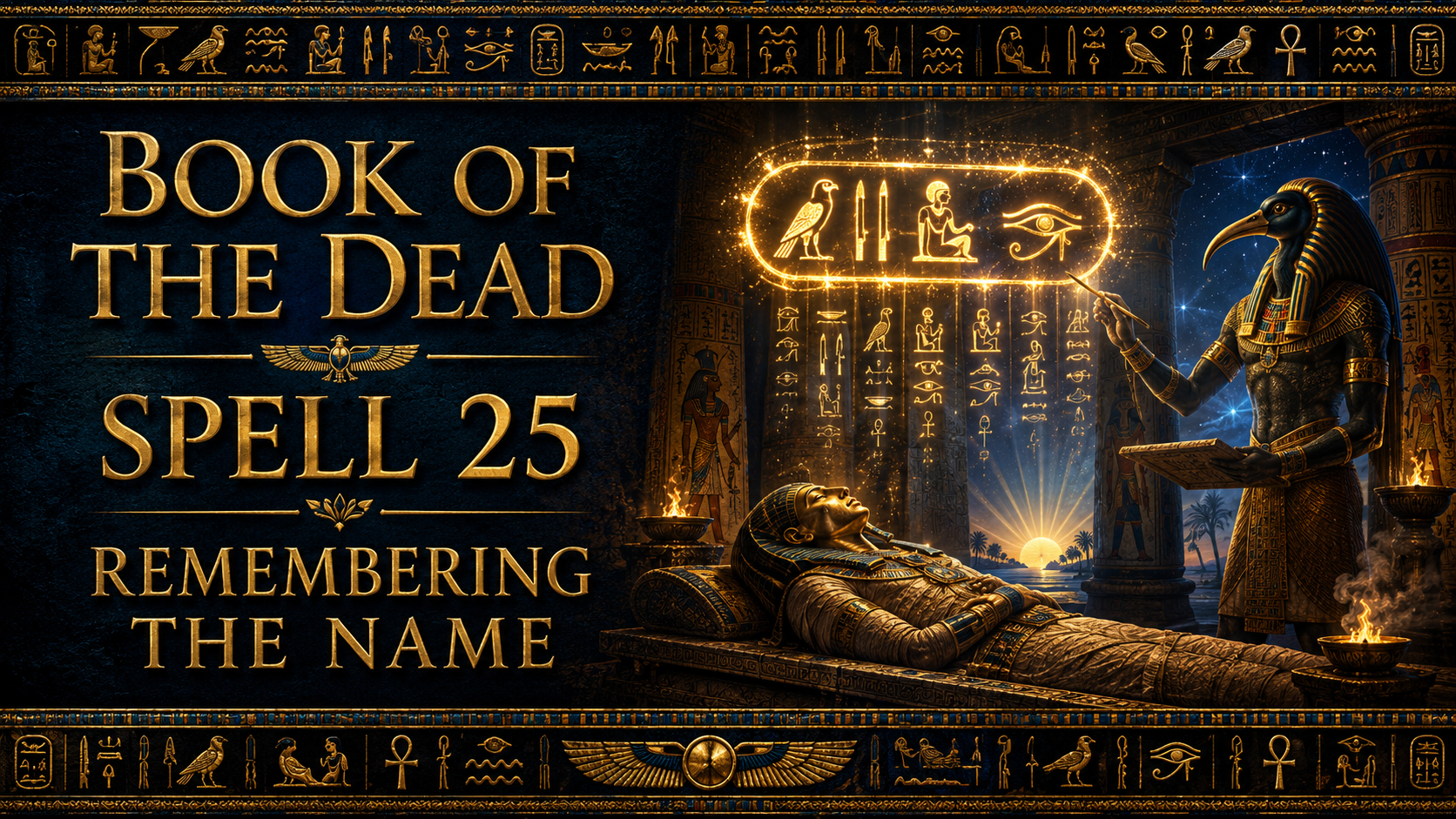
No. Thoth would be an understandable modern artistic choice because he was associated with writing and knowledge, but the surviving Spell 25 translation does not invoke Thoth by name. If you depict Thoth in a modern illustration, it is best to treat him as symbolic of writing and memory rather than claim he appears in the text.
Does Spell 25 Have a Ritual Rubric?
The brief Renouf and Naville version moves directly from the chapter title into the spell and then its commentary. It does not provide the kind of elaborate ritual instructions found with some other chapters. That means we do not have instructions here comparable to:
- Recite twice at dawn
- Place an amulet on the body
- Burn incense
- Speak over a particular object
The primary magical instrument is the text itself.
The Name as a Link Between the Living and the Dead
The importance of the name also helps explain why ancient Egyptian funerary monuments so frequently identify the tomb owner. The dead remained connected to:
- Descendants
- Offering rituals
- Tomb cults
- Written monuments
A name allowed the individual to remain recognizable across those relationships. Spell 25 ensures that the recognition is reciprocal. The living know the deceased’s name. The gods know the deceased’s name. And the deceased still knows it too.
The Meaning of Spell 25 in Simple Terms
Book of the Dead Spell 25 protects the deceased against losing their identity after death. The person asks for their name to be restored in a sacred divine place and for the ability to remember it during a mysterious night when years and months are counted.
The deceased then declares a place in the eastern heavens and demonstrates divine knowledge by immediately speaking the name of any god who does not follow.
The meaning can be summarized as: Death cannot erase who I am. I remember my name, I retain my identity, and I know the names of the gods around me. I remain myself in the afterlife. Spell 25 restores one of the simplest and most profound things a person can know: their own name.
Frequently Asked Questions About Book of the Dead Spell 25
What is Book of the Dead Spell 25?
Spell 25 is a short funerary formula intended to restore the deceased’s memory of their own name in the underworld. UCL summarizes it as a spell “for giving the memory of a man to him in the underworld.”
What is the traditional title of Spell 25?
Renouf and Naville call it: Chapter whereby a person remembereth his name in the Netherworld.
What is the full translation of Spell 25?
A reader-friendly rendering is: Let my name be given back to me in the Great House. Let me remember my name in the House of Flame on the night when the years and months are reckoned. I dwell on the eastern side of heaven, and if any god does not follow me, I speak his name immediately. This closely follows Renouf and Naville’s complete short version.
Why did the deceased need to remember their name?
The name was closely tied to identity and continued recognition after death. Forgetting it would threaten one of the deceased’s most fundamental markers of selfhood.
What is the ren?
The term ren is commonly used for the personal name as a component of Egyptian identity.
What is the Great House?
Renouf interprets it as an important sacred area within an Egyptian temple.
What is the House of Flame?
Renouf also identifies the House of Flame as a sacred temple space. The spell itself does not explain its precise function.
What does “the night when the years are counted” mean?
The text does not explain the event. It appears to involve a sacred reckoning of years and months, making time and continued memory central to the passage.
Why is the east mentioned?
The speaker places themselves on the eastern side of heaven. Within broader Egyptian solar symbolism, the east is associated with sunrise and renewed life.
Why does the deceased name other gods?
Knowing and pronouncing divine names demonstrates sacred knowledge and gives the deceased the ability to identify beings encountered in the afterlife. Spell 25 explicitly says the speaker can immediately utter the name of a god who does not follow.
How is Spell 25 connected to Spell 24?
Spell 24 restores the Words of Power. Spell 25 restores the memory and identity needed to use sacred knowledge effectively. UCL places the two directly beside each other in the sequence.
What comes after Spell 25?
Spell 26 restores the deceased’s heart.
Is Spell 25 the only memory spell?
No. UCL lists Spell 90 as a later formula for granting memory continually to the deceased.
Did Spell 25 have a standard vignette?
Renouf and Naville list no vignette for Spell 25.
Book of the Dead Spell 25 asks one deceptively simple question: Will you still know who you are after death? The answer is yes. The deceased receives the name again. The person remembers it inside the sacred House of Flame. Years are counted. Months pass. Yet identity remains intact. The speaker sits in the eastern heavens and possesses enough divine knowledge to name any god who does not follow. This makes Spell 25 an important step in the reconstruction of the deceased. The mouth has been restored. The magical words have returned. Now memory itself is secure. Death may change the person’s form and location, but it cannot erase the most fundamental declaration of identity: I know my name.