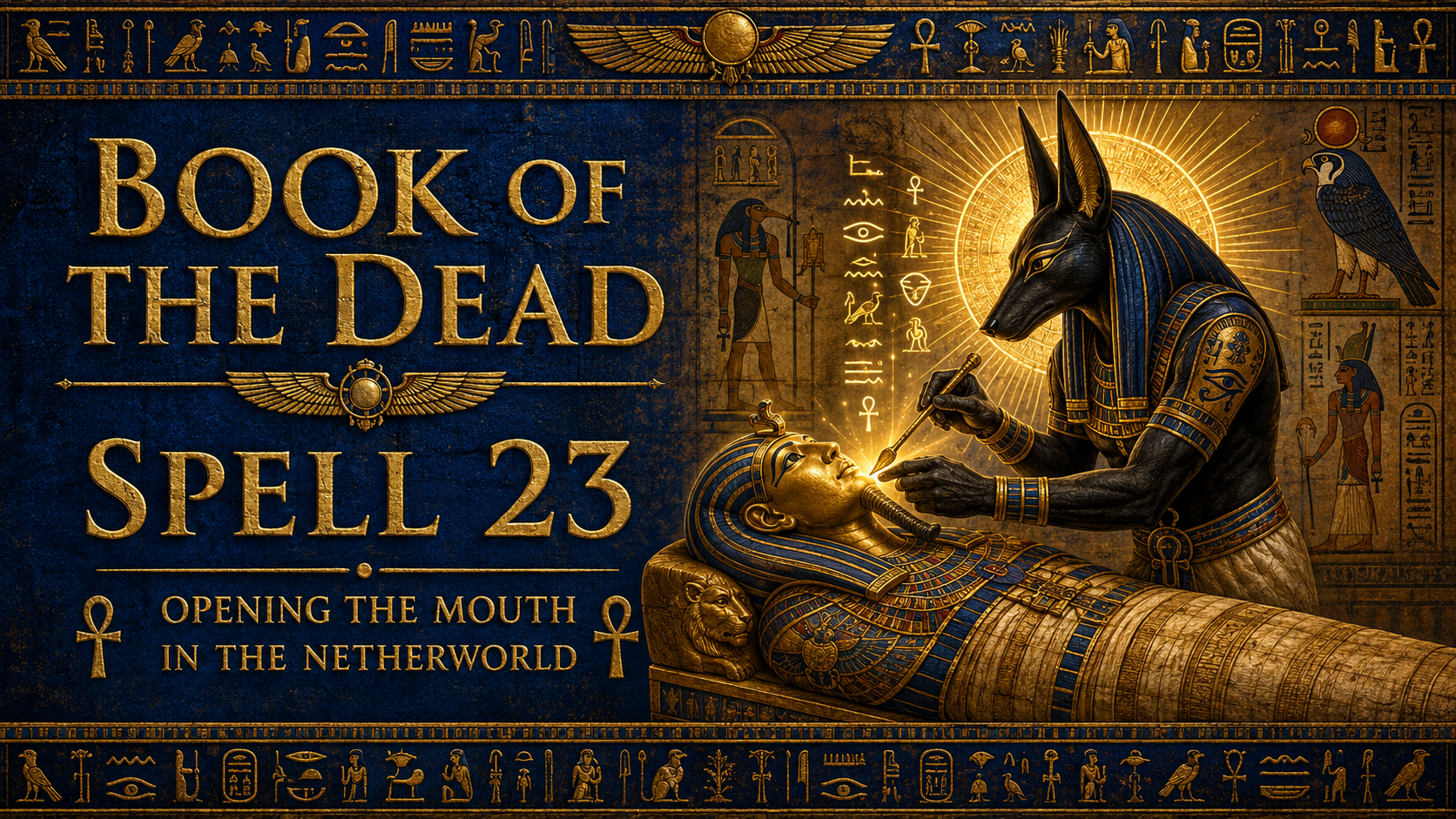
The ancient Egyptian Book of the Dead was a collection of funerary compositions intended to help the deceased regain life, movement, speech, memory, and other essential powers needed in the afterlife.
Book of the Dead Spell 23 focuses on one of the most important of those restorations: opening the mouth of the deceased.
Its traditional title is:
A formula for opening the mouth
The spell calls upon Ptah, Thoth, and Atum to remove the restraints placed upon the deceased’s mouth. Ptah then opens the mouth with a divine metal instrument, the same kind of tool the spell says was used to open the mouths of the gods.
The deceased then assumes powerful divine identities associated with Sekhmet, Wadjet, and the celestial powers of Heliopolis. Finally, the gods are called upon to oppose every hostile word or accusation spoken against the deceased.
Spell 23 is therefore about much more than physically opening the lips.
It restores the deceased’s ability to:
- Speak
- Recite spells
- Use magical words
- Defend against accusations
- Address gods and gatekeepers
- Receive food and drink
- State an identity before divine tribunals
- Function again as a living and effective spirit
In simple terms, Spell 23 declares:
My mouth is no longer sealed by death. Ptah opens it, Thoth removes its restraints, and I can once again speak with divine authority.
What Is Book of the Dead Spell 23?
Book of the Dead Spell 23 is a funerary formula for opening the mouth of the deceased in the underworld.
UCL Digital Egypt gives the title simply as:
Formula for opening the mouth
Renouf and Naville use the longer title:
Chapter whereby the Mouth of a person is opened for him in the Netherworld.
The spell follows directly after two related compositions:
- Spell 21: Gives the deceased their mouth.
- Spell 22: Another formula for giving the deceased their mouth.
- Spell 23: Opens and activates that mouth.
This creates a logical progression. First, the mouth must be restored. Then it must be opened. Only after that can the deceased fully use speech and magical language.
English Translation of Book of the Dead Spell 23
The following reader-friendly translation is based primarily on the Eighteenth Dynasty text published by UCL Digital Egypt. UCL notes that this version follows two Eighteenth Dynasty Books of the Dead, including the Papyrus of Amenhotep and Cairo Papyrus 2512.
Spell 23: Opening the Mouth
My mouth is released by Ptah.
The bonds upon my mouth
are loosened by the god of my city.Thoth comes fully equipped
with his words of power,and he releases for me
the restraints of Set
that bind my mouth.Atum moves my hands
and sets them forward
as guardians of my mouth.My mouth is opened.
My mouth is parted by Ptah
with that metal instrument
with which he opened
the mouths of the gods.I am Sekhmet-Wadjet.
I sit beside the great starboard
in the sky.I am Sahyt
among the powers of Heliopolis.As for every word of power
and every accusation
spoken against me,let the gods stand against them,
the assembled Ennead
and all its divine companies.
The central theme is unmistakable: the mouth is freed, opened, protected, and empowered.
Historical Translation of Spell 23
Renouf and Naville translated the chapter in 1904 as:
“Let my mouth be opened by Ptah, and let the muzzles which are upon my mouth be loosed by the god of my domain.”
They continue by calling upon Thoth to arrive equipped with “Words of Power,” Atum to assist, and Ptah to open the mouth with the divine instrument used for the gods themselves.
Their translation uses older forms of several names:
- Sutu for Set
- Tmu for Atum
- Sechit for Sekhmet
- Uat’it for Wadjet
For a modern audience, using the more familiar forms Set, Atum, Sekhmet, and Wadjet makes the text easier to follow.
What Does Book of the Dead Spell 23 Mean?
Spell 23 restores the deceased’s ability to speak effectively. Death had made the body silent. The mouth could no longer:
- Move
- Eat
- Drink
- Speak
- Pronounce names
- Recite magical formulas
- Answer divine questions
Spell 23 reverses that condition. Its meaning can be summarized as:
The restraints of death are removed from my mouth. Ptah opens it with divine authority, Thoth restores the magical words I need, and no hostile accusation can silence me again.
This makes Spell 23 one of the most practical spells in the Book of the Dead. The deceased cannot successfully use the rest of the funerary text without the ability to speak.
Why Was Opening the Mouth So Important?
Speech was essential in the ancient Egyptian afterlife. The deceased might need to say:
- Their own name
- The names of gods
- The names of gates
- The names of guardians
- Protective spells
- Statements of innocence
- Prayers for food and water
- Divine identifications such as “I am Horus” or “I am Ra”
A silent deceased person would be unable to participate fully in the divine world.
Spell 23 therefore restores agency. The mouth becomes an instrument through which the deceased can act.
Spell 23 and the Opening of the Mouth Ceremony
Spell 23 is closely connected with the famous Egyptian Opening of the Mouth ceremony.
UCL specifically tells readers to compare the spell with the ritual for the Opening of the Mouth as depicted in New Kingdom tomb chapels and later inscriptions and manuscripts.
The British Museum also identifies Spell 23 texts as ritual utterances associated with the Opening of the Mouth ceremony. However, the spell and the entire ceremony are not exactly the same thing.
Spell 23
Spell 23 is one written funerary formula.
The Opening of the Mouth Ceremony
The full ceremony was a much larger ritual involving priests, implements, offerings, gestures, and other recitations.
Its purpose was to restore the deceased’s sensory and bodily faculties.
What Was the Opening of the Mouth Ceremony?
The Opening of the Mouth ceremony could be performed on:
- A mummy
- A coffin
- A statue
- A cult image
The ritual symbolically restored the ability to:
- Breathe
- See
- Hear
- Eat
- Drink
- Speak
The mouth was especially important because eating and speaking were both essential to continued existence. Spell 23 preserves the same basic idea in a compact magical formula.
Spell 21, Spell 22, and Spell 23
These three spells are best understood together.
Spell 21
The deceased asks:
Give me my mouth so that I may speak.
Spell 21 restores possession of the mouth.
Spell 22
The deceased declares that the mouth has been given back and can be used before the ruler of the underworld.
Spell 22 adds divine authority and identification with Osiris.
Spell 23
Ptah actually opens the mouth.
Thoth removes its restraints, Atum protects it, and divine powers defend the speaker against hostile words.
The sequence can be summarized simply: Spell 21 gives the mouth. Spell 22 confirms its return. Spell 23 opens it.
Who Is Ptah in Spell 23?
Ptah is the principal deity responsible for opening the mouth. He was the great god of Memphis and was associated with:
- Creation
- Craftsmen
- Artisans
- Divine speech
- The formation of bodies
- Sacred craftsmanship
Spell 23 says:
My mouth is opened by Ptah.
This role fits Ptah extremely well. In Egyptian theology, Ptah could create through heart and speech. The heart conceived. The tongue expressed. That makes him a natural divine power to restore the mouth of the deceased.
Ptah and Creation Through Speech
The connection between Ptah and speech makes Spell 23 especially meaningful.
A mouth is not merely reopened so that the deceased can talk casually. It is restored as an instrument of creative and magical speech.
The same principle that allows divine words to bring things into existence now empowers the deceased.
By receiving a mouth opened by Ptah, the dead person gains access to a divine model of effective speech.
“The Bonds of My Mouth”
Spell 23 describes the mouth as restrained or bound.
UCL translates the passage as: “The bonds of my mouth are caused to be unfettered.”
Renouf used the stronger image of: “muzzles which are upon my mouth.”
Both translations express the same basic problem. Death has imposed a restraint. The deceased cannot speak freely until that restraint is removed.
What Are the Restraints of Set?
The spell says that Thoth removes restraints associated with Set. Set frequently represents opposition, conflict, and hostile disruption within Osirian funerary mythology.
In the context of Spell 23, his restraints represent whatever prevents the deceased from speaking.
This may symbolize:
- Death
- Silence
- Hostile magical restraint
- An enemy’s accusation
- Disorder
- A supernatural attempt to immobilize the deceased
Thoth removes those restraints completely.
Why Does Thoth Remove Them?
Thoth was the god of:
- Writing
- Sacred language
- Magical knowledge
- Divine records
- Judgment
- Effective speech
UCL says:
“Thoth comes fully equipped with his words of power.”
That phrase is central to understanding his role. Thoth does not simply untie a physical knot. He defeats the restraints through heka, sacred magical authority. The deceased’s mouth becomes free because the master of divine language intervenes.
What Are “Words of Power”?
Older translations often use expressions such as:
Words of Power
These were not ordinary spoken sentences. They were magically effective words capable of changing reality.
Correct speech could:
- Open gates
- Command beings
- Heal injuries
- Defeat enemies
- Reverse magical attacks
- Restore body parts
- Establish divine identity
Spell 23 depends heavily upon this idea.
The mouth must be restored because magical speech is one of the deceased’s greatest weapons.
Why Is Atum Mentioned?
The spell also invokes Atum.
UCL translates:
“My hands are moved by Atum, he puts them forward as the guard of my mouth.”
Atum was the creator god of Heliopolis.
He represented:
- Creation
- Completion
- Divine authority
- Self-generation
- The totality of existence
His role seems protective. Once the mouth has been released, Atum helps guard it. The speaker’s restored faculty cannot simply be taken away again.
Why Are the Hands Mentioned?
The hands may appear surprising in a spell about speech. However, the passage connects bodily movement with restored life.
Death had deprived the person of both:
- Speech
- Movement
When Atum moves the hands forward, another bodily faculty has become active.
The deceased is not only speaking again. The entire body is returning to functional supernatural life.
The Divine Instrument Used to Open the Mouth
Spell 23 says Ptah opens the deceased’s mouth with a special instrument.
UCL translates the material as:
iron
Renouf translated it as:
steel
The Egyptian term is biA, whose precise rendering can vary depending on date and context.
For a modern article, the safest wording is:
a divine metal instrument
You can then note that older translations rendered the material as iron or steel.
“With Which He Opened the Mouths of the Gods”
The instrument is given extraordinary authority. Ptah does not invent it specifically for the deceased.
It is the tool with which he opened the mouths of the gods.
This gives the deceased the same ritual treatment as divine beings. The speaker is not receiving a lesser human version of the rite. The mouth is opened according to a divine precedent.
What Did the Opening of the Mouth Instrument Look Like?
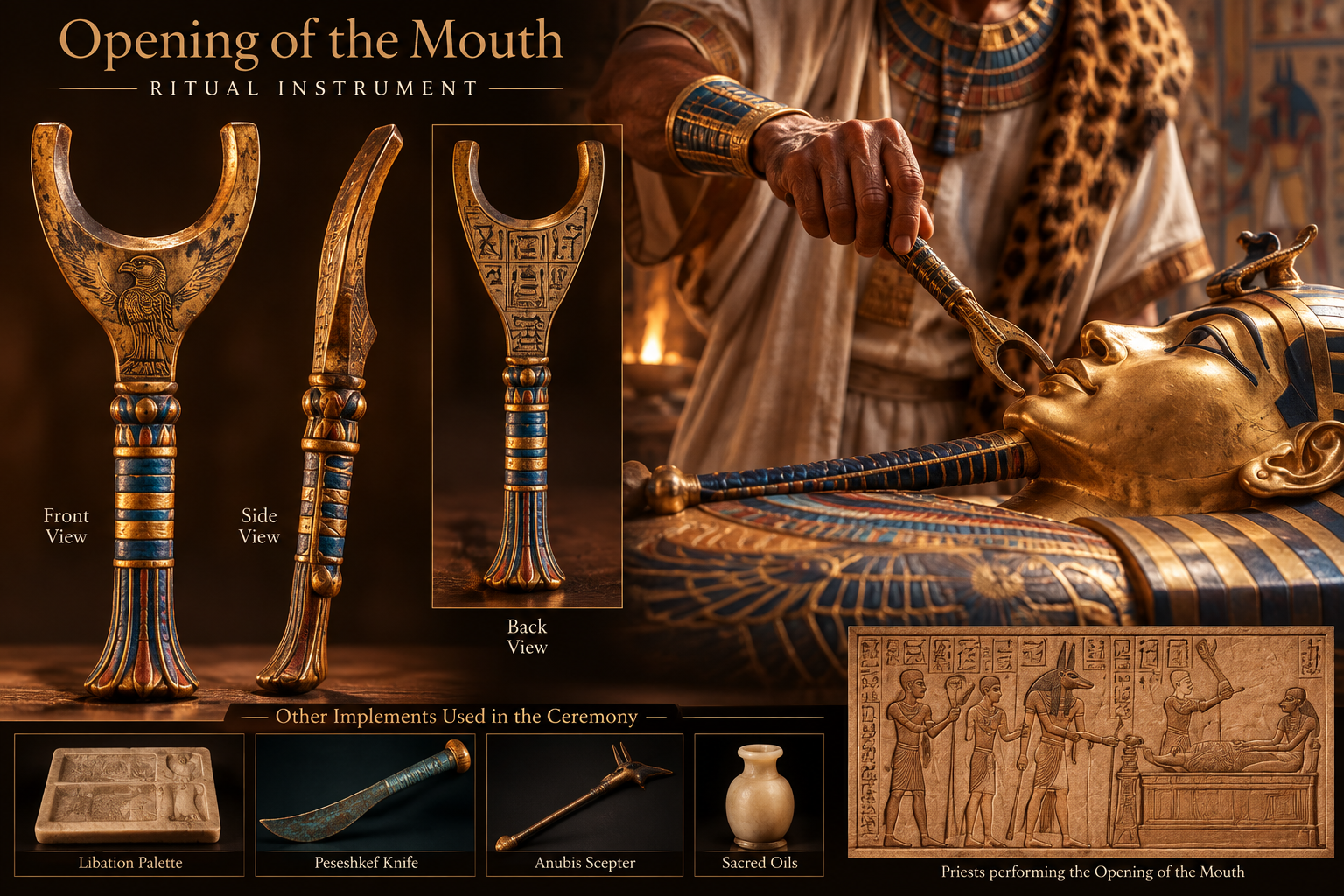
The full Opening of the Mouth ceremony used several ritual implements. One of the best-known is a forked or adze-like tool commonly associated with the ceremony.
These objects could be touched to the mouth of a mummy or statue as part of the symbolic restoration of the senses. Spell 23 does not provide a detailed visual description of the implement itself.
Its significance lies in who has used it: Ptah used it on the gods. The deceased now receives the same restoration.
Was the Tool Literally Made of Iron?
The UCL text translates biA as iron, while Renouf historically used steel. Ancient Egyptian material terminology can be difficult because a word may carry different meanings over long periods.
It is therefore better not to insist that every historical version of the ritual instrument was physically made of modern industrial iron or steel.
The safest explanation is: The spell describes a special metal implement with divine associations.
Who Is Sekhmet-Wadjet?
After the mouth is opened, the deceased declares: “I am Sekhmet Wadjyt.” This is another example of divine identification.
Sekhmet was the powerful lioness goddess associated with:
- Solar heat
- Destruction
- Protection
- Disease
- Healing
- Royal power
Wadjet was the cobra goddess associated with:
- Lower Egypt
- Royal protection
- The uraeus
- Fiery defensive power
The combination creates a formidable divine identity.
Why Does the Deceased Become Sekhmet and Wadjet?
Once the mouth is restored, the speaker needs protection from anyone who might challenge or silence it again.
Sekhmet and Wadjet provide exactly that kind of defensive force.
They represent:
- Fierce protection
- Royal authority
- Solar power
- Destruction of enemies
- Resistance to hostile speech
The restored voice is not weak.
It is protected by two of Egypt’s most dangerous divine powers.
Is “Sekhmet-Wadjet” One Goddess?
The Egyptian line can be interpreted as combining or identifying the speaker with these closely related protective divine powers.
Egyptian theology frequently allowed deities to:
- Merge
- Share attributes
- Be invoked together
- Appear in composite forms
It is therefore better to focus on the shared protective force of Sekhmet and Wadjet than to impose a rigid modern distinction on the short phrase.
What Is Sahyt?
The spell also declares:
“I am Sahyt amid the powers of Iunu.”
Iunu is Heliopolis. The precise identity of Sahyt is less familiar and may be translated or interpreted differently in different editions.
What is clear is that the deceased is placing themselves among the divine powers of Heliopolis. This gives the speaker a recognized celestial position.
Why Is Heliopolis Important?
Heliopolis was one of ancient Egypt’s most important centers of solar and creation theology.
It was associated with:
- Atum
- Ra
- Shu
- Tefnut
- Geb
- Nut
- Osiris
- Isis
- Set
- Nephthys
These gods formed the great Heliopolitan Ennead.
When Spell 23 places the deceased among the powers of Heliopolis, it gives the person membership within one of the most important divine communities in Egyptian religion.
What Is the Ennead?
The Ennead was a divine group associated especially with Heliopolis. The classical Heliopolitan Ennead consisted of:
Spell 23 ends by calling upon the gods and assembled Enneads to oppose hostile words spoken against the deceased. The speaker therefore gains the backing of an entire divine tribunal.
Why Does the Spell End With Accusations?
The final lines say that if any magical words or accusations are spoken against the deceased, the gods will stand against them.
This connects the restoration of speech with judgment. The deceased now has a mouth, but enemies may also possess mouths.
They may speak:
- Accusations
- Curses
- False testimony
- Magical attacks
Spell 23 ensures that hostile speech cannot outweigh the deceased’s own restored and divinely protected voice.
Speech Against Speech
The ending creates a contest between two forms of language.
The deceased’s speech
It is:
- Opened by Ptah
- Empowered by Thoth
- Guarded by Atum
- Protected by Sekhmet and Wadjet
The enemy’s speech
It is:
- Opposed by the gods
- Rejected by the Ennead
- Prevented from harming the deceased
The spell therefore restores not only the ability to speak but the superiority of the deceased’s speech.
Spell 23 and Divine Judgment
The concern with accusations makes sense after Spells 18 through 20. Those earlier spells focused on:
- Vindication
- Divine tribunals
- Enemies
- Thoth’s judgment
- The triumph of Osiris
Spell 23 ensures that the deceased remains capable of defending that status. A favorable verdict is useless if the deceased can later be silenced by hostile words. The mouth must remain active and protected.
Spell 23 and Spell 24
Spell 24 immediately continues the theme of speech.
UCL lists it as:
Formula for fetching the words of power of a man for him in the underworld.
This creates another logical sequence:
- Restore the mouth.
- Open the mouth.
- Restore the magical words.
Spell 23 gives the instrument.
Spell 24 supplies the magical content.
Spell 23 and Spell 25
Spell 25 then restores memory. This is necessary because magical speech depends upon remembering:
- Names
- Spells
- Identities
- Sacred places
- Divine relationships
The mouth can be open, but the deceased must also know what to say.
Spell 23 and Spell 26
Spell 26 concerns restoring the heart. The sequence therefore reconstructs the entire mechanism of thought and speech:
- Mouth
- Magical language
- Memory
- Heart
Ancient Egyptians viewed these faculties as interconnected. The deceased must become intellectually, verbally, and spiritually complete.
How Old Is Spell 23?
UCL states that Spell 23 is not attested in the Middle Kingdom. Its first known occurrence is among Book of the Dead chapters on the coffin of the king’s wife Mentuhotep of the Seventeenth Dynasty.
That makes it similar in textual history to Spell 22. Both appear at a transitional moment shortly before the New Kingdom.
This was a period when older Coffin Text traditions were being transformed into what would become the Book of the Dead.
Spell 23 and Queen Mentuhotep
The earliest known occurrence cited by UCL comes from the coffin of the king’s wife Mentuhotep.
This is important because it shows that the spell was used before Book of the Dead papyri became widespread during the New Kingdom.
The Book of the Dead did not suddenly appear as one finished book.
It developed gradually across:
- Coffins
- Tombs
- Sarcophagi
- Papyri
- Other funerary objects
Spell 23 belongs to that evolving tradition.
Which Manuscripts Preserve Spell 23?
UCL’s translation follows two Eighteenth Dynasty Books of the Dead:
- The Papyrus of Amenhotep
- Cairo Papyrus 2512
Renouf and Naville’s illustrated edition also lists Spell 23 imagery from:
- The Tomb of Bekenrenef
- British Museum Papyrus 9900
- A vignette published by Lepsius
This shows that the spell circulated across different manuscripts and media.
Is Anubis the One Who Opens the Mouth?
This is an important distinction for imagery.
Modern depictions often show Anubis performing an Opening of the Mouth-like ceremony because jackal-headed funerary priests or deities are visually associated with mummification.
However, Spell 23 itself specifically names Ptah as the god who opens the mouth.
Thoth removes the restraints, Atum provides protection, and the deceased identifies with Sekhmet-Wadjet.
So if you create an image specifically labeled Book of the Dead Spell 23, featuring Ptah would be more textually precise than making Anubis the central divine actor.
Does Spell 23 Restore Eating and Drinking Too?
Spell 23 specifically focuses on speech. However, the broader Opening of the Mouth ritual was connected with restoring multiple functions of the mouth, including eating and drinking.
The deceased needed nourishment in the afterlife, and many Book of the Dead spells ask for:
- Bread
- Beer
- Water
- Offerings
An opened mouth naturally supported those goals.
But Spell 23 itself emphasizes speech and magical defense more strongly than food.
Why Was Speech So Powerful in Ancient Egypt?
Ancient Egyptian religion did not treat words as powerless descriptions. Sacred speech could participate directly in reality.
A properly spoken formula could:
- Invoke a god
- Establish an identity
- Repel an enemy
- Remove a magical restraint
- Open a road
- Heal a body
- Protect a soul
That is why Thoth arrives “equipped with his words of power.” The deceased needs access to the same kind of effective language.
The Mouth as a Magical Weapon
Once opened, the mouth becomes one of the deceased’s most important tools.
With it, the deceased can say:
I know your name.
Open for me.
I am Osiris.
I am Horus.
My enemy shall fall.
Give me bread and water.
The mouth is therefore simultaneously:
- A bodily organ
- A ritual faculty
- A legal defense
- A magical weapon
Spell 23 restores all of these functions at once.
The Meaning of Spell 23 in Simple Terms
Book of the Dead Spell 23 activates the deceased’s mouth after death. Ptah opens it. Thoth removes the magical restraints that keep it closed. Atum guards it.
The deceased assumes the protective powers of Sekhmet and Wadjet and gains a place among the divine powers of Heliopolis.
Finally, the gods themselves oppose every hostile word or accusation spoken against the deceased.
The spell’s meaning can be summarized as:
Death cannot keep me silent. Ptah opens my mouth, Thoth frees my speech, and the gods protect my words. I can now speak, defend myself, invoke divine power, and continue through the afterlife as an active being.
Spell 23 turns silence back into speech.
Frequently Asked Questions About Book of the Dead Spell 23
What is Book of the Dead Spell 23?
Spell 23 is a funerary formula for opening the mouth of the deceased so the person can speak and use magical words in the afterlife.
What is the traditional title of Spell 23?
UCL gives the title: Formula for opening the mouth. Renouf and Naville call it: Chapter whereby the Mouth of a person is opened for him in the Netherworld.
Who opens the mouth in Spell 23?
Ptah opens the deceased’s mouth.
What does Thoth do?
Thoth arrives equipped with words of power and removes the restraints associated with Set that bind the mouth.
What does Atum do?
Atum moves the deceased’s hands forward as protection or guardianship for the mouth.
What instrument opens the mouth?
The spell refers to a divine metal tool used by Ptah to open the mouths of the gods. UCL translates the material as iron, while Renouf historically rendered it as steel.
Is Spell 23 the Opening of the Mouth ceremony?
It is closely connected with the ceremony, but Spell 23 is one funerary formula rather than the entire ritual. UCL explicitly compares it with the broader Opening of the Mouth ceremony.
How is Spell 23 different from Spell 21?
Spell 21 restores possession of the mouth, while Spell 23 specifically opens and activates it.
How is Spell 23 different from Spell 22?
Spell 22 confirms that the mouth has been restored and can be used before the gods. Spell 23 specifically invokes Ptah to open it.
Who are Sekhmet and Wadjet in the spell?
The deceased identifies with their combined protective power after the mouth has been opened.
Why is Heliopolis mentioned?
The deceased identifies with a divine being among the powers of Heliopolis, placing the speaker within the celestial community associated with Atum and the Ennead.
Why does Spell 23 mention accusations?
The spell ends by asking the gods to oppose every hostile word or accusation spoken against the deceased.
Is Spell 23 found in the Coffin Texts?
UCL says the composition is not attested in the Middle Kingdom. Its earliest known occurrence is on the coffin of the king’s wife Mentuhotep from the Seventeenth Dynasty.
Did Spell 23 have illustrations?
Yes. Renouf and Naville list several vignettes associated with Chapter 23, including examples from the Tomb of Bekenrenef and British Museum Papyrus 9900.
Book of the Dead Spell 23 restores one of the deceased’s most powerful abilities: the ability to speak. The mouth is no longer restrained. Ptah opens it with the same divine instrument used for the gods.
Thoth arrives carrying words of power and removes the bindings associated with Set. Atum protects the restored faculty.
The deceased then assumes the fierce protective authority of Sekhmet and Wadjet and receives the support of the divine Ennead against every hostile accusation.
The result is much greater than the physical opening of the lips. The deceased regains a voice.
That voice can invoke gods, answer challenges, defend against enemies, speak magical formulas, and declare divine identity. In the Book of the Dead, speech is power. Spell 23 gives that power back.