The ancient Egyptian Book of the Dead was a collection of funerary spells created to help the deceased move safely through the afterlife, overcome supernatural dangers, and attain eternal life among the gods.
Book of the Dead Spell 7 protects the deceased from Apep, the enormous serpent who represented chaos and threatened the daily journey of the sun god Ra.
The spell confronts Apep directly. The deceased refuses to become motionless, rejects the serpent’s poison, identifies with powerful creator gods, and claims divine protection.
Its traditional title has been translated in several ways, including:
A spell for passing the sandbank of Apep
and:
A chapter for passing through the empty back or spine of Apep
Despite the variations in translation, the purpose remains clear. Spell 7 prevented Apep from immobilizing, poisoning, or destroying the deceased during the journey through the afterlife.
What Is Book of the Dead Spell 7?
Book of the Dead Spell 7 is a protective incantation directed against Apep, also known as Apophis. Apep was imagined as a gigantic serpent associated with darkness, disorder, violence, and the forces that threatened the stability of creation. Each night, he attempted to obstruct Ra’s solar boat as it traveled through the hidden realm.
The deceased hoped to participate in Ra’s cycle of death and rebirth. That meant they might also encounter the dangers that opposed the sun god. Spell 7 allowed the deceased to confront Apep with divine authority rather than approach him as a helpless human soul.
The spell declares that:
- Apep cannot paralyze the deceased
- His poison cannot enter the deceased’s body
- The deceased’s limbs belong to Atum
- The speaker possesses the powers of the gods
- The deceased emerges safely with the creator god
- Apep has no authority over the speaker
UCL Digital Egypt describes Spell 7 as a ritual pronouncement referring to a wax figure. The composition is not presently attested before the New Kingdom, and one surviving version comes from the Eighteenth Dynasty papyrus Cairo 2512.
The Title of Book of the Dead Spell 7
UCL translates the title as:
Formula for passing the sandbank of Aapep
Renouf and Naville give the more unusual title:
Chapter of passing through the chine of Apepi which is void
In older English, chine can mean a spine, backbone, ridge, or narrow raised surface. The difference may result from uncertainty over the Egyptian word and the imagery behind it. The obstruction could be understood as Apep’s back, a ridge associated with the serpent, or a sandbank that blocked the solar boat.
Renouf and Naville’s index places Spell 7 immediately after the shabti formula of Spell 6 and lists no standard vignette for the chapter.
For modern readers, the clearest descriptive title is:
A spell for passing the sandbank of Apep and resisting his poison
English Translation of Book of the Dead Spell 7
The following reader-friendly translation combines the principal meaning of the Eighteenth Dynasty version published by UCL with the fuller wording preserved in the Renouf and Naville edition.
Spell 7: Passing the Sandbank of Apep
O being of wax,
who plunders, seizes with violence,
and lives upon those who have become motionless:I will not become motionless before you.
I will not be paralyzed before you.Your poison shall not enter my body,
for my limbs are the limbs of Atum.You shall not enter this body of mine.
Your weakness and corruption
shall not enter my limbs.I am the Sole One
who stands at the forefront of the primeval waters.I am the eternal protection of every god.
My names are hidden.
My dwelling place is secret
for millions of years.I am one of those gods.
I come forth together with Atum.I am beyond your reckoning.
I am safe.
I am whole.
The word Atum appears as Tmu in the older translation. Both names refer to the same creator god.
Historical Translation of Spell 7
Renouf and Naville translated the spell as follows:
“Oh, One of Wax, who takest captive and seizest with violence, and livest upon those who are motionless! Let me not become motionless before thee, let me not be paralysed before thee, let not thy venoms enter into my limbs, for my limbs are the limbs of Tmu.
And if thou wouldst not be paralysed, let me not be paralysed. Let not thy languors enter these limbs of mine.
I am the One who presideth over the pole of Heaven, and the powers of all the gods are my powers.
I am he, whose names are hidden, and whose abodes are mysterious for all eternity.
It is I who proceed from Tmu, and I am safe and sound.”
The older edition titles the spell as a chapter for passing through Apep’s empty “chine” and presents it immediately after Spell 6.
The UCL version is shorter and includes the declaration: “I am the protection of every god, eternally.” It also concludes by repeating that the speaker is healthy or whole.
What Does Book of the Dead Spell 7 Mean?
Spell 7 prevents the deceased from suffering the same fate as Apep’s victims. The serpent is described as feeding upon the weary, still, or motionless. This imagery connects death with physical helplessness.
A corpse cannot move. It cannot defend itself. It cannot resist poison or attack. The deceased therefore begins by denying that condition: I will not become motionless.
This is more than a request for physical protection. It is a declaration that death has not deprived the speaker of power. The deceased remains active, conscious, protected, and capable of continuing the journey.
Who Was Apep?
Apep was the great serpent enemy of Ra and the ordered world. He was not simply a dangerous snake. He represented the destructive forces that opposed Ma’at, the Egyptian principle of truth, justice, balance, and cosmic order.
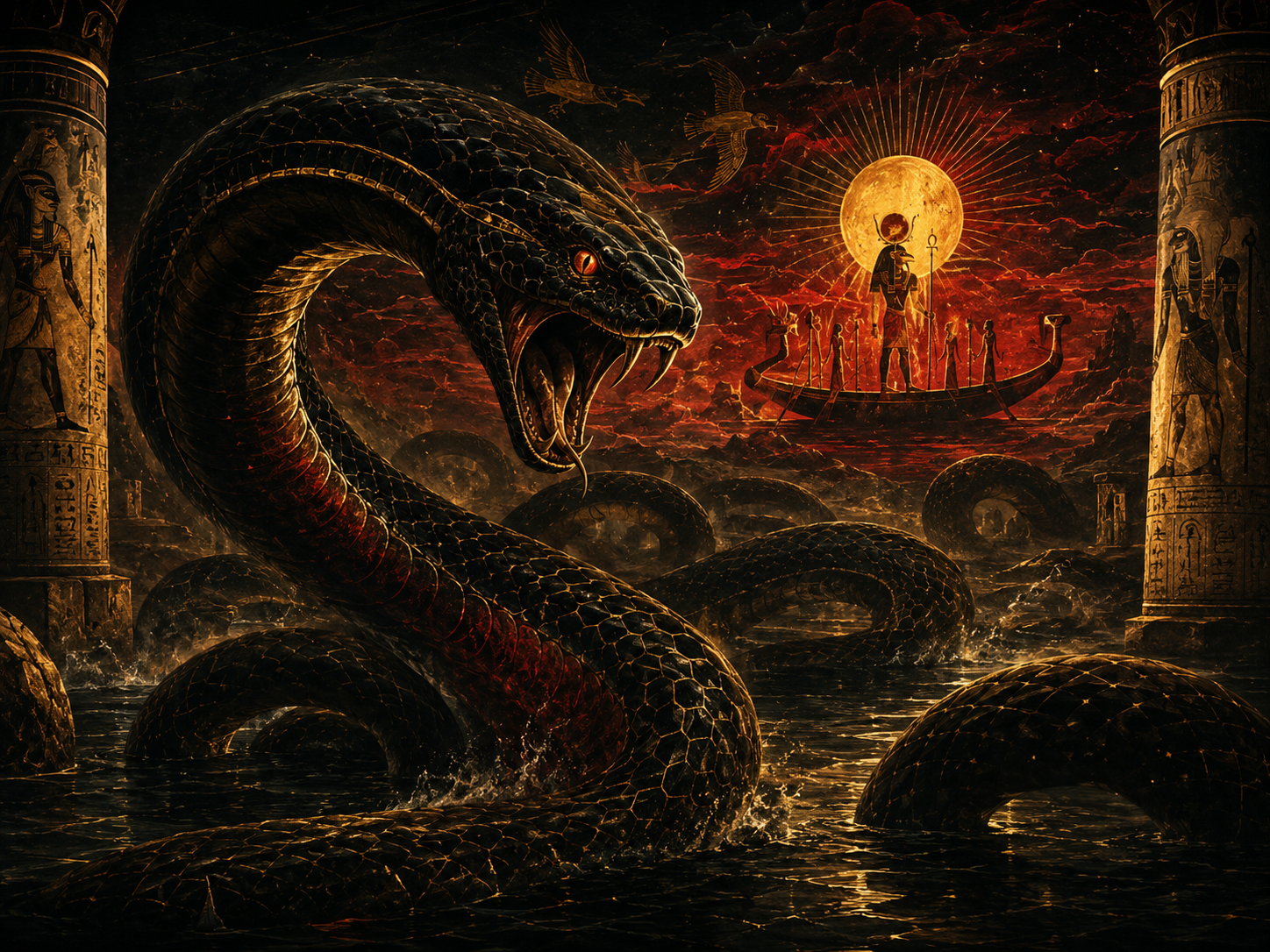
Apep could be imagined as:
- An enormous serpent
- A creature inhabiting the darkness
- An enemy of Ra’s solar boat
- A source of storms and disorder
- A being who attempted to swallow the sun
- A supernatural obstacle placed across the solar route
- A force that had to be defeated repeatedly
Unlike many hostile figures in Egyptian religion, Apep was not permanently destroyed.
Ra rose every morning, but the serpent returned to threaten him again the following night. The struggle represented the continuing need to defend order against chaos. Spell 7 allows the deceased to join that cosmic resistance.
Apep or Apophis?
Apep is the English form closest to the ancient Egyptian name, often transliterated as ꜥꜣpp. Apophis is the Greek form of the name.
Older English translations may use spellings such as:
- Apepi
- Aapep
- Apep
- Apophis
All refer to the same serpent enemy.
Why Is Apep Called the “One of Wax”?
Spell 7 opens by addressing Apep as:
O one of wax
This wording is especially important because UCL describes the composition as a ritual pronouncement involving a wax figure.
Ancient Egyptian protective rituals could use small models of enemies made from wax. The image could be bound, pierced, cut, burned, crushed, or otherwise destroyed.
The ritual treatment of the model symbolically transferred defeat to the being it represented.
Wax was useful because it could be:
- Easily shaped
- Given the form of an enemy
- Pierced or cut
- Melted in fire
- Destroyed without damaging a permanent sacred object
Calling Apep a being of wax reduces the mighty serpent to a vulnerable ritual image.
The deceased is no longer confronting an unstoppable monster. Apep has become something that can be controlled and destroyed through sacred words and ritual actions.
Did Egyptians Make Wax Figures of Apep?
The reference to wax suggests that Spell 7 was connected with ritual practice rather than existing only as writing on papyrus. The spell may have been spoken while a wax representation of Apep was manipulated or destroyed.
Later Egyptian rituals against Apep are known to have included hostile actions against models or drawings of the serpent. These rituals treated Apep as an enemy who had to be restrained repeatedly.
The uploaded Renouf and Naville edition does not provide detailed instructions for creating or destroying the wax figure within Spell 7 itself. The exact performance therefore cannot be reconstructed solely from the chapter’s surviving text.
What the text clearly establishes is that Apep is addressed as a wax being whose power can be rejected.
“Who Lives Upon Those Who Are Motionless”
The spell describes Apep as living upon or feeding upon the motionless. This may refer to the dead, the exhausted, the paralyzed, or beings rendered helpless by his power. Motion was essential to a successful Egyptian afterlife.
The deceased wanted to:
- Rise from the coffin
- Leave the tomb
- Walk upon the earth
- Travel through the Duat
- Sail in divine boats
- Pass through gates
- Receive offerings
- Join Ra and Osiris
- Return safely to the body
Becoming motionless would prevent nearly all these goals. Apep’s danger is therefore not limited to physical attack. He threatens the deceased’s ability to continue existing as an active being.
“I Will Not Become Motionless Before You”
The deceased responds with a direct denial: I will not become motionless before you. Like many Book of the Dead formulas, Spell 7 states the desired result as an accomplished reality.
The speaker does not say: Please do not paralyze me. Instead, the deceased declares: You cannot paralyze me.
This confident language was part of the spell’s power. By speaking as someone who already possessed divine protection, the deceased transformed vulnerability into authority.
The phrase also connects Spell 7 with the opening chapters of the Book of the Dead. Spells 2 through 4 gave the deceased movement, emergence, and access to divine roads. Apep threatens to reverse that progress by forcing the speaker back into stillness.
Spell 7 ensures that the journey can continue.
Why Is Poison Important in Spell 7?
The deceased commands: Your poison shall not enter my body. Snakes presented a genuine danger in ancient Egypt, so protective magic against venom had a practical basis. Within Spell 7, however, Apep’s poison is also cosmic.
The serpent represents corruption entering the ordered body. His venom could weaken, immobilize, or destroy the deceased in the same way that chaos threatened the created world.
Refusing the poison means refusing everything Apep represents:
- Disorder
- Weakness
- Decay
- Paralysis
- Spiritual destruction
- Separation from the gods
- Failure to complete the afterlife journey
The deceased’s body is presented as closed to chaos.
“My Limbs Are the Limbs of Atum”
The reason Apep’s poison cannot enter is that the deceased’s limbs belong to Atum. Atum was the creator god of Heliopolis and one of the oldest gods in Egyptian religious tradition.
According to Heliopolitan creation theology, Atum emerged from the primeval waters and brought the ordered world into existence. By identifying the body with Atum, the deceased claims that their physical and spiritual form is divine.
Apep cannot poison the creator without attacking creation itself.
This type of divine identification appears throughout the Book of the Dead. The deceased often declares that individual body parts belong to particular gods.
The strategy provides several forms of protection:
- The body becomes sacred.
- Injury to the deceased becomes an attack upon a god.
- Divine strength replaces human weakness.
- The deceased gains access to the god’s authority.
- Hostile beings must recognize the speaker’s transformed status.
The deceased survives because they are no longer merely human.
Atum and the Primeval Waters
Spell 7 also identifies the speaker as the sole being at the forefront of Nun. Nun was the limitless primeval water that existed before the creation of the ordered world. Atum emerged from these waters as the self-created god. The image therefore places the deceased at the beginning of creation itself.
Instead of being defined by recent death, the deceased claims an identity older and more powerful than Apep’s attack. The speaker stands with the creator at the moment when order first emerged from chaos.
This is an especially effective answer to Apep. The serpent represents chaos, but the deceased identifies with the god who overcame the primeval state and created the ordered world.
“I Am the Protection of Every God”
The UCL translation contains the extraordinary declaration: I am the protection of every god, eternally. The deceased is not merely protected by the gods. The speaker becomes the force that protects them.
This reverses the apparent balance of power. Apep threatens both the gods and the dead, but the deceased now occupies the role of defender. The statement may connect the deceased with the divine beings who protected Ra’s solar boat and fought Apep during the nightly voyage.
The deceased’s survival and the sun god’s survival become part of the same cosmic struggle.
“The Powers of All the Gods Are My Powers”
Renouf and Naville’s version similarly declares: The powers of all the gods are my powers. This is a collective form of divine identification. The deceased does not rely on the protection of one deity alone. Every divine power becomes available to the speaker.
The declaration gives the deceased:
- Atum’s creative power
- Ra’s power of daily rebirth
- The authority of the divine company
- Protection against poison
- Control over movement
- Freedom from paralysis
- A hidden and sacred identity
Apep cannot defeat someone who possesses the combined powers of the gods.
Hidden Names and Secret Dwelling Places
The deceased states: My names are hidden, and my dwelling places are mysterious.
Names had tremendous importance in ancient Egyptian religion.
Knowing a being’s name could provide access, understanding, or power over that being. This is why many Book of the Dead spells require the deceased to know the names of gates, guardians, ferrymen, and divine regions.
A hidden name, however, could protect its owner from magical attack. If Apep cannot discover the deceased’s true names or dwelling place, he cannot easily seize, control, or destroy the person.
The line therefore creates magical concealment.
The deceased is:
- Present but inaccessible
- Named but unknowable
- Active but hidden from enemies
- Located within sacred space
- Protected for eternity
Secrecy becomes another defense against chaos.
“I Come Forth Together With Atum”
Spell 7 ends with the deceased emerging alongside Atum. This connects protection from Apep with resurrection. Atum’s emergence from Nun represented the beginning of creation. The deceased repeats that original coming forth.
The person emerges:
- From the darkness of death
- From the waters of chaos
- From the danger represented by Apep
- Into ordered divine life
- Whole and unharmed
The phrase also connects Spell 7 with the ancient title of the Book of the Dead, Going Forth by Day. The deceased does not merely survive Apep. They emerge beyond him.
Why Does the Spell Repeat “I Am Safe and Sound”?
The conclusion repeats the condition of health or wholeness.
Repetition reinforced the desired outcome.
Apep’s poison has failed. His attempt to paralyze the deceased has failed. The speaker’s divine body remains complete.
Wholeness was central to Egyptian funerary belief.
Death threatened to separate or damage the parts of the person, including:
- The physical body
- The heart
- The name
- The shadow
- The ka
- The ba
- The limbs and organs
To be safe and whole meant that the deceased had preserved the integrity required for eternal life.
What Is the Sandbank of Apep?
The spell’s title refers to the sandbank of Apep. A sandbank could obstruct a boat’s progress, causing it to stop or become stranded.
This image fits the nightly journey of Ra’s solar vessel. Apep’s body or supernatural power could create an obstacle across the route, preventing the boat from moving forward.
The sandbank therefore represents:
- An obstruction
- A place where movement stops
- The danger of becoming stranded
- A boundary controlled by chaos
- A test the deceased must pass
Spell 7 grants passage over or through that obstruction.
The deceased cannot be stopped because Apep cannot make the speaker motionless.
Why Does Renouf Call It the “Chine of Apep”?
Renouf and Naville’s phrase “chine of Apepi” may describe the serpent’s back as a raised ridge. Apep’s enormous body could be imagined as forming a barrier like a sandbank.
The word “void” may describe an empty, barren, or dangerous region associated with the serpent. The translation is difficult, and modern scholars generally prefer the clearer title referring to Apep’s sandbank.
Both versions preserve the same basic image: the deceased must cross a dangerous obstruction associated with the serpent.
Spell 7 and the Solar Journey
The struggle against Apep belonged especially to the nightly journey of Ra. At sunset, the sun god entered the western horizon and traveled through the Duat. During this journey, Apep attempted to halt the solar boat.
Protective gods restrained, pierced, cut, burned, or repelled the serpent so Ra could continue toward sunrise. The deceased hoped to join Ra and share in his daily renewal. Spell 7 allowed the speaker to survive the same cosmic enemy.
Passing Apep meant:
- Continuing through the night
- Avoiding spiritual paralysis
- Protecting the divine order
- Reaching the eastern horizon
- Emerging renewed with the sun
The spell turns personal salvation into participation in the maintenance of the cosmos.
Is Spell 7 a General Protection Spell Against Animals?
Some simplified lists categorize Spell 7 as “protection from animals.” That description is too broad. Spell 7 concerns Apep specifically. Apep takes the form of a serpent, but he is a cosmic enemy rather than an ordinary animal.
Other Book of the Dead chapters protect against crocodiles, snakes, insects, and supernatural creatures. Spell 7 belongs more accurately in the category of:
Protection against Apep, paralysis, poison, and cosmic chaos
Was Spell 7 Included in the Coffin Texts?
UCL states that Book of the Dead Spell 7 is not attested before the New Kingdom.
This means it does not currently have a securely identified Middle Kingdom Coffin Text predecessor in the same way as Book of the Dead Spell 6.
The numbering can cause confusion because Coffin Text Spell 7 is a different composition.
The uploaded doctoral study describes Coffin Text Spell 7 as part of a group concerned with justification. That text begins with a mythological conflict between Horus and Set and prepares the deceased to be vindicated against enemies as Horus was.
Therefore:
- Book of the Dead Spell 7: Protection from Apep
- Coffin Text Spell 7: A separate spell involving Horus, Set, and justification
The shared number is coincidental because modern scholars numbered the collections independently.
Why Is Spell 7 Sometimes Found With Spell 119?
UCL notes that Spells 7 and 119 occur together in several manuscripts, including the papyrus of Hepres. Spell 119 concerns knowing Osiris and entering and leaving Rosetau.
Placed together, the two spells create a logical sequence:
- The deceased approaches or enters the sacred domain of Osiris.
- The deceased confronts Apep and passes his obstruction.
- The speaker continues safely through the afterlife.
Spell 119 has earlier connections with the Book of Two Ways, while Spell 7 itself is not attested before the New Kingdom.
Their pairing shows how scribes could combine compositions from different textual histories to create practical protection for the deceased.
The Meaning of Spell 7 in Simple Terms
Book of the Dead Spell 7 protects the deceased from Apep, the great serpent of chaos. Apep attempts to stop movement, inject poison, and reduce his victims to helpless stillness. The deceased rejects every part of that threat.
The speaker declares:
- I will not be paralyzed.
- Your poison cannot enter me.
- My body is divine.
- The powers of the gods belong to me.
- My names and dwelling place are hidden.
- I emerge with Atum.
- I remain safe and whole.
The spell’s meaning can be summarized as:
You cannot stop me, poison me, or trap me in death. I possess the power of the creator and the protection of the gods. I will pass your obstruction and emerge whole.
Spell 7 transforms the deceased from potential prey into a defender of divine order.
Frequently Asked Questions About Book of the Dead Spell 7
What is Book of the Dead Spell 7?
Spell 7 is a protective funerary incantation that allows the deceased to pass Apep’s sandbank and resist paralysis, poison, and destruction.
What is the title of Spell 7?
Its title is commonly translated as A Formula for Passing the Sandbank of Apep. Renouf and Naville called it a chapter for passing through the empty “chine” of Apep.
Who is Apep?
Apep, also called Apophis, is the giant serpent who represents chaos and threatens the nightly journey of Ra.
Why is Apep made of wax?
The spell refers to Apep as a wax being, probably connecting the text with a ritual in which a wax model of the enemy could be magically attacked or destroyed. UCL classifies it as a ritual pronouncement involving a wax figure.
What does Apep’s sandbank represent?
It represents an obstacle that could stop the progress of the solar boat or the deceased’s journey through the afterlife.
Why does the deceased mention poison?
Apep’s venom represents physical and supernatural corruption. The deceased declares that it cannot enter a body identified with Atum.
Why does the deceased identify with Atum?
Atum was the creator who emerged from the primeval waters. Identifying with him gives the deceased divine creative power and the ability to emerge safely from chaos.
What is Nun?
Nun was the limitless primeval water believed to exist before the creation of the ordered world.
Is Spell 7 found in the Coffin Texts?
Book of the Dead Spell 7 is not currently attested before the New Kingdom. Coffin Text Spell 7 is a separate composition.
Did Spell 7 have an illustration?
No standard vignette is listed in the Renouf and Naville edition.
Was the spell intended to kill Apep permanently?
The text protects the deceased and defeats Apep’s immediate attack. In Egyptian mythology, however, the struggle against Apep had to be repeated as part of the continuing defense of cosmic order.
Book of the Dead Spell 7 confronts one of the most dangerous beings in Egyptian mythology. Apep threatens movement, life, and the continuation of the solar cycle. He feeds upon the motionless and attempts to send his poison into the deceased’s body. The speaker refuses to submit. The deceased identifies with Atum, claims the powers of every god, conceals their sacred names, and emerges unharmed from the primeval waters.
Apep may block the road, but he cannot end the journey. Through Spell 7, the deceased passes the serpent’s obstruction and continues toward renewal, sunlight, and eternal life.