The ancient Egyptian Book of the Dead contains spells intended to help the deceased overcome the many dangers and obligations they might face after death.
Some spells opened gates. Others protected the body, restored speech, supplied food and water, or allowed the deceased to travel with the gods.
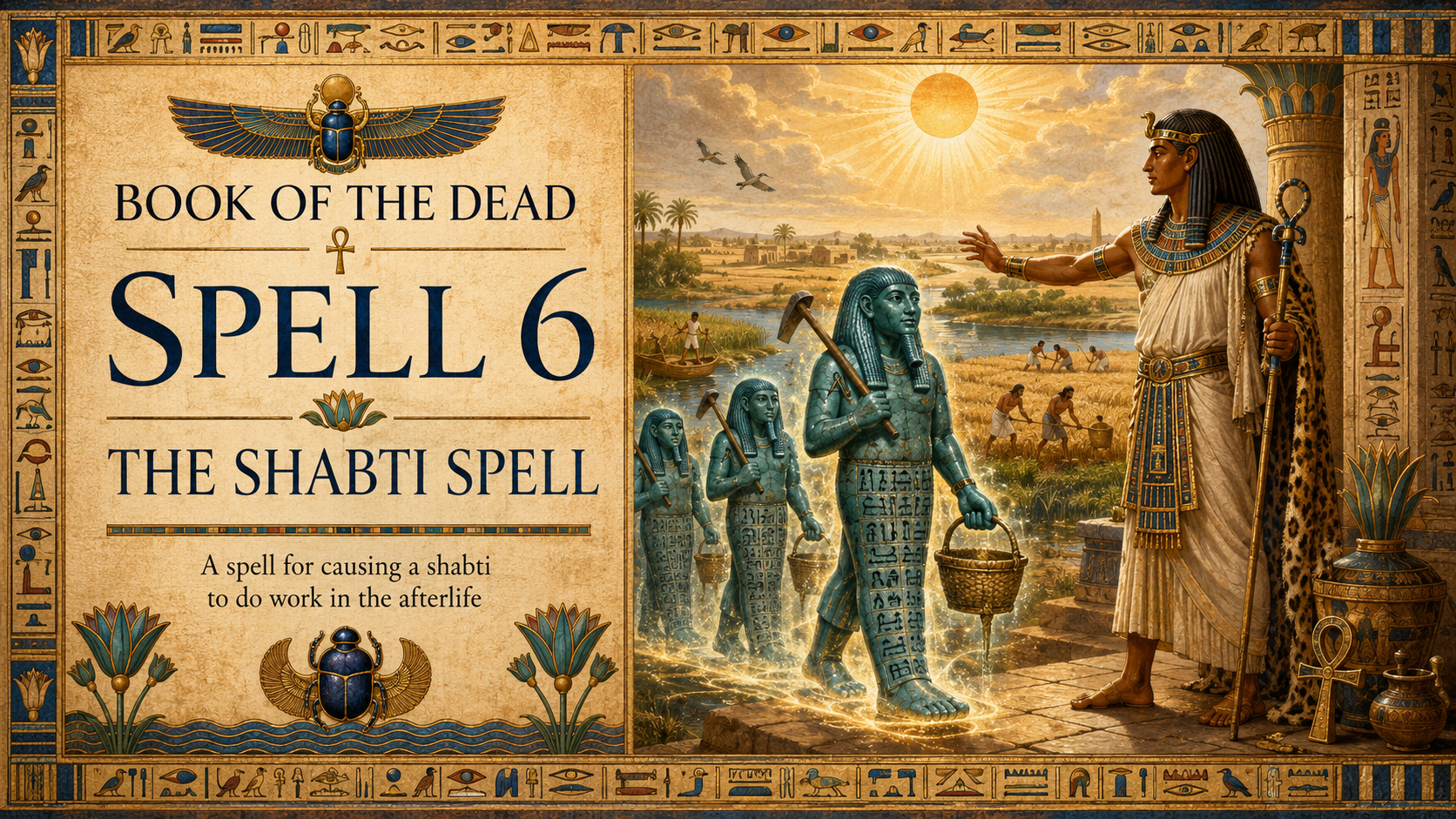
Book of the Dead Spell 6 addressed a more practical concern: compulsory labor in the afterlife.
The spell instructed a small funerary figure, known as a shabti, to answer whenever the deceased was summoned to work. Instead of the tomb owner cultivating fields, maintaining irrigation channels, or transporting sand, the shabti was expected to take the deceased’s place.
Its traditional title is commonly translated as: A spell for causing a shabti to do work for a person in the realm of the dead.
Spell 6 became one of the most frequently reproduced funerary formulas in ancient Egypt. It was not confined to papyrus copies of the Book of the Dead. The words could also be written directly on the shabti figures that were expected to perform the work.
What Is Book of the Dead Spell 6?
Book of the Dead Spell 6 is the famous shabti spell. It commands a funerary statuette to respond on behalf of its owner whenever work is assigned in the afterlife.
Peter Le Page Renouf and Édouard Naville titled it: Chapter whereby the funereal Statuettes may be made to do work for a person in the Netherworld.
Their index places Spell 6 directly after Spell 5, which was intended to prevent work from being imposed upon the deceased at all.
The two spells offered complementary forms of protection:
- Spell 5: Do not assign the deceased any work.
- Spell 6: Should the deceased still be summoned, let a shabti answer and work instead.
Spell 6 therefore acted as a form of magical insurance.
English Translation of Book of the Dead Spell 6
The exact wording varies among manuscripts and shabti inscriptions. The following reader-friendly translation preserves the standard meaning of the spell while using modern English.
Spell 6: A Spell for Causing a Shabti to Work
O shabti assigned to me,
if I am summoned or appointed
to perform any work that must be done
in the realm of the dead,if obstacles are placed before me
as a man at his duties,you shall present yourself in my place
whenever the fields must be cultivated,whenever the riverbanks must be irrigated,
or whenever sand must be carried
from east to west.“Here I am,” you shall say.
The short final response is the key to the spell: Here I am.
The shabti does not argue, delay, or ask who has called. It immediately identifies itself as the worker who will fulfill the assignment.
The Renouf and Naville Translation
Renouf and Naville begin the spell:
“O Statuette there! Should I be called and appointed to do any of the labours that are done in the Netherworld by a person according to his abilities…”
Their version continues by commanding the figure to take responsibility for the work whenever the deceased is summoned. The chapter’s title explicitly identifies the figure as a funerary statuette made to labor for a person in the Netherworld.
Older translations often use statuette, funerary figure, or ushabti where modern discussions may use shabti. The central meaning remains the same: the figure substitutes for the deceased.
What Does Book of the Dead Spell 6 Mean?
Spell 6 transforms a small burial figure into a magical worker. The deceased might be called to perform labor in the afterlife, just as people could be called to work in ancient Egyptian society. The spell transfers that obligation to the shabti.
In simple terms, the deceased tells the figure: If anyone calls me to work, answer for me. Go in my place and complete the task.
The spell gives the shabti three essential abilities:
- It can hear the summons.
- It can recognize that the summons applies to its owner.
- It can respond and perform the required labor.
The statuette was therefore more than a model or decoration. Through its inscription and burial with the deceased, it became an active magical substitute.
What Is a Shabti?
A shabti was a small human-shaped funerary figure placed in an ancient Egyptian tomb. Shabtis were made from materials such as:
- Faience
- Wood
- Stone
- Pottery
- Clay
- Wax
- Bronze
- Glass
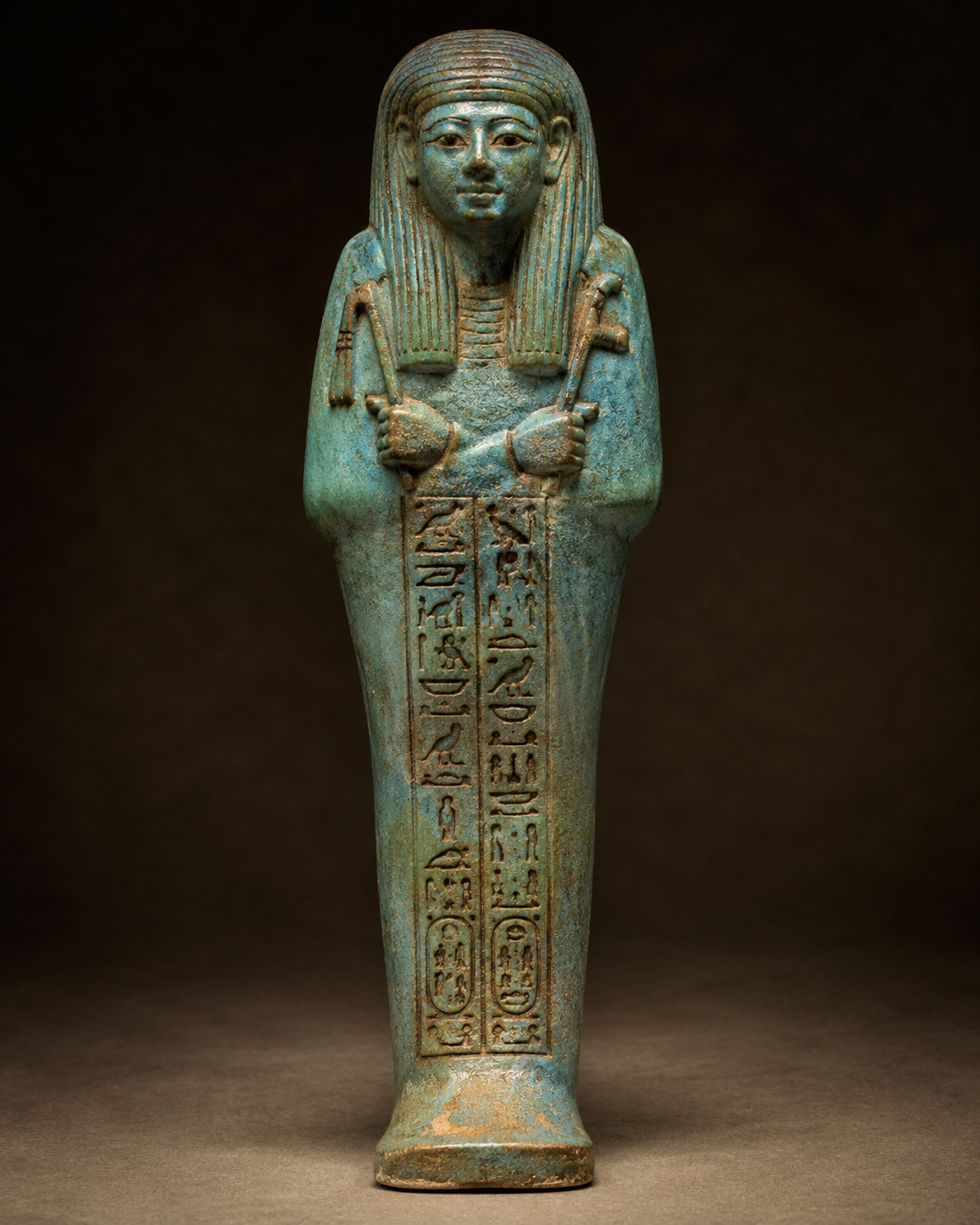
Many were shaped like mummies, with only the head and hands emerging from the wrappings. Others were dressed as living workers. Agricultural tools were often shown in their hands. These might include:
- Hoes
- Picks
- Mattocks
- Baskets
- Seed bags
- Water vessels
The tools visually reinforced the purpose of Spell 6. The figure was equipped to cultivate fields, move soil, and complete whatever agricultural work might be required.
A shabti inscribed with Spell 6 combined image and text. Its body represented a worker, while the written formula gave it instructions.
Shabti, Shawabti, or Ushabti?
The funerary figures are known by several related names.
Shabti
Shabti is widely used as a general modern term for the figures.
Shawabti
Shawabti appears especially in connection with certain periods and forms of the Egyptian word. The precise development of the term remains a subject of linguistic discussion.
Ushabti
Ushabti became common during later periods. It has often been connected with an Egyptian verb meaning “to answer,” which fits the figure’s role in responding: Here I am.
The words are frequently used interchangeably in popular writing, although Egyptologists may distinguish between them according to date, spelling, and historical usage.
For an accessible article, shabti works well as the primary term, with ushabti included as a common alternative.
Why Would the Dead Have to Work?
Ancient Egyptian visions of the afterlife often resembled an idealized version of Egypt.
The blessed dead could live in fertile fields, travel along waterways, eat bread, drink beer, and participate in an ordered agricultural world.
However, agriculture required labor.
Fields had to be:
- Plowed
- Sown
- Irrigated
- Harvested
- Cleared
- Maintained
Canals and riverbanks also required attention. Sand and soil might need to be moved so water could reach cultivated land.
Spell 6 reflects the fear that a deceased person could be summoned to perform these duties personally.
The solution was not to eliminate the agricultural afterlife. Instead, the tomb owner delegated the work to a magical servant.
“If I Am Summoned or Appointed”
The spell begins with the possibility that the deceased will be called:
If I am summoned or appointed…
This language resembles an official labor assignment. The deceased is imagined as living within an organized afterlife where authorities can issue commands and assign duties. The spell does not identify one universal official responsible for the summons. Its purpose is broad enough to apply whenever the call occurs.
The shabti must answer whether the deceased is:
- Summoned by name
- Selected for a work detail
- Assigned a routine duty
- Ordered to maintain the fields
- Required to complete a task for the divine administration
The wording makes the protection comprehensive.
“To Do Any Work in the Realm of the Dead”
The spell does not limit the shabti to one specific assignment. It refers generally to work that must be done in the afterlife and then supplies several examples. This open wording ensured that the figure could respond to duties not individually named in the formula.
The spell therefore functions almost like a standing authorization:
Whatever legitimate labor is assigned to me, you are designated to perform it.
That flexibility may help explain why Spell 6 became so popular. Its protection applied to an entire category of afterlife obligations.
“As a Man at His Duties”
The spell compares the expected labor with the ordinary responsibilities of a person. This makes the afterlife sound less like an abstract spiritual realm and more like an organized extension of Egyptian society.
A person on earth could be expected to carry out work according to their place, abilities, and obligations. Spell 6 imagines a comparable system beyond death. Yet the deceased hoped to enter the afterlife with greater status and freedom than an ordinary laborer.
The shabti preserved that freedom by taking over the work.
“Cultivating the Fields”
The first major task is agricultural:
Cultivating the fields.
Agriculture was the foundation of ancient Egyptian life. The Nile’s annual inundation renewed the soil, but people still had to prepare the land, sow seed, tend crops, and gather the harvest.
The afterlife included idealized agricultural regions, especially the Field of Reeds, where the deceased could enjoy abundance.
Spell 6 reveals a tension within that vision.
The deceased wanted the benefits of fertile land without being personally compelled to perform every difficult task required to maintain it.
The shabti made that possible.
“Irrigating the Riverbanks”
The next task concerns water management.
Agriculture in Egypt depended on controlling and distributing the Nile’s water. Fields far from the river could not flourish without irrigation.
Maintaining the banks might involve:
- Clearing channels
- Strengthening embankments
- Directing water
- Opening or closing irrigation routes
- Removing accumulated soil
- Repairing damage after flooding
Irrigation was therefore essential work, but it could also be physically demanding.
By naming it in Spell 6, the text shows how closely the imagined afterlife remained tied to the environmental realities of life in Egypt.
“Carrying Sand From East to West”
The final named task is:
Carrying sand from east to west.
This phrase has inspired several interpretations.
It may refer generally to moving soil as part of agricultural or irrigation work. Sand could obstruct fields and canals, so transporting it would have been a recognizable labor assignment.
The east-to-west direction may also carry symbolic significance.
The east was associated with sunrise and renewed life, while the west was associated with sunset, burial, and the realm of the dead. Moving material between these directions could place the shabti within the cosmic geography of the afterlife.
The spell itself does not explain why the sand must be moved in that direction. It is safest to treat the line first as a practical labor assignment while acknowledging its possible symbolic associations.
“Here I Am”
The shabti’s required answer is concise: Here I am.
This response is central to the entire purpose of the figure. The shabti must not remain silent. It must answer promptly when the deceased’s name is called.
The words accomplish several things at once:
- They acknowledge the summons.
- They present the shabti as available.
- They redirect the assignment away from the tomb owner.
- They confirm that the figure accepts the duty.
- They activate the figure as a substitute worker.
The shabti exists to be present when its owner wishes to be absent.
Was the Shabti Thought to Come Alive?
The figure was not expected to become physically alive in the way a living person was. Its effectiveness belonged to the magical and ritual world of the tomb.
Ancient Egyptians believed that images, names, and written words could make beings and actions present.
A representation did not have to move physically to possess ritual power.
Through Spell 6, the figure acquired:
- The identity of a worker
- The ability to hear a summons
- The power to answer
- The obligation to perform labor
- A relationship with its named owner
The text did not merely describe what the figure should do. It helped make the figure capable of doing it.
Why Was the Owner’s Name Important?
Many shabtis were inscribed with the name and titles of their owner.
The name ensured that the figure belonged to a specific deceased person and that its service could not easily be redirected.
In Egyptian thought, the name was an essential part of identity. Preserving the name helped preserve the person.
Including the owner’s name on a shabti established a magical connection:
This worker belongs to this individual and answers on this individual’s behalf.
A mass-produced figure could be personalized by adding the owner’s name and, in some cases, the full or abbreviated shabti formula.
Did Every Shabti Carry Spell 6?
No. Some shabtis carried the complete text. Others contained a shortened form, only the owner’s name and titles, or no inscription at all.
The amount of text depended on:
- The figure’s size
- Its date
- Its material
- The owner’s wealth
- Workshop practices
- Available writing space
- The intended function of the figure
A small shabti might preserve only an abbreviated command. A larger and more expensive example could carry much more of Spell 6.
Even when the formula was shortened, the figure’s appearance and burial context could still identify it as an afterlife worker.
How Many Shabtis Were Placed in a Tomb?
The number changed over time and varied according to wealth and custom.
Some tombs contained only one or a few figures. Later elite burials could contain large groups.
A theoretically complete workforce might include:
- 365 worker shabtis, one for each day of the year
- 36 overseers, one for each group of ten workers
This produced a total of 401 figures.
Not every large group followed this exact arrangement, and many burials contained fewer. The system nevertheless shows how the shabti tradition could develop into a fully organized magical labor force.
The deceased was no longer protected by a single substitute. An entire miniature workforce could be placed in the tomb.
What Were Overseer Shabtis?
Large groups of shabtis sometimes included overseer figures.
These could be distinguished by their clothing, posture, or attributes. An overseer might carry a whip rather than agricultural tools.
Their function was to supervise groups of worker shabtis.
The arrangement mirrored the organization of human labor in ancient Egypt:
- Workers completed assigned tasks.
- Overseers managed the workers.
- The tomb owner stood above the labor system.
This miniature hierarchy transformed the tomb into the center of an imagined estate.
Is Spell 6 the Oldest Shabti Spell?
Book of the Dead Spell 6 developed from an earlier funerary formula generally identified as Coffin Text Spell 472.
The Coffin Texts were written primarily on Middle Kingdom coffins and preserved many ideas that later became part of the Book of the Dead.
This means the shabti formula predates its familiar Book of the Dead numbering.
The development can be summarized as:
- Earlier models and figures were placed in tombs.
- A work-replacement formula appeared in the Coffin Texts.
- The formula became Book of the Dead Spell 6.
- Spell 6 was increasingly written directly on funerary figures.
- Shabti groups became larger and more organized in later periods.
The spell therefore reflects centuries of change in Egyptian funerary practice.
Is Book of the Dead Spell 6 the Same as Coffin Text Spell 6?
No. The numbering systems for the Book of the Dead and the Coffin Texts were created separately by modern scholars. Book of the Dead Spell 6 corresponds most closely with Coffin Text Spell 472, not Coffin Text Spell 6.
Matching numbers across the two collections do not indicate matching compositions. This distinction is important for online research. A page labeled “Coffin Text Spell 6” discusses a different text from the familiar shabti formula.
How Does Spell 6 Relate to Spell 5?
Spells 5 and 6 address the same underlying anxiety: being forced to work after death.
Spell 5
Spell 5 attempts to prevent the labor assignment itself. Its logic is: Work must not be imposed upon me.
Spell 6
Spell 6 assumes that a summons may still occur and appoints a substitute. Its logic is: If I am called, the shabti will answer and perform the work.
Together, they create a two-part defense:
Do not call me, but should you call me, my worker will respond.
The Renouf and Naville index deliberately presents Spell 5 as protection from imposed work and Spell 6 as the means by which a funerary statuette performs that work.
Does Spell 6 Mean Egyptians Hated Work?
Spell 6 should not be interpreted as proof that ancient Egyptians considered all labor shameful. Work was necessary for Egyptian society, and agricultural abundance remained an important image of the ideal afterlife.
The spell concerns compulsory labor and status. A prosperous person could own land while servants performed much of the physical work. Spell 6 transfers a comparable social arrangement into eternity.
The deceased hoped to enjoy:
- Fertile fields
- Food and drink
- Personal estates
- Irrigated land
- Harvests
- Freedom from exhausting obligations
The issue was not whether agriculture existed. It was who had to perform the labor.
Did Ordinary Egyptians Own Shabtis?
Shabtis are found in burials belonging to people of different social ranks, but quality and quantity varied greatly. A wealthy individual could commission numerous carefully carved and inscribed figures. A less wealthy person might possess only one inexpensive example.
Materials also reflected status. Fine faience, stone, wood, or elaborately painted figures required more resources than simple clay examples.
The spread of shabtis shows that the desire for relief from afterlife labor was not confined to royalty. However, the most elaborate magical workforces belonged to those who could afford them.
Were Shabtis Servants or Copies of the Deceased?
Early funerary figures did not always have precisely the same function as later shabtis. Some early statuettes may have represented the tomb owner rather than a separate servant. Over time, the work-replacement role became increasingly explicit.
Spell 6 addresses the figure as an entity assigned to the deceased. It is expected to answer for the owner and complete the owner’s work. That makes the mature shabti less a portrait of the deceased and more a substitute worker.
Its mummiform appearance still linked it visually to the dead, but its inscription defined its practical role.
Did Spell 6 Have a Standard Vignette?
The Renouf and Naville index does not list a standard papyrus vignette for Spell 6 among the early spells in their edition. The absence of a regular papyrus illustration makes sense because the physical shabti could itself serve as the spell’s three-dimensional image.
The figure was both:
- The object addressed by the spell
- The visual representation of its intended worker
Rather than requiring a painted scene beside the text, Spell 6 could be written directly on the being expected to carry out its command.
Why Is Spell 6 So Important?
Spell 6 is important because it connects three forms of ancient Egyptian evidence:
- Funerary literature: The written command preserved in the Book of the Dead
- Material culture: The thousands of shabti figures found in tombs
- Social history: The organization of agricultural labor and supervision
The spell shows how Egyptians projected earthly institutions into the afterlife.
The realm of the dead had fields, irrigation, officials, labor assignments, workers, and overseers. Magic did not abolish this system. It allowed the tomb owner to occupy a privileged position within it.
Spell 6 therefore reveals both a religious hope and a social ideal.
The Meaning of Spell 6 in Simple Terms
Book of the Dead Spell 6 gives the deceased a magical substitute worker. When the owner is summoned to cultivate fields, irrigate riverbanks, or move sand, the shabti must answer: Here I am.
The figure then accepts the work in the deceased’s place. The spell’s meaning can be summarized as:
I am entitled to enjoy the afterlife without being forced into labor. This figure is appointed to answer for me and complete whatever work I am assigned.
Spell 6 transformed a small statuette into an eternal servant through the combined power of image, name, and sacred words.
Frequently Asked Questions About Book of the Dead Spell 6
What is Book of the Dead Spell 6?
Spell 6 is the shabti formula. It commands a funerary figure to perform work on behalf of the deceased in the afterlife.
What is the title of Spell 6?
Its title is commonly translated as: A spell for causing a shabti to do work for a person in the realm of the dead. Renouf and Naville call it the chapter by which funerary statuettes may be made to work for a person in the Netherworld.
What does the shabti say?
The shabti is ordered to respond: Here I am. The response acknowledges the summons and accepts the deceased’s labor assignment.
What work did shabtis perform?
Spell 6 names cultivating fields, irrigating riverbanks, and transporting sand from east to west.
Was a shabti a real servant?
It was a magical funerary figure rather than a living servant. Its image and inscription enabled it to act as the deceased’s substitute in the afterlife.
Why were shabtis shaped like mummies?
Their form connected them with funerary transformation and the world of the dead. Many also held agricultural tools that identified them as workers.
What is the difference between a shabti and an ushabti?
The terms reflect different historical forms and spellings of the Egyptian name. They are often used interchangeably, although specialists may distinguish them by period and language.
How is Spell 6 different from Spell 5?
Spell 5 prevents work from being imposed. Spell 6 commands a shabti to complete the work should the deceased be summoned anyway.
Where did Spell 6 originate?
Its earlier predecessor is generally identified as Coffin Text Spell 472.
Is Book of the Dead Spell 6 the same as Coffin Text Spell 6?
No. The two collections use independent modern numbering systems.
Did Spell 6 appear on papyrus or on shabtis?
It could appear in Book of the Dead manuscripts, but it was also frequently written in complete or abbreviated form directly on funerary figures.
Did every tomb contain 401 shabtis?
No. Some burials contained one or only a few. Large later groups could include 365 workers and 36 overseers, but the number varied widely.
Book of the Dead Spell 6 is one of the clearest examples of ancient Egyptian practical magic. The afterlife promised fertile fields and abundant harvests, but those rewards carried the possibility of labor. The deceased did not want eternity to become an endless work assignment.
Spell 6 provided a substitute. The shabti was given a body, tools, a name, and a command. When its owner was summoned, the figure had only one required answer: Here I am. Those words transformed a miniature funerary object into a worker for eternity.