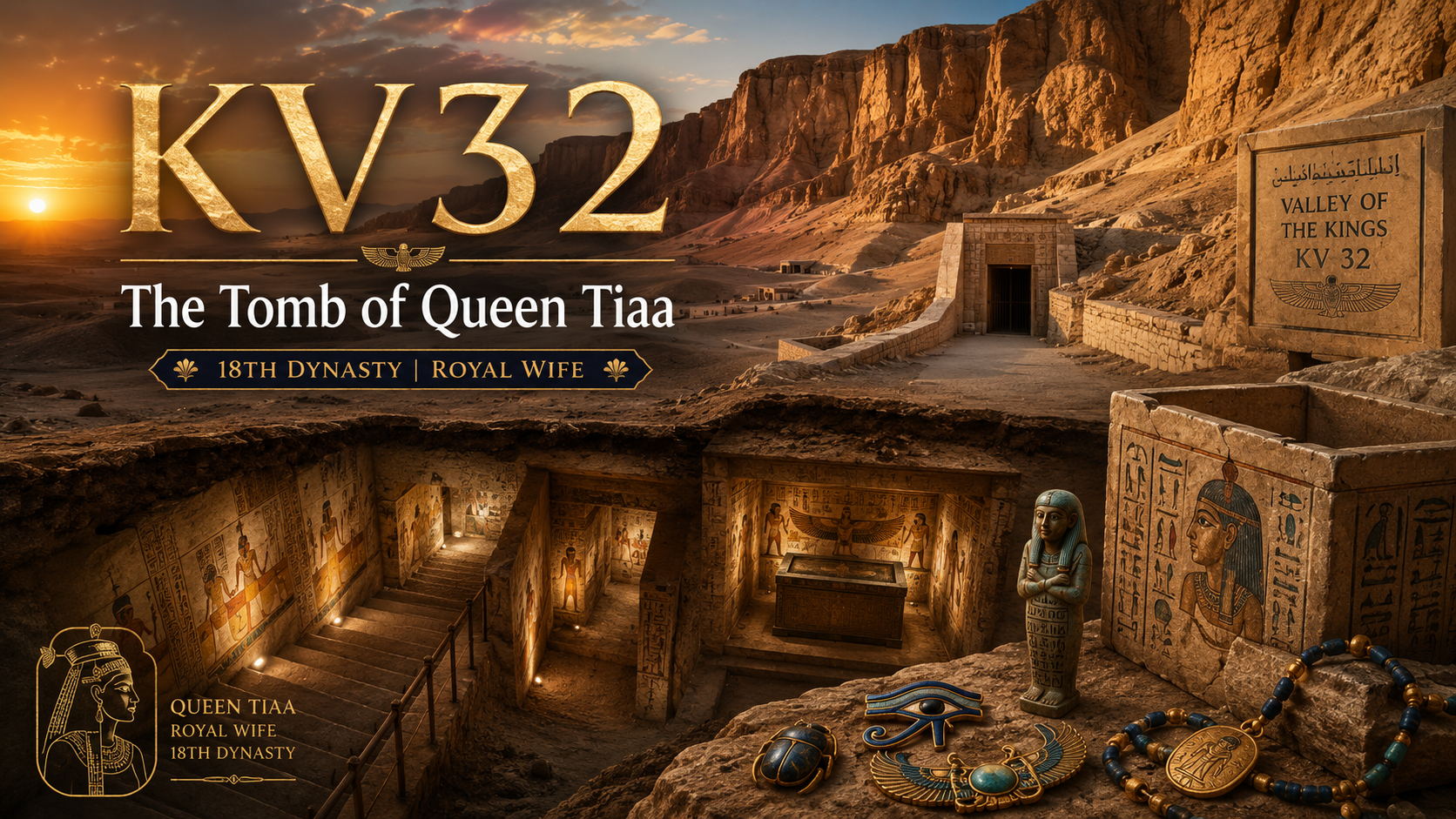
KV32 is the tomb of Queen Tiaa, the Great Royal Wife of Pharaoh Amenhotep II and mother of his successor, Thutmose IV. Located in a secluded side valley near the tomb of Thutmose III, KV32 is one of the most important undecorated monuments in the Valley of the Kings.
The tomb was discovered by Victor Loret in 1898, but its owner remained unknown for more than a century. The answer finally emerged during excavations conducted by the University of Basel in 2000 and 2001. Archaeologists recovered fragments of funerary equipment bearing Tiaa’s name, including pieces of her canopic chest, shabtis, amulets, canopic-jar lids, and a miniature coffin. These discoveries securely identified KV32 as her burial place.
KV32 is especially significant because it is currently the only tomb in the Valley of the Kings that can be securely assigned to a royal wife. During the later Nineteenth and Twentieth Dynasties, queens received elaborate decorated tombs in the nearby Valley of the Queens instead.
The monument also has an unusual connection with KV47, the tomb of Pharaoh Siptah. When workers excavated KV47 more than a century after Tiaa’s burial, they accidentally broke into KV32. This ancient collision damaged the queen’s tomb and allowed fragments of her funerary equipment to pass into the later monument.
Structure: KV32
Location: Valley of the Kings, East Valley, Thebes West Bank, Luxor
Owner: Queen Tiaa
Titles: Great Royal Wife of Amenhotep II and King’s Mother
Probable Date: Eighteenth Dynasty, reigns of Amenhotep II and Thutmose IV
Site Type: Royal woman’s tomb
Decoration: None
Public Access: Closed
Queen Tiaa was the wife of Amenhotep II and the mother of Thutmose IV.
Unlike some royal women of the Eighteenth Dynasty, she was not clearly identified as a king’s daughter. Her origins remain uncertain, and relatively little is known about her life before becoming queen.
Tiaa appears more prominently in surviving monuments after her son became pharaoh. As the mother of Thutmose IV, she held the prestigious title King’s Mother, a position that gave her considerable status within the royal court.
A black granite statue from Karnak depicts Tiaa seated beside her son Thutmose IV. The statue emphasizes her close connection with the reigning king and is now held in the Egyptian Museum in Cairo.
Tiaa survived Amenhotep II and appears to have died during the reign of Thutmose IV. Her son probably completed or furnished KV32 for her burial.
Location
KV32 lies in a side valley branching from the main Valley of the Kings and leading toward KV34, the tomb of Thutmose III.
Nearby tombs include:
- KV26, an anonymous Eighteenth Dynasty elite tomb
- KV29, a largely unexplored shaft tomb
- KV30, known as Lord Belmore’s Tomb
- KV31, which contained five unidentified elite mummies
- KV34, the tomb of Thutmose III
- KV42, a royal-scale tomb associated with the Thutmosid court
- KV47, the tomb of Siptah
This part of the Valley appears to have been used for members of the royal family and people closely connected with the kings of the Middle Eighteenth Dynasty. The identification of KV32 encouraged the University of Basel to investigate the surrounding undecorated tombs more extensively.
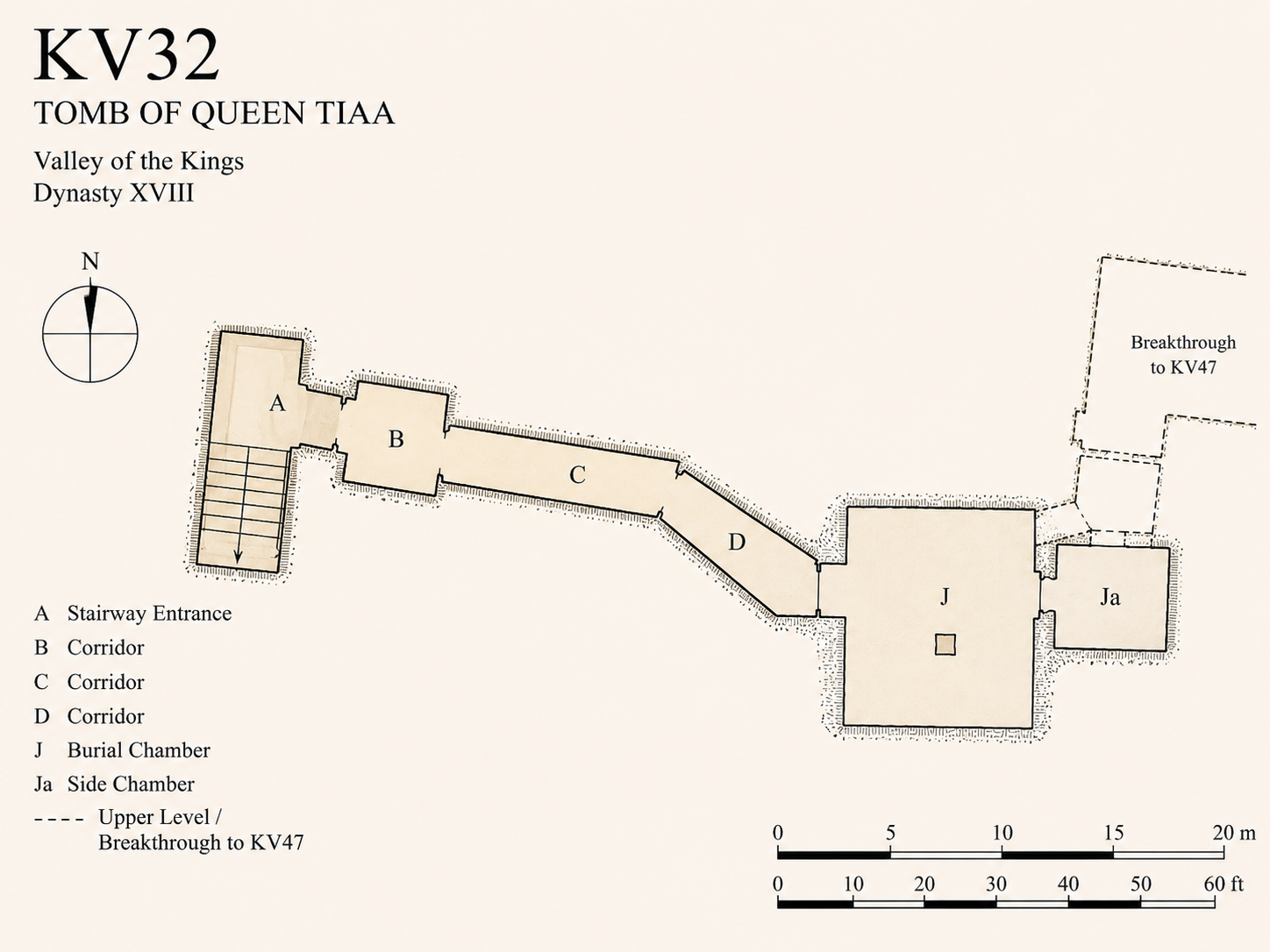
KV32 follows a bent underground plan typical of Eighteenth Dynasty royal and elite tombs.
The monument consists of:
- A very steep entrance stairway
- Three descending corridors
- A rectangular burial chamber
- One central pillar
- A side chamber opening from the burial chamber
The initial stairway, designated Corridor A, is extremely steep and badly damaged. It is followed by Corridors B, C, and D, with Corridor C descending sharply toward the burial chamber.
The burial chamber, designated J, contains a single pillar. A smaller side room, Ja, opens from its left side. The later breakthrough into KV47 occurs through the right side of this subsidiary chamber.
KV32 is considerably more elaborate than the simple shaft tombs built for many court officials. Its corridors, burial chamber, pillar, and subsidiary room reflect Tiaa’s position as a queen and mother of a king.
The Steep Entrance
The entrance stairway of KV32 is exceptionally steep.
Modern excavators found that the stairway had been heavily damaged, making entry into the tomb physically difficult. The steep descent may have helped conceal and protect the burial, but it also made the monument vulnerable to falling debris and water.
Unlike the vertical shafts used in nearby non-royal tombs, KV32 has a descending staircase and corridor system. This design places it closer architecturally to other tombs made for royal family members.
Burial Chamber J
The burial chamber is the principal room in KV32.
It is rectangular and supported by a single pillar. The room would originally have contained Tiaa’s coffin or sarcophagus, her canopic equipment, shabtis, vessels, amulets, food offerings, furniture, and other objects needed for the afterlife.
No intact royal burial remained when archaeologists cleared the chamber. The tomb had been robbed, damaged, and disturbed during antiquity.
Even so, scattered fragments of Tiaa’s funerary equipment survived among the debris and ultimately revealed her identity.
Side Chamber Ja
A small side room opens from the burial chamber.
This chamber probably served as a storeroom for funerary equipment, although its original contents were heavily disturbed.
The most dramatic feature of Ja is the opening created when ancient workmen excavating KV47 accidentally broke through its wall. This breach connected a Nineteenth Dynasty royal tomb with Tiaa’s much earlier Eighteenth Dynasty monument.
Decoration
KV32 is completely undecorated. Its walls contain no surviving:
- Painted divine scenes
- Carved reliefs
- Funerary texts
- Cartouches
- Representations of Queen Tiaa
- Offering formulas
The absence of wall decoration does not mean the burial lacked religious protection. Sacred texts and protective images could appear on coffins, canopic equipment, amulets, shabtis, papyri, and other portable objects.
KV32 is important because it shows that even a Great Royal Wife could be buried in an undecorated tomb during the Eighteenth Dynasty. Decorated tombs for royal wives became more common later, especially in the Valley of the Queens.
The Collision Between KV32 and KV47
One of KV32’s most unusual features is its accidental connection with KV47, the tomb of Pharaoh Siptah.
Siptah ruled near the end of the Nineteenth Dynasty, more than a century after Tiaa’s death. While cutting KV47, ancient workmen broke through into KV32’s side chamber.
The collision appears to have been accidental. The builders of KV47 may not have known that the older tomb lay in their path.
Water and debris later traveled through the breakthrough, carrying fragments from KV32 into KV47. This explains why objects bearing Tiaa’s name were discovered during early excavations of Siptah’s tomb. Those fragments were initially misinterpreted as belonging to a woman associated with Siptah rather than to an Eighteenth Dynasty queen.
The later University of Basel excavations demonstrated that the objects had originated in KV32 and entered KV47 through the ancient breach.
Discovery by Victor Loret
Victor Loret discovered KV32 in 1898 while serving as director of the Egyptian Antiquities Service.
Loret was conducting major excavations in the Valley of the Kings and discovered several important monuments, including KV35, the tomb of Amenhotep II.
Although he entered and excavated KV32, he did not identify its owner. The tomb was undecorated, and much of its burial equipment had been destroyed, removed, or washed into neighboring KV47.
The monument remained an anonymous numbered tomb for more than a century.
University of Basel Excavation
The University of Basel investigated KV32 as part of the Mission Siptah–Ramesses X project.
During the 2000–2001 season, archaeologists examined both KV32 and the point where it intersects with KV47. Their work documented the tomb’s steep passages, burial chamber, side room, and structural condition.
During the following season, fragments bearing Tiaa’s name established the identity of the owner. These discoveries transformed KV32 from an anonymous tomb into one of the most important monuments associated with an Eighteenth Dynasty queen.
The excavations formed part of a larger University of Basel research program that investigated KV18, KV47, KV32, and the neighboring side valley between 1998 and 2008.
The Identification of Queen Tiaa
KV32 was identified through funerary objects inscribed with Tiaa’s name and titles. The discoveries included:
- Fragments of Tiaa’s canopic chest
- Two canopic-jar lids
- Shabtis bearing her name
- A miniature coffin
- A tit amulet
- A wedjat-eye amulet
- A djed-pillar amulet
- Duck-shaped vessels
- A vessel made from glass paste
- Pottery
- Other fragments of burial equipment
Several objects preserve Tiaa’s name inside a royal cartouche, leaving little doubt that the tomb belonged to her.
Tiaa’s Canopic Chest
One of the most important finds was the shattered canopic chest of Queen Tiaa.
Canopic equipment held the embalmed organs removed from the body during mummification. The chest would originally have contained four jars or compartments associated with the protective Sons of Horus.
Fragments from Tiaa’s chest were found in both KV32 and KV47. Some pieces had entered museum collections before the connection between the two tombs was fully understood.
Researchers reconstructed most of the chest by combining the newly excavated fragments with casts made from pieces held by the Metropolitan Museum of Art. Nearly the entire structure could be restored, although parts of the top and one wall remained missing.
Canopic-Jar Fragments
Fragments of Tiaa’s calcite canopic equipment also survived.
The jars were made from calcite, often called Egyptian alabaster, and decorated in sunk relief. Traces of blue pigment remained in the carved decoration.
Two canopic lids were recovered, although the jars themselves were heavily broken and scattered.
These objects demonstrate the high quality of Tiaa’s original burial equipment despite the undecorated condition of the tomb walls.
Shabtis
Shabtis were small funerary figures intended to perform agricultural or manual labor for the deceased in the afterlife.
Fragments of shabtis bearing Tiaa’s name were found during excavation. One preserves her name inside a cartouche, providing direct evidence that the tomb belonged to the queen.
A shabti of Tiaa was later reidentified and photographed in museum storage as part of the University of Basel’s continuing documentation work.
The Miniature Coffin
A miniature coffin inscribed for Tiaa was also recovered.
Miniature coffins could hold shabti figures, ritual objects, symbolic remains, or small funerary deposits. They copied the form of full-sized coffins and extended the protective symbolism of burial equipment to smaller sacred objects.
The survival of Tiaa’s name on the miniature coffin provided another important clue to the tomb’s ownership.
Protective Amulets
Several protective amulets were recovered from KV32.
Tit Amulet
The tit, sometimes called the Knot of Isis, was associated with the goddess Isis and offered protection to the deceased.
Wedjat-Eye Amulet
The wedjat eye represented healing, restoration, and completeness. It referred to the restored eye of Horus and was one of the most common protective symbols in Egyptian funerary religion.
Djed-Pillar Amulet
The djed pillar symbolized stability, endurance, and the backbone of Osiris. It helped ensure that the deceased would remain strong and secure in the afterlife.
These amulets demonstrate that Tiaa’s burial contained the customary religious objects expected for an important royal woman.
Duck-Shaped Vessels
Duck-shaped containers were among the objects associated with the tomb.
Such vessels could hold oils, cosmetics, ointments, or other valuable substances. Ducks were also connected with food offerings and the marsh environment, which symbolized renewal and fertility.
Their presence suggests that Tiaa’s burial included both practical provisions and symbolically meaningful objects.
Objects Belonging to Sennefer and Senetnay
The excavation also recovered an object associated with Sennefer and Senetnay, two prominent members of the Eighteenth Dynasty court.
Sennefer was a high-ranking official, while Senetnay served as a royal nurse. They are more closely associated with nearby KV42.
Their material may have entered KV32 because of robbery, shifting debris, ancient movement between tombs, or the later mixing of burial equipment.
The presence of their names does not indicate that KV32 was originally constructed for them. Tiaa’s inscribed funerary equipment securely identifies her as the principal owner.
Was Queen Tiaa Buried in KV32?
The funerary equipment strongly indicates that Tiaa was intended to be buried in KV32.
However, her mummy has not been securely identified. The tomb was robbed and disturbed, and no recognizable body of the queen remained when it was excavated.
It is possible that priests removed her mummy during the Twenty-first Dynasty, when many royal and elite bodies were transferred to hidden caches for protection. This remains a possibility rather than a confirmed event.
The present location of Tiaa’s remains is unknown.
Relationship with Amenhotep II
Tiaa was the Great Royal Wife of Amenhotep II.
Amenhotep II was the son of Thutmose III and ruled during a period when Egypt remained a powerful imperial state. Royal texts celebrated his military ability, athletic strength, horsemanship, and archery.
Amenhotep II was buried in KV35, a large decorated royal tomb that later became a cache for the mummies of other kings.
KV32’s placement in the same general area of the Valley connected Tiaa symbolically and physically with her husband’s dynasty.

Relationship with Thutmose IV
Tiaa’s son Thutmose IV succeeded Amenhotep II as king.
As King’s Mother, Tiaa achieved greater visibility during his reign. The surviving statue of mother and son from Karnak reflects her elevated position within the royal family.
Thutmose IV was buried in KV43, elsewhere in the Valley of the Kings. His tomb contained evidence of later restoration and reburial activity.
Tiaa’s burial in KV32 may have been completed or substantially furnished during her son’s reign, especially if she survived Amenhotep II by several years.
Dating
KV32 was constructed and used during:
- New Kingdom, Eighteenth Dynasty
- Reign of Amenhotep II or early reign of Thutmose IV: Probable construction
- Reign of Thutmose IV: Probable burial of Queen Tiaa
- Nineteenth Dynasty: Accidental breakthrough during the excavation of KV47
- Later antiquity: Robbery, disturbance, and movement of debris
- Modern period: Discovery, excavation, conservation, and identification
History of Exploration
- Victor Loret, 1898: Discovery and excavation
- Early twentieth century: Objects bearing Tiaa’s name found in KV47 but misunderstood
- University of Basel, 2000–2001: Excavation of KV32 and investigation of its collision with KV47
- University of Basel, 2001–2002: Recovery of inscribed funerary objects identifying Queen Tiaa
- Later seasons: Reconstruction, conservation, publication, and museum documentation of the finds
Conservation Challenges
KV32 presents several conservation difficulties:
- The entrance stairway is steep and damaged.
- The tomb contains unstable passages and rock surfaces.
- The breakthrough into KV47 weakened part of the monument.
- Water movement carried fragments between the two tombs.
- Ancient robbery destroyed much of the burial equipment.
- The tomb is difficult to access safely.
Modern work has included consolidation of the entrance, documentation of the underground architecture, conservation of fragile objects, and monitoring of nearby rock surfaces.
Site Condition
KV32 remains undecorated and heavily disturbed.
Its basic architecture survives, but the steep stairway and ancient collision with KV47 complicate access. Most funerary objects exist only as fragments, although major pieces such as the canopic chest have been substantially reconstructed.
The tomb is closed to ordinary visitors.
Noteworthy Features
KV32 is notable for several reasons:
- It is the tomb of Queen Tiaa.
- Tiaa was the wife of Amenhotep II and mother of Thutmose IV.
- Victor Loret discovered the tomb in 1898.
- Its owner remained unidentified until the twenty-first century.
- Inscribed funerary objects securely connected the tomb with Tiaa.
- KV32 is currently the only tomb in the Valley of the Kings securely assigned to a royal wife.
- The monument is completely undecorated.
- It contains a steep stairway, three corridors, a pillared burial chamber, and one side room.
- Workmen excavating KV47 accidentally broke into KV32.
- Water carried Tiaa’s funerary objects from KV32 into KV47.
- Archaeologists reconstructed much of her shattered canopic chest.
- Tiaa’s mummy has not been securely identified.
Why KV32 Matters
KV32 changed the modern understanding of royal women’s burial in the Valley of the Kings.
Before its identification, the tomb was one of many anonymous and undecorated monuments scattered through the side valley near Thutmose III. The discovery of Tiaa’s inscribed funerary equipment showed that a Great Royal Wife and King’s Mother could receive a substantial tomb within the royal necropolis even without painted walls.
The monument also demonstrates the importance of archaeological context. Objects bearing Tiaa’s name were once attributed incorrectly because they were found inside KV47. Only by studying the physical connection between the two tombs could archaeologists reconstruct how those fragments had moved.
KV32 now preserves the story of a queen whose name was lost from her tomb for more than three thousand years, then recovered from shattered pieces scattered through two different monuments.
Interesting Facts About KV32
- KV32 belonged to Queen Tiaa.
- Tiaa was the wife of Amenhotep II.
- She was the mother of Thutmose IV.
- The tomb was discovered in 1898.
- Its owner was not identified until excavations in 2001.
- The entrance staircase is exceptionally steep.
- The burial chamber contains one pillar.
- KV32 has no wall decoration.
- KV47 accidentally broke into the tomb during the Nineteenth Dynasty.
- Pieces of Tiaa’s burial equipment were washed into KV47.
- Her canopic chest was reconstructed from fragments held in different collections.
- Shabtis and amulets preserved her name.
- Her mummy remains unidentified.
- KV32 is the only securely attributable tomb of a royal wife in the Valley of the Kings.
