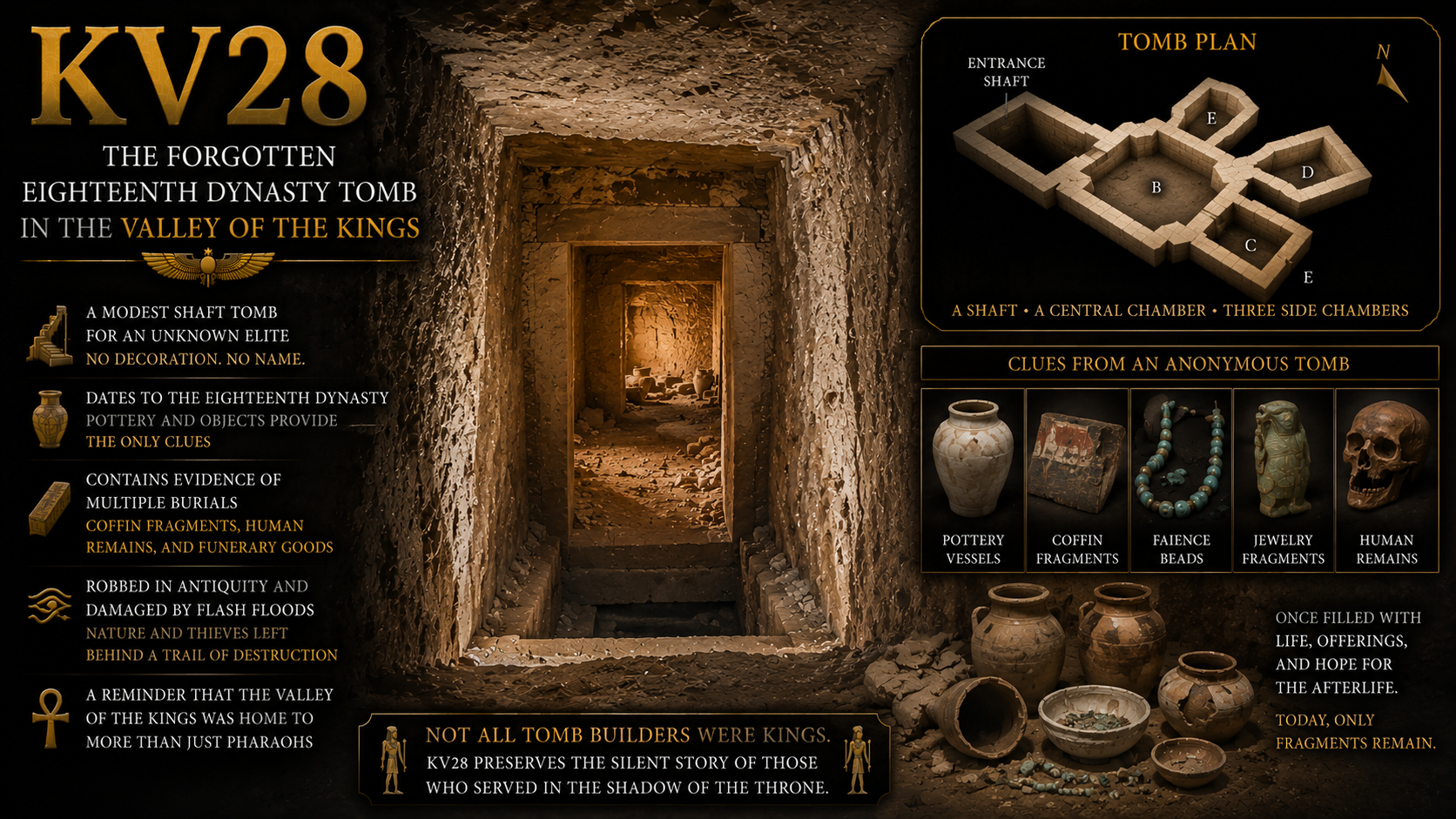
KV28 is one of the Valley of the Kings’ least-known tombs, yet it offers valuable insight into the burial practices of Egypt’s royal elite during the Eighteenth Dynasty. Unlike the magnificent painted tombs of the pharaohs, KV28 is a modest, undecorated shaft tomb whose original owner has never been identified.
Although the site is small, archaeologists recovered fragments of coffins, pottery, human remains, jewelry, and funerary equipment, dating primarily to the Eighteenth Dynasty. These discoveries show that the tomb was used for one or more important individuals connected to the royal court.
Like many of the smaller tombs in this part of the Valley, KV28 was robbed in antiquity, damaged by flash floods, and later reused during subsequent periods. Much of its original story has therefore been lost, leaving Egyptologists to reconstruct its history from the surviving archaeological evidence.
Today, KV28 remains an important reminder that the Valley of the Kings served not only as the burial place of pharaohs, but also of queens, royal relatives, trusted officials, and members of Egypt’s elite.
Structure: KV28
Location: Valley of the Kings, East Valley, Thebes West Bank, Luxor
Owner: Unknown
Possible Occupants: Members of the Eighteenth Dynasty royal court
Site Type: Undecorated shaft tomb
KV28 lies in the central part of the East Valley of the Kings. It sits close to several other undecorated shaft tombs, including:
The surrounding area appears to have been used primarily for burials of royal family members and high-ranking officials during the Eighteenth Dynasty.
Its position suggests that the occupants enjoyed exceptional status, since burial inside the Valley of the Kings was normally reserved for those closely associated with the royal household.
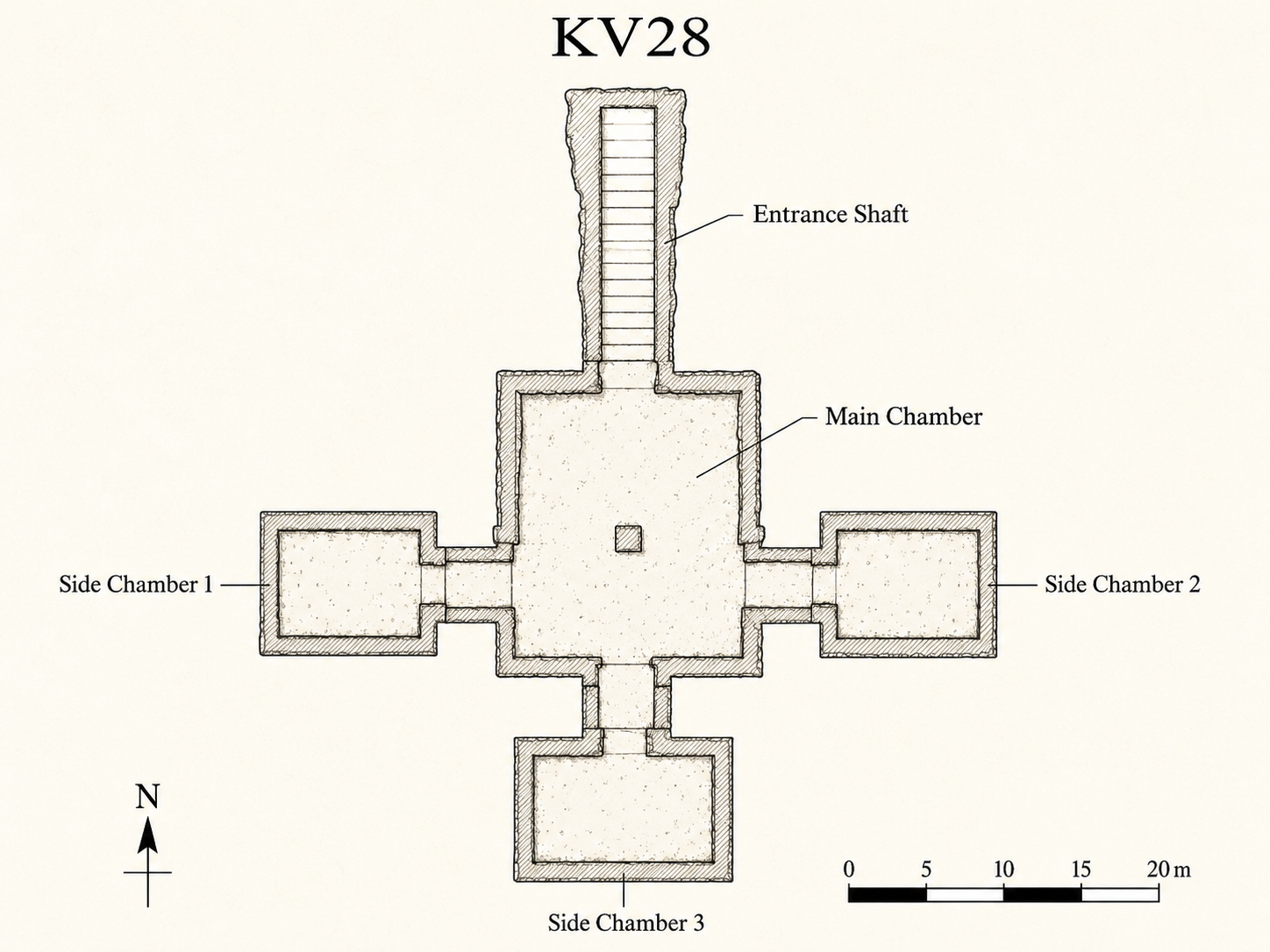
KV28 is a relatively small shaft tomb. A vertical shaft descends into a central chamber from which three side chambers branch off.
Unlike the elaborate royal tombs with long corridors, pillared halls, and decorated burial chambers, KV28 follows the simple shaft-and-room design commonly used for elite burials during the Eighteenth Dynasty.
The tomb measures approximately 19 meters (62 feet) in length and covers roughly 70 square meters.
Although modest compared to nearby royal monuments, its multiple chambers indicate that it may have been intended for several individuals.
Architecture
The tomb consists of:
- Entrance shaft
- Main burial chamber
- Three side chambers
The vertical shaft provided security by making the entrance difficult to locate after burial.
The main chamber likely served as the focus of the burial, while the side chambers probably held coffins, funerary equipment, and additional burials.
No inscriptions survive to indicate how each room was originally used.
Decoration
KV28 contains no surviving wall decoration. Its walls were never painted or carved with religious texts such as:
- The Amduat
- Book of Gates
- Book of Caverns
- Litany of Ra
Likewise, no cartouches or inscriptions identify the tomb’s owner.
The absence of decoration is typical of many non-royal tombs within the Valley of the Kings.
Who Was Buried Here?
The owner of KV28 remains unknown.
Human skeletal remains recovered during excavation indicate that the tomb contained at least one burial, although evidence suggests there may originally have been several occupants.
Because the tomb dates primarily to the Eighteenth Dynasty, archaeologists believe it probably belonged to one or more members of the royal household, such as:
- Royal officials
- Courtiers
- Royal attendants
- Members of the extended royal family
Without inscriptions, however, these identifications remain speculative.
Pottery and Dating
The pottery recovered from KV28 provides the strongest evidence for dating the tomb. Most ceramic vessels belong to the middle or later Eighteenth Dynasty.
Recovered pottery includes:
- Whitewashed storage jars
- Bowls
- Jugs
- Small offering vessels
- Beer jars
- Wine jars
These vessels were likely deposited during the burial ceremonies and contained food, drink, oils, perfumes, and embalming materials intended for use in the afterlife.
Coffin Fragments
Excavators recovered numerous fragments of wooden coffins from inside KV28.
Although the coffins were badly damaged by ancient robbers and repeated flooding, traces of paint and plaster survived on several fragments.
Unfortunately, no surviving inscription preserves the names of the individuals buried there.
The broken coffin fragments demonstrate that the burials had been extensively disturbed long before modern archaeology began.
Jewelry and Personal Objects
Despite ancient robbery, archaeologists discovered several small artifacts, including:
- Faience beads
- Glass inlays
- Jewelry fragments
- Small decorative objects
These finds suggest that the original burials were once considerably richer than the fragmentary remains found today.
Most precious metals and valuable items were likely removed by ancient tomb robbers.
Human Remains
Only scattered human remains survived inside KV28. Archaeologists recovered bones from several parts of the body, but the burials had been badly disturbed.
The remains indicate that the tomb originally contained one or more adults. Because the bodies had been displaced by robbery and flooding, it is impossible to reconstruct their original arrangement.
Ancient Robbery
KV28 was robbed in antiquity.
The robbers removed valuable objects, broke apart coffins, and disturbed the mummies while searching for jewelry and precious amulets.
The surviving objects were scattered throughout the chambers, making it difficult to determine which artifacts originally belonged together.
Like many tombs in the Valley of the Kings, KV28 never escaped the attention of ancient thieves.
Flood Damage
After the robbery, nature caused even greater destruction. Flash floods repeatedly entered the open shaft, carrying:
- Sand
- Mud
- Limestone rubble
- Large stones
These flood deposits buried much of the remaining archaeological material and mixed artifacts from different chambers.
The flooding also accelerated the deterioration of wood, textiles, and human remains.
Discovery
KV28 was known to early explorers during the nineteenth century, although it received little attention compared with the nearby royal tombs.
The tomb was later surveyed by the Theban Mapping Project before being excavated by the Pacific Lutheran University Valley of the Kings Project under the direction of Dr. Donald P. Ryan during the 1990s.
Ryan’s excavations recovered pottery, coffin fragments, beads, human remains, and other objects while clearing centuries of flood debris.
These excavations provided the first detailed archaeological record of the monument.
Objects Recovered
Excavations uncovered numerous artifacts, including:
- Human remains
- Wooden coffin fragments
- Pottery vessels
- Storage jars
- Faience beads
- Glass inlays
- Jewelry fragments
- Linen
- Stone vessel fragments
- Animal bones
- Funerary equipment
Although individually modest, together these objects provide valuable evidence for elite burials during the Eighteenth Dynasty.
Noteworthy Features
KV28 is notable because:
- The original owner remains unknown.
- It probably dates to the Eighteenth Dynasty.
- It contains a central chamber with three side chambers.
- It was likely used for multiple burials.
- It is completely undecorated.
- Ancient flooding preserved many archaeological deposits beneath thick layers of debris.
- The tomb demonstrates that important non-royal individuals were buried within the Valley of the Kings.
- Modern excavation greatly expanded our understanding of smaller Valley tombs.
Measurements
- Maximum Height: Approximately 2.9 m
- Minimum Width: Approximately 0.8 m
- Maximum Width: Approximately 5.8 m
- Total Length: Approximately 19 m
- Total Area: Approximately 70 m²
Additional Tomb Information
- Owner Type: Unknown elite individual(s)
- Entrance Type: Vertical shaft
- Interior Layout: Shaft and chambers
- Axis Type: Straight
- Decoration: None
- Public Access: Closed
Dating
KV28 was used during the following periods:
- New Kingdom, Dynasty 18: Original construction and burial.
- Third Intermediate Period: Possible later intrusion.
- Modern Era: Archaeological excavation and documentation.
History of Exploration
- John Gardner Wilkinson: Early nineteenth-century visit.
- Victor Loret: Recorded the tomb during surveys of the Valley.
- Theban Mapping Project: Surveyed and documented the monument.
- Donald P. Ryan (Pacific Lutheran University): Excavated and cleared the tomb during the 1990s.
Conservation History
Following excavation, the entrance shaft was secured with a protective metal gate to prevent unauthorized access and reduce damage from falling debris.
Documentation of the architecture and recovered artifacts has preserved important information about the tomb despite its poor condition.
Site Condition
KV28 has suffered extensive damage from robbery, flooding, and natural weathering. Very little of the original burial equipment remains intact, and the human remains are highly fragmentary.
Nevertheless, the architecture of the tomb survives in relatively stable condition.
Why KV28 Matters
Although KV28 lacks the spectacular treasures of Tutankhamun or the magnificent paintings of Seti I, it fills an important gap in our understanding of the Valley of the Kings.
The tomb demonstrates that the royal necropolis was home to far more than kings alone. High-ranking officials, royal relatives, and trusted members of the court also found their final resting places within the sacred valley.
The pottery, coffin fragments, and human remains recovered from KV28 help archaeologists reconstruct the burial customs of Egypt’s elite during one of the greatest periods of the New Kingdom.
Even anonymous tombs like KV28 contribute valuable pieces to the larger story of ancient Egypt.
Interesting Facts About KV28
- KV28 is one of the Valley of the Kings’ lesser-known tombs.
- The original owner has never been identified.
- The tomb dates primarily to the Eighteenth Dynasty.
- It contains a central chamber with three side chambers.
- It has no surviving wall decoration.
- Ancient robbers stripped the burials of valuables.
- Flash floods buried the chambers beneath thick deposits of debris.
- Excavations recovered pottery, jewelry fragments, and coffin remains.
- The tomb was probably used by members of the royal court rather than a pharaoh.
- It helps archaeologists understand elite burials within the Valley of the Kings.