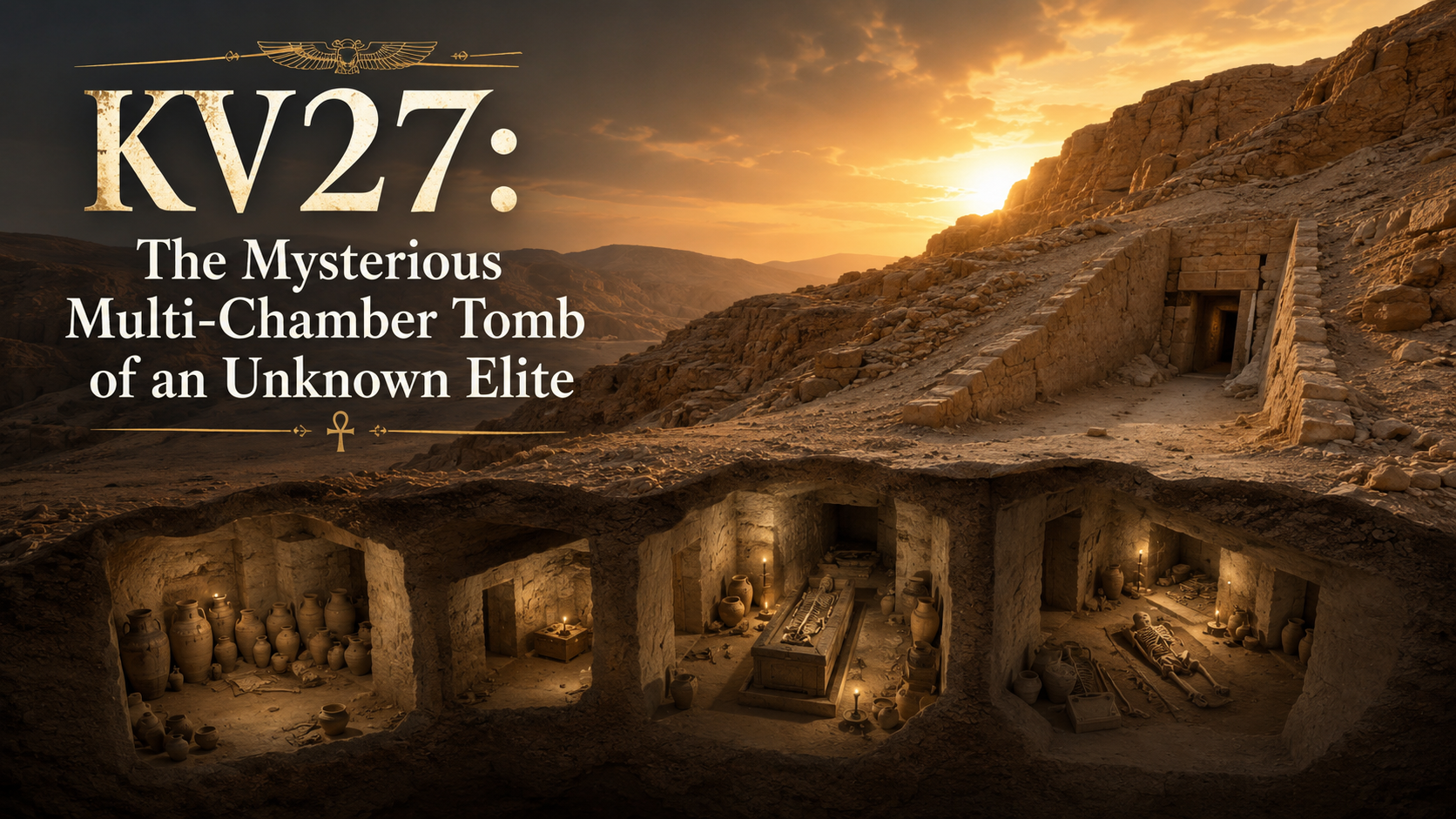
KV27 is an unusual undecorated tomb whose original owner remains unknown. Located in a secluded side wadi of the Valley of the Kings, it consists of a vertical entrance shaft leading to a central chamber and three additional rooms. Its size and multi-room plan distinguish it from the simpler shaft tombs created for many non-royal members of the Eighteenth Dynasty court.
Although no inscription identifies the tomb’s occupants, pottery recovered during excavation dates its principal use to the middle of the Eighteenth Dynasty, probably around the reigns of Thutmose IV and Amenhotep III. Fragmentary human remains, coffin materials, stone vessels, faience objects, and large storage jars confirm that KV27 was used for burial, possibly for more than one individual.
KV27 is especially important because it reveals how people close to the royal family could receive substantial tombs within the Valley of the Kings. Its anonymous occupants may have been royal relatives, court officials, nurses, attendants, or other privileged members of the palace community.
Structure: KV27
Location: Valley of the Kings, East Valley, Thebes West Bank, Luxor
Owner: Unknown
Possible Occupants: One or more elite members of the Eighteenth Dynasty court
Site Type: Undecorated shaft tomb
KV27 lies in a small side wadi branching from the main Valley of the Kings. It is situated between KV21 and KV28, in an area containing several undecorated tombs associated with the Eighteenth Dynasty royal court.
Nearby monuments include:
- KV21, which contained two unidentified female mummies
- KV28, another undecorated shaft tomb containing evidence of multiple burials
- KV20, associated with Hatshepsut and Thutmose I
- KV43, the tomb of Thutmose IV
The concentration of elite shaft tombs in this part of the Valley suggests that the area may have served as a cemetery for people closely connected with the royal family.
Description
KV27 has a simple but relatively spacious layout.
A vertical shaft descends from the surface into the main rectangular chamber, designated Chamber B. Three additional rooms open from this central space:
- Chamber C lies to the south
- Chambers D and E extend toward the west
The four-room arrangement makes KV27 more complex than a basic shaft tomb with only one burial chamber. It may represent an intermediate stage between simple single-room tombs and larger monuments with multiple chambers connected by corridors.
The tomb is approximately 20.78 meters long and covers an area of about 91.87 square meters. Its largest chamber measures more than seven meters across, giving the monument considerable internal space for a non-royal burial.
The Plastered Ramp
One of KV27’s most unusual architectural features is a plastered ramp leading from the main chamber into the southern side chamber.
Early investigators initially thought this feature might conceal another burial shaft. Later excavation demonstrated that it was a sloping passage or ramp rather than a sealed vertical opening.
Its purpose is uncertain. It may have helped workers move coffins and heavy burial equipment into the side chamber, or it may reflect an alteration made while the tomb was being excavated.
No comparable feature is commonly found in the simpler shaft tombs of the Valley.
Decoration
KV27 is completely undecorated.
Its walls contain no painted scenes, carved reliefs, hieroglyphic inscriptions, or funerary texts. No surviving name identifies the person or people for whom the tomb was constructed.
The absence of decoration was common in the smaller tombs made for royal relatives and court officials during the Eighteenth Dynasty. These monuments were designed primarily as secure burial places, while religious texts and imagery could be placed on coffins, papyri, vessels, and other portable funerary objects.
Because KV27 contains no wall inscriptions, its date and ownership must be reconstructed from architecture, pottery, human remains, and surviving fragments of burial equipment.
Who Was Buried in KV27?
The identity of KV27’s original occupant remains unknown.
Human remains recovered from the tomb include:
- Part of a skull
- Vertebrae
- Ribs
- Bones from a right arm
- Small bones from the hands
The remains recovered during the 2006 excavation were believed to belong primarily to one adult who was at least 30 years old. However, earlier reports mentioned additional mummy fragments, and the tomb’s size leaves open the possibility that more than one person was originally buried there.
The occupants were probably members of the royal household or individuals who held high positions at court. Burial within the Valley of the Kings was an exceptional privilege, even when the tomb itself was undecorated.

Possible Multiple Burials
KV27’s multiple side chambers may have been intended to accommodate several members of the same family.
The central chamber could have served as a shared space from which separate burial rooms were accessed. This arrangement would have allowed relatives or members of the same household to be buried in a single underground monument.
The scattered human remains and disturbed burial equipment make it impossible to determine the original number of occupants with certainty. Robbery and flooding destroyed the archaeological context that might once have answered this question.
Pottery and Dating
Pottery provides the strongest evidence for dating KV27.
Most of the ceramics recovered from the tomb belong to the middle of the Eighteenth Dynasty, particularly the period associated with Thutmose IV and Amenhotep III. The finds include large whitewashed storage jars, smaller vessels, and pottery used for funerary offerings.
The whitewashed jars may originally have contained:
- Food
- Wine or beer
- Oils and resins
- Embalming materials
- Linen
- Other supplies required for the funeral and afterlife
The pottery supports a date broadly similar to several neighboring tombs used by elite members of the Thutmosid court.
The Canopic Jar of Userhet
Two inscribed fragments from a canopic jar were recovered from Chamber C.
The inscription named a man called Userhet, who held the title God’s Father. However, Userhet is normally associated with KV45, where three of his canopic jars were discovered by Howard Carter in 1902.
The fragments in KV27 probably do not indicate that Userhet was originally buried there. They may have entered the tomb through:
- Floodwater
- Robbery
- Movement of debris between nearby tombs
- Later reuse or storage
- Activity by early excavators
The discovery demonstrates how easily objects could become separated from their original archaeological contexts in the Valley of the Kings.
Animal Remains
Animal bones were also found inside KV27.
These may represent the remains of food offerings placed in the tomb for the deceased. Ancient Egyptians frequently included meat, birds, and other provisions to sustain the dead in the afterlife.
The animals may have been mummified or wrapped before burial, although the surviving material was too fragmentary to reconstruct the original offerings completely.
Some animal remains could also have entered the tomb naturally after its opening, but their association with the burial debris makes funerary offerings a plausible explanation.
Discovery and Early Exploration
The precise date and identity of KV27’s original modern discoverer are unknown.
The tomb was known by the early nineteenth century and was certainly visited by Egyptologist John Gardner Wilkinson. Richard Pococke may have observed its location earlier, although the evidence is uncertain. Eugène Lefébure later described mummy fragments inside the monument, and Auguste Mariette may have investigated it around 1859.
These early visits were poorly documented. Objects may have been removed, moved between chambers, or left exposed to later damage.
KV27 did not receive a properly recorded archaeological excavation until the late twentieth century.
The Pacific Lutheran University Excavations
Donald P. Ryan and the Pacific Lutheran University Valley of the Kings Project investigated KV27 during the 1990s and returned for a more extensive excavation in 2006.
The first excavation partially cleared the entrance shaft and recovered fragments of:
- Pottery
- Wood
- Gold leaf
- Mummy wrappings
- Burial equipment
When the team returned in 2006, the shaft contained modern rubbish and souvenirs, indicating that the entrance had remained accessible in recent times.
Remains of the original mudbrick blocking were still visible at the bottom of the shaft. This blocking had once sealed the entrance to the underground chambers after the funeral.
Chamber B
The first chamber entered from the shaft is Chamber B.
During the 2006 excavation, archaeologists removed most of the accumulated fill while deliberately leaving a small column of debris intact. This retained section preserved a record of the tomb’s archaeological layers for future study.
Relatively few objects were recovered from this chamber. The finds included:
- Pottery fragments
- Stone-vessel pieces
- Faience objects
- Human hand bones
The limited number of artifacts may indicate that ancient robbers removed most of the original burial equipment.
Chamber C
Chamber C contained the largest concentration of pottery and human remains.
The room was almost completely filled with fragments of whitewashed storage jars, stones, sediment, and broken burial material. Human remains found there included part of a skull, vertebrae, ribs, and a right arm.
The concentration of skeletal material may indicate that Chamber C served as the principal burial room. However, flooding could have moved the remains from another part of the tomb.
The chamber also contained the canopic-jar fragments naming Userhet.
Catastrophic Flooding
KV27 experienced severe flood damage.
Excavators found large stones mixed violently with pottery, bones, and funerary objects. This suggests that a powerful torrent entered through the open shaft and smashed the tomb’s contents against the walls and floor.
Floodwater probably:
- Broke pottery vessels
- Displaced human remains
- Destroyed coffins
- Mixed objects from different chambers
- Deposited sand, mud, and stones
- Erased much of the tomb’s original archaeological arrangement
The surrounding wadi concentrates rainfall during rare but intense storms, making shaft tombs such as KV27 especially vulnerable.
Later Activity
Fragments of Late Period and Coptic pottery were discovered within the flood deposits.
These later ceramics suggest that KV27 remained accessible for centuries after its original Eighteenth Dynasty burials. Visitors, robbers, local residents, or religious communities may have entered the monument before it became completely filled with debris.
The later pottery does not necessarily mean that the tomb received formal new burials during those periods. It may instead represent temporary occupation, exploration, rubbish disposal, or objects washed inside.
Modern Use Before Excavation
Before its modern excavation, KV27 was reportedly used as a place of shelter from the heat.
Local antiquities sellers occasionally rested near or within the entrance, and a family of dogs was found living there around 1990.
Modern rubbish and souvenir items discovered in the shaft confirm that the tomb had remained accessible during the twentieth century.
Although these details may seem minor, they illustrate the complicated modern lives of ancient monuments before they receive archaeological protection.
Objects Recovered
Objects and materials found in KV27 include:
- Fragmentary human remains
- Wooden coffin fragments
- Gold leaf
- Mummy wrappings
- Whitewashed storage jars
- Pottery vessels and sherds
- Stone-vessel fragments
- Faience objects
- Animal bones
- Canopic-jar fragments naming Userhet
- Late Period pottery
- Coptic pottery
- Modern rubbish and tourist souvenirs
No object securely identifies the tomb’s original owner.
Noteworthy Features
KV27 is notable for several reasons:
- Its original owner remains unknown.
- It contains a central chamber and three side rooms.
- Its multi-room plan is unusual for a relatively small shaft tomb.
- A plastered ramp connects the main chamber with a side chamber.
- Pottery dates the tomb to the middle of the Eighteenth Dynasty.
- Human remains indicate that at least one adult was buried there.
- It may originally have contained multiple burials.
- Canopic-jar fragments bearing the name Userhet were found inside.
- The monument suffered catastrophic flood damage.
- It was known in the nineteenth century but not properly excavated until the 1990s and 2006.
- The tomb remains completely undecorated.
Measurements
Maximum height: Approximately 2.89 m
Minimum width: Approximately 0.89 m
Maximum width: Approximately 7.65 m
Total length: Approximately 20.78 m
Total area: Approximately 91.87 m²
Total volume: Approximately 178.5 m³
Additional Tomb Information
Owner type: Unknown elite individual or members of the royal household
Entrance type: Vertical shaft
Interior layout: Central chamber with three side chambers
Axis type: Irregular shaft-and-chamber plan
Decoration: None
Principal date: Middle Eighteenth Dynasty
Public access: Closed
Dating
KV27 was used during the following periods:
- New Kingdom, Middle Eighteenth Dynasty: Original construction and burial
- Late Period: Later entry or activity
- Coptic Period: Continued access or intrusion
- Modern period: Informal use, excavation, and conservation
The pottery indicates that the original burial most likely dates to the reigns of Thutmose IV or Amenhotep III.
History of Exploration
- Before 1832: Tomb already known to European explorers
- John Gardner Wilkinson: Visit and early documentation
- Auguste Mariette, possibly 1859: Possible investigation
- Eugène Lefébure, nineteenth century: Description of mummy remains
- Donald P. Ryan, 1993: Partial excavation for the Pacific Lutheran University Valley of the Kings Project
- Donald P. Ryan, 2006: More extensive excavation and clearance
- 2006: Installation of a protective steel door and flood-diversion wall
Conservation History
At the end of the 2006 excavation, a steel door was installed to secure KV27.
The protective wall surrounding the entrance shaft was repaired, and a diversion wall was constructed to direct future floodwater away from the tomb. These measures were intended to prevent another destructive torrent from entering the shaft.
Artifacts recovered during excavation were transferred to protected storage areas. Some material was stored in KV21 because it offered better protection from flooding.
Site Condition
KV27 has suffered severe damage from ancient robbery, flooding, later intrusion, and modern access.
The tomb’s limestone architecture remains recognizable, but much of its original burial equipment was destroyed or removed. Flood deposits filled the chambers and scattered the surviving human and funerary remains.
The monument is secured and is not normally open to visitors.
Why KV27 Matters
KV27 demonstrates that some of the Valley of the Kings’ most informative monuments are not the richly painted pharaonic tombs.
Its architecture helps trace the development of shaft tombs used for elite members of the royal court. The four-room plan suggests a need for more burial space than that provided by simpler single-chamber monuments, possibly because KV27 was intended for a family or group of related people.
The pottery, human remains, coffin fragments, and storage vessels offer valuable evidence for funerary practices during the reigns of Thutmose IV and Amenhotep III.
KV27 also reveals how natural forces can transform an archaeological site. A single violent flood appears to have smashed and mixed much of the tomb’s contents, permanently obscuring the identities of the people once buried there.
Interesting Facts About KV27
- KV27 is located between KV21 and KV28.
- Its original owner has never been identified.
- The tomb contains four rooms reached through a vertical shaft.
- Its plan resembles an expanded version of a single-chamber shaft tomb.
- One chamber is reached by an unusual plastered ramp.
- Most pottery dates to the reigns of Thutmose IV and Amenhotep III.
- The tomb contained remains of at least one adult over 30 years old.
- Whitewashed storage jars filled much of one chamber.
- Two canopic-jar fragments named the official Userhet.
- A catastrophic flood smashed and scattered the tomb’s contents.
- Late Period and Coptic pottery show that the tomb remained accessible for centuries.
- A family of dogs reportedly lived near or inside the tomb before its modern excavation.
- A protective steel door and flood wall were installed in 2006.