The ancient Egyptian Book of the Dead was not a single fixed book but a collection of funerary compositions that could be selected, arranged, illustrated, and personalized for individual tomb owners. Modern Egyptologists assigned numbers to these spells for convenience, and some compositions received lettered designations such as Spell 1B.
Book of the Dead Spell 1B belongs at the very beginning of the deceased’s journey.
While Spell 1 is associated broadly with the day of burial and the funeral procession, Spell 1B focuses more specifically on allowing the transformed deceased to enter the underworld after burial. Modern summaries describe it as a recitation for the day of burial that permits the noble dead to descend into the Netherworld on the day of interment.
E. A. Wallis Budge gave its title as: The Chapter of making the Sahu to enter into the Tuat on the day of the funeral.
The text invokes protection against corpse-eating worms, requests air for the deceased, associates the speaker with Osiris, Horus, and Ra, and ends with a ritual instruction stating that the spell should be recited after the deceased has been laid to rest. Its promised result is that the deceased will emerge successfully, join the boat of Ra, and become established in the Duat, the Egyptian underworld.
In simple terms, Spell 1B says:
My burial is complete, but my existence is not. Protect my body, give me air, admit me into the underworld, and allow me to begin my new life among the gods.
What Is Book of the Dead Spell 1B?
Book of the Dead Spell 1B is a funerary spell associated specifically with the transition from burial into the afterlife.
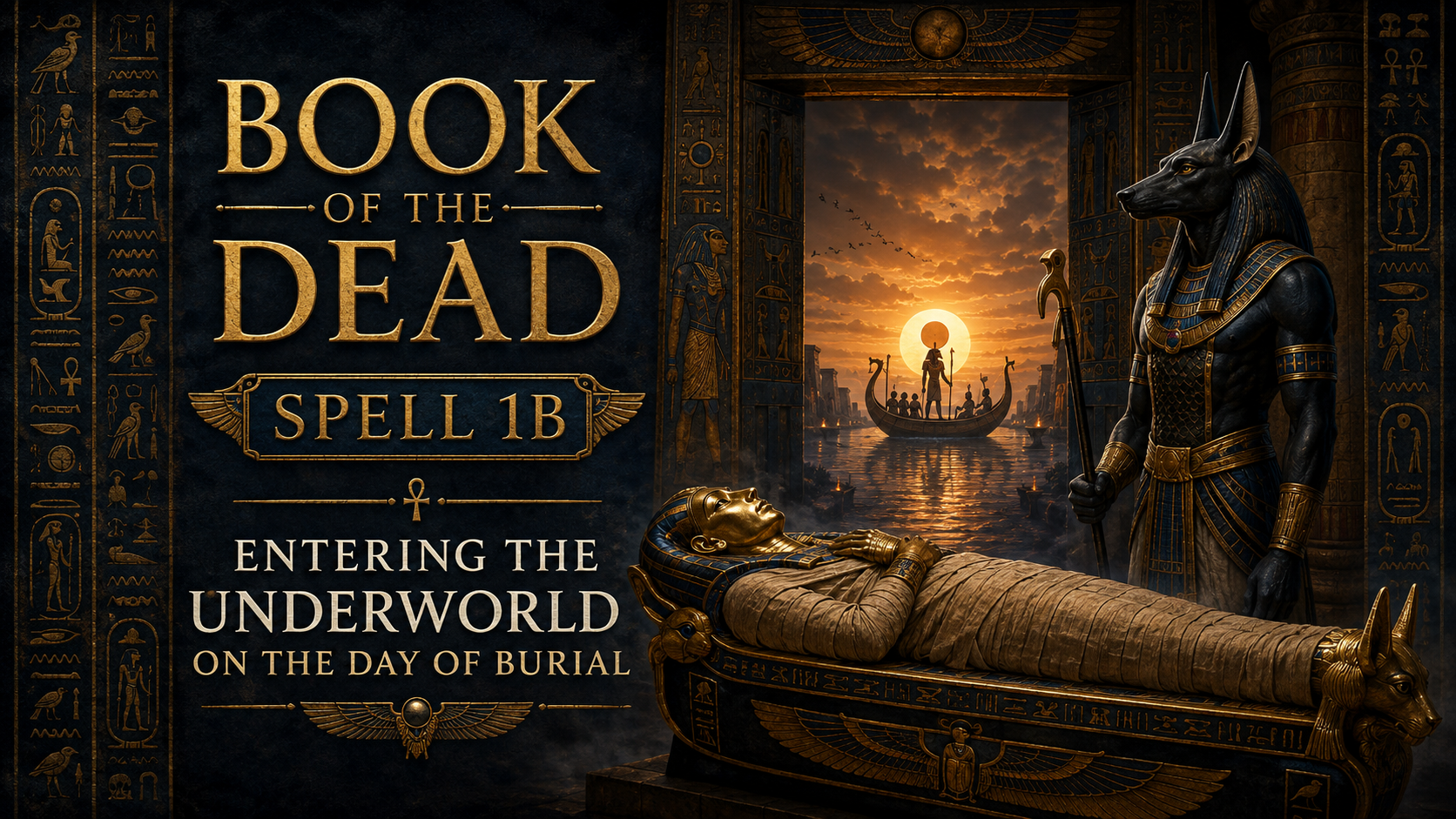
Budge’s edition identifies the text as coming from the Papyrus of Nekhtu-Amen and describes its vignette as showing Anubis standing beside the bier on which the mummy lies.
The title describes its purpose directly: The Chapter of making the Sahu, or spiritual body, enter the Tuat on the day of the funeral.
This is different from simply placing the physical mummy inside a tomb. The spell is concerned with the deceased as a transformed being entering the sacred afterlife realm.
The burial is therefore both:
- A physical event
- A supernatural transition
Spell 1B helps make that transition successful.
Why Is It Called Spell 1B?
The designation 1B is modern. Ancient Egyptian scribes did not label the composition “Spell 1B.” Modern numbering developed as scholars organized the roughly two hundred known Book of the Dead compositions into a reference system.
Richard Lepsius numbered Spells 1 through 165 in 1842, and later scholarship added further distinctions and alternate forms. Spell 1B was identified as a separate funerary composition closely related in subject and placement to Spell 1.
Modern lists therefore usually distinguish:
- Spell 1: A spell for the day of burial and going forth by day
- Spell 1B: A recitation for the day of burial that allows the deceased to descend into the Netherworld
The letter does not mean that Spell 1B is simply the second paragraph of Spell 1. It is its own composition.
English Translation of Book of the Dead Spell 1B
The following is a reader-friendly translation based on the version of Spell 1B published by E. A. Wallis Budge from the Papyrus of Nekhtu-Amen. Some names are modernized for clarity, while the basic structure and meaning are preserved.
Spell 1B: Entering the Underworld on the Day of Burial
Homage to you
who dwell in the sacred land of the West.Osiris [Name], justified,
knows you
and knows your name.Deliver him from the worms
that are in Rosetau,those that live upon
the bodies of men and womenand feed upon their blood.
Osiris [Name], justified,
knows you,and he knows your names.
Let this be the first command
of Osiris, Lord of All,whose body is hidden.
May he give air
to the deceased,and may the deceased escape
from the Terrible Onewho dwells at the bend
of the stream of the West.May he decree the actions
of the one who rises.Let the deceased pass onward
to the one whose throne
is within darkness,the one who gives glory
in Rosetau.O Lord of Light,
come and consume
the worms that are in the West.The great god who dwells in Djedu,
the unseen one,
hears the prayers of the deceased.
Those who suffer fear him
when he comes forthwith judgment
at the divine execution block.I, Osiris [Name],
have come bearing
the decree of the Lord of All.Horus has taken possession
of his throne for him.Praise has been given to him.
May he see Heliopolis.
The chiefs stand before him,
and the scribes praise him
at the doors of their assemblies.His wrappings are bound
in Heliopolis.He has taken possession
of heavenand seized the earth
in his grasp.Neither heaven nor earth
can be taken from him.Behold, he is Ra,
the firstborn of the gods.
His mother nurses him
and gives him her breast
at the horizon.
This is a modernized rendering rather than a new critical translation. Budge’s surviving text contains several obscure and archaic expressions, so some lines remain difficult to interpret with complete confidence.
The Ritual Rubric of Spell 1B
The ritual instructions are especially important because they tell us when the spell was meant to be used.
Budge’s version states that the words were to be recited after the deceased had been laid to rest in the West. The rubric then promises that the deceased would come forth, embark in the boat of Ra, and be established in the Duat.
A reader-friendly rendering is:
These words are to be recited
after the deceased has been laid to rest in the West.Then the sacred region shall be satisfied with its lord.
Osiris [Name], justified, shall come forth.
He shall embark in the boat of Ra.
His body upon its bier shall be counted among those who belong there.
He shall be firmly established in the Duat.
This rubric makes the spell’s purpose unusually clear.
Spell 1B belongs at the moment when the funeral has ended but the afterlife journey has just begun.
What Does Book of the Dead Spell 1B Mean?
Spell 1B protects the deceased during the immediate transition from burial into the underworld.
Its main concerns are:
- Protecting the corpse
- Preventing worms from consuming it
- Giving the deceased air
- Allowing safe entry into Rosetau
- Gaining access to Osiris
- Receiving divine recognition
- Identifying with Ra
- Joining the solar boat
- Becoming established in the Duat
The spell can therefore be summarized as:
My body has been buried, but I will not be destroyed. I know the beings who threaten me, I know their names, and divine power protects me. I can breathe, rise, enter the underworld, join Ra, and continue living after death.
Spell 1 vs. Spell 1B
Because their numbering is so similar, Spell 1 and Spell 1B are easily confused. They are related but distinct.
Spell 1
Spell 1 is a much longer composition associated with the day of burial. In the Renouf and Naville edition, it invokes Thoth, Horus, Osiris, the divine tribunals, the funerary rites of Osiris, Sokar’s Hennu boat, offerings, and admission into the house of Osiris. It asks that the deceased be allowed to see, hear, stand, sit, receive bread and beer, and move freely among the blessed dead.
Spell 1B
Spell 1B concentrates more narrowly on what happens once the burial has occurred. It addresses:
- The descent into the Duat
- Protection of the body
- Worms in Rosetau
- Air
- Osirian protection
- Solar rebirth
- Establishment in the Netherworld
A simple distinction is: Spell 1 accompanies the funeral and admission into Osiris’s realm. Spell 1B helps the deceased make the actual transition into the underworld after burial.
What Is the Sahu?
Budge translates the title of Spell 1B as a chapter for making the Sahu enter the Tuat and glosses the term as the spiritual body. The exact ancient Egyptian concepts behind body and spirit are more complex than this older English phrase suggests.
The sahu is the transformed or spiritualized form of the deceased that becomes effective after the funerary rites have been performed.
The important point is that Spell 1B does not imagine only the inert corpse entering the afterlife. It imagines a deceased person who has been ritually transformed.
What Is the Duat?
Budge uses the spelling Tuat, while modern English usually uses Duat. The Duat was the hidden realm through which divine and deceased beings traveled after death.
It could include:
- Darkness
- Rivers
- Gates
- Caverns
- Divine courts
- Dangerous beings
- Regions of punishment
- Places of resurrection
Spell 1B explicitly aims to establish the deceased safely within this world. The Duat should not be reduced simply to a modern idea of “hell.” It was a complex divine realm containing both danger and regeneration.
Why Is the Day of Burial So Important?
The burial marked a decisive transition. The deceased had undergone:
- Mummification
- Funeral rites
- Procession to the tomb
- Ritual lamentation
- Offerings
- Placement within the burial chamber
Spell 1B begins at the moment when those earthly actions are complete. The body is now inside the tomb.
From the Egyptian religious perspective, the next phase must begin: The deceased must become active in the afterlife. That is why the spell’s rubric specifies that it is recited after the deceased has been laid to rest.
Anubis in the Vignette
Budge describes the vignette accompanying his Spell 1B source as: Anubis, jackal-headed, standing beside the bier on which the mummy lies.
This is especially appropriate. Anubis was closely associated with:
- Embalming
- Mummification
- The necropolis
- Protection of the corpse
- Funerary ritual
The image places Spell 1B exactly where it belongs: At the boundary between the prepared mummy and the active afterlife.
Interestingly, the surviving translation presented by Budge does not make Anubis the central speaking deity. He appears most clearly in the vignette rather than dominating the words of the spell itself.
This distinction is useful for accurately describing the image. The artwork shows Anubis protecting the mummy, while the spoken composition invokes other divine powers and sacred regions.
Why Does Spell 1B Mention Worms?
One of the first threats named in Spell 1B is disturbingly physical.
The deceased asks to be delivered from: worms in Rosetau that live upon human bodies and feed upon their blood. This reflects a basic funerary fear: decomposition.
The Egyptians invested enormous effort in preserving the body through mummification. Spell 1B supplements physical preservation with magical protection. The corpse must not become food for creatures of decay.
Are the Worms Literal?
They may reflect both physical and supernatural danger. From one perspective, worms are an obvious threat to a corpse.
But in Book of the Dead language, harmful creatures frequently become supernatural beings within the afterlife.
Spell 1B treats them as entities that can be addressed, named, and magically controlled. The deceased’s protection comes partly from knowing their names.
“He Knows Your Names”
Spell 1B repeatedly emphasizes knowledge. The deceased knows the being addressed. The deceased also knows the names of the dangerous worms.
This reflects a major principle throughout the Book of the Dead: Knowledge gives power.
The dead person survives by knowing:
- Divine names
- Names of dangerous creatures
- Names of gates
- Sacred places
- Correct spells
The same principle becomes increasingly important in later spells.
Why Did Knowing a Name Matter?
In Egyptian religious and magical language, naming something could establish recognition and authority.
To say: I know you, and I know your name was not just trivia.
It meant the deceased was not helpless or ignorant before the supernatural being. The speaker knew what they were facing.
Spell 1B uses that knowledge against beings that might destroy the corpse.
What Is Rosetau?
Budge spells the place Re-stau. Modern spellings include:
- Rosetau
- Rostau
- Rosetjau
Spell 1B locates dangerous worms there and later refers to a divine figure who gives glory within Rosetau. Rosetau was associated with the necropolis and developed into an important mythological region of the underworld.
It appears repeatedly in the Book of the Dead.
This gives your Spell 1B article a natural internal link to Spell 4: Passing on the Upper Road of Rosetjau.
Spell 1B and Spell 4
Spell 4 deals specifically with passing along the upper road of Rosetau. Spell 1B already introduces Rosetau as a dangerous funerary region associated with:
- The corpse
- Worms
- Darkness
- Divine protection
The early spells therefore begin building the geography of the afterlife almost immediately. Spell 1B gets the deceased into the Netherworld. Spell 4 later helps the deceased travel one of its roads.
“Give Him Air”
Spell 1B asks that the deceased receive air. This is an important theme that returns much later in the Book of the Dead.
A mummy cannot physically breathe. But the transformed deceased needs the supernatural power of breathing.
Later spells, especially Spells 54 through 59, explicitly concern obtaining air or breath. Spell 1B introduces the problem right at burial.
Why Would the Dead Need Air?
The Egyptian afterlife was imagined as active life. The deceased hoped to:
- Breathe
- Speak
- Eat
- Drink
- Walk
- Travel
- See
- Hear
A corpse lacks all these faculties. Book of the Dead spells restore them.
Spell 1B’s request for air is therefore one of the earliest signs that Egyptian resurrection meant far more than simply preserving a dead body. The deceased must become functional again.
The “Terrible One”
The spell asks that the deceased escape from a dangerous being Budge calls the Terrible One, dwelling at a bend in the stream of Amentet.
The passage does not securely identify this being with one of the familiar major gods. It is safest to leave the figure unnamed rather than force a modern identification.
What matters is the function:
This is another supernatural danger the newly buried deceased must pass safely.
What Is Amentet?
Amentet, broadly meaning the West, was closely connected with:
- Sunset
- Burial grounds
- The dead
- Osiris
- Entry into the afterlife
The Egyptian dead were often described as going west because major necropolises commonly lay on the western side of the Nile and because the setting sun symbolized entry into the hidden world.
Spell 1B places the deceased firmly in this western funerary geography.
“The One Whose Throne Is in Darkness”
The deceased is allowed to approach: the one whose throne is within darkness. The text does not clearly identify this figure by name in Budge’s rendering.
The image is important, however. The newly buried deceased enters a hidden, dark region where divine beings rule from unseen places.
Darkness in Egyptian funerary thought was not simply evil. It was also:
- Hidden
- Regenerative
- Nocturnal
- Part of the solar cycle
The deceased must pass through it rather than be destroyed by it.
“Lord of Light”
Immediately after the throne in darkness, Spell 1B invokes: O Lord of Light. The contrast is striking: Darkness followed by Light. This reflects one of the central rhythms of Egyptian afterlife theology.
The deceased passes through darkness in order to emerge renewed, just as the sun travels through the night before appearing again at dawn.
Spell 1B and Solar Rebirth
The solar imagery becomes explicit near the end of the spell.
The deceased is identified with Ra, the firstborn of the gods, and is described as being nursed at the horizon. The rubric then promises that the deceased will embark in the boat of Ra.
The journey is therefore not only Osirian. It is solar.
Osiris and Ra Together
Spell 1B combines two of the most important models of Egyptian resurrection.
Osiris
Osiris represents:
- Death
- Burial
- Preservation
- Restoration
- Life in the realm of the dead
Ra
Ra represents:
- Sunset
- Nighttime passage
- Dawn
- Daily rebirth
- Solar immortality
The deceased participates in both. The burial follows the pattern of Osiris. The renewed journey follows the cycle of Ra.
Why Is the Deceased Called Osiris?
The text repeatedly calls the deceased: Osiris Nekhtu-Amen. This was a standard funerary identification.
The deceased was not claiming to erase their individual identity. Instead, the person’s fate was linked with the successful resurrection of Osiris.
In a personalized copy, the formula would effectively mean:
the Osiris [Name]
The dead person now participates in Osiris’s transformed condition.
Who Is Neb-er-tcher?
Budge renders one divine title as Neb-er-tcher, commonly understood in older translations as something like:
Lord of All
or
Lord to the Limit
Spell 1B calls him the one:
who keeps his body hidden.
Within the funerary context, the title is associated with a supreme Osirian power.
For a modern reader-friendly explanation, Lord of All is sufficient without forcing a more precise identification than the text securely allows.
“His Body Is Hidden”
The hidden body is an important Osirian image.
Osiris’s body is:
- Dead
- Concealed
- Preserved
- Protected
- Ultimately restored
The deceased’s mummy is undergoing a comparable process.
The physical corpse rests hidden within the tomb while the transformed person begins a new existence.
Spell 1B therefore connects the hidden body with continuing life rather than disappearance.
Djedu and Osiris
Budge refers to the great god dwelling in Tattu, an older spelling of Djedu, usually identified with Busiris and closely associated with Osiris.
Djedu was a major cult center of Osiris.
Its appearance reinforces the spell’s Osirian theology.
The newly buried dead person enters a sacred landscape filled with places linked to the god’s death and restoration.
The Divine Execution Block
Spell 1B refers to a divine judgment or sentence connected with an execution block. Execution imagery recurs throughout the Book of the Dead.
Enemies of the gods could be:
- Bound
- Slaughtered
- Burned
- Beheaded
- Destroyed
The deceased must make sure they are not counted among those enemies.
Spell 1B places the speaker under the correct divine decree so that the destructive powers of the afterlife are directed elsewhere.
Horus Takes the Throne
Spell 1B says: Horus has taken possession of his throne. This evokes the larger myth of Osiris and Horus.
After Osiris’s death:
- Horus becomes his avenger
- Set is defeated
- Horus receives rightful kingship
- Divine order is restored
The deceased benefits from the same mythological victory.
The restoration of Horus’s rightful rule becomes another guarantee that cosmic order will prevail.
Why Does Heliopolis Appear?
The spell refers to Annu, or Heliopolis, where chiefs and scribes honor the divine figure.
Heliopolis was a major center of solar and creation theology.
It was associated with:
- Ra
- Atum
- The Ennead
- Creation
- Solar kingship
Its appearance fits perfectly with the transition toward Ra imagery in the later part of the spell.
The Scribes Praise Him
Spell 1B says that scribes praise the divine figure at the entrance to their assemblies. This imagery gives the deceased public divine recognition.
The speaker is not slipping secretly into the afterlife. The cosmic institutions themselves acknowledge the successful transformation.
This is important because afterlife survival repeatedly depends upon recognition.
“He Has Seized Heaven and Earth”
The deceased or divine figure is described as taking possession of:
- Heaven
- Earth
The statement represents cosmic authority. The newly transformed deceased is no longer confined by the tomb. The person participates in powers extending across the entire universe.
That is a dramatic reversal of burial. The body has just been enclosed underground, yet the spell declares cosmic freedom.
“He Is Ra”
Spell 1B eventually states: Behold, he is Ra, the firstborn of the gods.
This is one of the strongest declarations in the composition. The deceased does not merely ask Ra for assistance. The speaker participates in Ra’s identity.
This gives the deceased access to the most important solar power of all: rebirth after darkness.
The Mother Nursing the Reborn Deceased
The final image describes a divine mother nursing the transformed being at the horizon.
The imagery is unmistakably one of rebirth.
The deceased has moved from:
- Corpse
- Burial
- Darkness
to:
- Child
- Nourishment
- Horizon
- Solar renewal
Death has become another birth.
Why Is the Horizon Important?
The horizon is the place where the sun appears and disappears. It therefore represents a threshold.
At sunset: The sun enters the hidden world.
At sunrise: The sun emerges renewed.
Spell 1B places the deceased within this same cycle. The tomb is not the end. It is a horizon.
The Boat of Ra
The rubric promises that the deceased will:
embark in the boat of Ra.
Ra’s solar boat traveled through the sky and the hidden world.
To join it meant participating in:
- Divine travel
- Solar protection
- Daily regeneration
- Cosmic order
For a newly buried person, this is one of the strongest assurances of continued existence.
Why Does the Body Remain on the Bier?
The rubric simultaneously says that the body remains upon its bier while the deceased becomes established within the Duat.
This reveals an important feature of Egyptian ideas of personhood.
The physical body can remain in the tomb while another transformed aspect of the person participates in divine life.
The afterlife did not require abandoning the body.
Instead, different elements of the person could remain connected while functioning in different ways.
Burial and Transformation Happen Together
Spell 1B presents two realities at once.
Physical reality
The mummy lies upon the bier and is placed in the tomb.
Divine reality
The deceased:
- Breathes
- Travels
- Knows names
- Approaches gods
- Becomes Ra
- Joins the solar boat
- Enters the Duat
The funeral therefore changes the person’s mode of existence rather than ending it.
Why Spell 1B Is Important to the Book of the Dead Series
Spell 1B helps explain the structure of many later spells.
The deceased has now:
- Been buried
- Entered the Netherworld
- Gained protection for the body
- Received air
- Been identified with Osiris
- Been identified with Ra
- Joined the divine afterlife journey
Only after this foundation can later spells deal with more specialized problems.
These include:
- Going forth by day
- Traveling through Rosetau
- Avoiding compulsory labor
- Defeating Apep
- Recovering the mouth
- Recovering memory
- Protecting the heart
Spell 1B gets the deceased inside the system.
Spell 1B and Spell 2
Spell 2 immediately shifts toward another major goal:
going forth by day and living after death.
Budge’s Spell 2 explicitly asks that the underworld be opened so the deceased can come forth and move among the living.
The sequence is logical.
Spell 1B
Establish me successfully in the Duat.
Spell 2
Now let me come forth from it.
The deceased needs both abilities.
Entering and Leaving the Underworld
This is one of the most important ideas in the Book of the Dead.
Successful death does not mean staying permanently inside the tomb or underworld.
The deceased wants freedom to:
- Enter
- Leave
- Return
- Travel
- Visit the earth
- Join the gods
- Reunite with the body
Spell 1B establishes safe entry.
Later spells establish freedom of movement.
Is Spell 1B Part of the Papyrus of Ani?
The version translated by Budge as Spell 1B comes specifically from the Papyrus of Nekhtu-Amen, not the Papyrus of Ani.
That is worth stating clearly because the Papyrus of Ani is often treated online as though it contained every Book of the Dead spell.
It did not.
Book of the Dead manuscripts varied substantially in which compositions they included.
Who Was Nekhtu-Amen?
Budge identifies the owner of his Spell 1B manuscript as Nekhtu-Amen, described within the spell as a royal scribe.
The text repeatedly inserts his name.
This personalization was fundamental to funerary texts.
The magical benefits were not intended vaguely for all humanity.
They were directed toward a specific dead person.
In a generic translation, scholars replace the personal name with N or [Name].
Does Spell 1B Have a Vignette?
Yes.
Budge explicitly describes the vignette as:
Anubis, jackal-headed, standing beside the bier on which the mummy lies.
This is one of the clearest visual concepts in the early Book of the Dead.
It shows the exact threshold that the spell addresses:
The mummy lies prepared.
Anubis stands watch.
The deceased begins the journey into the Duat.
Is Spell 1B About Resurrection?
Yes, but in a specific sense. It does not tell the entire story of resurrection.
Instead, it helps accomplish the transition from: buried corpse to: active deceased person within the divine afterlife.
The requests for:
- Air
- Protection
- Divine recognition
- Solar identity
- Entry into Ra’s boat
all belong to that regeneration process.
Is Spell 1B a Protection Spell?
Partly. It clearly protects the deceased from:
- Corpse-eating worms
- A dangerous supernatural being
- The execution block
- Rejection from the divine realm
But its purpose is larger than defense.
It also positively grants:
- Air
- Divine identity
- Access to the Duat
- Solar rebirth
- A place aboard Ra’s boat
So Spell 1B is both a protection spell and a transition spell.
Does Spell 1B Protect the Mummy?
Yes. The passage about worms makes bodily protection one of its explicit concerns.
This fits the Egyptian belief that successful eternal existence required preserving the body.
Mummification did the physical work. Spell 1B added magical defense.
Does Spell 1B Promise Eternal Life?
Not in those exact modern words.
But the promises of:
- Entry into the Duat
- Identification with Ra
- Participation in the solar boat
- Establishment in the underworld
all form part of the wider Egyptian program for continued existence after death.
The deceased is intended to become active and enduring rather than annihilated.
Is Spell 1B Older Than the New Kingdom?
The web sources reviewed here establish its use in Book of the Dead manuscript traditions, but they do not provide enough secure information to date the original composition with precision.
It is better not to claim a specific Coffin Text predecessor unless a reliable textual study establishes one.
The safe statement is:
Spell 1B belongs to the funerary tradition represented in Book of the Dead manuscripts and was classified by modern scholars as a composition closely related to Spell 1.
The Meaning of Spell 1B in Simple Terms
Book of the Dead Spell 1B was recited around the time the deceased was laid to rest. The physical funeral is over. Now the supernatural journey begins.
The deceased knows the names of dangerous beings and is protected against worms that would consume the body.
Air is restored. Dangerous underworld powers are overcome.
The speaker becomes associated with Osiris and Horus and finally takes on the identity of Ra.
The rubric promises that the deceased will come forth, board Ra’s boat, and become established within the Duat.
The meaning can be summarized as:
My body has been buried, but death cannot destroy me. Protect my body, give me breath, open the sacred underworld to me, and allow me to join the gods. Like Osiris I survive burial, and like Ra I will be reborn.
Spell 1B is the bridge between the funeral and the afterlife.
Frequently Asked Questions About Book of the Dead Spell 1B
What is Book of the Dead Spell 1B?
Spell 1B is a funerary composition intended to help the transformed deceased enter the Duat on the day of burial. Modern summaries describe it as a recitation permitting the noble dead to descend into the Netherworld on the day of interment.
What is the traditional title of Spell 1B?
Budge calls it:
The Chapter of making the Sahu to enter into the Tuat on the day of the funeral.
What does Spell 1B protect against?
It explicitly asks for protection against worms that consume human bodies and feed on blood, as well as other dangers in the western underworld.
Why are worms mentioned?
They represent a threat to the preserved corpse and may also function as supernatural dangers within Rosetau. The deceased defeats them partly through knowledge of their names.
What is the Sahu?
Budge glosses the term as the deceased’s spiritual body. In modern explanatory language, it can be understood as a transformed or spiritualized form of the deceased.
What is the Tuat?
Tuat is an older spelling of Duat, the hidden Egyptian underworld through which gods and the dead traveled.
What is Rosetau?
Rosetau is a funerary and underworld region also encountered in other Book of the Dead compositions, including Spell 4.
Does Spell 1B mention Osiris?
Yes. The deceased is repeatedly identified as Osiris [Name], and the spell invokes Osirian divine authority.
Does Spell 1B mention Ra?
Yes. The deceased is ultimately identified with Ra, and the rubric promises that the deceased will embark in Ra’s boat.
Why is Horus mentioned?
The spell says Horus has taken possession of his throne, evoking the restoration of divine order after the death of Osiris.
Does the spell give the deceased air?
Yes. It specifically requests that air be given to the deceased.
When was Spell 1B recited?
The rubric says it should be recited after the deceased has been laid to rest in the West.
What happens if the spell works?
The rubric promises that the deceased will come forth, embark aboard the boat of Ra, and become established in the Duat.
Did Spell 1B have a vignette?
Yes. Budge describes a vignette showing Anubis standing beside the bier of the mummy.
Is Spell 1B the same as Spell 1?
No. Spell 1 is a longer funeral-day composition. Spell 1B is a separate text specifically concerned with the deceased entering the underworld after burial.
Is Spell 1B in the Papyrus of Ani?
The version translated by Budge comes from the Papyrus of Nekhtu-Amen, not Ani.
Did ancient Egyptians call it “Spell 1B”?
No. The numbering is a modern scholarly system.
Book of the Dead Spell 1B begins at one of the most important moments in the ancient Egyptian funerary process. The coffin has reached the tomb. The mummy has been laid to rest.
Earthly burial is complete. But according to Egyptian funerary belief, the deceased’s real journey is only beginning.
Spell 1B protects the corpse from destruction, drives away creatures that would consume it, restores air, invokes the authority of Osiris, recalls the triumph of Horus, and transforms the deceased into a being associated with Ra.
Its rubric makes the intended result explicit. The deceased will: come forth, enter the boat of Ra, and become established in the Duat.
That makes Spell 1B an important companion to Spell 1. Spell 1 accompanies the funeral. Spell 1B carries the deceased across the threshold created by that funeral.
The body enters the tomb. The transformed person enters the afterlife.