The ancient Egyptian Book of the Dead was a collection of funerary spells designed to help the deceased survive death, move through the afterlife, regain essential powers, and become a fully effective spirit among the gods.
Book of the Dead Spell 21 focuses on one of the most basic abilities a dead person needed to recover: the mouth.
Its traditional title is:
A formula for giving the mouth of the deceased to him in the underworld
UCL Digital Egypt preserves a New Kingdom version of the spell and notes that the composition is older than the Book of the Dead itself. An earlier form appears in the Middle Kingdom Coffin Texts as Spell 351.
Spell 21 allowed the deceased to speak again. That was not a minor concern. Without a functioning mouth, the person could not recite spells, identify gods, answer gatekeepers, defend against accusations, praise the gods, or request food and drink.
In simple terms, Spell 21 restores the deceased’s voice, agency, and ability to participate in the afterlife.
What Is Book of the Dead Spell 21?
Book of the Dead Spell 21 is a short funerary formula asking a divine being to restore the deceased’s mouth. UCL gives the title:
Formula for giving the mouth of the Osiris N to him in the underworld
Here, Osiris N means the deceased person identified with Osiris, with the individual’s name replacing the letter N.
The spell addresses a mysterious deity described as:
- Lord of light
- Foremost of the Great Temple
- Master of complete darkness
The deceased approaches this being in a purified and transformed condition and asks: Give me my mouth so that I may speak with it.
The spell then adds a second request: Let my heart guide me during the dangerous hour of night. The two requests work together. The mouth restores speech, while the heart provides guidance and judgment.
English Translation of Book of the Dead Spell 21
The following reader-friendly translation is based closely on the text published by UCL Digital Egypt.
Spell 21: Giving the Mouth to the Deceased
Hail to you,
Lord of Light,foremost of the Great Temple,
master of complete darkness.
I have come before you
as one who is transformed and pure.Your two arms are behind you,
restraining those before you.Give me my mouth
so that I may speak with it.Let my heart guide me
during the dangerous hour of the night.
This is a very short spell, but every line contributes to the restoration of the deceased as an active being.
A More Literal Historical Translation
UCL translates the surviving version as:
“Hail lord of light, foremost of the Great Temple, master of complete darkness, I have come before you who are transfigured and pure, your two arms behind you, restraining your uppers, so that you may give me my mouth for me to speak with it, and so that my heart may guide me at its evil night hour.”
The phrase translated as “restraining your uppers” is difficult and may reflect damage or uncertainty in the manuscript. UCL notes that the version follows the partly damaged text in the Book of the Dead of Nu, supplemented from other sources by Édouard Naville.
What Does Book of the Dead Spell 21 Mean?
Spell 21 restores one of the deceased’s most important powers: speech.
Death made the body silent. The mouth no longer moved, and the person could no longer pronounce the words needed to function in the divine world.
Spell 21 reverses that condition. Its meaning can be summarized as:
Death has silenced me, but my mouth will be restored. I will speak again, and my heart will guide me safely through the darkness of the afterlife.
The spell does not merely give the deceased a physical mouth. It restores the ability to:
- Speak
- Recite spells
- Answer questions
- State one’s identity
- Call upon gods
- Defend against enemies
- Request nourishment
- Praise divine beings
- Use magical words effectively
Speech meant power.
Why Was the Mouth So Important in the Egyptian Afterlife?
Ancient Egyptian funerary religion imagined the afterlife as an active environment. The deceased might need to:
- Speak to gatekeepers
- Name gods and demons
- Answer divine challenges
- Recite protective spells
- Defend against accusations
- Ask for food and water
- Command hostile beings
- Praise Ra and Osiris
- Give testimony before a divine tribunal
A silent deceased person would be at a severe disadvantage. The Book of the Dead itself depends upon speech. Many spells are written in the first person as though the deceased is speaking.
Spell 21 ensures that those words can actually be uttered.
The Mouth as an Instrument of Magic
Egyptian magical practice placed enormous importance on correctly spoken words. Words could:
- Open gates
- Repel serpents
- Heal injuries
- Restore body parts
- Defeat enemies
- Transform the speaker
- Compel divine beings
- Establish a desired condition as reality
This is why the restoration of the mouth appears so early in the sequence of spells dealing with the parts of the person.
A deceased person without speech could possess knowledge but still be unable to use it. Spell 21 gives that knowledge a voice.
Spell 21 and the Opening of the Mouth Ceremony
Spell 21 is closely related in theme to the famous Opening of the Mouth ceremony, but the two should not be treated as identical. The Opening of the Mouth was a larger ritual performed on:
- Mummies
- Statues
- Coffins
- Cult images
Its purpose was to restore the senses and bodily faculties needed for life. The ritual could symbolically reactivate:
- The mouth
- The eyes
- The ears
- The nose
- The ability to breathe
- The ability to eat and drink
- The ability to speak
Spell 21 focuses specifically on restoring the mouth within the afterlife. It belongs to the same broad religious concern, but it is a Book of the Dead formula rather than the entire ceremonial rite.
Why Does Spell 21 Come After the Vindication Spells?
The placement of Spell 21 is meaningful. Spells 18 through 20 concern vindication and triumph over enemies.
Then the Book of the Dead turns toward restoring the deceased’s personal faculties:
- Spell 21: Gives the mouth back
- Spell 22: Another formula for giving the mouth
- Spell 23: Opens the mouth
- Spell 24: Restores words of power
- Spell 25: Restores memory
- Spell 26: Restores the heart
UCL’s numerical list confirms this sequence. This creates a logical progression. The deceased has been accepted and vindicated. Now the person must become fully functional again.
Spell 21 Begins a New Section of the Book of the Dead
Spell 21 marks an important shift in the early Book of the Dead. Earlier spells concentrated on:
- Burial
- Going forth by day
- Travel
- Enemies
- Apep
- Divine judgment
- Vindication
Beginning with Spell 21, the focus turns toward preserving and restoring the individual person. The deceased needs:
- A mouth
- Speech
- Memory
- A heart
- A functioning body
- Protection from losing these parts again
This section reflects the Egyptian idea that death threatened to separate or disable the different components of a person. Eternal life required putting the person back together.
Who Is the “Lord of Light”?
The spell begins: Hail, Lord of Light.
The text does not explicitly identify this god by name in the UCL version. The title suggests a divine being associated with illumination, visibility, or the transition from darkness into light.
Possible associations may include solar deities such as Ra or a local form of a god connected with the temple and underworld.
However, because the surviving text does not name the deity directly, it is best not to identify him with certainty.
The title itself is what matters. The deceased approaches a being who possesses authority over light.
“Foremost of the Great Temple”
The god is also described as: Foremost of the Great Temple. The phrase may refer to a major sanctuary or sacred divine dwelling.
The exact temple intended is uncertain from this short text alone. What the title establishes is rank.
The god is not a minor guardian. The speaker approaches a powerful deity holding an important position within a sacred domain. That authority makes him capable of restoring the mouth.
“Master of Complete Darkness”
The same deity is also called: Master of complete darkness. This creates an interesting contrast with Lord of Light. The god has authority over both:
- Light
- Darkness
This makes perfect sense in funerary theology. The deceased is passing through a world in which darkness and light are part of the same cycle.
Ra disappears into darkness at sunset and emerges into light at dawn. The god addressed in Spell 21 may therefore control the boundary between:
- Death and renewed life
- Silence and speech
- Darkness and illumination
- Inactivity and restored agency
Why Does the Spell Mention Darkness?
Darkness could symbolize several dangers after death:
- The tomb
- Loss of sight
- Loss of direction
- The Duat at night
- Separation from the sun
- Ignorance
- Spiritual danger
However, darkness was not automatically evil. The hidden nighttime world was also where regeneration occurred. Spell 21 places the deceased before a god who has mastered this darkness rather than being overcome by it.
“I Have Come Before You”
The deceased announces: I have come before you. This declaration itself proves that the person is active. The deceased can:
- Travel
- Approach
- Recognize a deity
- Speak
- Make a request
The formula places the speaker in the presence of divine authority. The journey has already begun successfully.
“Transformed and Pure”
The UCL translation describes the deceased as arriving: Transfigured and pure. This is significant. The person is not approaching the god as an ordinary corpse.
The deceased has already undergone ritual transformation and purification. The concept of being transfigured is closely related to becoming an akh, an effective spirit capable of functioning within the divine world.
Purity ensures that the deceased is fit to approach sacred beings.
What Is an Akh?
An akh was a successfully transformed spirit. Ancient Egyptian ideas of the person included several components, such as:
- Body
- Ka
- Ba
- Heart
- Name
- Shadow
- Akh
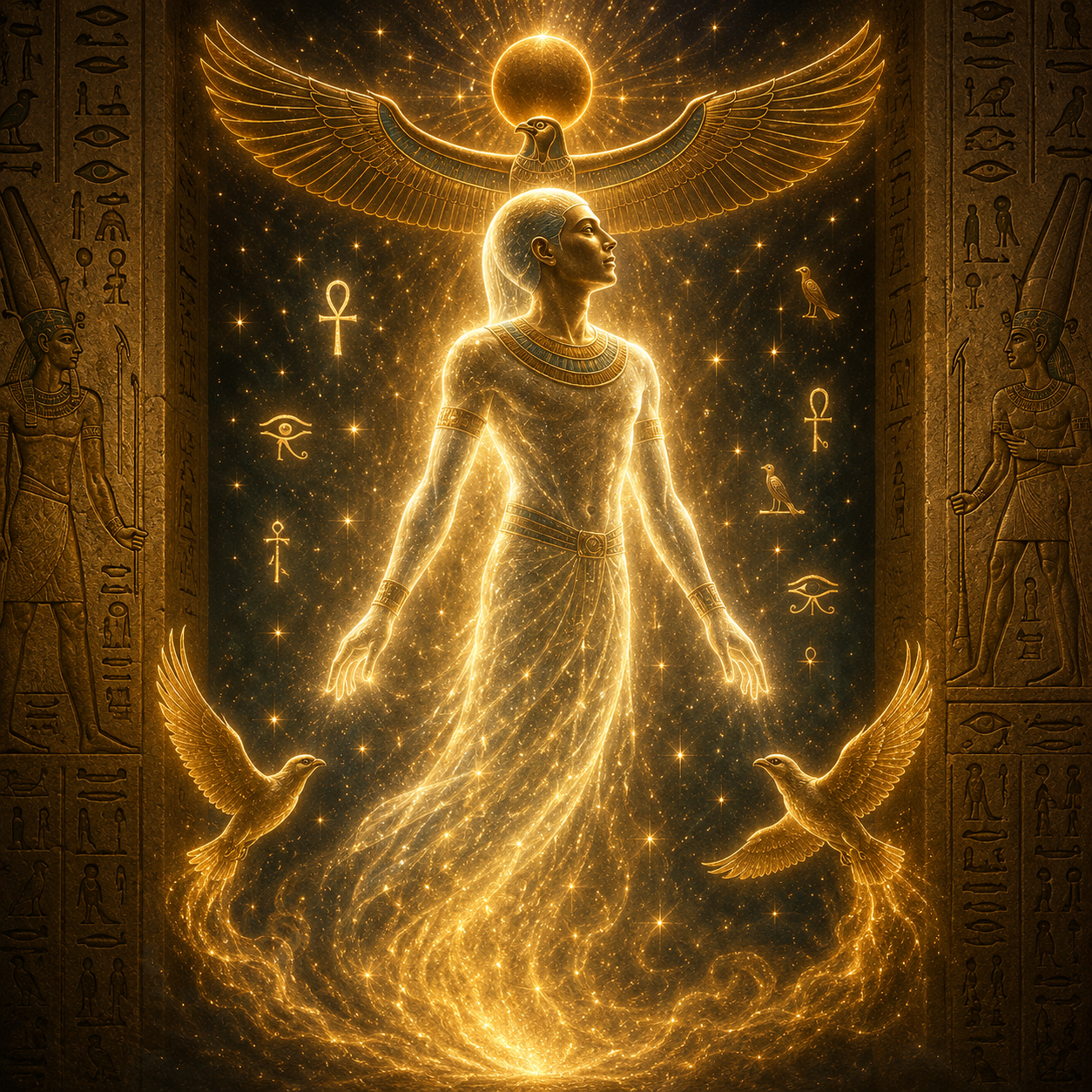
The akh was not simply the same thing as a modern concept of the soul. It represented the deceased in an effective, radiant, transformed state.
An akh could:
- Travel
- Approach gods
- Receive offerings
- Use magical powers
- Interact with the living
- Exist within the divine world
Spell 21 helps make that effective existence possible by restoring speech.
Why Does the Deceased Need Purity?
Approaching a god required ritual purity. Impurity could prevent:
- Entry into sacred spaces
- Acceptance of a prayer
- Participation in rituals
- Contact with divine beings
- Successful judgment
Purification could involve:
- Water
- Natron
- Incense
- Ritual washing
- Sacred clothing
- Correct speech
By announcing purity, the deceased establishes that there is no ritual reason for the request to be refused.
“Give Me My Mouth”
The central request is extremely direct: Give me my mouth. The wording is important. The deceased does not ask for a mouth. The speaker asks for my mouth.
This reflects a wider Book of the Dead concern with preserving personal identity. The deceased wants the restoration of the same individual faculties that belonged to the person during life.
Death must not permanently take them away.
Personal Identity After Death
The ancient Egyptian afterlife did not require complete loss of individuality. A successful deceased person retained:
- Their name
- Their heart
- Their body
- Their memory
- Their relationships
- Their ability to speak
- Their personal identity
The person could also identify with gods, but divine identification did not necessarily erase the human individual. Spell 21 protects continuity. The deceased remains recognizably themselves.
“So That I May Speak With It”
The purpose of receiving the mouth is stated explicitly: So that I may speak with it. This is one of the clearest statements of the spell’s function. Speech is restored so the deceased can participate actively in the afterlife.
The speaker does not merely want a physically intact body. The restored organ must work. That distinction appears throughout funerary magic. A body part had to possess its proper function.
What Could the Deceased Say?
Once the mouth was restored, the deceased could speak the rest of the Book of the Dead. That included formulas such as:
- I know your name.
- Open the gate for me.
- I am Horus.
- I am Ra.
- I am justified.
- My enemy shall not escape.
- Give me bread and beer.
- Let me go forth by day.
The mouth therefore becomes the instrument through which many other spells operate. Spell 21 could be thought of as restoring the deceased’s ability to use the magical toolkit contained in the rest of the manuscript.
Speech and Identity
In ancient Egyptian thought, speaking one’s name and identity carried great importance.
The deceased repeatedly tells gods and guardians:
I am…
The ability to say who one is helps establish:
- Identity
- Status
- Divine relationships
- Rights
- Knowledge
- Authority
Without speech, the deceased could struggle to demonstrate belonging within the divine realm.
Spell 21 restores the capacity for self-identification.
Why Is the Heart Mentioned?
The final request is: Let my heart guide me. The heart was one of the most important parts of the Egyptian person.
It was associated with:
- Thought
- Memory
- Intention
- Emotion
- Judgment
- Moral awareness
- Identity
The brain did not occupy the same symbolic role in Egyptian religious thought. The heart was the internal guide.
The Heart as Guide
Spell 21 pairs two faculties: The mouth speaks. The heart guides. This combination is powerful. The deceased needs both:
- The ability to express words
- The wisdom to know what to say and where to go
Speech without guidance could be dangerous. The heart provides direction during the uncertain nighttime journey.
“The Evil Hour of Night”
UCL translates the final phrase as: Its evil night hour. The exact interpretation is difficult, but it clearly associates the heart’s guidance with a dangerous period of darkness.
Night in Egyptian solar theology contained:
- Gates
- Hostile beings
- Serpents
- Executioners
- Apep
- Dangerous regions
- Tests of knowledge
The heart helps the deceased navigate these dangers. A smoother modern interpretation would be: Let my heart guide me through the dangerous hours of night.
Night and the Journey of Ra
The nighttime danger connects Spell 21 with the solar journey. Ra entered the western horizon at sunset and traveled through the Duat. The deceased hoped to participate in this cycle.
During the night, the speaker would need:
- Guidance
- Speech
- Knowledge
- Divine protection
- Correct identity
Spell 21 supplies two of those essentials directly.
Is Spell 21 Connected With Ra?
The spell itself does not explicitly name Ra in the surviving UCL version. However, the combination of:
- Lord of light
- Complete darkness
- Nighttime guidance
fits naturally within the broader solar framework of the Book of the Dead.
It is reasonable to explain that the spell reflects the same movement between night and renewed light seen throughout the collection, while avoiding the claim that the unnamed god must be Ra.
Is Spell 21 Connected With Osiris?
Yes, in one important sense. The title refers to: The Osiris N. The deceased is identified with Osiris.
Osiris had died, been restored, and continued existing in the afterlife. By calling the tomb owner “the Osiris [Name],” the spell places the person inside that successful pattern of resurrection.
The mouth restored to Osiris can also be restored to the deceased.
Why Is the Deceased Called “Osiris [Name]”?
This formula appears frequently in the Book of the Dead. For example, a man named Ani can be referred to as: The Osiris Ani.
The expression means that Ani participates in the fate and transformed status of Osiris. It does not necessarily mean that Ani ceases to be Ani.
Instead, Osiris provides the divine model for the deceased’s restoration.
Spell 21 and Coffin Text Spell 351
UCL states clearly that the composition existed during the Middle Kingdom and is numbered Coffin Text Spell 351 by Adriaan de Buck.
This is an important historical connection. Unlike cases where a Book of the Dead spell happens to share a number with an unrelated Coffin Text, Spell 21 has a known earlier textual ancestor.
The development can be summarized as:
Coffin Text Spell 351 → Book of the Dead Spell 21
This demonstrates continuity between Middle Kingdom coffin literature and the New Kingdom Book of the Dead.
What Were the Coffin Texts?
The Coffin Texts were funerary compositions written mainly on Middle Kingdom coffins. They developed after the earlier Pyramid Texts and before the widespread New Kingdom use of Book of the Dead papyri.
The broad historical progression is often described as:
- Pyramid Texts
- Coffin Texts
- Book of the Dead
This should not be understood as three completely isolated works.
Many themes and individual compositions passed from one tradition into another. Spell 21 is a good example.
How Old Is Spell 21?
Because its earlier form appears as Coffin Text Spell 351, the composition predates the New Kingdom Book of the Dead tradition. The Coffin Texts belong primarily to the Middle Kingdom and related periods.
By the New Kingdom, the formula had been incorporated into the Book of the Dead and copied onto papyri. This means the concern with restoring the mouth had already existed for centuries before manuscripts such as the Papyrus of Ani were produced.
The Book of the Dead of Nu
UCL bases its published version partly on the Book of the Dead of Nu, with damaged portions completed from other sources following Naville’s edition. Nu’s papyrus is an important Eighteenth Dynasty Book of the Dead manuscript.
The damaged state of the Spell 21 passage explains why some phrases are harder to understand than the central request.
The clearest surviving elements are:
- The divine greeting
- Purity and transformation
- Restoration of the mouth
- The ability to speak
- Guidance by the heart at night
Is Spell 21 the Opening of the Mouth Spell?
Not exactly. This distinction will help your article rank for related searches without misleading readers.
Spell 21 is titled: Formula for giving the mouth of a man to him in the underworld.
Spell 22 is another formula for giving the mouth.
Spell 23 is specifically titled: Formula for opening the mouth of a man in the underworld.
Therefore, Spell 21 belongs to a sequence dealing with restoration of the mouth, but Spell 23 is the Book of the Dead chapter specifically called the opening-the-mouth formula.
Spell 21 vs. Spell 22
UCL’s numerical list describes:
- Spell 21: Formula for giving the mouth of a man to him in the underworld
- Spell 22: Another formula for giving the mouth of a man to him in the underworld
The two spells serve nearly the same broad purpose. The existence of more than one formula reflects the way the Book of the Dead developed.
Different traditions could preserve alternative magical solutions to the same problem.
Spell 21 vs. Spell 23
Spell 23 goes one step further. The sequence is:
- Spell 21: Give the deceased the mouth.
- Spell 22: Another formula for giving the mouth.
- Spell 23: Open the mouth.
This resembles the difference between restoring possession of an organ and activating it fully.
Together, the three spells ensure that the deceased has a mouth and can use it effectively.
Spell 24 and Words of Power
Immediately after the mouth spells comes Spell 24, which UCL titles:
Formula for fetching the words of power of a man for him in the underworld.
The sequence is highly logical. First: Give me a mouth. Then: Open my mouth. Then: Give me my magical words.
The deceased needs both the physical-spiritual faculty and the knowledge to use it.
Spell 25 and Memory
Spell 25 restores memory. Again, the sequence makes practical sense. A deceased person who can speak but cannot remember:
- Their name
- The names of gods
- The correct spells
- The route
- Their earthly identity
would still be vulnerable.
The Book of the Dead gradually reconstructs the complete person.
Spell 26 and the Heart
Spell 26 gives the deceased the heart again. Spell 21 already mentions the heart as a guide, showing how closely speech and thought are linked.
The later heart spells then protect this essential organ from:
- Being removed
- Being taken away
- Being separated from the deceased
- Speaking against the person during judgment
The restoration begins with the mouth but quickly expands to the entire personality.
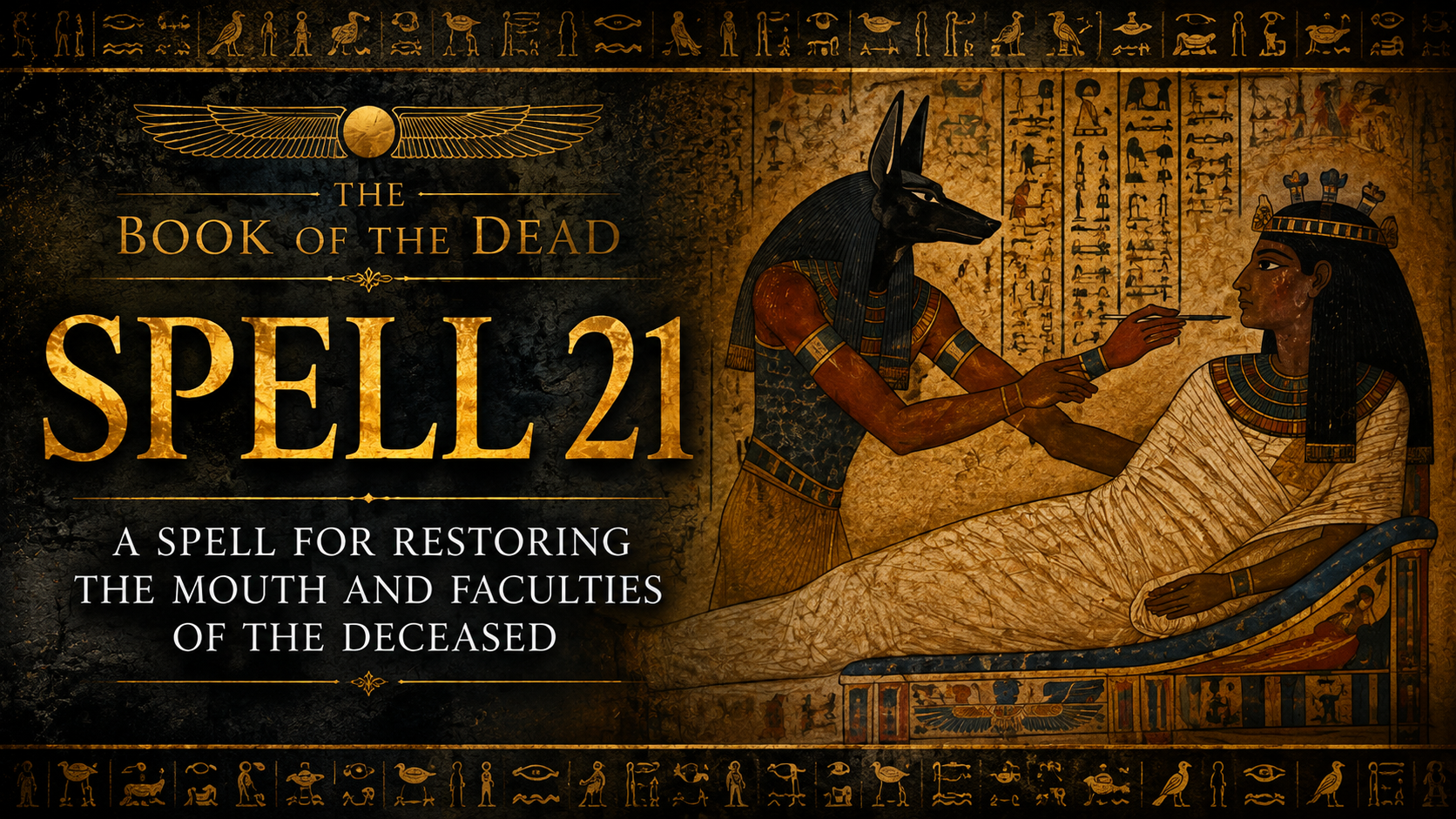
Why the Feature Image We Created Should Be Interpreted Carefully
The feature image for this article depicts a scene inspired by the Opening of the Mouth ritual. That is visually appropriate to the article’s subject, because Spell 21 concerns restoration of the mouth.
However, it is best not to caption the image as: “An ancient vignette for Spell 21.”
A more accurate caption would be:
Artistic interpretation of the restoration of the deceased’s mouth, inspired by ancient Egyptian Opening of the Mouth imagery.
That keeps the visual useful without implying that Spell 21 itself always had that exact illustration.
Was the Mouth Considered Part of the Soul?
The ancient Egyptians did not divide humans into a simple body-versus-soul system. A person consisted of multiple interconnected elements.
The mouth remained important because the deceased still needed bodily faculties within transformed existence. Physical and spiritual identity were deeply connected.
That is one reason mummification mattered. The body was not discarded as irrelevant. Its parts remained bound to the person’s eternal identity.
Why Did Egyptians Preserve Individual Body Parts?
Death threatened the integrity of the person. Funerary practices attempted to preserve or restore:
- Head
- Mouth
- Eyes
- Heart
- Limbs
- Organs
- Name
- Memory
- Shadow
- Ka
- Ba
A destroyed or missing part could threaten eternal existence. Spell 21 participates in this larger program of reconstruction.
Speech After Death
The idea that the dead could speak appears throughout Egyptian funerary literature. The deceased speaks directly in the first person:
I am…
I know…
Open for me…
Give me…
I have come…
My enemy shall fall…
These are not written as descriptions spoken by a narrator. They are the words of the deceased. Spell 21 provides the magical foundation for that voice.
Why Is Speech Connected With Creation?
Egyptian theology sometimes presented divine speech as creative. Most famously, Memphite theology describes Ptah as creating through heart and tongue.
The heart conceives. The tongue gives expression. Spell 21 uses a similar pairing:
- The heart guides.
- The mouth speaks.
The deceased regains a small version of the divine creative relationship between thought and utterance.
The Heart and Mouth Working Together
This may be the most important symbolic idea in Spell 21. The person requires both internal knowledge and external expression.
The heart provides:
- Thought
- Judgment
- Direction
- Memory
- Intention
The mouth provides:
- Speech
- Invocation
- Magical command
- Self-identification
- Communication
Together, they allow the deceased to function as a complete intelligent being.
Did Ancient Egyptians Believe Spells Worked Literally?
Book of the Dead texts were not merely inspirational poems. They were funerary tools intended to produce real effects for the deceased.
The British Museum describes the Book of the Dead as a collection of magical spells designed to help the dead negotiate the dangerous journey through the afterlife.
Spell 21 therefore was intended to do more than symbolize speech.
Its words were supposed to help make the deceased capable of speaking again within the afterlife.
Why Is Spell 21 So Short?
Short does not mean unimportant. The basic problem is simple: The deceased needs a mouth. The solution is equally direct: Give me my mouth so that I may speak.
Egyptian funerary literature often combines brief practical formulas with enormous theological compositions. Spell 17 may discuss creation, cosmic time, and dozens of divine mysteries.
Spell 21 solves one specific problem in only a few lines. Both were considered useful.
The Meaning of Spell 21 in Simple Terms
Book of the Dead Spell 21 restores the deceased’s ability to speak.
The person approaches a powerful deity who rules both light and darkness, announces that they are purified and transformed, and asks for the return of their mouth.
The deceased then asks the heart to provide guidance through the dangerous hours of night.
The meaning can be summarized as:
Death will not leave me silent. Give me back my mouth so I can speak, use sacred words, identify myself, and communicate with the gods. Let my heart guide me safely through the darkness.
Spell 21 restores more than a body part. It restores a voice.
Frequently Asked Questions About Book of the Dead Spell 21
What is Book of the Dead Spell 21?
Spell 21 is a funerary formula that restores the mouth of the deceased so the person can speak in the underworld.
What is the title of Spell 21?
UCL gives the title: Formula for giving the mouth of the Osiris N to him in the underworld.
What does Spell 21 say?
The deceased greets a god who controls light and darkness, asks for the mouth to be restored so speech becomes possible, and asks the heart for guidance through the dangerous nighttime journey.
Why did the deceased need a mouth?
The mouth allowed the deceased to recite spells, identify gods, answer guardians, defend against accusations, request nourishment, and use magical speech.
Is Spell 21 the Opening of the Mouth?
It is related in purpose but is not exactly the same. Spell 23 is specifically titled as the formula for opening the mouth in the underworld.
What is Spell 22?
Spell 22 is another formula for giving the mouth back to the deceased.
Why is the heart mentioned in Spell 21?
The heart represented thought, memory, judgment, and intention. The deceased asks it to guide them through the dangerous hours of night.
Who is the Lord of Light?
The surviving version does not clearly name the god, so the identity should not be stated with certainty.
Why is the god also master of darkness?
The title suggests authority over both light and the darkness through which the deceased must travel.
Is Spell 21 older than the Book of the Dead?
Yes. UCL states that the composition existed during the Middle Kingdom as Coffin Text Spell 351.
Is Book of the Dead Spell 21 the same as Coffin Text Spell 21?
No. Book of the Dead Spell 21 developed from Coffin Text Spell 351, not Coffin Text Spell 21.
What manuscript preserves Spell 21?
UCL’s version follows the partly damaged Book of the Dead of Nu, supplemented from other manuscript sources.
Book of the Dead Spell 21 begins a new stage in the deceased’s transformation. The divine courts have been faced. Enemies have been overcome. Vindication has been secured. Now the dead person must become fully functional again. The first essential faculty restored is the mouth.
Without it, the deceased cannot speak the sacred words, declare an identity, answer the gods, command enemies, or participate fully in the afterlife. Spell 21 therefore makes a direct and powerful request: Give me my mouth so that I may speak. The heart then takes its place beside the restored voice, guiding the deceased through the dangerous darkness of night.
The result is a person who is no longer silent or helpless. The deceased can speak again. And in the world of the Book of the Dead, the ability to speak is the ability to act.