The ancient Egyptian Book of the Dead was a collection of funerary spells intended to help the deceased awaken, move freely, overcome supernatural dangers, and attain eternal life among the gods.
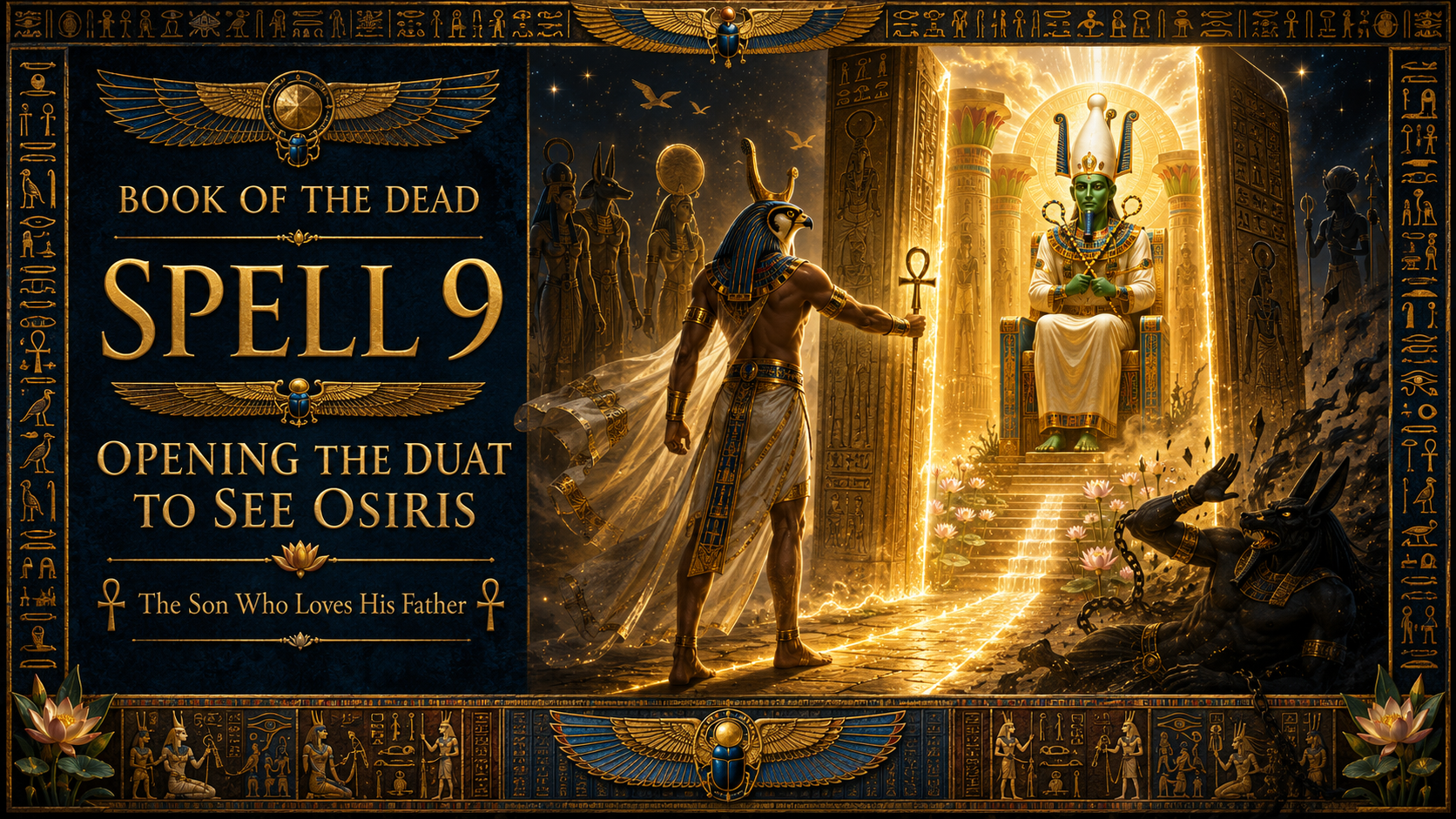
Book of the Dead Spell 9 opens the Duat, the hidden realm of the dead, so the deceased can enter, find Osiris, drive away darkness, and travel freely through heaven and earth.
The speaker assumes the role of Horus, the devoted son of Osiris. Like Horus, the deceased approaches Osiris as a loving child, confronts Set as the enemy responsible for his death, and asks the gods to prepare an open road.
Its traditional title is:
A spell for opening the Duat
Although the composition is brief, it contains several of the Book of the Dead’s most important themes: divine identification, filial loyalty, victory over darkness, freedom of movement, and reunion with Osiris.
What Is Book of the Dead Spell 9?
Book of the Dead Spell 9 is a funerary formula that gives the deceased the power to open and enter the Duat.
Peter Le Page Renouf and Édouard Naville titled the composition:
Chapter for opening the Tuat
Tuat is an older English spelling of Duat. The spell begins with an appeal to a mighty soul. The deceased then explains the purpose of the journey:
I open the Duat that I may see my father Osiris and drive away the darkness.
The speaker identifies as someone loved by Osiris, declares an intention to strike the heart of Set, opens every road in heaven and on earth, and asks the gods to prepare a path.
The text therefore functions as both an entrance spell and a declaration of identity.
The deceased can enter the Duat because they approach it in the role of Horus, the rightful son and defender of Osiris.
The Title of Spell 9
The title is commonly translated as:
A spell for opening the Duat
Renouf and Naville use:
Chapter for opening the Tuat
Unlike Spell 8, which is titled “Opening the Duat by Day,” Spell 9 does not include the phrase “by day” in its title.
The two compositions are related, but their emphasis differs:
- Spell 8 invokes Thoth, the Eye of Horus, Ra, Osiris, Set, and Horus to reveal and open the hidden realm.
- Spell 9 presents the deceased as Horus entering the Duat to find Osiris and clear every road.
The Papyrus of Ani contains Spells 8 and 9 in the same surviving section, along with several other short compositions. The British Museum catalog identifies that section as frame 18 of the papyrus.
English Translation of Book of the Dead Spell 9
The following reader-friendly translation is based on the version published by Renouf and Naville.
Spell 9: Opening the Duat
O mighty soul,
behold, I have come to you
so that I may see you.I open the Duat
so that I may see my father Osiris
and drive away the darkness.I am the one whom he loves.
I have come to see my father Osiris,
to pierce the heart of Set,
and to perform every duty
for my father Osiris.I open every path
in heaven and upon earth.I am the son who loves his father.
I have come as one who is mummified,
glorified, and fully equipped.O all you gods and goddesses,
the path has been prepared for me.
This version modernizes the language while preserving the structure and meaning of the historical translation.
Historical Translation of Spell 9
Renouf and Naville translated the chapter as follows:
“O Soul most mighty, here am I: I am come to thee that I may see thee.
I open the Tuat that I may see my father Osiris and may drive away the darkness.
I am he whom he loveth. I have come to see my father Osiris, to pierce the heart of Sutu, and to perform all duties to my father Osiris.
I open all the paths in heaven and upon earth.
I am the son who loveth his father, and I am come as a mummied one, glorious and well equipt.
Oh, all ye gods and goddesses, the path is made for me.”
In this older translation:
- Tuat means Duat.
- Sutu is Set.
- Mummied means mummified.
- Well equipt means fully supplied or magically prepared.
The uploaded Renouf and Naville edition preserves the title and complete short text of the spell.
What Does Book of the Dead Spell 9 Mean?
Spell 9 allows the deceased to enter the hidden world by adopting the identity and responsibilities of Horus.
The speaker is not a stranger wandering through the Duat. The deceased approaches Osiris as his beloved son.
This relationship grants both a reason and a right to enter:
- The son wishes to see his father.
- The son must avenge the wrong committed against him.
- The son performs the duties required for his restoration.
- The son has inherited the power to open the roads.
The spell’s meaning can be summarized as:
I come as Horus, the loving and dutiful son of Osiris. Darkness cannot keep me away from my father. I will defeat his enemy, fulfill my obligations, and travel freely through every divine road.
Who Is the “Mighty Soul”?
Spell 9 begins: O mighty soul, behold, I have come to you. The text does not identify the mighty soul by name in the surviving translation.
Because the next line states that the deceased wishes to see “my father Osiris,” the mighty soul may be Osiris himself or a divine manifestation connected with him. The Egyptian word commonly translated as “soul” is likely connected with the ba, an active and mobile aspect of a person or deity.
A divine ba was not simply an invisible ghost. It could represent a god’s manifest power, personality, mobility, or ability to act within the created world.
Addressing a “mighty soul” therefore acknowledges a powerful divine presence within the Duat. The deceased does not enter an empty realm. The speaker approaches a living and active divine power.
What Was the Duat?
The Duat was the hidden realm through which the sun god traveled during the night. It was also inhabited by:
- Osiris
- Other gods
- The blessed dead
- Guardians
- Gatekeepers
- Serpents
- Hostile beings
- Divine tribunals
- Spirits
- Regenerative forces
The Duat was not identical to the modern idea of hell. It contained dangers, punishments, and terrifying beings, but it was also a place of renewal. Ra entered it at sunset and emerged from it at dawn. Osiris ruled within the realm as the divine model of resurrection.
The deceased hoped to enter the Duat without becoming trapped there. Opening it meant gaining access to its divine mysteries while retaining the freedom to leave and continue traveling.
Why Did the Duat Need to Be Opened?
Death closed the individual off from the visible world. The body was wrapped, placed in a coffin, and sealed inside a tomb. The deceased therefore needed magical power to overcome both physical and supernatural enclosure.
Book of the Dead spells repeatedly ask for:
- Doors to be opened
- Gates to be unbolted
- Roads to be cleared
- Caverns to become accessible
- Ferries to transport the deceased
- Guardians to grant permission
- Paths through the sky and earth to appear
The opening of the Duat represents freedom from confinement. Without that opening, the deceased could remain:
- Trapped in darkness
- Unable to reach Osiris
- Separated from the gods
- Prevented from receiving offerings
- Unable to participate in solar rebirth
- Confined within the tomb
Spell 9 turns the hidden realm from a barrier into an accessible road.
“That I May See My Father Osiris”
The deceased says: I open the Duat that I may see my father Osiris.
Calling Osiris “my father” places the speaker in the identity of Horus.
According to Egyptian mythology, Horus was the son of Osiris and Isis. After Osiris was killed, Horus became his defender and avenger.
This relationship was central to Egyptian funerary religion.
The deceased could identify with:
These identities were not mutually exclusive.
The deceased could be Osiris in relation to personal death and resurrection, while also becoming Horus when carrying out the ritual duties required for restoration.
In Spell 9, the speaker takes the active role of Horus.
Why Did the Deceased Want to See Osiris?
Seeing a god was a sign of successful access and divine acceptance. Osiris was ruler of the dead, judge of the deceased, and the divine model for eternal life. Reaching his presence meant that the journey had succeeded.
To see Osiris could imply:
- Admission into the divine realm
- Recognition by the ruler of the dead
- Participation in resurrection
- Acceptance among the followers of Osiris
- Freedom from darkness
- The successful completion of the journey
The deceased does not ask merely to know that Osiris exists. The speaker wants direct access to him. Spell 9 opens the road that makes that encounter possible.
“And Drive Away the Darkness”
The deceased opens the Duat not only to see Osiris but also to: Drive away the darkness. Darkness had several connected meanings in Egyptian funerary thought.
It represented:
- Night
- Death
- The sealed tomb
- Lack of sight
- Lack of knowledge
- Isolation
- Spiritual danger
- Separation from the sun god
The deceased hoped to regain sight, awareness, movement, and access to light. Driving away darkness therefore means more than illuminating a room. It reverses the condition of death.
The person who can disperse darkness possesses a power associated with Ra, Horus, and the divine eye. Darkness no longer controls the deceased. The speaker can reveal the hidden world and move through it knowingly.
The Connection Between Spell 9 and Solar Rebirth
Although Spell 9 focuses on Osiris, the act of defeating darkness also connects it with the solar cycle.
Ra entered the Duat when the sun set in the west. During the night, the solar god passed through darkness and was renewed before sunrise.
The deceased sought to follow a similar pattern:
- Enter the western realm
- Travel through the hidden world
- Meet Osiris
- Overcome enemies and darkness
- Emerge into renewed life
Osirian resurrection and solar rebirth were not competing ideas. Egyptian funerary texts frequently joined them.
Osiris provided the model of restored life within the realm of the dead. Ra provided the model of daily emergence from darkness.
Spell 9 participates in both traditions.
“I Am the One Whom He Loves”
The speaker declares: I am the one whom he loves. This statement establishes a privileged relationship between the deceased and Osiris. The deceased does not approach as:
- An enemy
- An intruder
- A condemned spirit
- A stranger without divine connections
The speaker comes as someone already loved and accepted. Love becomes a form of authorization.
Because Osiris loves the speaker, the deceased has a rightful place in his presence and among his followers.
The declaration may also echo the relationship between Osiris and Horus. Horus is not merely a servant performing assigned duties. He is the beloved son acting from loyalty to his father.
“To Pierce the Heart of Set”
The deceased announces an intention:
To pierce the heart of Set.
Set was the principal enemy of Osiris in the myth of his death. Depending on the surviving version of the story, Set murdered, attacked, dismembered, or conspired against Osiris.
Horus later fought Set to avenge his father and claim the kingship.
Piercing the heart of Set represents the defeat of the force that caused the death and suffering of Osiris.
It can symbolize:
- Avenging Osiris
- Defeating disorder
- Punishing the divine enemy
- Preventing further attacks
- Restoring rightful succession
- Establishing Ma’at over conflict
The deceased claims Horus’s role in this victory.
Does Spell 9 Encourage Literal Violence?
The mythological language should be understood within its ancient ritual context. The “heart of Set” represents the center of the enemy’s power and intention. Piercing it neutralizes the force opposing Osiris.
Funerary spells frequently describe hostile beings being:
- Restrained
- Cut apart
- Burned
- Beheaded
- Pierced
- Driven away
- Trampled
Such language was intended to make threats powerless. The deceased needed confidence that the enemies of Osiris could not interfere with resurrection.
The violence of the formula establishes the complete defeat of opposition.
Set Was More Than a Simple Devil
It’s easy to think of everything as good or evil, but that wasn’t the ancient Egyptian way of thinking. They thought of things in terms of order and chaos, and Set personified that chaos.
Set should not be reduced to an Egyptian equivalent of Satan. His role changed across different places and periods. Set could represent destructive disorder, but he could also embody strength, storms, desert power, and protection.
In some solar traditions, Set defended Ra’s boat against Apep. Spell 8 even has the deceased identify directly with Set as an imperishable divine force.
In Spell 9, however, Set appears specifically in his role as the enemy who harmed Osiris.
Egyptian gods could possess several roles that changed according to the mythological and ritual context.
“To Perform Every Duty for My Father Osiris”
The deceased has come: To perform every duty for my father Osiris.
Horus was responsible for more than revenge. As the dutiful son, he also participated in restoring his father through funerary rites and offerings.
These duties could include:
- Mourning Osiris
- Protecting his body
- Defeating his enemies
- Presenting offerings
- Performing ritual gestures
- Opening the mouth
- Restoring royal authority
- Ensuring his vindication
- Maintaining his cult
The deceased claims to know and perform these responsibilities. This declaration demonstrates ritual knowledge and filial loyalty.
The speaker deserves access to Osiris because they are actively helping maintain his restored existence.
The Importance of the Dutiful Son
Ancient Egyptian funerary religion placed great importance on the role of the son.
A son was expected to:
- Bury his father properly
- Preserve his name
- Maintain his tomb
- Present offerings
- Continue the family line
- Perform rituals on his behalf
Horus became the divine model of this ideal relationship.
By describing the deceased as the son who loves his father, Spell 9 places the speaker inside a recognized structure of duty and inheritance.
The deceased gains legitimacy through proper conduct toward Osiris.
“I Open Every Path in Heaven and Upon Earth”
Spell 9 expands beyond the Duat when the deceased declares: I open every path in heaven and upon earth.
The deceased does not seek access to only one location. The speaker claims complete freedom of movement across the cosmic landscape.
This includes:
- The Duat
- The sky
- The earth
- The tomb
- The realm of Osiris
- The paths of the sun
- Routes used by gods and spirits
Freedom of movement was one of the Book of the Dead’s central goals.
The deceased wanted to enter and leave different realms rather than remain trapped in one place for eternity.
Why Are Both Heaven and Earth Mentioned?
The ancient Egyptian afterlife was not imagined as a single distant heaven.
Different traditions placed the deceased:
- Among the stars
- In the solar boat
- Within the Duat
- In the realm of Osiris
- In the Field of Reeds
- Inside the tomb
- Returning to the world of the living
These destinations could overlap within funerary belief. Opening paths in heaven and earth gives the deceased access to all possible regions of renewed existence. The body may remain in the tomb, but the ba and transformed spirit can travel.
“I Am the Son Who Loves His Father”
The speaker explicitly confirms the Horus identity: I am the son who loves his father. The line combines emotion, duty, and legitimacy.
Horus’s love is shown through action:
- He seeks Osiris.
- He opposes Set.
- He performs the proper rites.
- He restores divine order.
- He ensures that his father is vindicated.
The deceased presents the same qualities. This is not passive affection. It is love expressed through protection and ritual responsibility.
“I Have Come as a Mummified One”
The deceased describes themselves as mummified.
At first, that may appear inconsistent with the role of Horus, who is normally active and living. The line, however, joins the human condition of the speaker with divine transformation.
The deceased has undergone the physical preparations required for burial:
- The body has been preserved.
- The limbs have been wrapped.
- The mummy has been placed in the tomb.
- Funerary rites have been performed.
Yet mummification does not make the person helpless.
The properly prepared mummy becomes the stable physical form to which the person’s spiritual elements can return.
The deceased is mummified, but also mobile, powerful, and capable of opening divine roads.
“Glorified and Fully Equipped”
The historical translation describes the speaker as: Glorious and well equipt.
“Glorious” can express the condition of becoming an effective or transfigured spirit, often associated with the Egyptian concept of the akh.
To be “equipped” meant possessing everything needed for successful existence after death.
This equipment could include:
- Funerary spells
- Ritual knowledge
- Amulets
- Offerings
- A preserved body
- Divine names
- Protective objects
- Magical power
- The proper rites
- Recognition by the gods
The deceased does not enter the Duat unprepared.
Spell 9 itself becomes part of that spiritual equipment.
What Is an Akh?
An akh was a successfully transformed and effective spirit. (Not to be confused with ankh 𓋹.
Becoming an akh required more than simply dying. The deceased needed proper burial, ritual transformation, divine acceptance, and the ability to function in the afterlife.
An effective spirit could:
- Travel
- Receive offerings
- Join the gods
- Influence the living
- Defend itself
- Enter sacred regions
- Exercise magical power
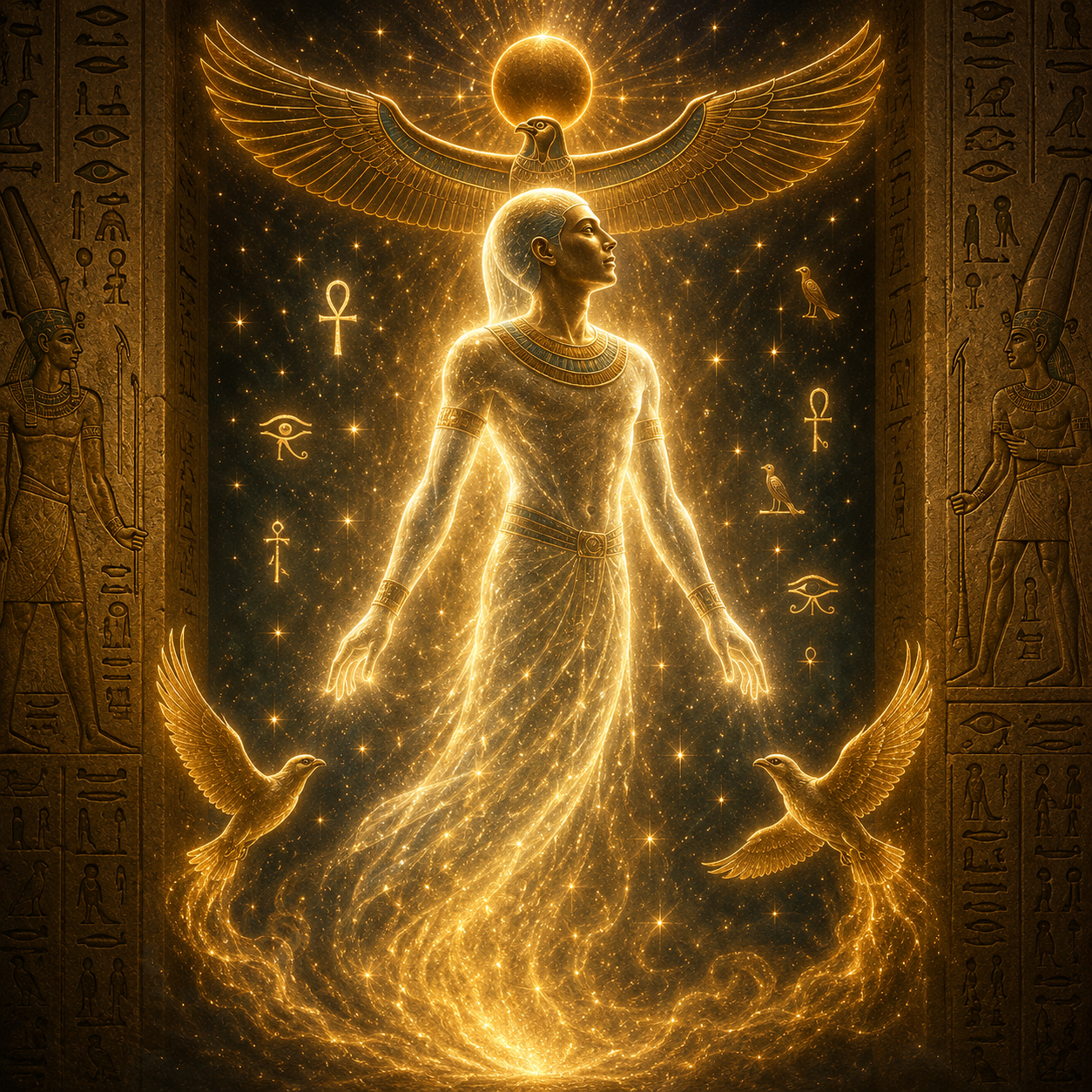
When Spell 9 presents the deceased as glorified, it indicates that the transformation has succeeded. The speaker possesses the status needed to approach Osiris.
“O All You Gods and Goddesses”
The spell ends by addressing the entire divine community: O all you gods and goddesses, the path has been prepared for me.
The deceased seeks universal recognition.
No individual deity should obstruct the road because all gods and goddesses have been placed on notice that the speaker possesses a legitimate path.
The declaration also changes the status of the road. It is no longer something the deceased hopes will appear. It has already been prepared.
As in many Egyptian magical formulas, the desired outcome is stated as fact.
“The Path Has Been Prepared for Me”
The final words complete the spell’s purpose.
The Duat is open. Darkness is driven away. The duties toward Osiris are performed. Set is defeated. Every road in heaven and earth is accessible.
The path has therefore been made ready. This path may include:
- The route into the Duat
- The way to Osiris
- The road back into daylight
- The paths used by Ra
- The routes between the tomb and the living world
- The journey toward divine judgment and acceptance
The deceased no longer wanders without direction.
The correct road exists and belongs to the speaker.
How Is Spell 9 Different From Spell 8?
The titles of Spells 8 and 9 are similar, but the texts use different strategies.
Book of the Dead Spell 8
Spell 8 opens the Duat by invoking:
- Time
- Thoth
- The Eye of Horus
- Ra
- Osiris
- Set
- Horus
Its language centers on divine secrets, restored light, and rapid identification with several gods.
Book of the Dead Spell 9
Spell 9 focuses on the deceased as Horus. The speaker:
- Seeks Osiris
- Drives away darkness
- Opposes Set
- Performs duties for Osiris
- Opens every road
- Declares filial love
- Asks the gods to recognize the prepared path
Spell 8 establishes cosmic authority to open the hidden realm. Spell 9 explains who enters and why.
Was Spell 9 Included in the Papyrus of Ani?
Yes. The British Museum catalog for frame 18 of the Papyrus of Ani identifies a group containing Spell 9 alongside Spells 92, 74, 8, 2, 132, 10, and 15.
The Papyrus of Ani was not arranged in a simple numerical sequence. This is typical of New Kingdom Books of the Dead, whose spell selections and order could vary significantly.
The numbering used today was imposed by modern scholars and should not be mistaken for the original page order of every papyrus. UCL explains that Richard Lepsius established much of the familiar numbering from the sequence in the Ptolemaic Book of the Dead of Iufankh, while earlier manuscripts show far greater variation.
Is Book of the Dead Spell 9 the Same as Coffin Text Spell 9?
No. This distinction is especially important because the uploaded doctoral study also contains an extensive discussion of Coffin Text Spell 9.
Coffin Text Spell 9 is a different Middle Kingdom composition. The study describes it as a speech made by Atum on behalf of the deceased to Thoth, acting as leader of the tribunal that declares the deceased justified. It survives in ten witnesses discussed by the author and contains seventeen identified phrases.
By contrast:
- Book of the Dead Spell 9 opens the Duat, so the deceased can see Osiris.
- Coffin Text Spell 9 concerns justification before a divine tribunal.
The shared number results from separate modern numbering systems and does not indicate that the texts are identical.
The Meaning of Spell 9 in Simple Terms
Book of the Dead Spell 9 gives the deceased the power to open the Duat, see Osiris, and travel freely through the divine world.
The deceased assumes the role of Horus, the beloved and dutiful son.
The speaker drives away darkness, defeats the power of Set, fulfills every obligation toward Osiris, and opens all roads in heaven and earth.
The spell’s meaning can be summarized as:
I enter the hidden realm as Horus, the son who loves and protects Osiris. Darkness cannot stop me, Set cannot defeat me, and no road in heaven or earth can remain closed. The gods have prepared a path for me.
Spell 9 is therefore more than an entrance formula. It gives the deceased a divine identity, a sacred purpose, and a recognized place within the family of Osiris.
Frequently Asked Questions About Book of the Dead Spell 9
What is Book of the Dead Spell 9?
Spell 9 is a funerary formula for opening the Duat so the deceased can find Osiris, drive away darkness, and travel along every path in heaven and earth.
What is the title of Spell 9?
Its traditional title is: A spell for opening the Duat. Renouf and Naville call it Chapter for Opening the Tuat.
Who is speaking in Spell 9?
The deceased is speaking in the identity of Horus, the loving son and avenger of Osiris.
Who is the mighty soul?
The text does not explicitly name the mighty soul. It may be Osiris or a powerful divine manifestation connected with him.
Why does the deceased call Osiris “my father”?
The speaker assumes the role of Horus, son of Osiris. This identity gives the deceased the right to approach, protect, and restore Osiris.
What does it mean to drive away darkness?
It means overcoming death, confinement, lack of knowledge, and separation from divine light.
Why does the deceased attack Set?
In this spell, Set appears as the enemy responsible for harming Osiris. Piercing his heart symbolizes defeating the opposition to resurrection and divine order.
Does Spell 9 say Set was entirely evil?
No. Set had several roles in Egyptian religion. In Spell 9 he is the enemy of Osiris, but other texts present him as a powerful protector of Ra.
What duties does the deceased perform for Osiris?
The text does not list them individually. They likely include protection, offerings, funerary rites, vindication, and actions modeled on Horus’s restoration of his father.
Was Spell 9 in the Papyrus of Ani?
Yes. The British Museum identifies Spell 9 in frame 18 of the Papyrus of Ani.
Did Spell 9 have a standard illustration?
No standard vignette is listed for it in the Renouf and Naville edition.
Is Book of the Dead Spell 9 the same as Coffin Text Spell 9?
No. They are different compositions belonging to independently numbered collections.
Book of the Dead Spell 9 opens the hidden world through the loyalty and authority of Horus. The deceased comes to see Osiris, not as a stranger, but as a beloved child. The speaker drives away darkness, confronts Set, fulfills the duties of a devoted son, and opens every path in heaven and upon earth.
By the end of the spell, the road is no longer uncertain. The gods have prepared it. The deceased is glorified and fully equipped. The Duat stands open, and Osiris can be reached. Spell 9 promises that death cannot permanently separate the deceased from divine family, light, or movement.